1. Background
Scrub typhus (ST) is currently the most common acute febrile illness in South Korea (1). However, due to the similarity of clinical signs, ST is often misdiagnosed as Kawasaki disease (KD), or diagnosed with delay. The purpose of this study was to summarize the clinical features of ST initially misdiagnosed as KD and to investigate the importance of careful searching for an eschar in all patients with an acute febrile illness to correctly discern ST from KD.
2. Methods
We retrospectively reviewed the records of patients under 18 years old who were discharged with diagnosis of KD and ST between March 2005 and June 2015. We excluded ST patients who did not present manifestations similar to KD and those who were initially correctly diagnosed as ST by using rapid immunochromatographic assay.
3. Results
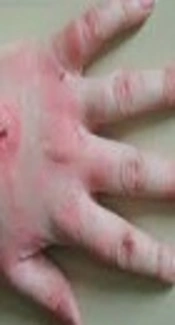
According to exclusion criteria, a total of 11 among 17 patients were included, and were all reassigned to incomplete KD group (n = 182) resulting in a misdiagnosis rate of ST as KD of 6%. Table 1 shows the clinical difference of ST and KD. Detection of eschars was reported in 5 (45.6 %) patients. The eschars were found in the neck (n = 1) and behind the skin folds of ear cartilage (n = 4). Anemia (hemoglobin < 11.7 g/dL, as per our hospital reference) was present in 4 (36.4%) patients, and thrombocytopenia (platelet count < 100,000/mm3) in 7 (63.6%). Chest radiography showed pneumonia findings in 2 patients, but they did not progress to acute respiratory failure and neither required assisted ventilation. Echocardiography was performed in all patients, but there were no specific findings suggestive of KD. Six patients (group 1) were initially treated by intravenous immunoglobulin (IVIG) (Table 2). In group 1, the serologic test for ST was not performed upon admission. Serologic testing was performed when, even after treatment with IVIG, the fever persisted (cases 1, 3, 5, 6, 8) or when eschar was detected (case 2) after treatment with IVIG. The remaining 5 patients (group 2) were initially diagnosed with KD but were not treated with IVIG because eschar was detected in cases 4, 7, 10 and 11 before the use of IVIG. Case 9 had no eschar, but the positive serologic test result for ST was determined before IVIG treatment. After discharge, none of the patients developed periungual desquamation of fingers and toes, which is characteristic of the subacute phase of KD.
Table 1.
Clinical Characteristics of Scrub Typhus (ST) and Kawasaki Disease (KD) Patients
| ST (n = 11) | KD (n = 182) | |
|---|---|---|
| Male/Female | 7/4 | 89/93 |
| Age, mo | 91.31 ± 12.72 | 34.31 ± 43.6 |
| Duration of fever, d | 5.4 ± 2.1 | 6.56 ± 2.37 |
| Conjunctival injection | 10 (90.9) | 128 (70.3) |
| Oropharyngeal changes | 0 (0) | 119 (65.4) |
| Hand and foot erythema and edema | 10 (90.9) | 98 (53.8) |
| Rash | 11 (100) | 112 (61.5) |
| BCG site redness | 0 (0) | 33 (18.1) |
| Cervical lymphadenopathy | 9 (81.8) | 29 (15.9) |
Table 2.
Clinical Characteristics of Patients with Scrub Typhus
| Case No. | Sex | Age, y | Date of diagnosis | Serologic Test for Scrub Typhus Days after Fever Onset | IVIG Use | Eschar | Treatment for Scrub Typhus |
|---|---|---|---|---|---|---|---|
| 1 | M | 7 | 2005/11 | 8 | (+) | (-) | Erythromycin |
| 2 | M | 11 | 2006/10 | 8 | (+) | (+) | Triaxone |
| 3 | F | 4 | 2008/11 | 9 | (+) | (-) | Chloramphenicol |
| 4 | M | 8 | 2008/11 | 7 | (-) | (+) | Erythromycin |
| 5 | F | 8 | 2009/11 | 8 | (+) | (-) | Doxycycline |
| 6 | M | 9 | 2010/11 | 7 | (+) | (-) | Doxycycline |
| 7 | M | 14 | 2011/10 | 5 | (-) | (+) | Doxycycline |
| 8 | F | 3 | 2013/11 | 5 | (+) | (-) | Erythromycin |
| 9 | M | 9 | 2013/12 | 4 | (-) | (-) | Doxycycline |
| 10 | F | 8 | 2014/10 | 5 | (-) | (+) | Doxycycline |
| 11 | M | 4 | 2014/11 | 4 | (-) | (+) | Erythromycin |
Abbreviations: IVIG, intravenous immunoglobulin; +, presence of eschar or management by IVIG.
4. Discussion
The main finding of this study is that when children have symptoms similar to KD but without red lips and strawberry tongue, clinicians should consider ST as differential diagnosis. If the fever duration before hospitalization is not long and echocardiography findings are normal, treatment for KD should be delayed until a final diagnosis can be made.
ST presents as an acute febrile illness with rash, conjunctival injection, and lymphadenopathy, which are similar to the symptoms of KD. Due to the variabilities of and similarities in clinical signs and the varying degree of detection rate of eschars, ST can easily be initially misdiagnosed as KD. Fever is documented in all children and generalized maculopapular rash develops in 23% to 87% of cases (2-4). In our series the rash was reported in all patients. The most common sites of eschars are axilla, genitalia, inguinal area, and behind the ear, similar to our findings (2, 5). Our results suggest that careful searching for an eschar is very important, particularly in hidden areas. Eschar is a diagnostic clue for ST, however, the absence of it does not rule it out. Compared with other reports (2-4, 6), cervical lymphadenopathy was the major clinical finding (81.8%), but there were no generalized lymphadenopathy, hepatomegaly, or splenomegaly. After replacing the pediatric cardiologist at our hospital in 2011, our policy to identify KD and ST changed. We now initially perform serologic testing for ST and search intensively for eschar, and when echocardiography findings are normal and no leukocytosis or thrombocytosis exists, we continue testing until ST diagnosis can be eliminated. Only after serologic testing for ST is complete with negative results, we treat for KD. Following this policy, patients in group 2 were initially diagnosed with KD but were not treated because eschar was detected in four patients; case 9 had no eschar, but serologic test results were positive before use of IVIG. Case 8 was early treated as KD until serologic test result of ST was available; however, reviewing the medical chart did not reveal the reason for this treatment.
The present study has some limitations. First, it was a etrospective study performed at a single, medium-sized tertiary referral hospital; therefore, does not reflect the actual burden of ST in the community. Second, rapid immunochromatographic assay was used for serological diagnosis because the indirect immunofluorescence assay, the gold standard confirmatory test was not yet available in our hospital during study period. Nonetheless, this study especially describes the children with ST initially misdiagnosed as KD and emphasizes the importance of searching eschar and rapid performing of serologic test for ST in febrile children. To our knowledge, this is the first study investigating the misdiagnosis of ST as KD.
5. Conclusions
Especially in autumn when children have symptoms similar to KD but without red lips and strawberry tongue, clinicians should search for an eschar and perform serologic testing for ST.