
1. Background
The prevalence of obesity is rising in children. The main complications of obesity include metabolic, respiratory, and cardiac involvement. Currently, the obesity is widely discussed as one of the most important issues in the public health worldwide. Childhood obesity is a risk factor for cardiovascular diseases, hypertension, diabetes, non-alcoholic fatty liver, and a chronic problem endangering the children health (1-3). Therefore, many public health systems have been motivated to study the obesity especially during the childhood in recent years. However, some methods, which directly measure the amount of body fat, are not routine ways in children. Obesity is usually evaluated by indirect estimation of body fat including the anthropometrics approach (2) and body mass index (BMI) in patients aged more than two years, and the measurement of regional fat distribution according to the waist-to-hip ratio (3-7). On the other hand, recent studies have indicated that the prevalence of nonalcoholic fatty liver disease (NAFLD) may be much higher than before (8). NAFLD is currently as the most common chronic liver disease in adults and children worldwide (9-13). Ultrasonography, CT scan, and MRI are noninvasive methods for diagnosing fatty liver disease and measuring the visceral and subcutaneous fat. Because of the availability, low price, and lack of ionizing radiation, the ultrasound is preferable imaging method especially for children. It is argued that the serum level of liver enzymes and lipids profile are merely beneficial and capable of diagnosing the fatty liver disease or checking vascular effects of obesity. In this case, it is very helpful to conduct a research on changes in liver enzymes and serum lipids level along with changes in liver echogenicity representing fat deposition by using ultrasound. In some studies, the measurement of the intra-abdominal fat using the CT and the ultrasonography were compared and their results indicated that the ultrasonographic inter-abdominal fat thickness was consistent with thickness measured by CT scan (14-16).
Ultrasonography is a noninvasive technique to detect some of above mentioned complications.
2. Objectives
The present study aimed to evaluate the thickness of subcutaneous and visceral fat, and degrees of fatty liver and common carotid arteries intima-media thickness (IMT) using the ultrasound technique along with assessing their relationships with each other and the patient’s lipids profile.
3. Methods
The present study was cross-sectional and conducted on 61 obese children (BMI > 95%) referring to endocrine and gastrointestinal clinics of the Children’s Medical Center from February 2016 to March 2017. Census method was used for sampling. The exclusion criteria of this study included the congenital or acquired liver disease, the use of corticosteroids or chemotherapy drugs, and non- consent of patient family to participate. Prior to the ultrasonography and tests, the informed consent was obtained from patients or their parents. After obtaining the history and clinical examinations, the encoded questionnaire including the age, gender, and growth indices were recorded.
Laboratory routine tests were done to study obesity conditions in children including biochemical tests such as serum triglyceride, cholesterol, HDL and LDL level.
The patients were subjected to the ultrasound examination of liver parenchyma for the presence of steatosis and its degree [mild (I), moderate (II) and severe (III)] and visceral fat thickness measurement using the curve probe and subcutaneous fat and the thickness of intima-media of both carotid arteries using linear probe in the supine position, normal breathing and at the minimum pressure. All tests were performed by a pediatric radiologist using a Toshiba Ultrasound Sonar Xario™ 200 with linear (7 - 12 MHz) and curve probes (5 – 7 MHz).
The midline abdominal subcutaneous fat thickness (MASFT) and right abdominal subcutaneous fat thickness (RASFT) were measured for subcutaneous fat thickness determination. In the middle of the abdomen, subcutaneous fat thickness was measured in the longitudinal plan, as the distance of skin from linea alba at 1 cm above the umbilical site; and subcutaneous fat of the right side was determined in two sites by calculation of the mean.
For visceral fat thickness two distances were measured in the longitudinal plan: (1) Distance between the anterior surface of peritoneum and anterior wall of the abdominal aorta; (2) distance between the anterior surface of peritoneum and the posterior wall of the abdominal aorta where their final average values were used. The spot was measured at the midline of the abdomen in 1 cm distance above the umbilical site. The thickness of carotid intima-media (IMT) was measured with the extended neck and the minimum probe pressure while a gentle neck turning to the opposite side was done in all cases. The IMT was measured on the longitudinal plan including the total echogenic intima and the hypoechoic media of the common carotid artery wall about 2 cm from carotid bifurcation and in the far wall from probe.
3.1. Statistical Analysis
SPSS software version 21 was used for data analysis. For quantitative variables, the mean and standard deviation, and for qualitative variables, frequency and percentage were used. To compare the levels or the mean of 3 or more independent samples of quantitative data, ANOVA was used. Chi-square test was used to determine the correlation between two qualitative variables in two or more independent groups. Pearson's correlation coefficient was used to measure the statistical relationship between two continuous variables. P value was considered as significant at < 0.05.
4. Results
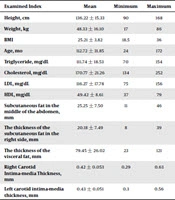
Sixty one children aged 2 to 14 years were studied in the present research. Thirty tree (54.1%) children were male and 28 (45.9%) female. All of 61 children had a BMI higher than the 95th percentile for age and gender. Examined indices are shown in Table 1.
Table 1.
The Examined Indicesa
| Examined Index | Mean | Minimum | Maximum |
|---|---|---|---|
| Height, cm | 136.22 ± 15.33 | 90 | 168 |
| Weight, kg | 48.33 ± 16.10 | 17 | 86 |
| BMI | 25.21 ± 3.82 | 18.5 | 36 |
| Age, mo | 112.72 ± 31.85 | 24 | 172 |
| Triglyceride, mg/dL | 111.74 ± 18.53 | 70 | 154 |
| Cholesterol, mg/dL | 170.77 ± 21.26 | 134 | 252 |
| LDL, mg/dL | 116.27 ± 17.78 | 75 | 156 |
| HDL, mg/dL | 49.42 ± 8.61 | 37 | 79 |
| Subcutaneous fat in the middle of the abdomen, mm | 25.25 ± 7.50 | 11 | 46 |
| The thickness of the subcutaneous fat in the right side, mm | 20.18 ± 7.49 | 8 | 39 |
| The thickness of the visceral fat, mm | 79.45 ± 26.02 | 23 | 121 |
| Right Carotid Intima-media Thickness, mm | 0.42 ± 0.053 | 0.29 | 0.63 |
| Left carotid intima-media thickness, mm | 0.43 ± 0.051 | 0.3 | 0.56 |
aValues are expressed as mean ± SD.
Twenty (32.8%) patients had no fatty liver, while 41 patients (67.2%) had fatty liver. Thirty (49.2%) patients showed a grade I fatty liver (mild) and 11 patients (18%) had grade II (moderate) fatty liver. None of the studied patients showed grade III fatty liver.
The average age was based on degrees of fatty liver in the present study. Accordingly, the mean age was 94.45 ± 29.38 months in subjects without the fatty liver; 112.43 ± 26.47 months in subjects with grade I; and146.73 ± 19.33 months in subjects with grade II (P < 0.001). Accordingly, 63.6% of males and 36.4% of females had fatty liver (P = 0.761).
Among children with fatty liver, 23 (56.1%) children were male and 18 (43.9%) female, in which the prevalence of grade II fatty liver was higher in males (63.6% versus 36.4%).
In this study, subcutaneous fat thickness was measured in the mid abdominal region and on the right side of the abdomen and visceral fat thickness in the mid abdominal region. The results of these measurements are shown in Table 1.
According to research results, there was a significant relationship between the BMI and the presence of fatty liver (P < 0.001). The BMI was also studied based on the degree of fatty liver. The results showed that the non-fatty liver and the grade I group had the average of 22.16 ± 1.68 and 25.21 ± 2.50, respectively. The BMI of patients with fatty liver grade II had the average of 30.77 ± 3.45 (P < 0.001). These results show the relationship between these two variables. The BMI and subcutaneous fat thickness had positive and significant relationship indicating that the increasing BMI results in subcutaneous fat thickness (r = 0.6; P < 0.001). A positive significant correlation was also obtained between the BMI and visceral fat thickness (r = 0.7; P < 0.001). Similarly, the correlation between the BMI and IMT was positive and significant for both the left side (r = 0.4; P = 0.001) and the right side (r = 0.4; P = 0.001). There was a significant direct relationship between the BMI and serum TG (r = 0.5; P < 0.001). The correlation between the BMI and serum cholesterol level (r = 0.3; P = 0.002) along with the correlation between the BMI and serum LDL level (r = 0.4; P < 0.001) were significant. On the contrary, the correlation between the BMI and serum HDL level was negative and significant at the probability level of 5% (r = -0.2; P = 0.025). The relationship between the fatty liver and subcutaneous fat thickness was direct and significant (P = 0.001). There was a direct and significant correlation between the presence of fatty liver and visceral fat thickness (P < 0.001) as well.
The relationship between left IMT and serum TG level was direct and significant (P = 0.012, r = 0.3) and for the right was direct and significant, as well (P = 0.007, r = 0.3). There was no significant relationship between the left and right IMT with serum cholesterol, LDL and HDL levels.
The relationship between the visceral fat thickness and IMT, serum TG, cholesterol and LDL levels was noticeable (P < 0.001). No considerable relationship was found between the thickness of visceral fat and serum HDL level.
All cases of these three groups were compared in terms of the subcutaneous fat thickness in the middle and on right side of abdomen, the thickness of visceral fat, and the thickness of the intima-media of the right and left internal carotid arteries and the results are separately presented in Table 2.
Table 2.
Mean Thickness of Fats Measured by the Ultrasound Among Patients with Different Degrees of Fatty Livera
| Fatty Liver | MASFT | RASFT | VFT | Right IMT | Left IMT |
|---|---|---|---|---|---|
| Absence | 20.56 ± 5.98 | 15.80 ± 4.40 | 61.5 ± 21.63 | 0.407 ± 0.04 | 0.416 ± 0.048 |
| Grade 1 | 25.13 ± 6.01 | 20.3 ± 6.70 | 81.53 ± 23.80 | 0.429 ± 0.05 | 0.44 ± 0.052 |
| Grade 2 | 34.09 ± 5.89 | 28.54 ± 7.35 | 106.45 ± 8.1 | 0.457 ± 0.06 | 0.45 ± 0.048 |
| Total | 25.25 ± 7.5 | 20.18 ± 7.49 | 79.45 ± 26.01 | 0.427 ± 0.053 | 0.434 ± 0.051 |
| P value | < 0.001 | < 0.001 | < 0.001 | 0.4 | 0.135 |
aValues are expressed as mean ± SD.
The average of laboratory indices based on the fatty liver grade was studied in patients and the results are presented in Table 3.
Table 3.
The Mean Serum Markers Among Patients with Different Degrees of Fatty Livera
| Fatty Liver | Absence | Grade 1 | Grade 2 | Total | P Value |
|---|---|---|---|---|---|
| Triglyceride, mg/dL | 101.75 ± 15.49 | 111.3 ± 16.29 | 131.81 ± 13.76 | 111.74 ± 18.53 | < 0.001 |
| Cholesterol, mg/dL | 158.75 ± 13.25 | 171.6 ± 21.17 | 190.36 ± 19.1 | 170.77 ± 21.26 | < 0.001 |
| LDL, mg/dL | 103.94 ± 8.85 | 117.96 ± 17.81 | 133.09 ± 14.03 | 116.27 ± 17.78 | < 0.001 |
| HDL, mg/dL | 53.05 ± 7.65 | 49.20 ± 9.80 | 43.72 ± 4.12 | 49.42 ± 8.61 | 0.018 |
aValues are expressed as mean ± SD.
5. Discussion
Atherosclerotic diseases are among most important causes of morbidity and mortality worldwide (14-18). However, cardiovascular events and death from these cardiovascular risk factors rarely occurred in children, the dispersion of cardiovascular disorders can be still diagnosed in children (19). Carotid intima-media thickness (IMT) is a measure which can be used as a sign of subclinical atherosclerosis and a predictor of future vascular events according to previous studies (20, 21).
The type of fat distribution in the body, especially the visceral fat, is one of the important factors for developing of cardiovascular diseases and metabolic syndrome. The amount of visceral fat can be evaluated by measuring the waist circumference or imaging methods such as the CT scan, ultrasound, and MRI. Disadvantages of the CT scan include exposing young children to ionizing radiation and its high cost. MRI is an expensive method with lower accessibility than other methods, with long imaging time making it not a proper imaging choice. On the contrary, the ultrasound method has become an ideal method for testing the fat in children because of low cost and easy access and reliable measurements (11, 22, 23).
This method has been now widely used by many references as the main method for measuring the inter-abdominal fat conten (12, 13, 19, 24).
Suzuki et al. (25) introduced a new indicator for visceral fat deposition as an abdominal wall fat index. They found that the subcutaneous fat and preperitoneal fat thickness measured by ultrasonography method had a direct correlation with results of the CT-measured visceral fat, and suggested that the subcutaneous and peritoneal fat, might be a proper indicator of fat thickness. Ribeiro-Filho et al. (8, 9) conducted several studies to examine the visceral fat tissue with 3.5 MHz probe at a distance of 1 cm from the umbilical site in obese patients. They found that the ultrasonographic estimate of the intra-abdominal fat and the visceral-to-subcutaneous fat ratio showed a high correlation with amount of visceral-fat that was measured by CT scan.
Several studies have been conducted on the thickness of adipose tissue and cardiovascular risk factors (15-17), but most of them have been conducted on adults and less on children. The present study investigated the relationship between the fatty liver and its degree with the subcutaneous and visceral fat thickness in addition to the IMT of common carotid arteries (known as predictor of cardiovascular risk) relationship with children's BMI and serum markers such as liver enzymes, lipids profile, and blood glucose levels with regard to other resources (18, 21, 26, 27).
The present study indicated a linear relation between BMI and the degree of steatosis which is consistent with the results reported by Sakuno et al. (14). There was a direct relationship between the peritoneal fat and the incidence of non-alcoholic fatty liver with BMI also observed in another study, that reported the possible relationship between subcutaneous and visceral fat thickness measured by ultrasound and occurrence of fatty liver. The relationships between serum level of HDL, LDL, TG, and CHOL with the grade of fatty liver were similar to previous studies (25).
According to a study by Kawamoto et al. (28) the IMT in both genders was related to visceral fat and obesity-related disorders; which is consistent with the results of the present study.
Limitation of this study is related to the including just obese children with BMI over 95th percentile. Therefore, the conclusions of our study cannot be extended to overweight subjects with BMI between 85th to 95th percentile and nonobese children.
5.1. Conclusions
In general, our results indicated that there was a good correlation between the thickness of visceral, subcutaneous fat measured by ultrasound, BMI, degree of non-alcoholic steatosis, and changes in some lipids profile in children. This method can be easily considered and used as a valuable non-invasive way to assess the risks of these diseases in obese children. Conducting further prospective cohort studies and long-term follow up can determine the exact relationship between the IMT, subcutaneous, visceral fat in the childhood and cardiovascular events and stroke at adolescence and adulthood of the affected subjects.