1. Background
Suicide is one of the leading causes of death accounting for 1.5% of all deaths worldwide. It has a considerable frequency among patients with depressive disorder (1). On the other hand, the suicide rate is several times higher in patients treated with methadone than in the general population (2).
According to the theory of neural plasticity, irregularities of the hypothalamic-pituitary-adrenal (HPA) axis leads to depression symptoms and could be involved in the pathophysiology of suicidal behavior. Oscillation or high-level cortisol has been reported in suicide attempters (1, 3).
On the other hand, discontinuing the use of substances is associated with psychological effects more harmful than its physical consequences. The Post-Acute Withdrawal Syndrome (PAWS) is a set of sustained injuries occurring after discontinuing the use of substances such as alcohol, opioids, benzodiazepines, and stimulants.
Acupuncture is a complementary medicine first described in 2,500 BC (4). The National Acupuncture Detoxification Association (NADA) has developed a protocol for auricular acupuncture.
Acupuncture has been associated with the regulation of HPA activity and adrenocorticotropic hormone (5). In this regard, Pirnia et al. (6) showed the significant effect of acupuncture on the level of salivary cortisol in a patient with colon cancer. Moreover, the results of another study by Pirnia et al. (7) showed that acupuncture is associated with the reduction of symptoms based on the addiction severity index (ASI).
The study of Tanahashi et al. (8) also showed that the use of acupuncture is associated with alleviated symptoms of mild depression by improved HPA axis function. Studies show that acupuncture reduces depression symptoms in human and animal models (9, 10). The results of a study by Pirnia et al. (11) indicated that acupuncture was associated with reductions in cortisol and depression levels in depressed patients.
Contrary to these findings, a study by Pirnia et al. (12) showed acupuncture had no significant effect on the decrease of subsyndromal depression among methamphetamine users. Moreover, the results of a study by Pirnia and Pirnia (13) showed that acupuncture was not associated with the reduced depression index in a case with lobular carcinoma.
2. Objectives
Due to the conflicting findings of the effectiveness of acupuncture and the importance of biological markers such as cortisol in the pathophysiologic understanding of psychiatric disorders, this study examined the following question: could acupuncture be effective in the regulation of salivary cortisol levels by improving HPA axis function, as well as in the reduction of suicidal ideation?
3. Materials and Methods
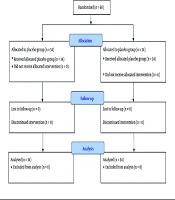
This randomized, double-blind, sham-controlled trial was conducted at Bijan Center for Substance Abuse Treatment in Tehran, Iran. The data were collected from December 2015 to June 2016.
The inclusion criteria were (1) age of 18 - 65 years, (2) ongoing patient status at the addiction clinic, (3) methadone intake for at least two years (syrup, mean ± SD = 35 ± 0.3 cc/per day), (4) screening based on scores within two standard deviations on the suicidal ideation scale of Beck and the diagnosis of persistent depressive disorder (dysthymia) based on diagnostic interviews and the adoption of DSM-5 criteria (since the minimum period for avoiding opioids other than methadone was considered two years, dysthymia symptoms after complete abstinence are short-term and are different from the diagnosis of mood disorders without a history of substance use), and (5) the history of at least one episode of suicide planning or committing.
The exclusion criteria included (1) nickel-allergy, (2) ear infection, (3) heart disease, (4) taking any psychiatric medication, and (5) receiving psychological interventions within the three months leading up to the study. In this study, concerning the one-way direction test and the assumptions of Z = 1.645, d = 0.2, α = 0.05, and the test power of 1 - β = 0.84, the sample size was estimated at 24 people. The sample was selected through respondent-driven sampling (RDS). The randomization sequence was computer-generated, with the randomization itself conducting using SPSS 20 software (random number generation) (SPSS, Inc., Chicago, IL, USA). The statistical significance was accepted at the level of P < 0.05. The allocation concealment was done by the researcher who was responsible for the randomization.
Acupuncture was performed twice a week for four weeks (eight sessions) in both ears using disposable stainless steel needles (0.25 + 13 mm) with a depth of 2 - 3 mm and using manual stimulation. Participants in the sham group also received eight sessions of acupuncture treatment; however, needling was performed 1 cm away from the real acupoints.
Cortisol was evaluated in the form of three meals on a randomly selected day every week and the mean of the three measures was considered as a criterion. Cortisol was collected from the saliva into labeled tubes. The patients were taught about eating, brushing the teeth, or any drink (except water) in hours prior to the testing session. The cortisol samples were stored at ≤ -20ºC and analyzed by enzyme-linked immunosorbent assay kit (ELISA).
Data collection was conducted using structured clinical interviews, a researcher-made demographic questionnaire, the suicide scale, and the radioimmunoassay method. The structured clinical interview for DSM-5 (SCID) was used for the diagnosis of dysthymia disorder based on DSM-5. A researcher-made demographic questionnaire was used by the researcher to collect personal information. The Beck scale for suicidal ideation (BSSI) is a 21-item scale to assess the severity of ideation and planning to commit suicide during the past seven days. Cronbach’s alpha of this scale was calculated in the range of 0.81 to 0.91. The validity of the Persian version of this scale was estimated at 0.95 (14). Radioimmunoassay (RIA) is a tool widely used at medical laboratories. In this method, radioactive iodine is used to create signals. Urinalysis was performed to ensure that the patients adhered to the maintenance treatment. A urine test with the threshold of > 300 ng/mL was done for each participant weekly and randomly (3).
According to the results of the Kolmogorov-Smirnov test related to the non-normal distribution of the two variables, the generalized estimation equation test was used. The chi-square test was used to evaluate the demographic characteristics.
After completing the explanation of the study details, written informed consent was obtained from eligible patients in their native language (Persian). Patients received only treatment routine- centered treatment. All stages of the study were performed after obtaining informed consent from patients and based on the latest version of the Helsinki Declaration. This trial was registered at www.clinicaltrials.in.th (TCTR20180328001, ethical approval: IR.SBMU.RETECH.REC.1397.631).
4. Results
The two groups were compared in terms of marital status, education level, employment status, monthly income, age, and ethnicity (Table 1). The results showed there was a difference in the distribution of employment status in the acupuncture group and monthly income in the sham group based on the chi-square test.
Table 1.
Demographic Characteristics of the Participants of the Studya
| Indices | Acupuncture (N = 12) | Sham (N = 12) |
|---|---|---|
| Marital status | ||
| Single | 3 (25) | 3 (25) |
| Married | 5 (42) | 4 (33) |
| Divorce | 4 (33) | 5 (42) |
| Education level | ||
| Lower than high school diploma | 7 (58) | 6 (50) |
| Higher than high school diploma | 5 (42) | 6 (50) |
| Employment status | ||
| Employed | 4 (33) | 5 (42) |
| Unemployed | 8 (67)b | 7 (58) |
| Monthly income, U.S. dollar | ||
| < 200 | 4 (33) | 3 (25) |
| > 200 | 8 (67) | 9 (75)c |
| Age, y | ||
| 18 - 25 | 7 (58) | 6 (50) |
| > 25 | 5 (42) | 6 (50) |
| Ethnicity | ||
| Kord | 3 (25) | 3 (25) |
| Lour | 3 (25) | 4 (33) |
| Tork | 5 (42) | 3 (25) |
| Fars | 1 (8) | 2 (17) |
aValues are expressed as No. (%).
bP < 0.05.
cP < 0.01.
The urinalysis results showed all participants adhered to the methadone maintenance treatment (MMT).
The groups were compared in the salivary cortisol level (Table 2). The results of the salivary cortisol level showed significant differences between the experimental and sham groups at weeks five, six, seven, and eight.
Table 2.
The Results of the Generalized Estimating Equation in in the Variable of Salivary Cortisol Level
| Course/Weeks | Salivary Cortisol | Pairwise Comparisons | |
|---|---|---|---|
| Experimental Group | Sham Group | ||
| Baseline | |||
| Week 1 | 181 (36) | 182 (41) | NS |
| Week 2 | 182 (66) | 183 (52) | NS |
| Week 3 | 183 (39) | 182 (64) | NS |
| Week 4 | 182 (51) | 181 (54) | NS |
| Treatment | |||
| Week 5 | 178 (68) | 182 (52) | 0.047a |
| Week 6 | 178 (47) | 183 (61) | 0.041a |
| Week 7 | 176 (67) | 182 (49) | 0.009b |
| Week 8 | 175 (53) | 183 (69) | 0.006b |
aP < 0.05.
bP < 0.01.
The two groups were compared in suicidal ideation, as well (Table 3). The results of the suicidal ideation test scores showed significant differences between the experimental and control groups at weeks six, seven, and eight.
Table 3.
The Results of the Generalized Estimating Equation in in the Variable of Suicidal Ideation
| Course/Weeks | Suicidal Ideation | Pairwise Comparisons | |
|---|---|---|---|
| Experimental Group | Sham Group | ||
| Baseline | |||
| Week 1 | 11.23 (1.14) | 11.42 (1.73) | NS |
| Week 2 | 12.03 (0.94) | 11.85 (1.12) | NS |
| Week 3 | 11.84 (1.24) | 12.22 (2.06) | NS |
| Week 4 | 12.11 (1.03) | 11.57 (1.42) | NS |
| Treatment | |||
| Week 5 | 11.06 (1.63) | 11.84 (1.53) | NS |
| Week 6 | 10.64 (1.12) | 11.82 (1.09) | 0.04a |
| Week 7 | 10.32 (1.13) | 11.48 (2.11) | 0.04a |
| Week 8 | 10.38 (0.85) | 11.94 (1.23) | 0.01b |
aP < 0.05.
bP < 0.01.
5. Discussion
Suicide is the second leading cause of death in young men and suicidal behaviors are mostly occur in psychiatric patients, especially patients with depressive disorders (1). It seems that one of the underlying mechanisms of depression is the HPA axis (8). The HPA axis dysfunction can be reflected in the levels of cortisol (3) so that high levels of cortisol have been reported in suicide attempters with depression (2).
In this randomized, double-blind, sham-controlled trial, we investigated the effectiveness of auricular acupuncture in suicidal ideation and cortisol level in dysthymic patients under methadone maintenance treatment. The results showed that four weeks of acupuncture treatment decreased the salivary cortisol level as the primary outcome and suicidal ideation as the secondary outcome. Consistent with the results of the primary outcome in the present study, Pirnia et al. (6) reported that the use of acupuncture leads to the regulation of HPA axis activity in a case with colon cancer. Guo et al. (5) showed that acupuncture has a significant effect on the level of morning salivary cortisol. In line with our findings, Yao et al. (15) demonstrated that acupuncture could have a moderating effect on HPA axis activity and influenced the cortisol levels. The study by Zhu et al. (16) showed that the use of electro-acupuncture could improve HPA axis hyperactivity in mice through AVP signaling.
In addition, the results of a study by Pirnia et al. (11) indicated that acupuncture was associated with reduced cortisol and depression levels in depressed patients under methadone maintenance treatment.
In fact, acupuncture can stimulate the secretion of tyrosine hydroxylase, increase the levels of dopamine, and reduce stress hormones such as cortisol, ultimately leading to the feeling of well-being (11).
This study showed that acupuncture could reduce the severity of suicidal ideation, as well. In line with our findings, the results of a study by Molinoff (9) indicated that acupuncture could be used as a preventive method for suicidal ideas. Moreover, several studies have investigated the effectiveness of acupuncture in depression symptoms.
The results of a study on mice showed that mechanical acupuncture instrument (MAI) increased the effects of antidepressants and reduced the symptoms of depression (10).
The results of a study by Le et al. (17) demonstrated that electro-acupuncture was associated with the reduced symptoms of depression by modulating HPA axis function and enhancing the activity of the hippocampus. In a study, Han et al. (18) stated that acupuncture caused a significant decrease in the symptoms of depression by regulating the biological flow. The results of a meta-analysis of 18 randomized clinical trials showed that acupuncture could be used for improving depression related to insomnia (19).
The results of a study by Pirnia et al. (7) on the effectiveness of acupuncture in the reduction of addiction indices, including the addiction severity index, indicated the significance of acupuncture intervention.
Contrary to the results of this study, the study by Pirnia et al. (7) showed that acupuncture had no significant effect on the improvement of psychological indices, including pain relief in a patient with Trismus syndrome. The difference between the present study and the study by Pirnia et al. (7) is in the history of methamphetamine abuse in the patient with Trismus. The results of previous studies showed that the production of tyrosine hydroxylase as a precursor to producing dopamine in chronic methamphetamine users could have an important role in the effectiveness of acupuncture (20).
The findings of this study showed that acupuncture could be an alternative to medication and psychotherapy for reducing suicidal ideation and improving HPA axis function by modulating cortisol secretion.
This study had some limitations. Concerning the limitations of research in the field of addiction, the sample of the study only consisted of men undergoing methadone maintenance. The evaluation of the role of tyrosine hydroxylase as a mediator in the effectiveness of acupuncture can be interesting in future studies.
5.1. Conclusions
The results of the study showed that acupuncture as an alternative therapy could reduce the cortisol level and significantly reduce suicidal ideation. The results of this study support the usefulness of cortisol level as a factor influencing suicide.