1. Background
Violence in people with epilepsy (PWE) mostly occurs while patients are in seizure-free periods exacerbated by many factors such as poor impulse control, cognitive impairment, or psychopathology (1, 2). Most violence occurs after seizures or postictal violence when it is possible; the violence also occurs against others (3). The aforementioned occurs in the non-self-conscious situations where patients attempt to defend themselves from people surrounding them when they try to protect themselves, or violence may be associated with repeated actions of patients (violence automatisms). Abnormalities of the temporal lobe cause the patient to exhibit violent behavior (4) and the violence that is related to epilepsy (5, 6).
Epilepsy is a chronic disease that affects patients’ lives in terms of physical, mental, emotional, and social entities. Not only does this disease directly affect their lives, but it also causes problems for those in charge of taking care of these patients as well as those around them, for example family, colleagues, or people in social situations. More than 60% of patients are diagnosed with depression and anxiety and over 56.6 % feel embarrassed and have low self-confidence (7, 8). In addition, 26.6% experience feelings of guilt (9). This also affects the economy and society with epileptics being unemployed more than normal people so patients’ incomes are likely lower. They need to depend on family or other people because of their condition; these factors, of course, affect the quality of living standards of patients (10, 11).
Previous studies were mostly focused on accident cases, not domestic violence even though the behavior of people with epilepsy always affects family members. Research in Sweden reported that 4.2% (973 persons) exhibited violent behavior at least once after diagnosis and it was found that patients were at a high risk of committing a crime, often violent crime, when compared to “normal” individuals (OR = 1.5, 1.4 - 1.7). Epileptic patients over the age of 16 exhibited violent behavior more often than the patient group aged under 16 years (12). A total of 30% of PWE displayed violent behavior (13) and 28 to 32% had attempted suicide (14). The violent aspect of epilepsy may be considered as a cognitive or pathopsychological problem. The PWE violence outcomes ratio was 0.67 (95% CI 0.46 - 0.96) (15), while Bogdanovic et al. found the prevalence of aggression at 17.2% in 1 year occurring more than 121 to 207 times per 100 PWE persons (16). The occurrences were related to mental disease and significant injury in younger offenders over people who had no violent behavior history.
The violence was not significantly related to gender, length of time having epilepsy, psycho profile, mobility or problems regarding MRI, and frequency of epilepsy attacks or intelligence. Kanemoto (2010) found that during epileptic seizures it was difficult to commit violence against other people (17). The violence was usually found in patients with postictal psychosis or PIP (22.8%), interictal psychosis or IIP (4.8%), and postictal confusion (0.7%) that may result in suicide attempts (17). PWE do not have social immunity and lack the skills to face problems, so they resort to aggressive behavior instead (3). The phases of ictal or postictal states tend to be related to aggressive behavior because it can be caused by the learning of unstable behavior from the frontal lobe of the brain that loses control while convulsions occur. Aggressive behavior such as that towards others or the property belonging to others may happen together with physical violence. In this context, these actions may ensue even when patients are alone. PWE are at risk of committing violence more than unaffected people and some patients have been known to commit murder. One individual used an axe to kill his own wife while she was sleeping; he then felt guilty and lost all memory of the incident (4). Even if the violence that is caused by PWE and the involved autonomic neuropathy could be treated differently, the effect of violence on society would still be the same.
From the pilot study interviewing epileptic patients in an epilepsy clinic at the KKU Srinagarind hospital, Khon Kaen province, it was found that the violence associated with epilepsy indeed creates offenders and victims. The actions of violent behavior commonly present themselves as moodiness, or yelling or attacking people in the family. Some patients were violent to the people taking care of them. One woman who was a victim, said that she was being bullied by her step-father; he was calling her lazy as she would get up late and be a family-burden. Sometimes she thought about committing suicide. Domestic violence is shown in different behavioral traits which create mental health problems from tension and anxiety to bad dreams and sleeplessness; as well as thoughts of suicide or self-abuse (18, 19). Violence can affect both epilepsy patients and people in the society. It is important to prevent violence in PWE. There is a lack of data regarding the prevalence of domestic violence of PWE in Thailand and acquiring these data may be an aid in developing guidelines for patients living with the condition. This study may assist in developing a better living environment of PWE; moreover, it could be an inspiration for reducing misunderstandings associated with sufferers and create a better understanding related to health care standards and decrease the despair in the sufferers’ lives. This study was aimed to evaluate the prevalence and characteristics of violence in people with epilepsy.
2. Materials and Methods
2.1. Research Methodology
This is descriptive research using a self-questionnaire survey of violence and effects of violence among PWE at the epilepsy clinic, Khon Kaen University hospital (Srinagarind Hospital), Thailand. The meaning of violence in this study followed the WHO definition that was defined as including all conscious physical, verbal, sexual, and economic forms drawing sadness or harm to the body (20). The violent events that were not punishment occurred between current or former intimate partners or between a parent and an adult child or caregivers (20, 21).
2.2. Research Population
The sample size was calculated based on the sample size calculation of the survey study (22). The subjects were 310 patients out of a total of 1,600 PWE from the epilepsy clinic with a 5% error, 95% confidence interval, and 50% response distribution. The 50% response distribution gives the largest study population. We added 10% to the desired sample size to account for missing data, therefore, a total of at least 341 subjects were needed. The inclusion criteria were PWE treated at the clinic aged over 18 years, fully conscious; being able to read; and agreeing to complete the questionnaire. Those who were physically/emotionally exhausted resulting from epilepsy or other conditions such as psychiatric conditions/diseases and could not complete the questionnaire were excluded.
2.3. Data Collection Tools
Questionnaires were used as interview instruments to detect domestic violent behavior among PWE. Reliability was tested in 17 PWE (Data by sampling from one day of PWE attending at epilepsy outpatient clinic) resulting in Cronbach’s alpha coefficient of 0.86. The questionnaire contained 3 parts; the first part requested demographic data, the second part contained characteristics of violence (33 items) whereby subjects were asked for information regarding the perpetrator’s part as they used violence against others as well as their perceptions of violence from others. For part 2, the reliability and sensitivity by Cronbach’s were 0.78 and 0.83. The third part asked about the consequences of violent behavior in 26 items: Cronbach’s alpha was 0.80.
2.4. Data Analysis
Data were categorized by the type of violence ie, violence towards others and being victims of violence. Various factors associated with violence towards others and being victims of violence were compared using descriptive statistics. Differences of numerical variables between two groups were analyzed by the Student’s t test or Wilcoxon rank sum test where appropriate, while categorical variables were analyzed by Chi square or Fisher Exact test where appropriate. The odds ratios and 95% confidence interval were reported for significant factors. The p values were calculated based on two-tailed tests. Factors associated with performed violence and being victims were analyzed by multivariate logistic regression model. Factors with univariate logistic regression analysis with a p value less than 0.20 were put in the multivariate logistic regression model. Data analyses were performed with SPSS software (Chicago, Illinois, USA) and STATA software version 10.1 (College Station, Texas, USA).
2.5. Research Ethics
This study collected data by giving questionnaires to volunteers directly, guided by a nurse who explained the questions and sealed the questionnaire envelopes and sent them back to the researcher. This process was put in place to help to protect the overall feelings and privacy of participants. The study protocol was approved by the ethics committee for human research, Khon Kaen University (HE551321). For the protection of the participants’ privacy, researchers used a code instead of the real names of participants and researchers subsequently destroyed all personal information when the study was ended. Neither names nor personal information were reported in this study.
3. Results
3.1. General Characteristics
In total, 350 participants completed the questionnaire. The average age of all patients was 37.1 years (ranging from 18 to 85 years). Most patients were female (59.7%), the age group was between 20 and 30 years (25.7%), married (54.0%), had low incomes (52.6%), and received Bachelor’s degrees (33.1%). There were 20 patients who reported having no income. The average income of all patients was 16 245 Baht/month (541.5 USD). Almost half of patients (48.6%) had no savings money, while 27.4% were in debt. There were 4% of patients who dropped out of high school and 16.9% were unemployed. Parents were the most common caregivers (father 29.1%, mother 16.6%). The histories of alcohol consumption, smoking, and sleeping pill use were 23.4%, 18.9%, and 4.3%.
3.2. Characteristics of Violence in PWE
There were 180 PWE (51.4%) who committed violence to other people and 140 PWE (40.0%) who were victims of violence. The top 5 modes of violence to other people were aggressive yelling (30.9%), fighting with family such as kicking, dragging or choking (28.9%), threatening other people (18.9%), hitting, punching, or head slapping (12.6%), and using other people’s valuable belongings without permission (9.7%) (Figure 1). For those who had experienced violence from others the, modes were aggressive yelling (21.7%); being threatened by others (17.4%); hit, punched or head slapped (9.1%); being pulled/pushed/shoved (7.1%); and insulted (6.6%) (Figure 2). When classifying the violence by type, emotional violence was the most common violence for either violence performed by PWE or the PWE as a victim (Table 1). The Pearson correlation between the violent behavior against others and experiencing violence from others was 0.58 (P value 0.01).
Table 1.
Number, Percentage of Type of Violence Towards Others and Being Victims of Violence
| Violence Towards Others | Number of Persons | Percentage |
|---|---|---|
| Physical violence | 74 | 21.4 |
| Emotional violence | 158 | 45.1 |
| Economic violence | 42 | 12.1 |
| Sexual violence | 11 | 3.2 |
| All types of violence | 180 | 51.4 |
| Being victims of violence | ||
| Physical violence | 52 | 19.4 |
| Emotional violence | 120 | 34.3 |
| Economic violence | 27 | 7.7 |
| Sexual violence | 10 | 2.9 |
| All types of violence | 140 | 40.0 |
3.3. Differences Between PWE Who Performed Violence to Others and Who Did Not Perform Violence to Others
There were 9 factors that were significantly different between PWE who performed violence to others and those who did not perform violence; they included gender, age group, relationships with relatives, family financial status, income, smoking habits, alcohol consumption, sleeping pill use, and marijuana use.
Those who performed violence were mostly male (46.7% vs. 33.5%), smoked more (26.7% vs. 10.6%), had more alcohol consumption (32.8% vs. 13.5%), used more sleeping pills (6.7% vs. 1.2%), and used more marijuana (4.4% vs. 0.6%) than those who did not perform violence as shown in Table 2. In addition, there were also differences in the age groups, relationships with relatives, family financial status, and income (Table 2).
Table 2.
Various Factors of Those Who Experienced or Never Experienced Violencea
| Factors | Violence, N = 180 | No Violence, N = 170 | P Value |
|---|---|---|---|
| Male gender | 84 (46.7) | 57 (33.5) | 0.010 |
| Age group, y | |||
| 14 - 19 | 19 (10.6) | 8 (4.7) | 0.003 |
| 20 - 30 | 51 (28.3) | 39 (22.9) | |
| 31 - 40 | 41 (22.8) | 33 (19.4) | |
| 41 - 50 | 31 (17.2) | 29 (17.1) | |
| 51 - 60 | 26 (14.4) | 26 (15.3) | |
| More than 61 years+ | 12 (6.7) | 35 (20.6) | |
| Relationships with relatives | < 0.001 | ||
| Very good | 83 (46.1) | 131 (77.1) | |
| Good | 90 (50.0) | 33 (19.4) | |
| Fair and poor | 7 (3.9) | 6 (3.5) | |
| Single marital status | 82 (45.6) | 61 (35.9) | 0.080 |
| Education | 0.350 | ||
| None | 2 (1.1) | 0 | |
| High school | 38 (21.1) | 25 (14.7) | |
| Bachelor or higher | 52 (28.9) | 64 (37.6) | |
| Occupations | 0.900 | ||
| Agriculture | 17 (9.4) | 16 (9.4) | |
| Labour | 26 (14.4) | 14 (8.2) | |
| Business owner | 30 (16.7) | 42 (24.7) | |
| Government officials | 29 (16.1) | 31 (18.2) | |
| No occupation | 21 (11.7) | 15 (8.8) | |
| Family financial status | 0.004* | ||
| With savings money | 33 (18.3) | 49 (28.8) | |
| No savings money | 62 (34.4) | 34 (20.0) | |
| With debt | 84 (46.7) | 86 (50.6) | |
| Non-caregivers | 15 (8.3) | 12 (7.1) | 0.400 |
| Incomes, USD/month | 0.003 | ||
| 0 - 166 | 97 (53.9) | 107 (62.9) | |
| 167 - 333 | 19 (10.6) | 12 (7.1) | |
| 334 - 666 | 9 (5.0) | 11 (6.5) | |
| 667 - 1000 | 22 (12.2) | 17 (10.0) | |
| 1001 - 166 | 25 (13.8) | 8 (4.7) | |
| 1667 - 3000 | 5 (2.8) | 10 (5.9) | |
| More than 3001 | 3 (1.7) | 5 (2.9) | |
| Smoking | 48 (26.7) | 18 (10.6) | < 0.001 |
| Alcohol consumption | 59 (32.8) | 23 (13.5) | < 0.001 |
| Amphetamine use | 5 (2.8) | 1 (0.6) | 0.120 |
| Solvent use | 4 (2.2) | 1 (0.6) | 0.200 |
| Sleeping pill use | 12 (6.7) | 2 (1.2) | 0.020* |
| Marijuana use | 8 (4.4) | 1 (0.6) | 0.020* |
| Non-specific drug use | 3 (1.7) | 0 | 0.240 |
Abbreviation: NA, Not Applicable.
aData presented as No. (%).
The odds ratios (OR) for the significant factors for performing violence were as follows: male to female, OR = 1.29 (95% CI: 1.06 - 1.58); no income to had income, OR = 1.2 (95% CI: 0.97 - 1.40); aged 30 to 60 years, OR = 1.05 (95% CI: 0.81 - 1.40); very good family relationships and other categories, OR = 2.13 (95% CI: 1.60 - 2.84); smoking or not smoking, OR = 1.96 (95% CI: 1.30 - 2.95); alcohol drinking vs. not drinking, OR = 1.95 (95% CI: 136 - 2.81); sleeping pill use vs. did not use sleeping pills, OR = 3.75 (95% CI: 1.02 - 13.68); used marijuana vs. did not use, OR =4.46 (95% CI: 0.70 - 28.36).
3.4. Differences Between PWE Who Were Victims of Violence and Those Who Were Not Victims
There were six factors that were significantly different between those who were victims of violence and those who were not; they included age group, marital status, relationships with relatives, family financial status, smoking history, and alcohol consumption.
Those who were victims were more often single (48.6% vs. 35.7%), smoked more (22.1% vs. 16.7%), and had a higher alcohol consumption (30.7% vs. 18.7%) than those who were not victims of violence as shown in Table 3. In addition, there were statistically significant differences in age groups, relationships with relatives, and the family financial status (Table 3).
Table 3.
Various Factors Between Those Who Were or Never Were Victims of Violencea
| Factors | Victim, N = 140 | Not a Victim, N = 210 | P Value | |
|---|---|---|---|---|
| Male gender | 62 (44.3) | 79 (37.6) | 0.120 | |
| Incomes, USD/month | 0 - 166 | 82 (58.6) | 122 (58.1) | 0.150 |
| 167 - 333 | 15 (10.7) | 16 (7.6) | ||
| 334 - 666 | 6 (4.3) | 14 (6.7) | ||
| 667 - 1000 | 11 (7.9) | 28 (13.3) | ||
| 1001 - 1666 | 19 (13.6) | 14 (6.7) | ||
| 1667 - 3000 | 4 (2.9) | 11 (5.2) | ||
| More than 3001 | 3 (2.1) | 5 (2.4) | ||
| Education | None | 1 (0.7) | 1 (0.5) | 0.070 |
| High school | 22 (15.7) | 41 (19.5) | ||
| Bachelor or higher | 40 (28.6) | 76 (36.2) | ||
| Age group, y | 14 - 19 | 16 (11.4) | 11 (5.2) | 0.020 |
| 20 - 30 | 39 (27.9) | 51 (24.3) | ||
| 31 - 40 | 28 (20.7) | 46 (21.9) | ||
| 41 - 50 | 24 (17.1) | 36 (17.1) | ||
| 51 - 60 | 24 (17.1) | 28 (13.3) | ||
| More than 61 years+ | 9 (6.4) | 38 (18.1) | ||
| Relationship with relatives | Very good | 59 (42.1) | 155 (73.8) | < 0.001 |
| Good | 74 (52.9) | 49 (23.3) | ||
| Fair and poor | 7 (5.0) | 6 (2.9) | ||
| Duration of antiepileptic drug use, y | Fewer than 10 | 2 (1.4) | 1 (0.5) | 0.580 |
| 11 - 15 | 71 (50.7) | 26 (12.4) | ||
| 16 - 20 | 149 (1.1) | 52 (24.8) | ||
| 21 - 30 | 22 (15.7) | 12 (5.7) | ||
| More than 30 | 9 (6.4) | 1 (0.5) | ||
| Marital status: single | 68 (48.6) | 75 (35.7) | 0.010 | |
| Occupations | Agriculture | 16 (11.4) | 17 (8.1) | 0.500 |
| Labour | 19 (13.6) | 21 (10.0) | ||
| Business owner | 27 (19.3) | 45 (21.4) | ||
| Government officials | 28 (20.0) | 32 (15.2) | ||
| No occupation | 18 (12.9) | 27 (12.9) | ||
| Family financial status | With savings money | 22 (15.7) | 60 (28.6) | 0.003 |
| No savings money | 50 (35.7) | 46 (21.9) | ||
| With debt | 66 (47.1) | 104 (49.5) | ||
| Non caregivers | 11 (7.9) | 16 (7.6) | 0.540 | |
| Incomes, USD/month | 0 - 166 | 82 (58.6) | 122 (58.1) | 0.150 |
| 167 - 333 | 15 (10.7) | 16 (7.6) | ||
| 334 - 666 | 6 (4.3) | 14 (6.7) | ||
| 667 - 1000 | 11 (7.9) | 28 (13.3) | ||
| 1001 - 1666 | 19 (13.6) | 14 (6.7) | ||
| 1667 - 3000 | 4 (2.9) | 11 (5.2) | ||
| More than 3001 | 3 (2.1) | 5 (2.4) | ||
| Smoking | 31 (22.1) | 35 (16.7) | 0.010 | |
| Alcohol consumption | 43 (30.7) | 39 (18.6) | 0.007 | |
| Amphetamine use | 2 (1.4) | 4 (1.9) | 0.540 | |
| Solvent use | 7 (5.0) | 8 (3.8) | 0.680 | |
| Sleeping pill use | 7 (5.0) | 8 (3.8) | 0.460 | |
| Marijuana use | 4 (2.9) | 5 (2.4) | 0.540 | |
| Non-specific drug use | 3 (2.1) | 0 | 0.100 | |
Abbreviation: NA, Not Applicable.
aData presented as No. (%).
The odds ratios (OR) for the significant factors for being victims of violence were as follows: aged below 30, aged more than 60 years OR = 1.17 (95% CI: 0.91 - 1.52); single vs. married, OR = 1.36 (95% CI: 1.06 - 1.76); very good family relationships, other OR = 1.79 (95% CI: 1.43 - 2.23); smoking vs. not smoking, OR = 1.34 (95% CI: 1.02 - 1.76); alcohol consumption vs. not drinking, OR = 1.34 (95% CI: 1.05 - 1.71).
3.5. Consequences of Violence on PWE
For PWE who performed violence or were victims of violence, the violence had negative consequences as follows: 71.6% felt guilty with themselves, 59.7% felt upset and sorrowful, 50.2% were worried and depressed, 38.8% felt bored and did not want to communicate with anybody, 31.3% had arguments with family members, and 30.8% felt unhappy with family life.
3.6. Factors Associated with Performed Violence and Being a Victim
After adjusted for sex, marital status, economy status, smoking, and alcohol consumption, only two factors were independently associated with performed violence or being victims which were age and relation with family members (Table 4).
Table 4.
Factors Associated with Performed Violence or Being Victims by Multivariate Logistic Regression Analysisa
| Factors | Performed Violence | Being Victims |
|---|---|---|
| Age, y | 0.965 (0.945, 0.985) | 0.968 (0.947, 0.989) |
| Poor family relation | 2.514 (1.646, 3.837) | 2.635 (1.760, 3.945) |
aData presented as adjusted odds ratio (95% confidence interval); the model adjusted for sex, marital status, economy status, smoking, and alcohol consumption.
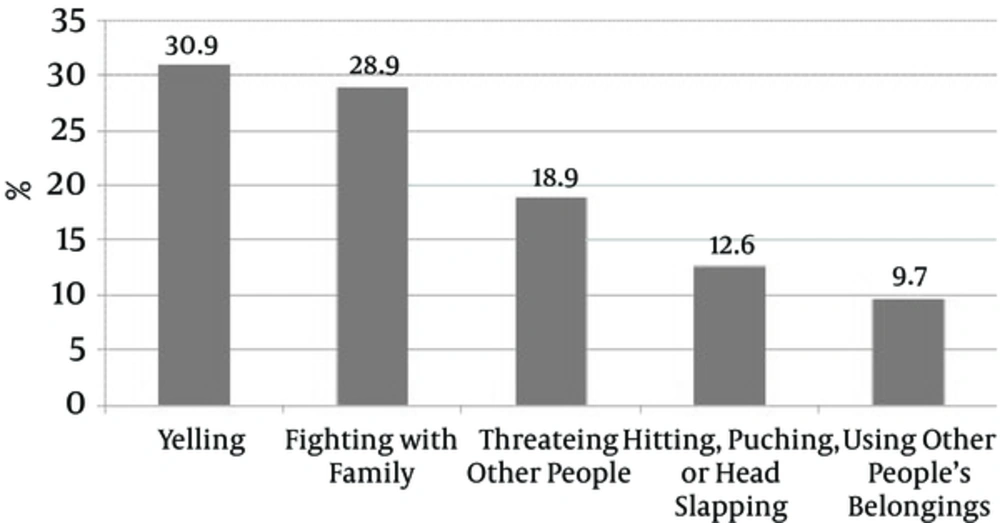
Figure 1.
Percentages of violence to other people performed by people with epilepsy (Top Five Behaviors)
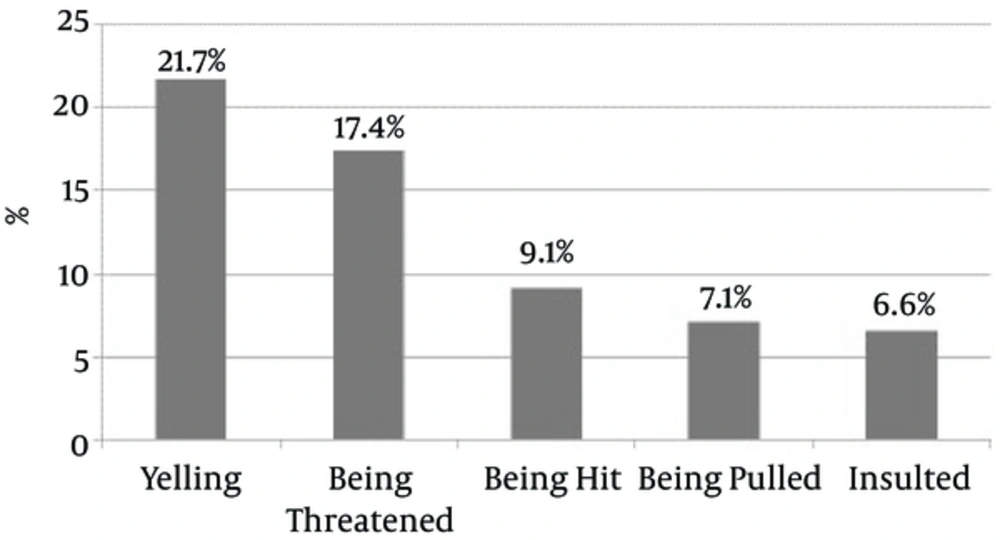
Figure 2.
Percentages of violence of victims performed by people with epilepsy (Top Five Behaviors)
4. Discussion
4.1. Characteristics of Violence in PWE
Patients committed violence against others in 51.4% of 180 cases and were victims of violence in 40.0% of 140 cases. Previous reports showed that the physical violence in PWE was 22 to 30% (13, 17). Among 33 cases, 13 items were notable for committing violent behavior, while 15 items were factors of being victims of violent behavior; the correlation of committing violent behavior towards others and being victims of violence was statistically significant at 0.58. This may imply that if patients committed violence against others, they would be victims of violence in return in at least half of the times.
It was expected that the domestic violence in Thai PWE should be very few because PWE or sick people in Thai or Asian culture should be treated well by family members. The results showed that almost half of PWE in Thailand reported domestic violence. The prevalence of domestic violence in PWE, however, was lower than in the normal population in Thailand (18). The violence between normal married individuals was 63.3%. The results indicated the need to reduce domestic violence not only in Thai PWE, but in Thai society as a whole.
Some violent items such as cursing or fighting with family members may be normal behavior in family dynamics. According to the WHO classification, however, these items are considered as violence (20). In addition, the PWE who reported the domestic violence indicated that the items were serious occurrences and not similar to just normal family issues.
4.2. Differences Between Each Factor of Patient Violence Directed Towards Others
There was an induced chance of being violent from the following factors; age less than 30 years and more than 60 years, single marital status, good relationships with relatives, smoking history, and alcohol consumption. A previous study regarding marriage status and violence in PWE was reported to be a significant factor by Sawangchareon et al. (18). The documented domestic violence ie, the wife being violent happened more than normal persons, because they were close to their partners. For those PWE who were single, they tended to be more violent than married persons who were being taken care of by a partner. In terms of age, Bogdonovic (2000) stated that patients who were being violent were younger and had less emotional control concerning violence and this was not related to gender (16). Using drugs and alcohol increased both domestic violence and social violence towards society because individuals lost self-determination (9, 23, 24). Good relationships turned out to increase the chance of violence occurring. It was found that the violence after epilepsy commonly happened among people who had close relationships.
Low socio-economic situation may be one contributing factor for violence in PWE or in the general population. Significant differences occurred in PWE who had violence, but these differences were not confined to only one socio-economic group (Tables 2 and 3). The high income group (more than 1,667 USD/month) still had violence and a different proportion was found in the income group of 1,001 to 1,666 USD/month. Further studies are needed to evaluate the association of socio-economic factors and violence occurrence.
4.3. Consequences of Violence in PWE
If the violence that happened to patients included being a victim and being an offender which affected patients emotionally, the behavior tended to be more negative and patients felt guilty within themselves, felt sorrowful, depressed, down, and bored and did not want to communicate with anyone; they had arguments between family members, and were unhappy with their family lives. This matches previous studies where epilepsy patients tended to feel guilty and even committed suicide (7, 17). They were worried about life, ended relationships (11); patients had poor skills when facing society and the effects of the disease blocked their understanding which led to the creation of violence (3, 17). The general public being offenders or causing violence towards patients were found amid every type of violence; it may be because patients were often unable to cope with social problems (7, 17). Another reason was that partners of patients and siblings and parents were the victims because they were in close relationships with the patients and, therefore, could not stop themselves fighting sometimes with the patients.
4.4. Risk Factors for Performed Violence and Being Victims
A previous study showed that several factors might be associated with self-harm in PWE such as psychiatric problem, unemployment, previous violence, and housing problems (25). This study confirmed that poor relation with family members increased the risk of performing violence and being victims by 2.5 and 2.6 times, respectively (Table 4). We also found a new risk factor related with violence which is age. Increasing age, particularly over 60 years (Tables 2 and 3), had significantly lower incidence of performing violence or being victim compared with other age groups.
4.5. Study Limitations
First, those patients who were physically or emotionally exhausted and unable to complete the questionnaire due to ethical issues were excluded. These subjects may likely be those who experienced domestic violence. Very few patients, however, (fewer than 10) who were physically or emotionally exhausted were excluded. Secondly, the risk factors for domestic violence in PWE in this study were not studied. There is no control group in this current study. Further studies are needed to find significant risk factors for having domestic violence in PWE and to, also, compare this group with a healthy cohort of non-PWE control subjects as well as with PWE with no history of violence.
4.6. Conclusion
The prevalence of domestic violence in PWE is high and has negative consequences. This can also affect patients’ lives in a multitude of ways; emotional behavior tends to be more negative and patients feel sorrow, sadness, and guilt along with depression and boredom. The feelings of being antisocial happened in terms of arguments between family members and were often correlated with discontentedness with family life.
4.7. Suggestions
1. Medical staff or persons taking care of PWE should realize that PWE have within them the possibility of creating violence, so staff and families should be made aware, educated, and guided on how to take care of the patients.
2. It should be made necessary to provide training and standards for staff assuring their understanding of epilepsy. This may actually be redundant if you accept the alteration of number 1.
3. PWE who feel sorrow and stress and want to commit suicide have to be focused on understanding the factors associated with domestic violence.
4. In this study, most participants were in the follow up stage at the hospital, so this group was limited, therefore, it would be better to study PWE out of a hospital setting or among those who had attended an outpatient department or PWE being taken care of within their community. In this case, results are likely to differ pertaining to violence frequencies.