


1. Background
Coronary heart disease (CHD) is one of the most important causes of mortality in the world. In Iran, cardiovascular disease is the first cause of death and imposes huge social and economic burdens on society (1). Depression has been known as a risk factor responsible for CHD and is associated with cardiac mortality, poor patients’ lifestyles, poor adherence to the treatment and poor treatment outcomes in patients with coronary artery disease (2). Comorbidity between depression and heart disease is typically acknowledged. Depression among heart patients is more prevalent than the general.
Population, and depressed people are more likely to develop heart disease (3). In addition to depression, anxiety is another psychological component that can affect heart patients (4). The prevalence of anxiety in heart patients has been reported to be 45.7 % in Iran (5). Anxiety is also considered as a risk factor for heart disease which can influence the onset of the first period of illness and its resultant death (6). For rapid diagnosis and early intervention, we need tools to screen these abnormalities. Several tools have been used to measure depression in cardiac patients, such as BDI-II, PHQ-9 and PHQ-2. The American Heart Association in 2008 proposed that PHQ-2 could be used to measure depression (7). The GAD-2 has also shown acceptable psychometric properties of measuring anxiety (8). Combining these two questionnaires, the PHQ-4 questionnaire was made, a much shorter tool. Because of this, Kroenke et al. combined these two questionnaires and developed a tool to measure anxiety and depression (9). This tool has been studied in some samples such as general population and students (10-12). Given the importance of screening in cardiac patients in terms of the anxiety and depression as well as the use of efficient and short tools, this study aimed at evaluating the psychometric properties of this tool in CHD patients.
2. Objectives
The aim of this study was to determine the psychometric properties of PHQ-4 as a screening tool for depression and anxiety in CHD patients in Iran.
3. Methods
3.1. Participants and Procedures
As for research participants, 279 patients with CHD referred to Imam Ali Hospital in Kermanshah were diagnosed with CHD by two cardiologists, some of the patients underwent angiography according to the cardiologists’ opinion. Afterwards, the heart patients not able to participate in the study due to severe heart problems were those with cognitive problems, such as Alzheimer’s, severe psychological problems, such as psychotic disorders, and physical problems, such as thyroid and they were excluded from the study because of symptoms such as depression. In cases where the patient was incapable of reading and writing, the questionnaire was read by the researchers and the patient responded to the questions. After explaining the purpose of the study and completing an informed consent form, the patients were first given a semi-structured clinical interview and then were asked to complete questionnaires, including the PHQ-4, PHQ-9, BDI-II, and GAD-7. This study was approved by ethics code IR.SBMU.MSP.RES.1396.286 in the Ethics Committee of Shahid Beheshti University of Medical Sciences in Tehran.
3.2. Measures
Structured clinical interview for DSM-5 (SCID-5): structured clinical interview for DSM-V (SCID-5) is a semi-structured clinical interview used for the primary diagnosis of DSM-5 (formerly located in axis 1). This tool has to be implemented by trained professionals (clinical experts, mental health experts, etc.) familiar with the diagnostic criteria and classification of disorders in DSM-5 (13).
3.3. Patient Health Questionnaire-4 (PHQ-4)
This questionnaire includes four questions of which the first two and the second two measure depression and anxiety respectively. The questionnaire comprises the question of how much each problem has hurt the subject in the past two weeks. The first two questions relate to the feeling of being depressed and lack of interest in doing things; while, the second two questions regarding the anxiety measure the feeling of anger and anxiety and how much one was able to control his/her own anxiety. Answers to questions are in four scales with different scores: Not at all (0), several days (1), more than half days (2), and almost every day (3) (9).
3.4. Patient Health Questionnaire-9 (PHQ-9) and Patient Health Questionnaire-2 (PHQ-2)
The PHQ-9 with 9-item is based on DSM-IV (14). In a cut-off point of 10 and above, the sensitivity and specificity of this tool have been reported to be 0.88 and 0.88 (15). Dadfar et al. reported a Cronbach’s α of 0.88 and one-week test-retest reliability of 0.79 for the PHQ-9 in a sample of Iranian psychiatric outpatients (16).
3.5. Beck Depression Inventory Second Edition (BDI-II)
3.6. Generalized Anxiety Disorder Scale-7 (GAD-7) and GAD-2
This questionnaire includes 7 questions and was developed by Spitzer et al. in 2006. As for scoring in this questionnaire, four scales have been used, including never (0), some days (1), several days (2), and almost every day (3). The score obtained is between 0 and 21, and at the cut-off point of 9, its sensitivity and specialty were 0.89 and 0.82, respectively. The internal consistency of the GAD-7 was 0.92 and test-retest reliability was 0.83 (21). The GAD-2 consists of the first two items of the GAD-7. Scores range from 0 to 6 (22). Seo and Park found a Cronbach’s alph of 0.82 for GAD-2 in in patients with a migraine. The GAD-2 well correlated with the beck anxiety inventory (BAI), and the Migraine Disability Assessment scale (MIDAS) (23).
3.7. Data Analysis
Data was analyzed by SPSS software version 24 and AMOS software version 24. Cronbach’s alpha was used to examine the internal consistency. The Pearson correlation coefficient between PHQ-4, BDI-II, PHQ-9, and GAD-7 were used to assess the criterion validity. To study correlation of the items, total score, and gain correlation range, Spearman’s correlation was used. Confirmatory factor analysis was performed using AMOS software for. A receiver operating characteristic curve (Roc curve) was applied to calculate sensitivity, specificity, area under the curve (accuracy), and optimal cut-off point. Eventually, maximal Youden index (sensitivity + specificity-1) was employed to obtain the optimal cut-off point.
4. Results
We studied 279 patients with CHD. Among them, 152 (54.5%) were male and 127 (45.5%) were female. They were in the age range of 33 and 85 years with the mean age of 59.5 ± 9.98. As for the participants’ occupational history, 132 (47.3%) were unemployed, 103 (36.9%) were self-employed, and 44 (15.8%) were employees.
4.1. Reliability Analysis
Cronbach’s alpha for PHQ-2, GAD-2, and PHQ-4 were reported to be 0.79, 0.75, and 0.78 respectively. Likewise, the results of Cronbach’s alpha coefficient analysis, if any item was deleted, showed that all items if deleted would reduce the value of alpha, indicating their suitability (Table 1).
Table 1.Characteristics of Items and Subscales of PHQ-4 in the CHD
| Item-Total Statistics | Corrected Item-Total Correlation | Cronbach’s Alpha if Item Deleted | |
|---|---|---|---|
| p1 | Feeling down, depressed, or hopeless | 0.55 | 0.76 |
| p2 | Little interest or pleasure in doing things | 0.67 | 0.69 |
| a1 | Feeling nervous, anxious, or on edge | 0.60 | 0.73 |
| a2 | Not being able to stop or control Worrying | 0.56 | 0.75 |
4.2. Validity
The correlations of the PHQ-4 questionnaire with the BDI-II, GAD-7, GAD-2, PHQ-9 and PHQ-2 were reported to be 0.72, 0.63, 0.85, 0.79, and 0.88 respectively (P < 0.5). The correlations of the PHQ-2 questionnaire with the BDI-II, GAD-7 and GAD-2 were found to be 0.64, 0.58, 0.51, 0.79, and 0.88 respectively (P < 0.05). The correlations of the GAD-2 questionnaire with the BDI-II, GAD-7, and PHQ-9 were obtained as 0.61, 0.90, and 0.51 respectively (P < 0.05).
The AMOS software was used for the factor analysis. In previous studies, a two-factor and one-factor structure has been introduced. The structure consists of two factors: anxiety and depression (11, 12). In the present study, the results of fitting one-factor and two-factor models showed that the two-factor model has a more suitable fit (chi-square = 1.28, df = 1 P value = 0.25, RMSEA = 0.03, χ2/df = 1.28, NFI = 0.99, IFI = 0.99,TLI = 0.99, and CFI = 0.99) (Figure 1).
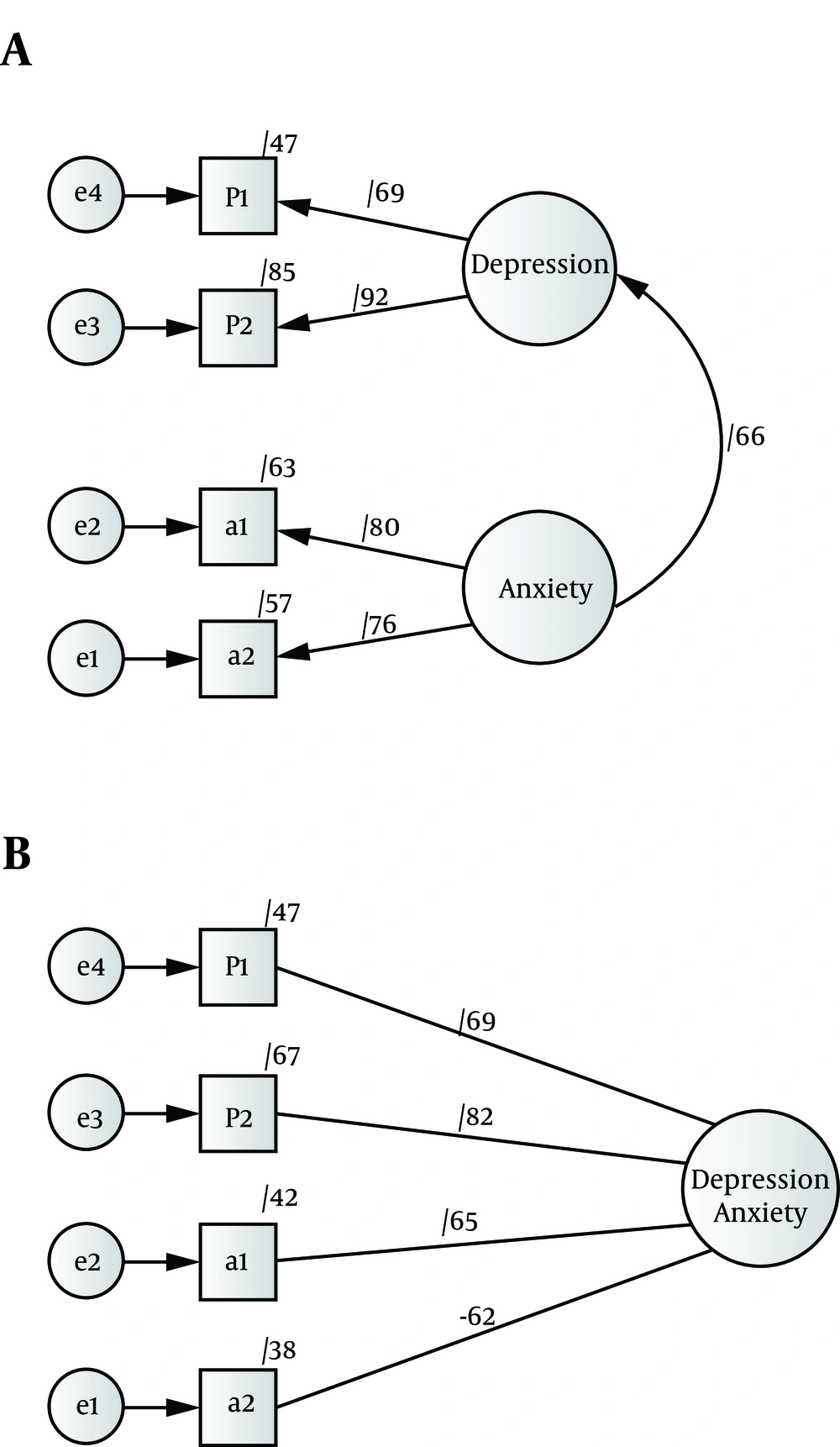
Figure 1.
Confirmatory factor analyses results for a one- and two-factor model
The uni-factorial model was also measured but not fitted properly. (Chi-square = 55.27, DF = 2, P value = 0.00, χ2 = 27.53, RMSEA = 0.3, TLI = 0.26, and CFI = 0.85) (Figure 1).
4.3. Test Features for Screening Purposes
The ROC test was used to obtain the sensitivity, specificity, area under the curve, and cut-off point. The cut-off point of PHQ-4 ≥ 7 to measure depression and anxiety concurrently (sensitivity = 0.86, specificity = 0.90, and the area under the curve was 0.94 (CI = 0.90 - 0.97) (Figure 2 and Tables 2 and 3), the cut-off point of PHQ-4 ≥ 5 to measure depression (sensitivity = 0.76, specificity = 0.80, and the area under the curve was 0.84 (0.79 - 0.89) (Figure 3 and Tables 2 and 3), the cut-off point of PHQ-4 ≥ 7 to measure anxiety (sensitivity = 0.80, specificity = 0.94, and the area under the curve was 0.94 (CI = 0.91 - 0.97) (Figure 4 and Tables 2 and 3), the cut-off point of PHQ-2 ≥ 3 to measure depression (sensitivity = 0.77, specificity = 0.84, and the area under the curve was 0.82 (CI = 0.77 - 0.87) (Figure 3 and Tables 2 and 3), and the cut-off point of GAD-2 ≥ 3 to measure anxiety (sensitivity = 0.96, specificity = 0.82, and the area under the curve was 0.95 (CI = 0.93 - 0.97) (Figure 4 and Tables 2 and 3).
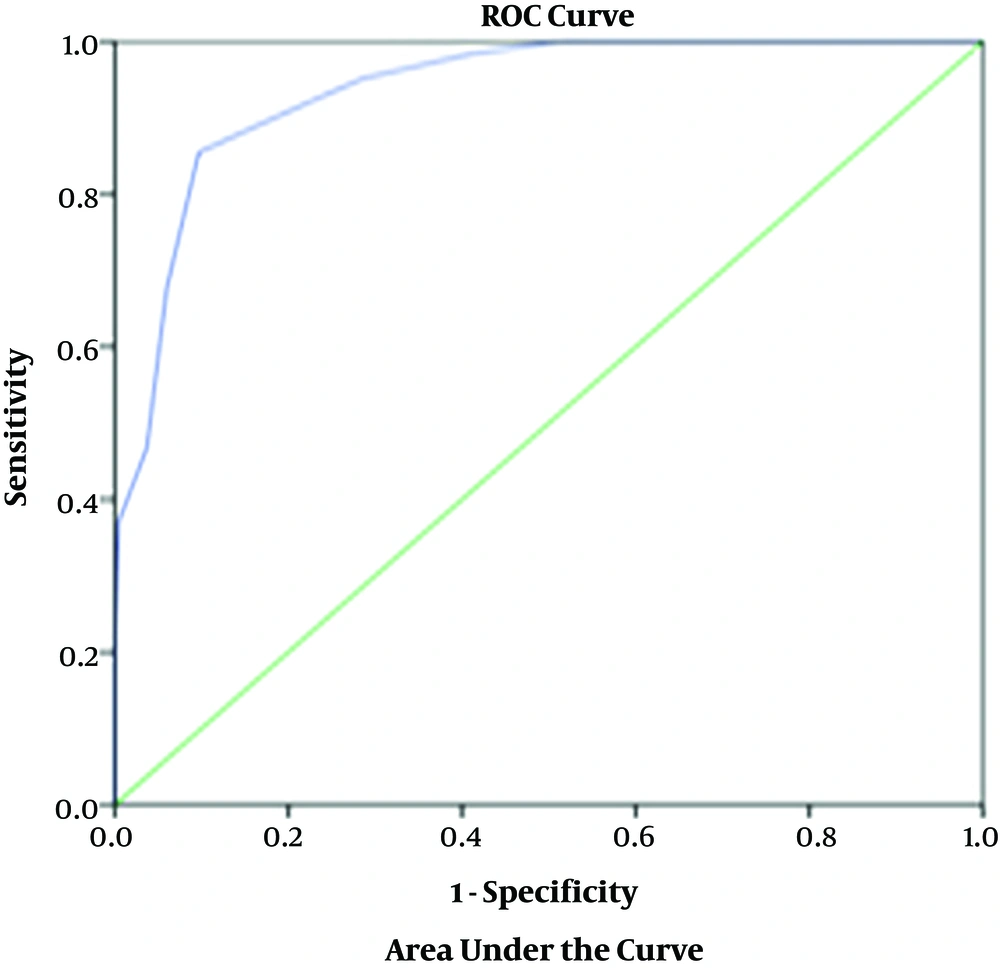
Figure 2.
ROC curve for PHQ-4 to detect depression and anxiety concurrently
Table 2.Area Under the Curve for the PHQ-9 and PHQ-2 (P Value < 0.001)
| Test Result Variable(s) | Area | Std. Error | Asymptotic 95% Confidence Interval | |
|---|---|---|---|---|
| Lower Bound | Upper Bound | |||
| Depression | ||||
| PHQ-4 | 0.84 | 0.02 | 0.79 | 0.89 |
| PHQ-2 | 0.82 | 0.26 | 0.77 | 0.87 |
| Anxiety | ||||
| PHQ-4 | 0.94 | 0.01 | 0.91 | 0.97 |
| GAD-2 | 0.95 | 0.01 | 0.93 | 0.97 |
| Depression and anxiety concurrently | ||||
| PHQ-4 | 0.94 | 0.01 | 0.90 | 0.97 |
Table 3.Sensitivity, Specificity, Predictive Values, and Likelihood Ratios at Various Cut-off Scores of the PHQ-4, PHQ-2 and GAD-2
| Test Result Variable(s) (Positive if Greater Than or Equal Toa) | Sensitivity | Specificity | Positive Predictive Value | Negative Predictive Value | Positive Likelihood Ratio | Negative Likelihood Ratio |
|---|---|---|---|---|---|---|
| PHQ-4 (depression-anxiety) | ||||||
| ≥ 6 | 0.92 | 0.78 | 0.54 | 0.97 | 4.15 | 0.10 |
| ≥ 7 | 0.86 | 0.90 | 0.71 | 0.95 | 8.81 | 0.16 |
| PHQ-4 (depression) | ||||||
| ≥ 4 | 0.86 | 0.69 | 0.66 | 0.86 | 2.76 | 0.21 |
| ≥ 5 | 0.76 | 0.80 | 0.74 | 0.82 | 3.94 | 0.29 |
| PHQ-4 (anxiety) | ||||||
| ≥ 6 | 0.87 | 0.82 | 0.64 | 0.94 | 4.73 | 0.15 |
| ≥ 7 | 0.80 | 0.94 | 0.83 | 0.92 | 13.25 | 0.21 |
| PHQ-2 (depression) | ||||||
| ≥ 2 | 0.82 | 0.69 | 0.65 | 0.84 | 2.65 | 0.25 |
| ≥ 3 | 0.68 | 0.85 | 0.76 | 0.78 | 4.44 | 0.37 |
| GAD-2 (anxiety) | ||||||
| ≥ 2 | 0.99 | 0.57 | 0.47 | 0.99 | 2.30 | 0.02 |
| ≥ 3 | 0.96 | 0.82 | 0.67 | 0.98 | 5.22 | 0.04 |
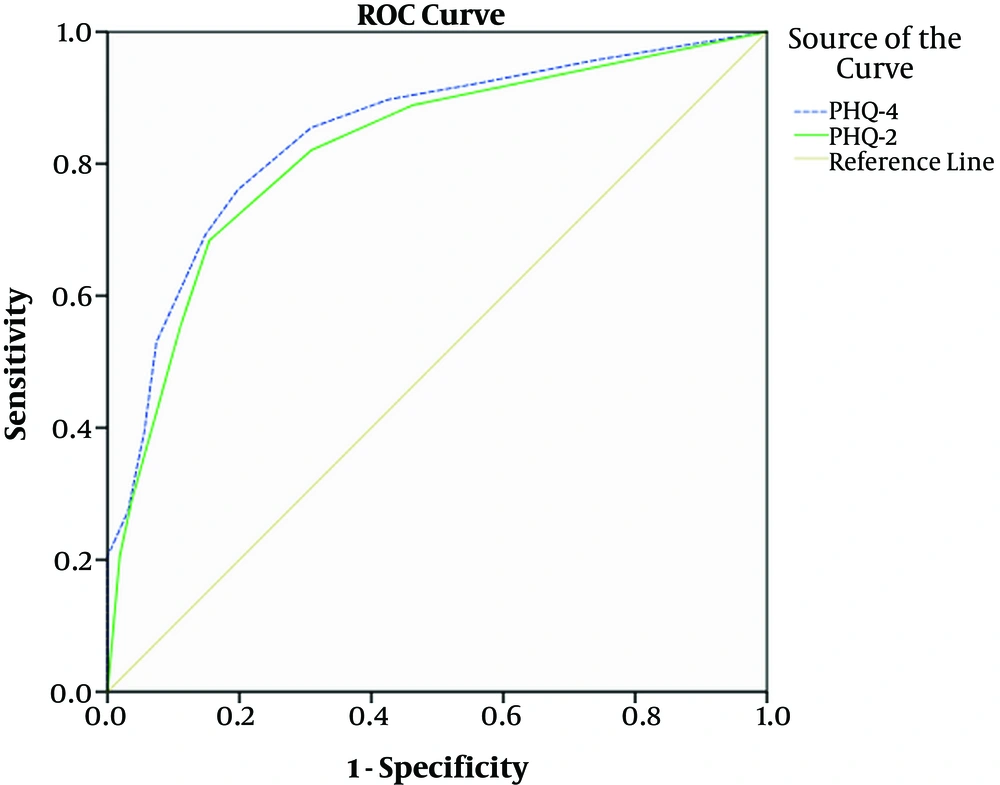
Figure 3.
ROC curves for PHQ-4 and PHQ-2 to detect depression
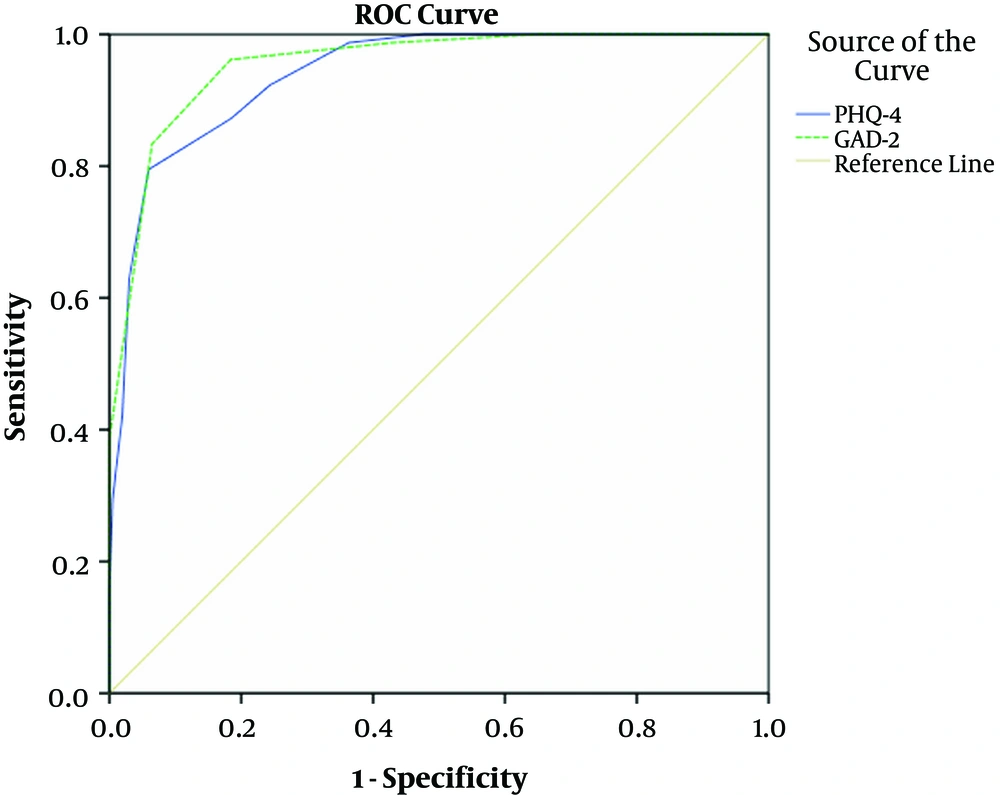
Figure 4.
ROC curve for PHQ-4 and GAD-2 to detect anxiety
The cut-off points obtained for the PHQ-4 questionnaire as a whole, PHQ-4 for the diagnosis of depression, PHQ-4 for the diagnosis of anxiety, PHQ-2 for the diagnosis of depression, and GAD-2 for the diagnosis of anxiety were as follows (Table 2). Based on the area under the curve, it can be said that the questionnaire with the two questions of depression and anxiety can well differentiate people with depression and anxiety from those suffering from CHD without these symptoms.
5. Discussion
The purpose of this study was to translate and investigate the psychometric properties of PHQ-4 as a brief questionnaire to screen patients with CHD in Iran. The study was also the first attempt to investigate the validity of PHQ-4 as a measure to investigate the depression and anxiety in patients with CHD in Iran.
Based on Cronbach alpha, the reliability values of 0.78, 0.79, and 0.75 were calculated for PHQ-4, PHQ-2, and GAD-2 respectively. However, in a study conducted on a general population, the Cronbach alpha has been reported to be 0.82, 0.78, and 0.75 for PHQ-4, PHQ-2, and GAD-2 respectively (11). In addition, in another study conducted on college students, the reported Cronbach alpha were 0.81, 0.76, and 0.82 for PHQ-4, PHQ-2, and GAD-2 respectively (10). The moderate to high correlation between PHQ-4 and other questionnaires of BDI-II, GAD-7, GAD-2, PHQ-9, and PHQ-2 brings evidence to the validity of the PHQ-4 questionnaire. While, in a study conducted on a general population, the concurrent validity of the PHQ-4 questionnaire which was investigated by checking the correlation between the questionnaire and Hospital Anxiety and Depression scale (HADS), General Health questionnaire (GHQ)-12 (GHQ-12), and General Self Efficacy scale (GSES) were r = 0.26, r = 0.46, and r = -0.44 respectively (11).
In this study, the validity of the questionnaire has been also investigated using confirmatory factor analysis. Following other studies, we used one and two factor structures. However, the results showed a better fit for the two-factor model. Accordingly, the results of the current study were in line with the results of the studies conducted in Germany and Colombia (11, 12).
The optimal cut off point of the PHQ-4 was ≥ 7 to measure depression and anxiety concurrently (sensitivity = 0.86, specificity = 0.90). While in a study on a general population, the same index for measuring the anxiety and depression was 6 (12). To separately measure the depression and anxiety, the optimal cut off point were 5 and 7 respectively. The optimal cut off point of PHQ-2 measuring the depression in this study was ≥ 3 (sensitivity = 0.77, specificity = 0.84(. In a study on a patient with heart disease, a cut-off point of 3 with a sensitivity of 0.39 and specificity of 0.92 was measured, showing low sensitivity (24).
To measure the anxiety, the selected cut off point of GAD-2 was ≥ 3 (sensitivity = 0.96, specificity = 0.82). The selected cut off point in this study was consistent with that of a meta- analysis conducted to determine the cut off point for GAD-7 and GAD-2 (8).
Given that the present study was conducted only on the patients with CHD in Kermanshah’s Imam Ali Hospital and it included a sample of 279 patients with CHD, further studies with larger sample sizes are needed on the patients in other hospitals across Iran.
5.1. Conclusions
The results of the current study provided evidence for the validity and reliability of the PHQ-4, GAD-2, and PHQ-2 questionnaires in the population of patients with heart disease. Hence, the indices of patient health two-item questionnaires, namely PHQ-2 and GAD-2 with the cut-off point of 3 can be used for screening the anxiety and depression in patients with heart disease. Additionally, if concurrent screening of these two variables is intended, the 4-item questionnaire with cut-off point of 7 can be useful. These three tools demonstrated acceptable sensitivity and specificity values of screening and conducting research.


