
1. Background
Marital satisfaction (MS) is an important factor in strengthening the family (1) and a key factor of spouses’ psychological health and emotional stability (2). The low level of MS may induce marital conflict or family breakdown (3), while a high level of MS improves spouses, families, and communities’ mental health (4). It was believed that MS follows a U-shape pattern over time. Many couples start lives with high MS in the pre-parental phase, lose their MS gradually in the parental phase, and regain their MS in the post-parental phase (5). It seems that MS significantly decreases during the first ten years of married life, and then it continues to decrease gradually (5). Shapiro et al. conducted a six-year study to assess the level of spouses’ MS. They found that the level of MS among 67% of those spouses who became parents decreased significantly. On the other hand, only 49% of women who did not become parents experienced a decrease in their MS, whereas the MS of the remaining 51% either remained unchanged or improved significantly (6). Daroone et al. conducted a cross-sectional study on 264 married women in Tehran. They showed that MS of women with no child was higher than that of women with one or two children (7).
Compared with other phases of life, the birth of the first child causes significant challenges and changes in families (8, 9). Mothers must make adjustments in their personal and professional lives (10). For example, challenges of caring for the newborn (10), role transition, pressure during a shift to parenthood period (8, 9, 11-14), changes in physical, psychological, and social aspects (15), sleep disruption, and daily routines (9). Studies in Iran show that after childbirth, more than 90% of women experience physical problems (16) and, one-third of them develop depression (17). Nourani et al. concluded that problems of transition to parenthood have a reverse relationship with MS (18). Studies show that the birth of the first child impairs the ability of conflict resolution (19), reduces MS, and increases the tendency for divorce (6, 12). From another point of view, the trend of MS variations over time depends on the age of couples, duration of the marriage, the wife's and husband's job (20, 21), personality characteristics, their ability to change the negative attributions into positive (22, 23) interpersonal (extraversion and agreeableness), spiritual, religious and sexual factors, mental health, and communication and interaction skills (24-26), besides positive problem-solving (22, 23).
Studies show that life skill training improves interpersonal relationships and interpersonal conflicts resolution (27), and enhances MS (27-29). Problem-solving is among the life skills, and Problem-solving skill (PSS) training has been shown to enhance MS (30-33). Pakravan et al. found that PSS training can be a good strategy to enhance spouses’ MS and alleviate their psychological symptoms (33). Barghandan et al. also found PSS group training was effective in enhancing MS and general health among a group of Iranian industrial workers (31). Moreover, Mousavizadeh and co-workers reported that PSS and assertiveness skills training positively affected female students’ MS (30). In contrast, Ahmadi and co-workers reported that family PSS training was ineffective in improving the religious orientation, financial management, parenting, and leisure activity dimensions of MS (32). Similarly, during the transition to parenthood, spouses who possess greater PSS, experience a lesser decline in their MS. Implementing strategies to improve spouses’ PSS can prevent marital conflicts (34). Contrarily, failure to implement such strategies can negatively affect other family relationships and increase the risk of developmental problems in children (35).
Although different studies have been conducted so far on the effects of life skills and PSS training on MS, no published study has yet investigated the effects of PSS training on the MS of primigravida breastfeeding mothers who are vulnerable and need PSSs because of significant challenges and changes in their lives after giving birth (8, 9). Moreover, previous studies did not assess the effects of PSS training on different dimensions of MS.
2. Objectives
Given the shortcomings of the previous studies and the adverse effects of unsolved marital conflicts on marriage, particularly during the transition to parenthood (36), we aimed to examine the effects of PSS training on MS among primigravida breastfeeding mothers.
3. Methods
3.1. Design
This pretest-posttest randomized controlled field trial was done on 68 primigravida breastfeeding mothers who attended healthcare centers affiliated to Babol University of Medical Sciences, Iran, in order to vaccinate their 2- month old infants at the beginning of this study. The primary endpoint was to examine the effect of small group PSS training on MS and its dimensions.
3.2. Ethical Considerations
This paper was extracted from an MSc thesis in Midwifery Counseling. The study protocol was approved by the Ethics Committee of Golestan University of Medical Sciences (code: IR.GOUMS.REC.1394.75, date: 2015-08-03). The IRCT registration code was IRCT20171209037794N2. The study protocol conformed to the ethical guidelines of the 1975 Helsinki declaration. Before starting the study, we obtained formal permission from the authorities of Golestan University of Medical Sceinces and Babol University of Medical Sciences, Iran. The administrators of the healthcare centers as well as the participants of the study, were provided with adequate explanations about the aim and the methods of the study. Furthermore, the participants were ensured that they were free to stay or withdraw from the study at any time. The study data was managed confidentially, and written consent was obtained from all participants.
3.3. Sampling
We included women who delivered term neontated (37th - 42nd weeks of a planned pregnancy), had a monogamous family and were married between 1 - 10 years, had a moderate-to-low MS score (60 or less) and basic literacy skills, were not divorced, did not experience a serious stressful life event three months prior to the study, had no known postnatal depression and psychosis, history of recent serious illnesses or chronic health conditions (such as cancer, kidney, lung, heart, and liver diseases), addiction to opiates, psychoactive agents, and alcohol. We excluded women who had a baby with congenital anomaly, a second pregnancy, were absent in the training classes for two or more sessions, failure to respond to more than 95% of the items of the study inventory, development of serious health conditions, or had undergone any type of surgery and participated in any personal or group psychotherapy programs during the study, based on self-report. Ten out of fifteen healthcare centers of Babol University of Medical Sciences were selected randomly through the drawing method in order to reach different socioeconomic levels of the society and keep two groups (experimental and control) apart from each other with the aim of prevention of data leakage and sharing between the two groups. The sample size was calculated based on the findings reported by Mousavizadeh et al.. They found that the pre- and post-test mean scores of MS in their experimental group were 114.86 ± 59.41 and 149.79 ± 79.36, respectively. These values in the control group were 137.7 ± 44.8 and 139.73 ± 41.96, respectively (30). Thus, with a minimum expected increase of 32 points in the mean MS score, a confidence interval of 95%, and a power of 80%, the sample size calculation formula indicated that 30 cases were needed for each group:
In order to access the cases according to MS score of 60 or less, rate of low MS (45%) (30), and attrition rate of 10% with the following formula, 160 cases needed to be recruited.
The mothers with MS scores of 60 or less were randomly allocated using a blocked randomized allocation technique with a block size of 4 to 34 people for control and experimental groups equally based on pretest MS score (Figure 1). Namely, a lower score of MS (dependent variable) was allocated to experimental groups, and a similar score was allocated to the control group until the sample size was completed.
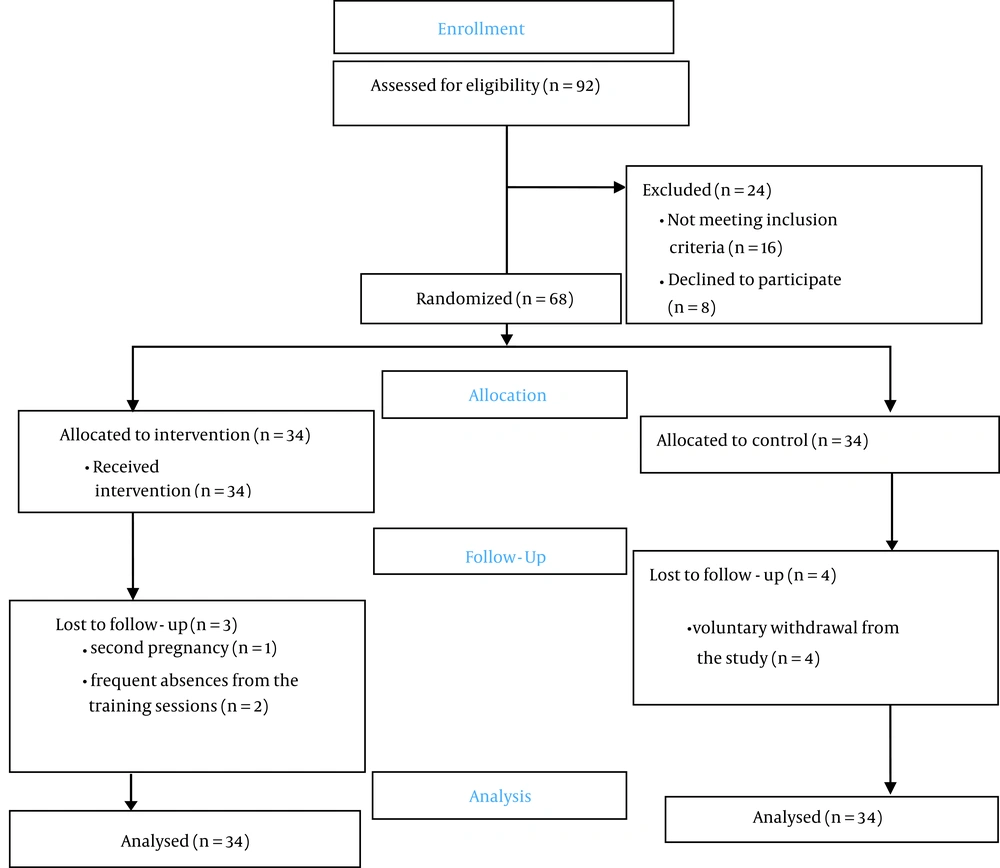
Figure 1.
Participants’ flowchart
3.4. Measures
Data was collected using a demographic inventory and the ENRICH (evaluating & nurturing relationship issues, communication, happiness) inventory based on self-report. The original ENRICH inventory was designed by Olson, Fournier, and Druckman (1983) with 125 questions and 14 scales (37). The Iranian version of Enrich Marital Satisfaction Scale was prepared by Soleimanian (1994) with 47 questions and 11 dimensions, namely idealistic distortion, MS, personality issues, communication, conflict resolution, financial management, leisure activities, sexual relationship, children and parenting, family and friends, and religious orientation (38). A five-point scale was used for scoring the inventory items on which 1 and 5 depict “Completely disagree” and “Completely agree”, respectively. The higher the score, the greater the MS (39). The raw total score of the inventory is converted into T scores in which the mean and the standard deviation were 50 and 10, respectively. Alpha Cronbach’s reliability of the original form of ENRICH inventory was detected 0.83 (36) and 0.95 (39). The validity of the inventory was approved by a psychologist (39), and its face and content validity was approved by psychology and education faculty members of Tabriz University of Medical Sciences (39).
3.5. Procedure
The program of a small group (10 - 11 women) PSS training was performed in six 80-minute sessions for the experimental group based on brainstorming, role-playing, and homework. The content of the sessions was adopted from a book called “life skills” (40) based on the steps proposed by Sahler et al. and Allen and co-workers (41, 42) and adjusted for breastfeeding and postpartum problems that were mentioned by mothers. The outline of the sessions is presented in Box 1. The participants in the control group did not receive any specific intervention. All sessions were held in one of the recruited healthcare centers, which had better training facilities. All mothers in both groups completed the ENRICH inventory three times, namely before (Time 1), immediately after the sixth training session (Time 2) for evaluation of early effects of intervention (end of intervention), and one month after the intervention (Time 3) for follow-up.
Box 1.
Outline of Problem-solving Skill Training for Primigravida Breastfeeding Mothers
| Outline |
|---|
| Session 1: Orientation to the problem |
| Focused on setting strategies, building a therapeutic alliance and obtaining information from the women, problems related to postpartum and breastfeeding, the definition of life skills and problem-solving skills and the necessity for their training; emotion- and problem-focused coping; emotions and the importance of their management |
| Session 2: Improving orientation to the problem |
| Reflection on the last week and repetition. Helping the patient recognize problems regarding motherhood, breastfeeding, relationship with husband, the realization of problems especially about caring for the baby, social concerns, marital concerns, and relationship concerns arising from postpartum, especially relationship with her husband. |
| Session 3: Clear definition of the problem |
| Reflection on the last week and repetition. Definition of the problems during the past week and discussing the problem in the group. |
| Session 4: Generating different solutions for the problem |
| Reflection on the last week and repetition. Encouraging women to generate different solutions to the problem. Also, eliminating unfeasible and irrational solutions. |
| Session 5: Selecting the best solution for the problem |
| Reflection on the last week and repetition. Dealing with the "advantages-disadvantages" technique for selecting the best solution. |
| Session 6: Presenting the steps of problem-solving |
| Reflection on the last week and repetition. Helping the women to develop steps of problem solving and practice, progress review, insights, techniques, and the individual evaluation of the sessions. Reflection on the learned skills and final discussion. |
3.6. Statistical Methods
Data analysis was done using SPSS software, version 20. Initially, the normality of the distributions of the study variables was assessed by the Shapiro-Wilk test. Variables with a normal distribution (total MS score and the scores of its children and parenting and religious orientation) were analyzed through running repeated measures analysis of variance and the Bonferroni's post hoc tests while the analysis of variables with non-normal distribution was done using the Freidman and the Wilcoxon tests. We chose intention to treat (ITT) approach for the analysis. The level of significance was 0.05.
4. Results
During the study, three mothers were excluded from the experimental group, one because of a second pregnancy and two because of frequent absences from the training sessions. Moreover, four mothers were excluded from the control group because they voluntarily withdrew from the study. At baseline, there were no significant differences between the two groups as well as between the excluded participants and the ones enrolled with respect to the demographic data and MS. Final data analysis was done on data retrieved from 68 mothers. The demographic information of the two groups is shown in Table 1. Findings showed that in the experimental group, MS increased significantly from 164.24 ± 22.85 at baseline to 181.84 ± 20.5 after the sixth training session and 184.41 ± 20.36 one month afterward, compared with the control group (Table 2).
Table 1.
Comparing the groups respecting demographic characteristics a
| Variables | Values | |
|---|---|---|
| Experimental | Control | |
| Route of delivery | ||
| Normal vaginal delivery | 17 (54.8) | 18 (60) |
| Cesarean section | 14 (45.2) | 12 (40) |
| Educational status | ||
| Below-diploma | 5 (16.1) | 5 (16.6) |
| Diploma | 12 (38.7) | 13 (43.3) |
| Higher degrees | 14 (45.1) | 12 (40) |
| Employment | ||
| White-collar worker | 3 (9.7) | 4 (13.3) |
| Housewife | 28 (90.3) | 26 (86.7) |
| Housing status | ||
| Rented | 12 (38.7) | 8 (26.6) |
| Private | 16 (51.6) | 14 (46.7) |
| Other | 3 (9.7) | 8 (26.6) |
| Monthly income (IR Rials) | ||
| < 5,000,000 | 4 (12.9) | 5 (16.7) |
| 5,000,000 – 10,000,000 | 19 (61.3) | 22 (73.3) |
| > 10,000,000 | 8 (25.8) | 3 (10) |
| Mothers’ age | 26.09 ± 5.36 | 24.20 ± 3.94 |
| Husbands’ age | 29.93 ± 5.25 | 29.06 ± 3.74 |
| Length of marriage | 3.83 ± 2.45 | 3.26 ± 1.72 |
| Age of marriage | 22.25 ± 4.67 | 20.93 ± 4.44 |
a Values are expressed as No. (%) or mean ± SD.
Table 2.
Comparing the Measurement Time Points Respecting the Marital Satisfaction Dimensions with Normal Distribution
| Variables | Mean±SD At the Three Measurement Time Points | P-Value a | P-Value b | ||||
|---|---|---|---|---|---|---|---|
| Time 1 | Time 2 | Time 3 | Time 1, Time 2, & Time 3 | Time 1 & Time 2 | Time 1 & Time 3 | Time 2 & Time 3 | |
| Total marital satisfaction | |||||||
| Experimental | 164.24 ± 22.85 | 181.84 ± 20.5 | 184.41 ± 20.36 | < 0.001 | < 0.001 | < 0.001 | 0.004 |
| Control | 166.85 ± 18.27 | 164.39 ± 19.02 | 168.77 ± 18.75 | 0.12 | - | - | - |
| Children and parenting | |||||||
| Experimental | 13.47 ± 2.64 | 15.79 ± 1.61 | 16.13 ± 1.97 | < 0.001 | < 0.001 | < 0.001 | 0.06 |
| Control | 13.82 ± 2.64 | 14.03 ± 1.8 | 14.55 ± 1.99 | 0.14 | - | - | - |
| Religious orientation | |||||||
| Experimental | 15.06 ± 3.36 | 15.77 ± 3 | 16.14 ± 2.42 | < 0.001 | 0.38 | 0.001 | 0.001 |
| Control | 14.29 ± 2.92 | 13.99 ± 2.7 | 14.77 ± 2.55 | 0.11 | - | - | - |
a Repeated measures analysis of variance
b Bonferroni’s post hoc test
Comparison between the mean total MS score in the two groups was confirmed with Cohens d test (43), showing an effect size of 0.93 (0.4 - 1.45). This represented the strength of the relation. Moreover, except for the score of the idealistic distortion dimension, all other dimensions increased significantly over time in the experimental group. However, in the control group, none of these scores increased significantly over time (Tables 2 and 3). Moreover, the between-group comparison and the interaction between groups and time were significant with respect to the scores of total MS and its children and parenting and religious orientation dimensions (Table 4).
Table 3.
Comparing the Measurement Time Points Respecting the Marital Satisfaction Dimensions with Non-normal Distribution
| Variables | Mean ± SD At the Three Measurement Time Points | P-Value a | P-Value b | ||||
|---|---|---|---|---|---|---|---|
| Time 1 | Time 2 | Time 3 | Time 1, Time 2, & Time 3 | Time 1 & Time 2 | Time 1 & Time 3 | Time 2 & Time 3 | |
| Idealistic distortion | |||||||
| Experimental | 11.6 ± 2.38 | 11.86 ± 1.66 | 11.87 ± 20.36 | 0.55 | -- | - | - |
| Control | 12.03 ± 1.58 | 11.88 ± 1.61 | 12.02 ± 1.94 | 0.78 | -- | -- | - |
| Marital satisfaction | |||||||
| Experimental | 30 ± 4 | 32.02 ± 3.54 | 32.41 ± 3.94 | < 0.001 | < 0.001 | < 0.001 | 0.28 |
| Control | 29.88 ± 3.39 | 29.48 ± 3.51 | 30.47 ± 3.62 | 0.1 | -- | -- | -- |
| Personality issues | |||||||
| Experimental | 12.26 ± 2.91 | 14.25 ± 3.17 | 14.21 ± 2.54 | < 0.001 | < 0.001 | < 0.001 | 0.22 |
| Control | 12.09 ± 3.35 | 12.20 ± 3.25 | 12.47 ± 3.29 | 0.13 | -- | -- | - |
| Communication | |||||||
| Experimental | 13.18 ± 3 | 14.94 ± 3.11 | 15.15 ± 2.72 | < 0.001 | < 0.001 | < 0.001 | 0.41 |
| Control | 13.24 ± 2.91 | 13.04 ± 2.98 | 13.30 ± 3.18 | 0.42 | -- | -- | -- |
| Conflict resolution | |||||||
| Experimental | 16.9 ± 3.5 | 19.75 ± 3.04 | 19.81 ± 2.82 | < 0.001 | < 0.001 | < 0.001 | 1 |
| Control | 18.18 ± 3.14 | 17.55 ± 2.99 | 17.56 ± 2.77 | 0.14 | -- | -- | -- |
| Financial management | |||||||
| Experimental | 10.12 ± 2.29 | 10.98 ± 2.45 | 11.30 ± 2.46 | < 0.001 | 0.001 | 0.003 | 0.34 |
| Control | 10.82 ± 2.08 | 10.59 ± 2.14 | 10.71 ± 2.48 | 0.81 | - | -- | - |
| Leisure activities | |||||||
| Experimental | 13.59 ± 2.35 | 15.54 ± 1.84 | 15.52 ± 2.12 | < 0.001 | < 0.001 | < 0.001 | 0.9 |
| Control | 13.41 ± 2.25 | 13.17 ± 2.28 | 13.54 ± 2.18 | 0.37 | -- | -- | -- |
| Sexual relationship | |||||||
| Experimental | 13.65 ± 2.54 | 15.21 ± 2.02 | 15.37 ± 2.16 | < 0.001 | < 0.001 | < 0.001 | 0.51 |
| Control | 14.56 ± 1.87 | 14.16 ± 2.04 | 14.56 ± 2.27 | 0.3 | -- | -- | - |
| Family and friends | |||||||
| Experimental | 14.32 ± 2.55 | 15.72 ± 2.46 | 16.14 ± 2.42 | < 0.001 | 0.001 | 0.001 | 0.08 |
| Control | 14.53 ± 1.71 | 14.29 ± 2.17 | 14.83 ± 2.43 | 0.17 | - | - | - |
a Friedman’s test
b Wilcoxon test
Table 4.
Comparing the Effects of Time, Group, and Group × Time Interaction Respecting the Marital Satisfaction Dimensions Which Had a Normal Distribution
| Variables | The Effect of Time | The Effect of Group | The Effect of Group × Time Interaction | |||
|---|---|---|---|---|---|---|
| F | P-Value | F | P-Value | F | P-Value | |
| Total marital satisfaction | 38.25 | < 0.001 | 4.82 | 0.03 | 36.91 | < 0.001 |
| Children and parenting | 20.0 | < 0.001 | 5.89 | 0.01 | 8.81 | < 0.001 |
| Religious orientation | 8.91 | < 0.001 | 4.68 | 0.03 | 2.87 | 0.06 |
5. Discussion
We found that PSS training significantly enhanced Primigravida breastfeeding mothers’ MS after the sixth training session and one month after the intervention. This is consistent with the findings of previous studies in different groups (30-33); however, this issue has not been evaluated in breastfeeding mothers. Barghandan et al. found that group training of PSS significantly improved MS of women that participated in seven 90-minute sessions (31). Another study showed that eight weekly sessions of PSS training based on Howton’s therapeutic model was an appropriate strategy to enhance spouses’ MS, and the positive effects remained two months after its implementation (32). Consistently, another study demonstrated that the MS of students that attended 10 sessions of problem-solving and assertiveness classes increased two months after training (29). Johnson and co-workers also noted that problem-solving and affective expression skills had significant roles in enhancing MS (44). In addition, Egeci and Gencoz showed that PSS in students that were in a romantic relationship was significantly correlated with satisfaction with their relationship (45).
PSS is a well-tested mental health strategy in many populations (46) and can be help individuals understand that conflict is an integral part of married life and enables them to consider it as a resolvable problem rather than a threatening factor. By giving individuals such an attitude, PSS plays a pivotal role in conflict resolution. Additionally, this skill helps women exactly define their problems, assess all possible solutions, and select the most appropriate one to effectively deal with their daily life issues. These abilities minimize interpersonal problems and enhance MS. The similarity of the present study with the mentioned studies was using the group approach and group dynamics. Meetings were also held at weekly intervals to provide sufficient time for participants to practice and learn. The difference between the results of the present study and other studies was that this study examined the effects of PSS training on MS of primigravida breastfeeding mothers who experienced challenges and changes in their lives after delivery. Also, this study focuses on self-defined problems and challenges. Wang et al. showed that the postpartum period for parents is a critical time that requires adjustments (47).
We found a significant increase in the mean scores of the ten dimensions of the ENRICH except for the idealistic distortion dimension. This dimension measures respondent’s desire for providing appropriate responses to the ENRICH items. Our findings were contrary to the findings reported by Ahmadi et al. showing that family PSS training in couples who had marital dissatisfaction did not significantly improve the leisure activities, parenting, financial management, and religious orientation dimensions of the ENRICH (32). This study evaluated breastfeeding mothers with MS scores of 60 and lower with one child, but Ahmadi’s study was on couples with MS. Marriage is an intricate type of interpersonal relationship (1). The contradiction of our findings with the findings reported by the mentioned study could be attributed to the differences in the cultural contexts, methodologies, and population of the studies. Mohammadi also noted that lifestyle could predict MS (48). Thus, another explanation for the contradiction between the findings of the present study and the findings reported by the latter study can be the differences in the lifestyles of the participants. We also found that the lowest dimensional score in both the control and the experimental groups was related to the personality issues and the communication dimensions of the ENRICH. Baneian et al. also reported the same findings (49), even though the population of their study was different from ours. These findings denote that women generally have no positive attitude towards their husbands’ behavioral and personality characteristics and cannot establish effective communication with them. Nonetheless, study findings revealed that these two aspects of MS can be improved through PSS training. We found that the mean score of children and parenting and religious orientation dimensions increased in both groups (intervention and control) during the time (Time 2 and Time 3), but the difference was not significant. This may be related to a process beyond this study similar to media as well as circumstantial factors or experiences that the population of the two groups earned equally during this study.
This study faced several limitations. One limitation was a relatively short follow-up period and the short-term nature of the intervention. Moreover, data collection was performed through the self-report approach, and hence, some sorts of measurement biases might have occurred. Many mothers participated in the classes with their baby since classes were held in the winter, which caused problems for mothers to care for their infants. In future studies, more facilities should be provided for mothers, such as babysitting services during the classes.
Also, researchers recommend that classes be held with a smaller group for better coordination or individually for better focus on problems. This kind of intervention is recommended to be studied in longer periods of time to provide convincing evidence about the long-term effectiveness of PSS training. Couples experience special challenges and difficulties in the main life cycle events (3) and, transitional life cycles. Therefore, future studies are recommended to replicate the present study on couples, other populations, and during adolescence and premarital and pre-pregnancy periods. One study explored the MS structural model with five significant predictors, including the role of communication patterns, their own and partner's motivation for conjugality, cohesion and flexibility within a couple, and several sociodemographic characteristics (3). Another phenomenological study showed that relative importance and weight of trust, respect, commitment, companionship, faithfulness, communication, positive relations with in-laws, forgiveness, shared values, and financial security varies in MS according to the personal context, beliefs, and values of individuals and their cultures (50). Also, we believe that meeting all problem-solving approaches and models in one study is probably unfeasible, and therefore, studies with different approaches and models could be conducted to eventually provide a brighter image.
The strength of the present study was the use of standard, simple, understandable, and easy taught problem-solving strategies that can be used by midwives, midwifery consultants and, the health team. It was also performed using PSS in response to the main life event and transitional life cycle that provides important clues about MS in breastfeeding mothers. PSS in this study was adjusted by the self-defined problems and the main challenges of breastfeeding mothers. These data provide a platform for future studies.
5.1. Conclusions
Family is the cornerstone of any society, especially in Iran. MS has a key role in the stability of this social unit. Therefore, it is essential to find approaches that lead to higher MS and strengthen the family foundation. PSS training is recommended to be provided to primigravida breastfeeding mothers with moderate-to-low MS to protect them and their families against potential post- natal changes and challenges. The result of this study can be used in prenatal counseling, and midwifery authorities can use this to improve MS of breastfeeding mothers. Also, governmental organizations and associated administrations may develop programs for PSS training as a strategy for promoting MS.