1. Context
Suicide is one of the mental health priorities in world health organization (WHO). According to the WHO report (2003), about 1,000,000 people die because of suicide each year. Findings of suicide attempts in general population demonstrate that the rate may vary from 0.2 to 2.6 and increase up to 10% during lifetime (1, 2). The one month-prevalence of 25% was reported in a study carried out in Morocco (3). A large population study systematically assessed suicide incidence with various psychiatric disorders. In Denmark 21,169 suicides over a 17-year period were compared with gender-age-time-matched people controls (4). According to this study, suicide risk significantly increased for persons with a hospitalized psychiatric disorder. This risk varies significantly by diagnosis, gender and age of subjects. The influence of various disorders usually decreases with increasing age; however, there are some exceptions. Schizophrenia affects people aged ≤ 35 years in the strongest form. Suicide risk strongly increases by recurrent depression in all ages. In young people, borderline personality disorder has a strong effect. For the persons over 60 years old, reaction to stress and adjustment disorder increases the risk for suicide.
A meta-analysis about the prevalence of depression in Iranian adolescents showed depression rates of 43.5%, 15.8% and 13%, employing BDI, symptom checklist-90 (SCL-90) and CDI, respectively (5). The WHO world mental health (WMH) surveys assessed suicidal behaviors and potential risk factors among 108,705 adults from 21 countries. In this research the WHO composite international diagnostic interview (CIDI) was applied. Risk factors for suicidal behaviors in both developed and developing countries were as follows:
Younger age, female, lower income and education, being single, unemployment, parents with psychiatric disorder, childhood adversities, and presence of 12-month DSM-IV psychiatric disorders (6).
A research was conducted in Korea to assess socio-demographic status in persons with suicidal ideation. Suicidal ideation was most prevalent among middle-aged females who were blue-collar workers (7). The middle-aged men with absent spouse showed significantly higher suicidal ideation.
Since various studies were carried out on suicide in different population in Iran, and each of them evaluated just some effective factors in attempting suicide (8-10), implementing a systematic review study to draw a vast picture of suicide and identifying informational gaps would be helpful for future studies.
2. Objectives
Attempted suicide behavior is a multi-factorial phenomenon from etiologic perspective. The current systematic review aimed to assess various effective factors in suicide attempts. These factors were classified and evaluated in three subgroups: psychiatric illnesses, personality problems and psycho-social variables. Also, demographic information of suicide attempter, the history of their mental-physical illnesses and level of perceived psychiatric services were appraised in this systematic review.
Cross-sectional and case-control studies which had evaluated etiology of suicide attempts were included in this review. The investigation covered all of the suicide attempters aged more than 15 years referred to the emergency wards.
3. Data Sources
3.1. Electronic Search (Desk Research)
Studies that focused on etiologic factors, published in peer-reviewed journals, and examining both social factors and suicide or related phenomenon (death wishes, suicide ideation and deliberate self-harm/non-fatal suicidal behavior) were considered eligible for inclusion.
Studies were identified through electronic searches performed through the Pubmed, PsychINFO, IranPsych, SID, IranMedex, IranDoc, Cinahil, WHO Int and ISI databases.
No search terms relating to social factors were applied. All publication years were considered. The following keywords were used in the search:
Suicide, suicidal idea, suicidal attempt, suicidal behavior and etiology, Iran.
3.2. Gray literature
About 5,000 theses from all universities of medical sciences all over the country (40 universities) and psychology colleges under coverage of ministry of science, research and technology were searched. Most of them were accessible from the library of universities. Also, all final reports of researches documented in Iran Psych Database were searched. None of them was about etiological factors in suicidal attempts.
4. Study Selection
4.1. Review Method
4.1.1. Study Identification and Selection
At first, the abstracts of the attained articles from electronic search and gray materials were separately reviewed by two investigators for the relevancy with the subject. In cases with no agreement, final decisions were made after discussion. Full texts of the researches selected based on their relevance to the research criteria were collected. Then, they were assessed and related forms were completed. Totally, 128 articles were included for abstract review.
4.2. Quality Assessment
The full texts of selected articles were appraised by two independent reviewers using critical appraisal form.
5. Data Extraction
5.1. Data Collection and Integration
In most parts of the literatures, there is only descriptive information about suicidal attempts and relationship between etiologic factors and demographic variables are not analyzed.
Since in each study, different etiologic factors were investigated, time trend estimation in etiology of suicidal attempts was not possible. Eighty-four papers were excluded from the study due to non-relevant data. A flowchart was drawn to show the search and selection process identification (Figure 1).
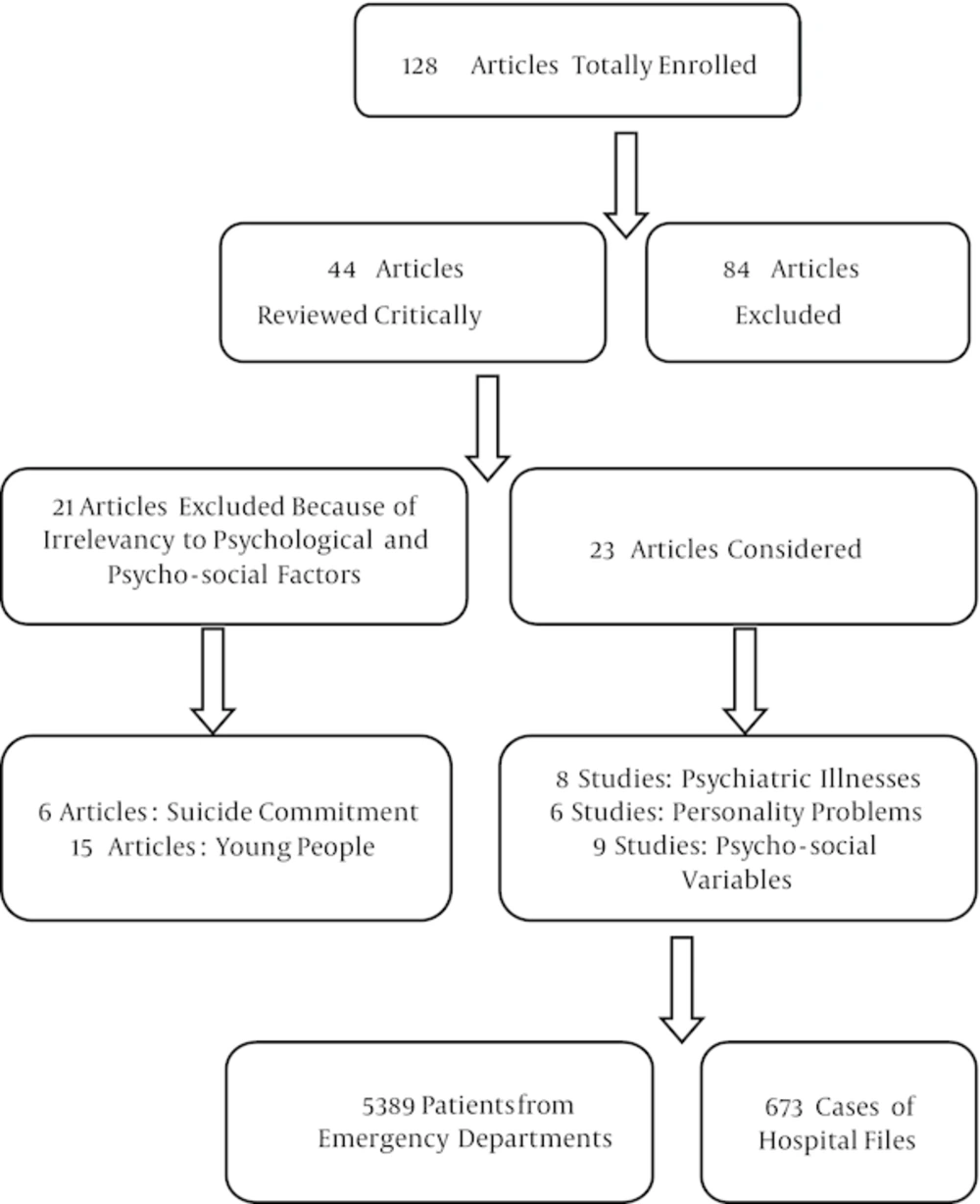
Figure 1.
Flowchart of the Search and Selection Process Identification
The full texts of included articles (44 literatures) were reviewed and the designed tables for data extraction were completed for etiologic factors. Because of the highly heterogeneous factors and variety of data collection scales, the results were not integrated and narrative report is provided. To compare different studies more easily, also to get a better perception of etiological factors; the collected data were categorized into three subgroups of psychiatric illnesses, personality problems and psycho-social variables. It is obvious that interpretation and generalization of these divergent results should be made cautiously.
5.2. Literature Description
Totally, 128 articles were enrolled in the study. After reading the abstracts, 84 studies were excluded and full texts of 44 articles were reviewed critically and 23 articles addressing different etiologic factors were considered. Among them, 21 articles were excluded because of their irrelevancy to psychological and psycho-social factors. Four of them had evaluated association between suicide commitment and lunar months. One article had assessed mental disorders in patients who had committed suicide with fatal and serious methods.
One research had evaluated suicide attempts in patients with addiction; another one was specified just to children aged 6 - 13 years old. In 14 studies, young people had been evaluated and considering different assessed factors in each study, they were not compared. From 44 related studies, 23 articles met the criteria of systematic review; eight studies were about psychiatric illnesses and six of them about personality problems. In nine studies psycho-social variables were attained.
Since two studies had assessed both mental disorders and psycho-social variables and one article had assessed both personality problems and psycho-social variables, they are mentioned in the tables twice.
Three studies had been done using hospital archive files and the others performed by cross-sectional design about people referred to emergency departments. Of the total 6062 persons attempting suicide, 5389 were from emergency departments and 673 cases were related to hospital files.
To evaluate psychiatric disorders, diagnostic and statistical manual of mental disorders, fourth edition (DSM-IV) criteria had been used in three studies and one study was based on DSM-III criteria. Two studies had applied SCL-90 and mood disorders questionnaire (MDQ) to measure psychiatric symptoms.
Assessment of personality problems in suicide attempters had been done by MMPI, the Millon clinical multiaxial inventory-II (MCMI-II) and the eysenck personality inventory.
The studies on psycho-social factors had used new questionnaires and none of them referred to validity and reliability of the scales. None of these studies had used valid questionnaires. They did not use any open ended questions.
6. Results
Among the 44 full text papers, 23 articles met the criteria of systematic review; eight studies were on psychiatric illnesses and six of them about personality problems. Nine studies had attained psycho-social variables. Of the total 5,220 persons attempting suicide in these papers 5,247 were from emergency departments and 673 cases from hospital files.
Young adults of 20 - 24 years had the highest suicide attempt rates. In one study the rate was 64.5% of the suicide attempters. Females attempted suicide two times more than the males. One study showed that significant interpersonal problems had an important role in suicide attempts among 15 to 25-year-old single persons, while significant family problems were important in married subjects less than 20 years. Educated persons with college certification had less suicide attempts. In order to get the conclusion easier, effective factors in suicidal attempts were ranked based on median and based on that three charts were drawn.
6.1. Psychiatric Diagnosis
Depressive disorder was the most common diagnosis in suicide attempters; 45% of the evaluated cases had depression. The rate of bipolar and anxiety disorders were 20% and 17.8% respectively. According to Figure 2, personality disorder with 5.8% had the lowest role among the assessed psychiatric disorders in attempting suicide.
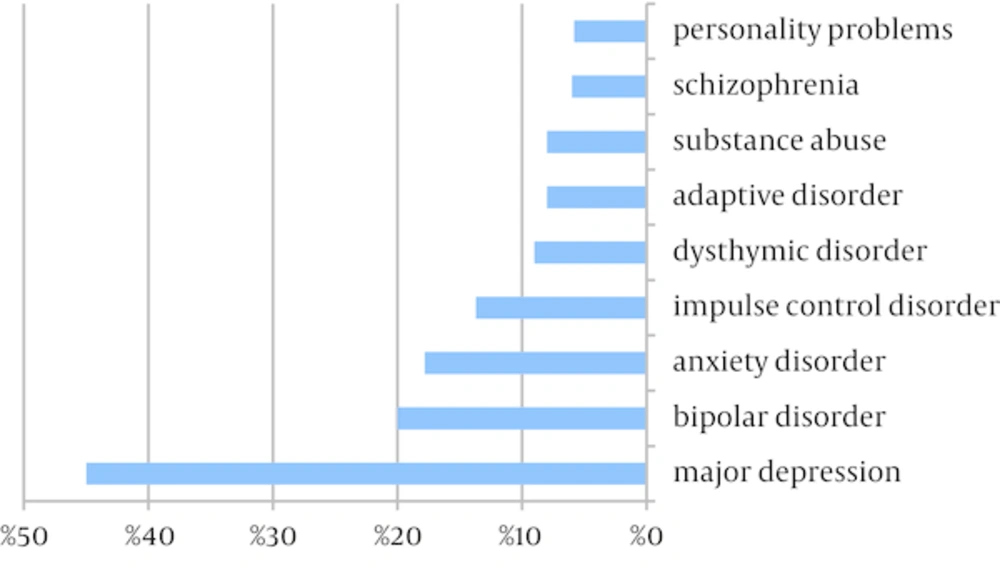
Figure 2.
Psychiatric Disorder in Suicide Attempters
6.2. Personality Problems
A study that used MMPI found that histrionics in females and schizophrenia and paranoia in males were significantly more than other problems. Depression and hypochondria in male and female suicide attempters were significantly more than other problems. Based on the study that applied the eysenck personality inventory, tendency to commit suicide was associated with neuroticism and psychoticism. This result was confirmed in other studies. Table 1 shows the findings of all studies about personality problems.
Table 1.Personality Problems in Suicide Attempters
| References | Year | Sample Size | Study Type | Scale | Personality Problems |
|---|---|---|---|---|---|
| 2003 | 30 college students | Case-control | MCMI-II | Anxiety, somatization, mania, depression dysthymia, alcohol dependence, drug dependence , schizophrenia, paranoid, avoidant personality, antisocial, borderline, schizotypal in suicide attempters is more than others. | |
| 1995 | 667 Subjects, Hamadan | MMPI | Personality disorders: 4.19% neurotic disorder: 3.16% psychosis: 5.13% health : 6.47% NOS: 2.3% severe depression: 4.34% | ||
| 1995 - 96 | 40 Subjects Semnan | Retrospective | MMPI | Histrionic in females and schizophrenia & paranoia in males were significantly more than others. Depression and hypochondria in male and females suicide attempters was significantly more than others. | |
| 1978 | 440 college Iranian and Turkish student | Eyzenck | Tendency to suicide was associated with neuroticism and psychoticism | ||
| 1997 | 56 Subjects, Ilam | Eyzenck | Extraversion in both genders was lower and psychoticism and neuroticism were significantly higher (except psychoticism in females) lying in males was more than control group. |
Abbreviations: NOS, not otherwise; OCD, obsessive compulsive disorder.
6.3. Specified Psychosocial Problems
Family conflicts with 50.7% and conflict with parents with 44.1% were two effective psychosocial factors in suicidal attempts. In around one fourth (28.7%) of the cases, conflict with spouse was the main etiologic factor (Figure 3). Psychosocial factors involved in suicide attempts are summarized in Tables 2 - 4.
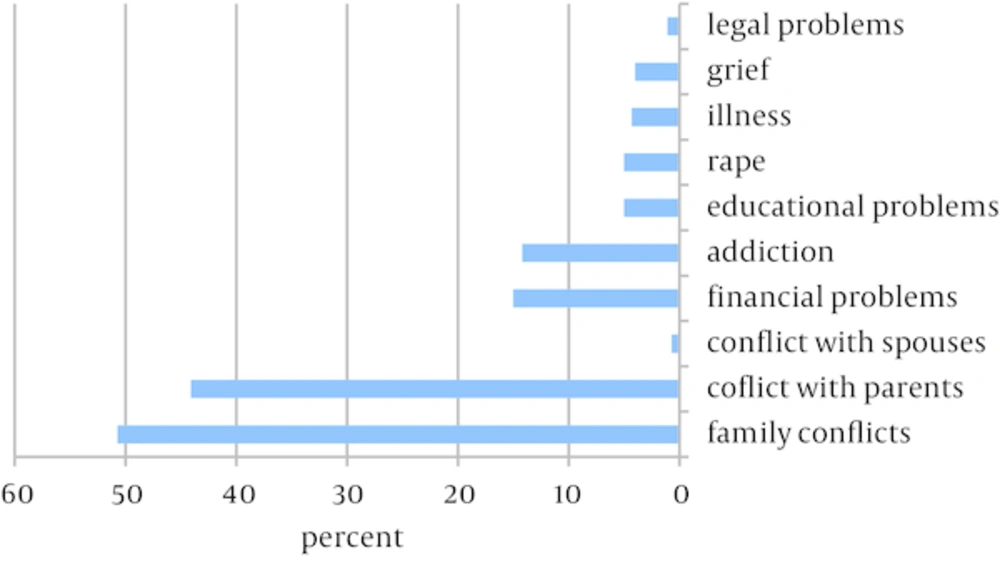
Figure 3.
Psychosocial Problems in Suicide Attempters
Table 2. [Part 1]Psychosocial Factors Involved in Suicide Attempt
| References | Sample Size | Year | Study Type | Demographic Factors | Scale | Family Problems | Conflict With Spouse | Conflict With Parents | Addiction | Romance Problems | Financial Problems | Death of Loving persons | Illness | Education Problems | Legal Problems | Other Factors |
|---|---|---|---|---|---|---|---|---|---|---|---|---|---|---|---|---|
| 600 subjects, house wives and employed women , (toxic urgency , Isfahan) | 2005 | Descriptive, convenient | House wives, 71%; employed, 63%; no significant difference | House wives 4.8%; employed, 6.4%; No significant difference | 4% | 4.3% | ||||||||||
| 173 subjects referred to Rasht EMS | 2001 | Descriptive, convenient | In age between 18 to 24, 53.7% illiterate, 53.2% elementary, 42.2% guidance school, 4.6% high school, 34%; high education 9.21%; Female, 67.8%; male, 32.2; Single, 53.2%; married, 42.2%; significant interpersonal problems between 15 to 25 years and singles, significant family problems in married subjects | Researcher made | 76.1% | 25% | 1.19% | 4% | 4.3% | 3.2% | 1.1% | |||||
| 390 subjects referred to Bandar Abbas EMS | 2001 | Descriptive, convenient | Under 20 year,6.33%; 20 to 30 years, 3.51%; married and house wives, maximum 39.7% | 83% | 20% history of substance abuse | |||||||||||
| 539 subjects referred to Zanjan EMS | 1996 | Descriptive, convenient | 20% unsuccessful marriage, financial problems in males; unsuccessful education in females | 40%, 20% unsuccessful marriage | 30% | |||||||||||
| 100 subjects referred to EMS in Mashhad | Descriptive, convenient | Illiterate, 9%; elementary, 30%; guidance school, 30%; high school, 29%; college 2%; single, 43%, married, 42% | 59% | 29% | 49% medium, 4% poor, 11% good | |||||||||||
| 62 subjects aged 11 - 25 years referred to Shiraz EMS | 1996 | Descriptive, convenient | Female attempter 64.5% | 32% | 31% | Not being successful, 24%; have no marriage permission, 11% | ||||||||||
| 519 subjects referred to Zanjan EMS | 1995 - 96 | Descriptive, convenient | illiterate, 18.5%; elementary, 26%; guidance school, 26%; high school, 22.3%; college 4.3%; married, 53.7% | 50.7% | 55% | 4.8% | 9% (Vocational), 4% | 3.4% | 4.6% |
Abbreviation: EMS, emergency medical services.
Table 3. [Part 2]Psychosocial Factors Involved in Suicide Attempt
| References | Sample Size | Year | Study Type | Demographic Factors | Scale | Family Problems | Conflict With Spouse | Conflict With Parents | Addiction | Romance Problems | Financial Problems | Death of Loving persons | Illness | Education Problems | Legal Problems | Other Factors |
|---|---|---|---|---|---|---|---|---|---|---|---|---|---|---|---|---|
| 58 subjects from Chaharmahal and Bakhtiari province | 2000 | Descriptive, files | 20 to 24 years, 29.4%; 25 to 29 years, 27.6%; illiterate, 22.4%; elementary, 41.2%; guidance school, 20.7%; High school, 12.2%, married, 53.4% | Females, 53.5%; males, 26.7% (mental illness) | ||||||||||||
| 52 subjects, 13 to 19 years referred to Ahvaz EMS | 2000 - 2001 | 55.8% Female | Researcher made questionnaire | 21%, (37.5%) | 41% physical punishment via spouse, 28% | 32.1% | 35.7% expensiveness, 25%, (about 50%), 37% salary problems | 26.7% being inpatient 25% | 37.5% | 23% (32.1%) | Bombing 42.8%, housekeeping responsibilities, 28.6% (42.8%), lovely person separation, 25% (31.3%) | |||||
| 173 subjects | 2001 | File | under 18 years interpersonal, 58%; familial 75%; 18 - 24 years financial problems, 20.4%, interpersonal, 23.4%, familial, 76.6%, vocational, 14%; 25 - 34 years, financial, 23.5%; vocational and interpersonal, 17.6% familial, 82.4%, over 35 years, 20.8% death of the beloved persons, familial, 66.7 | 59.7% | 28.4% | 58.2% | 43% (18%) friends, 82% romance | 33% (21%) vocational | ||||||||
| 500 subjects referred to Emam Reza hospital Mashhad | 2003 - 2004 | File | Under 20 years, 48%; 21 - 40 years, 43.4%; female 67.8%, married, 50.4% | History of opiate use, 4.10%, alcohol, 1.6%, heroin, 1.2% ; grass 1% | Good, 52.2%, intermediate, 11.6%, poor 36.2%, unemployed, 73%, employed, 27% |
Abbreviation: EMS, emergency medical services.
Table 4. [Part 3]Psychosocial Factors Involved in Suicide Attempt
| References | Sample Size | Year | Study Type | Demographic Factors | Scale | Family Problems | Conflict With Spouse | Conflict With Parents | Addiction | Romance Problems | Financial Problems | Death of Loving persons | Illness | Education Problems | Legal Problems | Other Factors |
|---|---|---|---|---|---|---|---|---|---|---|---|---|---|---|---|---|
| 15 subjects, adolescents | Analytic | Suicide ideation questionnaire, hopelessness scale Self-concept test, Children attribution questionnaire | Problem solving skill was effective to decrease suicide ideation thoughts (significant), level of hopelessness was significantly decreased in case group, there was no significant difference in self-concept | |||||||||||||
| 26 subjects from Ilam | 1997 | Analytic | 10 female, 16 male with mean age of 16.8 years | Problem solved through training significantly decreased depression severity level and hopelessness, and also improved coping skills | ||||||||||||
| 40 subjects referred to Loghman hospital in Tehran | 1999 | Analytic | Memory recall speed in depressed suicide attempters was less lower than normal people, retrieving of depression experiences were faster than positive memories, recalling memory experience was highly holistic | |||||||||||||
| 300 subjects from Tabriz | 2002 | 10% | 50% | 22.7% | Unemployment, 15.7%; financial bankruptcy, 2.7%, poverty1.7% | 1.3% | 2.7% | Loss of social base, 4.7%, spouse illicit relations, 0.7%; aging, 0.7%; lack of aim of life, 3.3% | ||||||||
| 946 subjects from Karaj | 2003 | 27.2% | 34.9% | 10.3% | 5.2% | 10.7% | ||||||||||
| 667 subjects from Hamadan | 1995 | 30.9% | 17.4% forced marriage, 3.6% | 1.2% | 3.1% | 7.6% | 1.8% | 8.4% |
Some information such as personal and family history of suicide attempts, history of mental and physical illnesses, and the level of received psychiatric services could be observed in Figure 4 and Table 5.
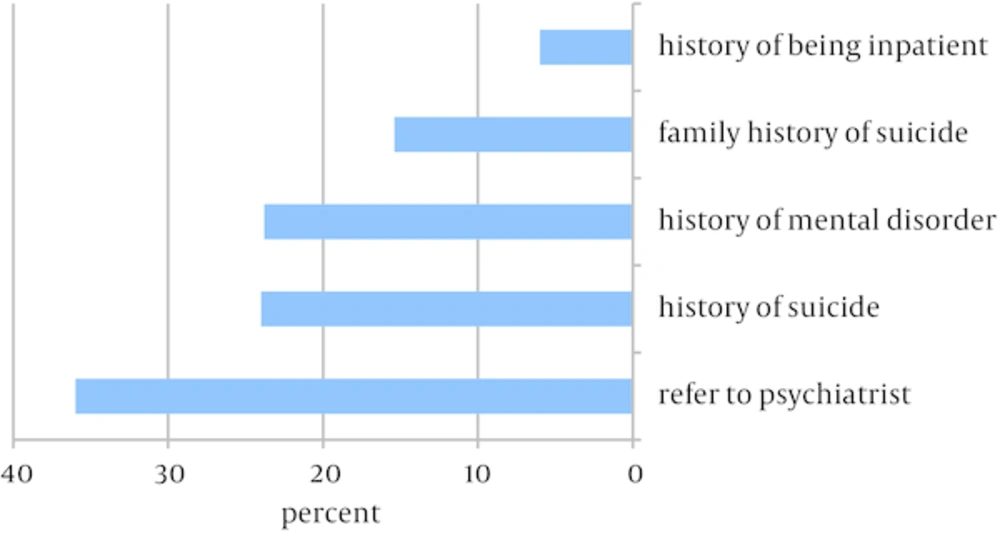
Figure 4.
History of Mental Disorders in Suicide Attempters
Table 5.History of Physical and Mental Illnesses in Suicide Attempters and the History of Suicide in Attempters and Their Families
| References | Year | Sample Size | Visit to a Psychiatrist | History of Tranquilizer Consumption | History of Mental Outpatient | History of Mental Illness | History of Suicide | History of Suicide in Family Members | Having Physical Illness |
|---|---|---|---|---|---|---|---|---|---|
| 2002 | 50 subjects, two hospitals of Birjand, convenient method | 36% | 6% | 80% | |||||
| 1998 | 673 subjects, teaching hospitals of Urmia | 7.3% | |||||||
| 2000 | 100 subjects, Shiraz convenient | 38% | 59% | ||||||
| 2002 | 300 subjects, Tabriz convenient | 17.7% | 3.7% | 6% | |||||
| 2003 | 946 subjects, Karaj catchment area | 58.5% (mental health services) | Neurotic disorders one year before commitment | 28% | 15.4% | ||||
| 1992 | 225 subjects, Qazvin | 24% | |||||||
| 2005 | 600 housewives and employed (toxic urgency , Isfahan) descriptive | Housewives: 38% and Employed 32% (No significant difference) | |||||||
| 2001 | 390 subjects, Bandar Abbas EMS | 11% | 24% |
Abbreviation: EMS, emergency medical services.
7. Conclusions
The current systematic review evaluated the etiologic factors of suicide attempts. The evaluated studies in the research not only had used different scales, but also each of them had assessed a different group of effective factors and just three articles had assessed a variety of etiologic factors . Thus, recognizing the role of each factor in suicide attempts was complicated. It appears that if similar scales were used, the heterogeneity of etiologic factors would be declined. In short, this systematic review showed that young adulthood, female gender and lower education are associated with increased risk of suicidal attempts in the Iranian population. It was concordant with a research in 17 countries on 84,850 subjects, which evaluated effective factors on suicide attempts. Female gender, being single, lower age and education are important factors in suicidal attempts (35). According to the current systematic review, major depression, bipolar disorders and anxiety disorders were the most frequent psychiatric disorders associated with suicidal attempts in the Iranian population. The Nock research (35) showed that mood disorders and low impulse control were the most important diagnostic risk factors in high and low income countries respectively. If Iran is accounted a low-income developing country, impulse control disorder may play a role in suicide attempts. On the other hand, the results of the current systematic review showed that conflict in interpersonal relationship significantly influenced half of the suicidal attempts. These conflicts may arise from poor impulse control. Next precise researches can clarify such a pathway. These answers can facilitate designing interventions for prevention strategies to decrease suicide in the country.
Although there were numerous limitations in concluding these studies, yet, the most prevalent effective factors in each subgroup could be described. The lack of advanced statistical models such as logistic regression and odds ratio complicated the identification of main effective factors in suicide attempts.
Another limitation was lack of a control group in most of these samples, which led to difficult generalization of the results. Therefore, considering the methodological limitations, outcomes should be generalized cautiously. Specific suicidal attempts, such as self-poisoning, self-cutting and self-immolation or self-burning are not selected for search. It is suggested to use valid and common scales in future studies.
In the end, it is reminded that there is a lack of systematic assessment of the reliability of suicide statistics about the epidemiology throughout the world (36).
According to the methodological limitations, the outcomes should be generalized cautiously. Such studies will help to plan preventive strategies for suicidal attempts; therefore, continued researches should be conducted to fill data gaps.