


1. Background
Osteoarthritis (OA) is one of the most common physical problems caused by aging or some diseases, and all studies of osteoarthritis and its association with age suggests that people with some degree of degenerative changes are aging (1). Osteoarthritis is the most common articular disorder and one of the causes of disability in this age group that can be associated with pain, impaired physical function and thus affecting the quality of life of individuals by limiting individual independence (1, 2). It is a type of non-inflammatory arthritic disease that occurs in the synovial and articular joints and presents with the destruction of the articular cartilage associated with new bone formation at the surface or margin of the joints, leading to loss of articular cartilage and alteration in other tissues. These include inflammation of the synovial membrane, thickening of the articular capsule, weakness, and new bone formation. Osteoarthritis is divided into two main groups: 1- Primary or idiopathic osteoarthritis in which no underlying disease is found to cause the disease. 2- Secondary osteoarthritis, where a locally or locally predisposing factor plays a role in the development of the disease (3). Osteoarthritis in the fingers and hands is the most common type of osteoarthritis in the joints of the body, and usually one-third of the world’s elderly populations have the disease. The pain caused by this disease can be severe and can cause harm to the person, which also results in reduced motor function and decreased muscle strength (4).
Some studies recommended advice Past research has suggested various methods for osteoarthritis of the hand, including pharmacological and non-pharmacological approaches. Medications such as anti-inflammatory, non-steroidal (NSAIDs) and painkillers are recommended (5). Patients with hand osteoarthritis often apply non-pharmacological care in the early stages. They are usually referred to non-medical health professionals, physiotherapists and occupational therapists to improve their health and performance (6, 7).
Recent work on interventions on hand, knee and hip and general osteoarthritis (8-10) has shown that self-reporting is important, but it has not had much clinical impact (11, 12). As patients with osteoarthritis have specific physical and mental requirements, combination interventions that consider different treatment options may be preferred to interventions that focus on a particular component e.g. honey-cinnamon supplementation and training only or orthoses only. However, there is little evidence for this approach, especially in cases where primary care is possible.
Therefore, further studies on the impact of individual, interdisciplinary, and interventional interventions that utilize both primary and specialist care aspects and are applicable to the community are warranted.
Villafane et al. (13) have investigated the outcomes of patients with carpometacarpal joint of the thumb osteoarthritis that were treated with a neural mobilization technique purported to bias the median nerve. A randomized controlled trial (13) compared the efficacy of a narcotic with a nerve (14) involvement and placebo and showed that exercise intervention was able to improve the grip strength of the carpometacarpal joints. However, most of these studies have examined the effects of only one intervention method. These studies do not show typical clinical effects in the management of these patients.
The purpose of exercises for patients with wrist joint osteoarthritis is to increase functional strength, maintain joint stability, maximizing pain-free wrist range of motion and prevent constant deformations of the fingers (15). Recently, exercise training has been considered for patients with wrist osteoarthritis. The findings of the Rogers and Wilder (16) clinical trial show that exercise was not better than the sham intervention in the study population.
However, a study conducted by Stamm et al. (7) found that training programs compared to the non-intervention group resulted in greater improvement in strength and performance. It should be noted that in this study, the intervention group did the exercises at home. Therefore, the extent to which these exercises are compatible with the exercise program outdoor training is unclear. It is not well known whether a similar program performed under the direct supervision of a physiotherapist will produce similar results. According to the authors’ knowledge until this time, no study has been conducted to evaluate the effect of strength training on honey and cinnamon supplementation in patients with wrist joint osteoarthritis.
2. Objectives
The authors of this article intend to examine the effects of eight weeks of strength-selective training and honey-cinnamon supplementation on muscle strength and wrist joint range of motion in women with wrist osteoarthritis.
3. Methods
This investigation is quasi-experimental study with pre-test and post-test with control group. Participants in this study included all women with osteoarthritis who referred to Imam Reza Medical Center in Kermanshah.
Forty-eight participants, 55 to 65 years of ages were selected as a specimen and randomly divided into four groups of selected strength training (n = 12), cinnamon-honey supplement (n = 12), combinatory (n = 12) and control (n = 12).
Before pretest demographic questionnaire was completed by participants. This questionnaire including questions about name, surname, age, physical activity history, history of skeletal problems, history of severe osteoporosis, history of Parkinson’s disease, history of stroke or neuropathy, history of severe lumbar disc or orthopedic problems ability to walk without the need for assistive devices, sufficient vision and hearing and work experience. participants also completed the consent form. This study is the result of a project with ethical approval: IR.KUMS.REC.1398.548 and clinical trial registration code: IRCT20130812014333N173.
3.1. Procedure
The hand strength training intervention was performed for 8 weeks as suggested by Hennig et al. (Appendix 1 in Supplementary File). In this group, standard hand strengthening training was performed using simple tools (17). The second group used honey supplements and cinnamon powder twice a day for 8 weeks. The third group also received hand-selected training and cinnamon and honey supplements simultaneously. The fourth group also participated in this study without any training or supplementation and as a control group. Daily (every morning) were consumed two tablespoons of honey plus one teaspoon of cinnamon in a cup of water according to Rao and Gan (18). The method of exercises in this study were (Appendix 1 in Supplementary File):
1- Warm up the hand by rubbing a hand cream
2- Slide your thumb to the side of the finger and bring it to 0. Then open your fingers and then do the same with other fingers.
3- Bend your fingers from the joint of second strap of finger (flexion) and then bend from the first strap of finger and palm bones, then bend your thumb, then hold for a few seconds, then open your fingers.
4- Grasp the massage ball with all your fingers and press it firmly. Pause for 5 seconds and repeat the movement.
5- Loop a strip around your fingers and keep your fingers apart. Pause for 5 seconds and repeat the movement again.
6- Put one hand on the other and apply pressure. Open your fingers with pressure when your wrist is flat. Now, hold for 5 seconds and then go back to the original mode.
3.2. Wrist Strength Measurement
A dynamometer was used to measure the strength of the wrist muscles. Subjects were asked to sit and press the dynamometer with the highest power with a 90-degree of elbow. Three hand strength assessments were performed for each patient, with the mean of these scores recorded and the final strength score taken (19, 20).
3.3. Wrist Range of Motion Measurement
Descriptive statistics were conducted to adjust and classify the data, calculate central tendency and dispersion indices such as mean and standard deviation as well as draw charts. For inferential analysis after examining the normality of the data by Shapiro wilk test, dependent t-test was used to compare between pretest and posttest groups and ANOVA test to compare wrist strength and wrist range of motion between the four groups. Data analysis was performed by SPSS software version 23 and the significance level P ≤ 0.05 was considered.
4. Results
The demographic characteristics of the subjects were as follows. The age, weight, height, and BMI of the subjects in the control group were 60 ± 2.41, 74.5 ± 4.71, 165.58 ± 2.42, 27.18 ± 1.19, respectively. The age, weight, height, and BMI of the subjects in the strength training group were 59.5 ± 1.73, 72.75 ± 7.18, 167.25 ± 3.98, 25.97 ± 2.06, respectively. The age, weight, height, and BMI of the subjects in the cinnamon and honey supplements group were 59.5 ± 4.81, 75.58 ± 4.64, 166.75 ± 4.67, 27.2 ± 1.65, respectively. The age, weight, height, and BMI of the subjects in the combinatory group were 59.08 ± 2.57, 74.08 ± 5.56, 167.08 ± 4.18, 26.54 ± 2, respectively.
The frequency, mean and standard deviation of wrist strength (kg), flexion and extension of wrist (degree) during the pre-test and post-test are shown in Table 1 in all four groups.
Table 1.Mean and Standard Deviation of Research Variables in Four Groups (Control, Strength Training, Cinnamon and Honey Supplement and Combinatory)
| Group/Variable | Wrist Strength (kg) | Wrist Flexion | Wrist Extension | |||
|---|---|---|---|---|---|---|
| Pre-test | Post-test | Pre-test | Post-test | Pre-test | Post-test | |
| Control | 19.91 ± 1.16 | 19.66 ± 0.88 | 50.91 ± 1.44 | 51.66 ± 1.23 | 58.16 ± 1.89 | 58.58 ± 1.31 |
| Strength training | 19.91 ± 1.16 | 25.83 ± 1.11 | 50.75 ± 1.13 | 59.16 ± 0.93 | 57 ± 1.75 | 62.08 ± 2.53 |
| Cinnamon and honey supplements | 20 ± 1.65 | 24 ± 0.12 | 50.08 ± 1.08 | 56.91 ± 1.16 | 57.58 ± 1.56 | 60.33 ± 2.7 |
| combinatory | 20 ± 1.75 | 25.91 ± 1.08 | 50.08 ± 1.24 | 59.5 ± 1.08 | 57.58 ± 1.37 | 62.91 ± 0.99 |
An intra-group design (dependent t-test) is used to compare the pre-test and post-test in the four groups on the wrist muscle strength (kg) variable. Comparison of pre-test and post-test in the four groups showed that there was a significant difference between the pre-test and post-test in all three experimental groups, but in the control group there was no significant difference between pre-test and post-test.
These results indicate that the independent variable was able to have a significant effect on the subjects in all three experimental groups on the wrist muscle strength, wrist flexion and wrist extension (degree) variables. Figures 1 and 2 also show that the control group did not differ in the pre-test and post-test, but in the other three groups, there was a significant difference between the pre-test and post-test.
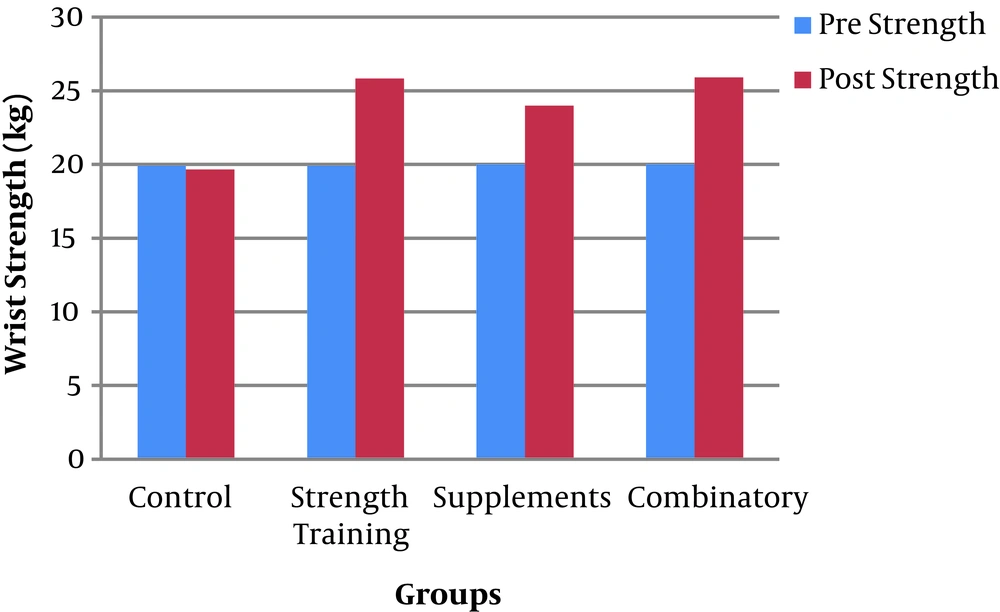
Figure 1.
Mean of wrist muscles strength (kg) in pretest and posttest in the four study groups
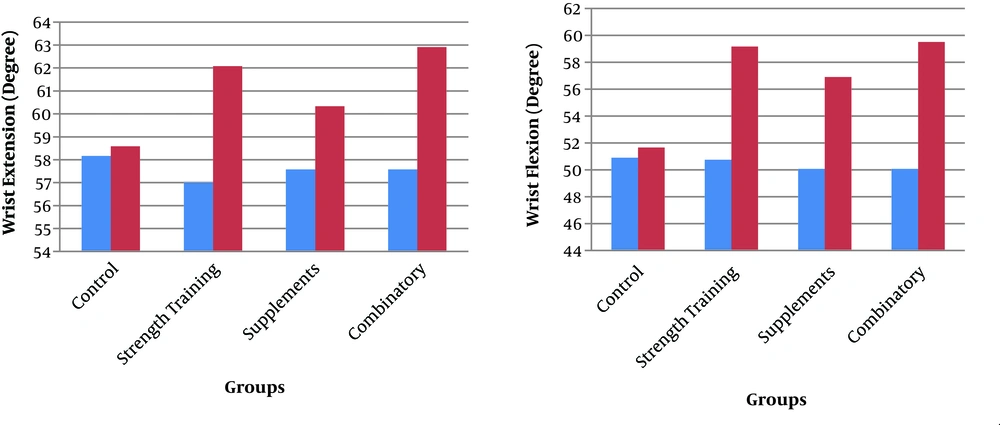
Figure 2.
Mean of wrist flexion and extension (degree) in pretest and posttest in the four study groups
Analysis of variance (ANOVA) was conducted to evaluate differences between groups. The results showed that there was no significant difference between the groups (strength training, cinnamon-honey supplement, combinatory and control) in the pre-test.
But the comparison between the four groups in the post-test showed that there was a significant difference between the four groups. Tukey post hoc test at 0.05 showed that there was no significant difference between post-test and strength training but there was a significant difference between strength training and supplement and control groups. There was a significant difference between the supplement and combinatory groups as well as between the control and supplement groups. There was also a significant difference between the combinatory and control groups. Therefore, all groups had a significant increase in wrist muscle strength, wrist range of motion (Flexion and Extension) compared with the control group (Table 2).
Table 2.Tukey Post Hoc Test Table to Examine the Differences Between Groups in Wrist Strength, Wrist Flexion and Extension Variables
| Variable | Group | Group | Mean Differences | Sig |
|---|---|---|---|---|
| Wrist strength (kg) | Strength training | Cinnamon-honey supplement | 1.83a | 0.045 |
| Combinatory | 0.08 | 0.231 | ||
| Control | 6.17a | 0.0001 | ||
| Cinnamon-honey supplement | Combinatory | -1.91a | 0.048 | |
| Control | 4.34a | 0.0001 | ||
| Combinatory | Control | 6.25a | 0.0001 | |
| Wrist flexion (degree) | Strength training | Cinnamon-honey supplement | 2.25a | 0.001 |
| Combinatory | -0.34 | 0.946 | ||
| Control | 7.5a | 0.0001 | ||
| Cinnamon-honey supplement | Combinatory | -2.59a | 0.001 | |
| Control | 5.25a | 0.0001 | ||
| Combinatory | Control | 7.84a | 0.0001 | |
| Wrist extension (degree) | Strength training | Cinnamon-honey supplement | 1.75a | 0.001 |
| Combinatory | -0.83 | 0.175 | ||
| Control | 3.5a | 0.0001 | ||
| Cinnamon-honey supplement | Combinatory | -2.58a | 0.001 | |
| Control | 1.75a | 0.001 | ||
| Combinatory | Control | 4.33a | 0.0001 |
a Significance level at the difference between the means is 0.05.
5. Discussion
The effect of 8 weeks of hand strength training, cinnamon-honey supplementation and combinatory on hand muscle strength, wrist range of motion in patients with osteoarthritis showed that there was significant differences between pre-test and post-test in strength training, cinnamon-honey supplementation and combinatory groups. Both training and supplements were able to make a significant improvement in the variability of hand muscle strength.
Comparison between the four groups indicated that there was no significant difference between the strength and combinatory groups in the post-test phase but there was significant difference between strength training group and supplement and control groups.
There are differences in physical abilities and lifestyles from adolescence to old age, and decreased mobility and aging can lead to muscle atrophy and lethargy (21). The researchers said that as the age increases, the risk of osteoarthritis in the elderly increases. Researchers believe that with age, biological functions decrease, elderly muscles with osteoarthritis become weaker and joint range of motion decreases. As a result, the feeling of pain in the elderly is increased and it reduces their mobility. In fact, these changes limit the function of the elderly and increase the risk of osteoarthritis. The results of research by Felson et al. stated that increasing age can decrease and possibly decrease many of the daily activities and activities and increase the risk of osteoarthritis in the elderly (21, 22).
Some researchers concluded that older women with osteoarthritis were more likely than older men. The lower incidence of osteoarthritis among elderly men can be attributed to the continuation of family-related activities. Also, the limited physical activity of women outside the home and the traditional beliefs that are often prevalent in some countries, and women perceive women as childcare, can make the difference in the number Women and men with knee osteoarthritis develop (22, 23).
Past research has shown that inactivity can be a risk factor for accelerating one’s osteoarthritis. For this reason, researchers have reported that the goal of treatment is to treat osteoarthritis, reduce pain, improve function, and maintain joint mobility.
Osteoarthritis may interfere with optimal performance in daily activities and exercise, and improve performance and pain in the elderly with this disorder, providing opportunities for increased activity and potential to prevent future illnesses. But the intensity of exercise should be kept to a minimum for each individual at first, and a long-term workout plan should be designed. In addition, the rehabilitation program for older people with osteoarthritis should be tailored to psychological and physiological changes (24).
A review of selected articles regarding exercises performed in people with osteoarthritis showed that muscle strengthening exercises could have a positive effect on individuals’ strength and function. Muscle weakness is a common feature of osteoarthritis and has been found to be strongly associated with limitations in daily activities (4, 25). Similarly, muscle strengthening exercises have been considered as one of the most important components of exercise therapy in patients with knee, hip and wrist osteoarthritis, and researchers have shown that they reduce pain and limit activity in patients with osteoarthritis (26-28). For best results, a resistance training program should include activities that are fully similar to the patient’s daily activities (29).
Restriction in the range of motion of the joint is one of the consequences of osteoarthritis, which can be caused by arthritis and shortening of the soft tissue of the joints. Restriction on the range of motion of the joint results in the restriction of daily activities (30). The efficacy of stretching exercises in improving the range of motion of patients with osteoarthritis has been less studied. Manual treatments are especially useful for improving the elasticity of the joint capsule and surrounding muscles. Training also increased the range of motion of the joint.
The results of the study on improving hand range of motion, hand grip, and hand function after applying a period of training were in line with the findings of Rogers and Wilder (31). They showed that a period of hand training improves strength in patients. In another study examining a course of general exercises and hand exercises, the findings showed that hand strength was improved (31). In a study by Lefler and Armstrong showed that a period of exercises to increase range of motion, ultimately leading to improvement in range of motion, increased finger grip (32). Boustedt et al. also showed that hand training led to improved pain and hand function and would be more effective if the exercises were combined with splinting (33). According to the results of this study and other studies, it seems that regular hand exercises under the supervision of the therapist can improve the range of motion of the hands and patients.


