
1. Background
War causes various physical injuries and psychological disorders in the war wounded that may last long after the traumatic event has ended (1, 2). Posttraumatic Stress Disorder (PTSD) is one of the most significant difficult issues for disabled veterans. The clinical course of PTSD is not clear, but the symptoms may persist even after months and years after the traumatic event (3). In the diagnostic and statistical manual of mental disorders fifth edition, PTSD has been defined as psychiatric severe reactions to upsetting traumatic events. To be diagnosed with PTSD, these reactions must last at least one month after the terrifying event and be associated with three main symptoms of “re-experiencing symptoms, avoidance symptoms, and arousal and reactivity symptoms (1, 2). Besides, it seems the interest or participation in executive activities decreases due to the mental and physical consequences of war (4). The term “executive functions” refers to a set of interrelated skills such as visual planning, goal-directed behavior adjustment, sustained attention, and flexibility to switch between two different tasks or strategies according to the objective value of choices. Executive functions are among the factors that may be affected by combat PTSD. Four cognitive processes of planning, attention, simultaneous, and successive processes have been discussed in Executive Functions theories (5).
Psychiatric disorders like PTSD have various negative impacts on cognitive functioning (6, 7). Executive functions have an important role in the quality of life of combat veterans, and due to the significance of these functions and their vulnerability to mental and physical disorders such as PTDS, the investigation of the effective treatments on executive functions of surviving combat veterans can provide insight to reduce their difficulties and challenges in the cognitive domain. It can be a step forward for planning to treat their cognitive problems, as well. Direct transcranial electrical current stimulation (TDCS) and cognitive rehabilitation (CR) are among the methods that can play a role in increasing executive functions. TDCS is a painless brain stimulation treatment that uses direct electrical currents to stimulate specific parts of the cortex (8). Research findings have indicated the significant effect of this approach on different cognitive and psychological constructs such as treatment of neurological disorders (9), promotion of planning function (10), mood and cognitive capabilities improvement (11), cognitive functioning enhancement (12), increasing phonemic and semantic fluency (13), major depression and treatment-resistant depression (8, 14), forward and backward digit span (15), working memory (16, 17), improving Improved picture naming in aphasia patients (18), improving working memory performance in children with the mathematical disorder (19). According to these evidences TDCS influences executive functions.
Cognitive rehabilitation is one of the other recent treatment approaches to cognitive impairments. In fact, cognitive rehabilitation is a kind of learning experience that results in restoring impaired brain functions and improving the fulfillment of life. The main objective of this treatment approach is the improvement of cognitive function impairments in patients including impaired memory, poor executive function, decreased concentration, impaired social perception, and attention. Rehabilitation is a unique type of treatment since it is based solely and primarily on cognitive abilities (20). On the other hand, executive functions require extensive functional and structural connections between different regions across the brain lobes. Recent studies have indicated that there are some pieces of evidence of the existence of these ruptures in the medial temporal lobes (21). While cognitive rehabilitation can lead to the elimination of these disconnections, the results of previous researches have illustrated the effectiveness of cognitive rehabilitation course in the enhancement of conceptualization, mental flexibility, initiation, designability, and the auditory memory of obsessive-compulsive patients (20), maintaining attention and academic achievement (22), improving diagnosis of distinguishing of emotional states (23), attention executive function (24). Despite these investigations, to the best of the authors' knowledge, there is no previously published work presenting the effect of CR on PTSD of combat veterans. Despite the studies confirming the effectiveness of TDCS in different psychological structures and cognitive abilities (8-14, 19), no research has investigated the effect of TDCS on executive functions.
2. Objectives
While therapeutic identification has been the most effective element in the treatment of executive functions of combat veterans with PTSD. Thus, the current research aims to investigate the effectiveness of CR and TDCS on the executive functions of combat veterans.
3. Methods
This study was quasi-experimental method research with a pretest, posttest, follow-up design which included two control groups and two experimental groups (placebo/sham, control, and treatment groups). This study was conducted in 1398, and it has been approved by Iran National Committee for Ethics in Biomedical Research, ethics code number IR.PNU.REC.1397.014. An ample number of combat veterans, introduced by the Foundation of Martyrs and Veterans, were selected based on the results of a primary interview to investigate the control parameters of physical and psychiatric disorders. The PTSD questionnaire was applied, and according to the responses, in a convenience sampling method, a number of 60 veterans with PTSD were identified as participants of the study. Patients were randomly assigned into four groups: (two experimental groups, one placebo/sham, and one control group). Then CR and TDCS were applied for the treatment of the participants of two experimental groups. It needs to be mentioned that neurostimulation devices were positioned for members of the sham/ placebo group, they didn’t receive real stimulation. After the treatment sessions, for the posttest stage, the research questionnaires were applied again, and then the obtained data were analyzed.
A single-blind experimental design was used; the participants did not know the group (treatment or control) that they have been assigned to.
Cognitive rehabilitation was performed for the second experimental group in10 sessions including Attention Bias Remediation (ABR) three 30-45-min session per week (one-day rest interval between sessions); TDCS was performed for another experimental group three 20 min session per week as well by applying a positive (anodal) and negative (cathodal) current via electrodes. It included an E.M.S. BrainSTIM© stimulator in which a fixed current 2mA was applied and two 5 × 7 cm sponge electrodes soaked in a saline solution (0.9% NaCl). Scalp anodal electrodes were positioned on the frontal right hemisphere, on the F4 area of the 1020 system, and Cathodal electrodes were placed on the frontal left hemisphere, on the F3 area of the 1020 system. For sham stimulation, the electrodes were placed at the same positions as an active stimulation; however, the stimulator was turned off after the 30 s of stimulation, and they didn’t receive real stimulation.
3.1. Inclusion Criteria
40 to 70 years old male combat veterans, with no substance abuse, no participation in other counselling programs, and completing the informed consent form in presence of the agent of the Foundation of Martyrs and Veterans Affairs.
3.2. Exclusion Criteria
Missing the treatment sessions, having other psychiatric or physical disorders that may affect the results of this research, alcohol addiction, and substance abuse.
3.3. Ethical Issues
All participants took part in the research voluntarily, with informed consent and the right to withdraw from the research. The principle of confidentiality was applied by substituting codes for participants identifiers.
Data was collected using a clinician-administered post-traumatic stress disorders scale for DSM-5 (CAPS-5). The CAPS was originally designed by the National Center for PTSD to assess PTSD. The scale has 17 items that 5 refer to re-experiencing symptoms, 7 to avoidance and numbing, and 5 to alterations in arousal and reactivity. There are three versions of the CAPS, but the post-traumatic stress disorder checklist military edition (PCL-M) is currently the gold-standard assessment for lifetime PTSD. The reliability and validity of this checklist have been evaluated in Shiraz University, Iran. It was applied to 117 participants; the analyzed data showed an excellent internal consistency, Cronbach alpha coefficient value (0.93). The reliability coefficient using the split-half method (odd-even reliability) of the checklist was reported as 0.87. In order to represent an index of the validity of the scale, it was correlated with Life Event Checklist and was reported as 0.37 that shows the concurrent validity of the scale (25).
In order to investigate executive functions, Barkley Deficits in Executive Functioning Scale for adults (BDEF) was applied. It contains 89 questions in five sub-skills and is designed by Barekly (2012). For evaluating the convergent validity, Barkley (2012) used attention deficit hyperactivity disorder for adults (ADHD) that includes three sub-scale and 18 items. The scale has acceptable reliability and validity.
BDEF is divided into 5 sub-scale of self-management of time (21 items), self-organization and problem-solving (24 items), self-discipline (inhibition—19 items), self-motivation (12 items), and emotional self-regulation (13 items). The test-retest reliability coefficient for the whole scale was 0.84.
The five subscales yielded test-retest reliabilities of 0.83, 0.90, 0.78, 0.63, and 0.78 for self-management of time, self-organization and problem-solving, self-discipline, self-motivation, and emotional self-regulation respectively. The test-retest reliability correlation coefficient for executive functions was reported as 0.76 (20).
In order to analyze the data, based on the post-test scores and controlling the effect of pre-tests, the multivariable analyze of covariance (MANCOVA) was used. The results of MANCOVA on the control and treatment groups’ scores show that regarding the tests of Pillai’s trace, Wilks’ lambda, Hotelling’s trace, and Roy’s largest root, there is a significant difference, and one-way ANOVA was applied for each dependent variable. To find the between-groups differences, Least Significant Difference (LSD) Post-Hoc was performed.
4. Results
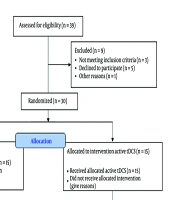
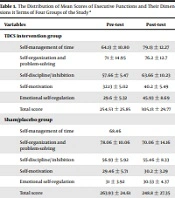
A number of 60 participants took part in the current research, they were randomly assigned to four groups; 15 per group,15 participants in the TDCS treatment group, 15 participants in the Cognitive Rehabilitation treatment group, 15 participants in sham/placebo group, and control group respectively. The average age of the participants was 48.6 with a standard deviation of 6.4. The youngest and oldest participants were 47 and 64 years old respectively. The distributions of the mean scores for executive functions and their dimensions in pre-test and post-test stages in terms of four experimental groups are presented in Table 1.
Table 1.
The Distribution of Mean Scores of Executive Functions and Their Dimensions it Terms of Four Groups of the Study a
| Variables | Pre-test | Post-test |
|---|---|---|
| TDCS intervention group | ||
| Self-management of time | 64.13 ± 10.80 | 79.13 ± 12.27 |
| Self-organization and problem-solving | 71 ± 14.95 | 76.2 ± 12.7 |
| Self-discipline/inhibition | 57.66 ± 5.47 | 63.66 ± 10.23 |
| Self-motivation | 32.13 ± 5.02 | 40.2 ± 5.49 |
| Emotional self-regulation | 29.6 ± 5.32 | 45.93 ± 8.69 |
| Total score | 254.53 ± 25.85 | 305.13 ± 29.77 |
| Sham/placebo group | ||
| Self-management of time | 68.46 | |
| Self-organization and problem-solving | 78.06 ± 10.06 | 70.06 ± 14.16 |
| Self-discipline/inhibition | 56.93 ± 5.92 | 55.46 ± 8.33 |
| Self-motivation | 29.46 ± 5.71 | 30.2 ± 3.29 |
| Emotional self-regulation | 31 ± 3.92 | 30.53 ± 4.37 |
| Total score | 263.93 ± 24.61 | 248.8 ± 27.35 |
| Cognitive rehabilitation intervention group | ||
| Self-management of time | 68.8 ± 10.33 | 70.66 ± 15.76 |
| Self-organization and problem-solving | 64.34 ± 10.33 | 70.66 ± 15.76 |
| Self-discipline/inhibition | 42.06 ± 6.41 | 62.26 ± 7.58 |
| Self-motivation | 25.4 ± 4.2 | 30.73 ± 5.27 |
| Emotional self-regulation | 31.20 ± 5.22 | 35.93 ± 5.54 |
| Total score | 221.8 ± 12.48 | 278.33 ± 19.5 |
| Control group | ||
| Self-management of time | 68.13 ± 10.14 | 68.06 ± 12.16 |
| Self-organization and problem-solving | 74.33 ± 15.12 | 72.86 ± 16.3 |
| Self-discipline/inhibition | 51.13 ± 5.62 | 52.26 ± 6.47 |
| Self-motivation | 27.4 ± 3.99 | 25.93 ± 3.3 |
| Emotional self-regulation | 35.2 ± 6.41 | 32.06 ± 7.44 |
| Total score | 256.2 ± 26.4 | 251.46 ± 25.36 |
a Values are expressed as mean ± SD.
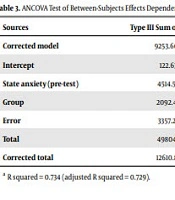
In order to compare the means of the post-test scores and controlling the effect of pre-tests for first group (TDCS) and control group, the Multivariate analysis of covariance (MANCOVA) was performed. Tables 2 and 3 show the results of the analysis.
Table 2.
The Results of MANCOVA for Comparing the Post-test Mean Scores of Executive Functions in TDCS Group and Control Group
| Tests | Values | F | Hypothesis df | Error df | P-Value a | Partial Eta Squares |
|---|---|---|---|---|---|---|
| Pilla’s trace | 0.783 | 13.7 | 6 | 23 | **0.0001 | 0.783 |
| Willk’s lambda | 0.217 | 13.7 | 6 | 23 | **0.0001 | 0.783 |
| Hotelling’s trace | 3.6 | 13.7 | 6 | 23 | **0.0001 | 0.783 |
| Roy’s largest root | 3.6 | 13.7 | 6 | 23 | **0.0001 | 0.783 |
a ** P < 0.01 & * P < 0.05. Significant level from MANCOVA with pre-test control compatible with intervention effectiveness.
In order to find the difference of treatments ‘effect, the results of post-test within subjects are indicated in Table 3.
Table 3.
The Results of MANCOVA for Comparing the Post-test Mean Scores of Research Variable in TDCS Group and Control Group a
| Sources | Sum of Squares | Degrees of Freedom | Mean of Squares | F | Significance Level | Partial Eta Squares |
|---|---|---|---|---|---|---|
| Self-management of time | ||||||
| Pre test | 87.47 | 1 | 87.47 | 0.432 | 0.571 | 0.016 |
| Group | 50.7 | 1 | 50.7 | 0.256 | 0.617 | 0.009 |
| Error | 5554.26 | 28 | 198.36 | |||
| Self-organization and problem-solving | ||||||
| Pre test | 2.7 | 1 | 2.7 | 0.015 | 0.905 | 0.0001 |
| Group | 208.03 | 1 | 208.03 | 1.17 | 0.288 | 0.04 |
| Error | 4975.46 | 28 | 177.69 | |||
| Self-discipline/inhibition | ||||||
| Pre test | 79.69 | 1 | 79.69 | 1.66 | 0.211 | 0.057 |
| Group | 750 | 1 | 750 | 15.08 | **0.001 | 0.35 |
| Error | 1391.86 | 28 | 49.71 | 0.845 | 0.366 | |
| Self-motivation | ||||||
| Pre test | 16.43 | 1 | 16.43 | 8.92 | **0.006 | 0.03 |
| Group | 172.8 | 1 | 172.8 | 0.26 | ||
| Error | 541.86 | 28 | 19.35 | 2.65 | 0.115 | |
| Emotional self-regulation | ||||||
| Pre test | 118.07 | 1 | 118.07 | 2.59 | 0.118 | 0.006 |
| Group | 112.13 | 1 | 112.13 | 0.085 | ||
| Error | 1207.86 | 28 | 43.13 | |||
| Total score | ||||||
| Pre test | 47.13 | 1 | 47.13 | 0.089 | 0.76 | 0.003 |
| Group | 5413.63 | 1 | 5413.63 | 10.75 | **0.003 | 0.27 |
| Error | 14333.06 | 28 | 511.89 | |||
| Total | ||||||
| Self-management of time | 14333.03 | 30 | ||||
| Self-organization and problem-solving | 19957 | 30 | ||||
| Self-discipline/inhibition | 176191 | 30 | ||||
| Self-motivation | 100526 | 30 | ||||
| Emotional self-regulation | 24798 | 30 | ||||
| Total score | 2124907 |
a ** P < 0.01 & *P < 0.05. Significant level from MANCOVA with pre-test control compatible with intervention effectiveness.
As indicated in Table 3, there is a significant relationship between mean scores of self-management of time, self-motivation, emotional self-regulation, and total scores of executive functions after removing the pre-test effect (P < 0.01). since the post-test mean scores of TCDS group are significantly larger than the same constructs in sham/placebo group. On the other hand, in comparison with the sham/placebo group TDCS treatment resulted in significant changes for TDCS group.
In order to compare the post-test mean scores of research variables in two groups of Cognitive Rehabilitation
Intervention and control group MANOVA was used. The results of analysis are indicated in Tables 4 and 5.
Table 4.
The Results of MANCOVA for Comparing the Post-test Mean Scores of Executive Functions in Cognitive Rehibition Group and Control Group
| Tests | Values | F | Hypothesis df | Error df | P-Value a | Partial Eta Squares |
|---|---|---|---|---|---|---|
| Pilla’s trace | 0.595 | 5.62 | 6 | 23 | **0.0001 | 0.595 |
| Willk’s lambda | 0.405 | 5.62 | 6 | 23 | **0.0001 | 0.595 |
| Hotelling’s trace | 1.467 | 5.62 | 6 | 23 | **0.0001 | 0.595 |
| Roy’s largest root | 1.467 | 5.62 | 6 | 23 | **0.0001 | 0.595 |
a ** P < 0.01 & *P < 0.05. Significant level from MANCOVA with pre-test control compatible with intervention effectiveness.
Table 5 indicates the effects of different treatments within participants.
Table 5.
The Results of MANCOVA for Comparing the Post-test Mean Scores of Research Variable in Cognitive Rehibition Group and Control Group a
| Sources | Sum of Squares | Degrees of Freedom | Mean of Squares | F | Significance Level | Partial Eta Squares |
|---|---|---|---|---|---|---|
| Self-management of time | ||||||
| Pre test | 87.47 | 1 | 87.47 | 0.432 | 0.571 | 0.016 |
| Group | 50.7 | 1 | 50.7 | 0.256 | 0.617 | 0.009 |
| Error | 5554.46 | 28 | 198.36 | |||
| Self-organization and problem-solving | ||||||
| Pre test | 2.7 | 1 | 2.7 | 0.015 | 0.905 | 0.0001 |
| Group | 208.03 | 1 | 208.03 | 1.17 | 0.288 | 0.04 |
| Error | 4975.46 | 28 | 177.69 | |||
| Self-discipline/inhibition | ||||||
| Pre test | 79.69 | 1 | 79.69 | 1.64 | 0.211 | 0.057 |
| Group | 750 | 1 | 750 | 15.08 | **0.001 | 0.35 |
| Error | 1391.86 | 28 | 49.71 | |||
| Self-motivation | ||||||
| Pre test | 16.43 | 1 | 16.43 | 0.845 | 0.366 | 0.03 |
| Group | 172.8 | 1 | 172.8 | 8.92 | **0.006 | 0.26 |
| Error | 541.86 | 28 | 19.35 | |||
| Emotional self-regulation | ||||||
| Pre test | 118.07 | 1 | 118.07 | 2.65 | 0.115 | 0.006 |
| Group | 112.13 | 1 | 112.13 | 2.59 | 0.118 | 0.085 |
| Error | 1207.86 | 28 | 43.13 | |||
| Total score | ||||||
| Pre test | 47.13 | 1 | 47.13 | 0.089 | 0.76 | 0.003 |
| Group | 5413.63 | 1 | 5413.63 | 10.75 | **0.003 | 0.27 |
| Error | 14333.06 | 28 | 511.89 | |||
| Total score of execute functions | ||||||
| Self-management of time | 14333.03 | 30 | ||||
| Self-organization and problem-solving | 1419957 | 30 | ||||
| Self-discipline/inhibition | 176191 | 30 | ||||
| Self-motivation | 100526 | 30 | ||||
| Emotional self-regulation | 24798 | 30 | ||||
| Total score | 2124907 |
a ** P < 0.01 & *P < 0.05. Significant level from MANCOVA with pre-test control compatible with intervention effectiveness.
According to the indicated results in Table 5 there is a meaningful relationship between post-test mean scores of self-disciplines, self-motivation, and total score of executive functions in cognitive rehibition group and control group (P < 0.05 and P < 0.01). the post-test mean scores of these variables in rehibition group are more than control group post-test mean scores.
Table 6.
The Results LSD Post-hoc Regarding the Unplanned Comparison of Mean Scores of Executive Functions in Four Groups a
| Dependent Variable | Groups (i) | Groups (j) | Mean Difference | Standard Error | Significance |
|---|---|---|---|---|---|
| Self-management of time | TDCS | Cognitive rehabilitation group | 11.8 | 4.47 | *0.019 |
| TDCS | Sham/placebo group | 15.34 | 5.28 | **0.005 | |
| Cognitive Rehabilitation | Control group | 3.12 | 6.56 | 0.636 | |
| Self-organization and problem-solving total score of executive functions | TDCS | Cognitive rehabilitation group | 3.55 | 7.19 | 0.624 |
| TDCS | Sham/placebo group | 7.16 | 5.47 | 0,195 | |
| Cognitive Rehabilitation | Control group | 2.76 | 6.77 | 0.689 | |
| Self-discipline/inhibition | TDCS | Cognitive rehabilitation group | 1.38 | 4.46 | 0.758 |
| TDCS | Sham/placebo group | 7.48 | 3.38 | *0.031 | |
| Cognitive Rehabilitation | Control group | 8.76 | 4.19 | *0.042 | |
| Self-motivation | TDCS | Cognitive rehabilitation group | 10.39 | 2.34 | **0.0001 |
| TDCS | Sham/placebo group | 10.17 | 1.77 | **0.0001 | |
| Cognitive rehabilitation | Control group | 4.51 | 2.2 | *0.046 | |
| Emotional self-regulation | TDCS | Cognitive rehabilitation group | 6.29 | 3.58 | 0.085 |
| TDCS | Sham/placebo group | 15.8 | 2.71 | **0.0001 | |
| Cognitive rehabilitation | Control group | 7.03 | 3.37 | *0.042 | |
| Total score of executive functions | TDCS | Cognitive rehabilitation group | 28.21 | 13.69 | *0.045 |
| TDCS | Sham/placebo group | 58.21 | 10.37 | **0.0001 | |
| Cognitive rehabilitation | Control group | 26.8 | 12.89 | *0.043 |
a ** P < 0.01 & *P < 0.05. Significant level from MANCOVA with pre-test control compatible with intervention effectiveness.
According to the indicated results in tale 6 both CR and TDCS have a significant effect on promoting executive functions (P < 0.01), the results of LSD post-hoc showed that there was a statistically significant difference between self-discipline, self-motivation, and total score of executive functions in TDCS and CR groups (P < 0.05 and P < 0.01). So, in comparison with CR, TDCS is more effective in increasing self-discipline and self-motivation, and total score of executive functions. Therefore, our hypothesis that states “there is a significant difference in effectiveness of TCDS and CR in executive functions of combat veterans”, is accepted concerning self-discipline and self-motivation, and total score of executive functions.in other words, TSCD has more effect on mentioned structures.
5. Discussion
The current research was conducted aiming the comparison the effectiveness of cognitive rehibition and TDCS treatments on executive functions of 60 surviving combat veterans with PTSD, they were randomly assigned to four groups (PTSD, cognitive rehibition, control and sham). The study indicated the effectiveness of both treatments, but as the results of post hoc LSD indicates, the difference between self- discipline and self-motivation, and overall, whole executive functions in TDCS and CR has been significant.
Accordingly, the effectiveness of TDCS in promoting self-discipline, self-motivation, and total score of the whole executive functions in comparison with the effect of CR on the same constructs has been approved to be more. Thus the hypothesis stating “there is a significant difference between effectiveness of TCDS and CR in executive functions of combat veterans.” was approved regarding self-discipline, self-motivation, and total score of whole executive functions. In other words, the effectiveness of TCDS is more salient in comparison with the effectiveness of CR on the mentioned constructs.
The findings of current research are in line with the findings of other studies in this area that have introduced TCDS and CR as effective approaches in different psychological potentials (9, 12). Studies have indicated that TCDS leads to improved performance in terms of cognitive activities course.
These results show that using cognitive techniques may enhance the effectiveness of TDCS. Therefore, the findings represent the effectiveness of both approaches on similar constructs (15).
In fact TDCS has a higher potential in promoting executive indices, and the reason may refer to the more significant effect of TDCS in comparison to other treatments of explicit motor learning, working memory, episodic memory, and Naming of Semantically-related Items (26, 27).
On the other hand, regarding the characteristics of the participants, the research sample consisted of 60 combat veterans with at least 25% disability. Although the finding of the studies in this area has indicated the primary therapy options of TCDS are concentrated on cognitive neuroscience illnesses. As a matter of fact, this approach has more improved performance on the people who suffer from specific physical and mental problems. While rehabilitation can be influential in promoting well-being in different areas, but it seems that due to the conditions of its application and the nature of the treatment, CR is less influential in the case of people with physical and psychological difficulties, and TCDS is more effective. The researchers have found that in comparison to sham and cathodic stimulation, anodic stimulation TCDS applied on the left temporal lobe causes tinnitus. Also, hand movement improved in patients with traumatic brain injury (chronic head trauma) after TDCS, and the Prefrontal cortex activation enhanced as well. Besides they investigate the effect of TCDS in the M1 area in Central neuropathic pain of spinal cord injury (SCI) patients during 16 days, and a remarkable improvement was observed. The above-mentioned results were obtained for individuals with major depressive disorder and as an element to future experiments and clinical applications of TDCS in depression and other affective temperaments and mood disorders (28). TDCS has been applied to reduce the pathological trauma of other disorders and has led to a decrease in stress and depression symptoms (8, 10, 13, 19). Briefly, although the role of TCDS as an intervention to neurostimulation is not completely known, but its role on the effectiveness of cortical arousal, accompanying with the possibility of modification and specification of its effect through combination with TMS and medical interventions have approved this approach as a non-invasive instrument for clinical studies and future efficient researches.
5.1. Conclusions
according to the significance of executive functions in the life quality of combat veterans and the fact that frontal lobe cognitive functions are among the most important mental functions, and they may be damaged due to physical and psychiatric disorders such as war injuries and PTSD, thus the findings of the current research can be applied as a new approach in decreasing problems, and promoting the executive functions of combat veterans.