
1. Background
Smoking cigarettes is one of the most significant health challenges worldwide. Tobacco use is a leading cause of preventable non-communicable diseases and deaths. In 2016, tobacco-related illnesses caused the deaths of more than seven million people globally, and it is predicted that smoking-related deaths will reach ten million in the next 25 years (1, 2). Tobacco and substance use are the primary contributors to the global disease burden, particularly chronic conditions such as cardiovascular and respiratory diseases, cancers, and stroke. They are among the most common preventable causes of death (3, 4).
Evidence shows that tobacco use has declined in many developed countries, yet 80% of the current 1.1 billion smokers reside in low- and middle-income countries (2). In contrast, some high-income countries, including the Kingdom of Saudi Arabia (KSA), have experienced a significant statistical increase in tobacco use between 1980 and 2012 (5, 6).
The association between addictive behaviors and other deviant traits has been well-documented. Additionally, tobacco and substance use are significantly linked to mental health disorders, running away from home, aggression and violence in social behaviors, theft, victimization, academic failure, suicide, and prostitution (7). However, when smoking and addiction occur among young people, they pose an even greater concern (8). Cigarettes account for 20% of preventable deaths in developed countries (9). In Iran, hookah smoking is the most prevalent form of tobacco addiction (10).
Smoking and substance use appear to be major challenges among students. According to the study by Haghdoost and Moosazadeh, the prevalence of smoking among university students in different regions of Iran is progressive and varies significantly. Additionally, female students at Iranian universities smoke considerably less than their male counterparts (3).
In a survey conducted by Nasser et al. on rural Yemeni students, the prevalence of tobacco use was found to be lower in rural areas. However, overall tobacco use exhibited an increasing trend (11). Almutairi in Saudi Arabia reported that individuals who were more religious had a 15% lower likelihood of smoking, while those more aware of the dangers of smoking were 8% less likely to smoke (12).
The results of a systematic review by Moosazadeh et al. in Iran indicated that a significant portion of the general population over the age of 15, including 20% of men, were cigarette smokers (13). Another systematic review (2019) showed that smoking and the use of other substances are on the rise in Iranian society (14).
In a study conducted by Khami et al. across seven different universities in Iran, 23% of students reported using cigarettes, with the smoking rate being significantly higher among males (15). Similarly, a study by Jafari et al. on students in Tehran, Iran, found the total prevalence of smoking to be 27.3%, with rates of 35.4% for men and 12.6% for women (16). Alotaibi et al. also reported that smoking is more prevalent among male students compared to female students (5).
Furthermore, it is believed that the actual statistics on smoking and substance use among medical sciences students may be influenced by cultural factors, such as the taboo nature of the topic and social stigma (17, 18).
Given the side effects of smoking and drug abuse among students, such as decreased academic performance, mental health issues, and physical problems (19), it is essential to implement practical programs to address this health challenge. The success of such programs relies on obtaining accurate information about the extent of the issue and its influencing factors.
2. Objectives
Considering that smoking and substance use are progressive and significant health challenges among medical science students—who serve as precursors to the health system—this study was designed to investigate the prevalence of cigarette and substance use among medical students and the factors associated with these behaviors. The primary aim of this study was to examine smoking and substance use among medical students in Kermanshah.
3. Methods
3.1. Population
This descriptive-analytical study was conducted from September to December 2018. The study population consisted of students enrolled at Kermanshah University of Medical Sciences during the first semester of the 2018 - 2019 academic year. Kermanshah University of Medical Sciences, located in western Iran, comprises seven faculties.
The sample size was calculated using Cochran's formula, considering a population of approximately 5,000 students, a Type I error rate of 0.05, and a power of 0.95. Based on this calculation, 357 students were selected through quota sampling. Inclusion criteria included providing consent to participate in the study, no history of psychiatric illnesses, and no use of psychotropic medications as declared by the participants. Questionnaires that were incomplete were excluded from the study.
3.2. Data Collection
Data were collected using a researcher-developed checklist. The checklist included information on age, gender, marital status, living location, education level, semester, cigarette smoking, age of smoking initiation, parental education level, number of family members, illegal substance use, type of addictive substance (e.g., Grass, Gol, Hashish, Opium, Methamphetamine, Cocaine, Tramadol, Ritalin), and family income.
After obtaining the necessary approvals, the researcher approached the Department of Education. Using stratified random sampling based on the schools, the first author visited the schools during class intervals. After explaining the study's objectives and obtaining consent, the students were asked to complete the form. Participants were given sufficient time to complete the questionnaire.
3.3. Ethical Consideration
This study was approved by the Ethical Research Committee with the code IR.KUMS.REC.1397.726. All participants provided informed consent, and assurances were given that their personal information would remain confidential and anonymous.
3.4. Data Analysis
Data were analyzed using SPSS-24 software. Descriptive statistics (frequency, percentage, mean, and standard deviation) and inferential statistics (chi-square test, Fisher's exact test, and Mann-Whitney U test) were employed. The significance level for the analytical tests was set at less than 0.05.
4. Results
In this study, 55.6% (199) of the participants were female, and 91.3% (327) were single. Most students were enrolled in the nursing and midwifery school (24.6%) and were in their second year of education (38.9%). Approximately 52.4% (187) of the students resided in student dormitories. The fathers of most students had an academic level of education (40.1%), while the majority of mothers had an education level below a diploma (35.3%) (Table 1).
Table 1.
Characteristics of the Studied Population
| Variables | No. (%) |
|---|---|
| Gender | |
| Male | 158 (44.3) |
| Female | 199 (55.7) |
| Marital status | |
| Single | 326 (91.3) |
| Married | 31 (8.7) |
| School | |
| Nursing and midwifery | 88 (24.6) |
| Hygiene | 48 (13.4) |
| Pharmacy | 22 (6.2) |
| Dental | 39 (10.9) |
| Nutrition | 24 (6.7) |
| Paramedical | 75 (21.0) |
| Medicine | 61 (117.1) |
| Educational year | |
| First | 99 (27.7) |
| Second | 139 (38.9) |
| Third | 79 (22.1) |
| Fourth | 27 (7.6) |
| Fifth and above | 13 (3.6) |
| Place of residence | |
| Personal home | 160 (44.8) |
| Dorm | 187 (52.4) |
| Student homes | 10 (2.8) |
| Father’s education | |
| Under diploma | 97 (27.2) |
| Diploma | 117 (32.8) |
| Academic | 143 (40.1) |
| Mother’s education | |
| Under diploma | 126 (35.3) |
| Diploma | 125 (35.0) |
| Academic | 107 (29.7) |
| Smoking | |
| Yes | 60 (16.8) |
| No | 297 (83.2) |
| Family history of smoking | |
| Friends | 67 (18.8) |
| First-degree family | 81 (22.7) |
| Second-degree family | 65 (18.2) |
| Not smoking | 144 (40.3) |
| Substance use | |
| Yes | 21 (5.9) |
| No | 336 (94.1) |
| Type of substance | |
| Grass (Gol) | 8 (42.1) |
| Hashish | 3 (15.8) |
| Opium | 1 (5.3) |
| Methamphetamine | 2 (10.5) |
| Cocaine | 1 (5.3) |
| Tramadol | 1 (5.3) |
| Ritalin | 3 (15.8) |
Based on the findings, 16.8% (60 students) were cigarette smokers, and 5.9% (21 students) were substance users, with Grass being the most commonly used drug (Table 1).
The mean age of the participants was 22.7 ± 3.11 years. The mean number of family members was 4.52 ± 1.37. Among smokers, the mean age of smoking initiation was 19.93 ± 3.28 years, and their average smoking duration was 3.79 ± 3.41 years, with a daily consumption of 6.56 cigarettes on average. Additionally, the mean monthly family income of all students was 4.17 ± 3.87 million Tomans (approximately 300$) (Table 2).
Table 2.
Mean and Standard Deviation of Quantitative Variables
| Variables | Mean ± SD | Minimum - Maximum |
|---|---|---|
| Age | 22.07 ± 3.11 | 18 - 44 |
| Family number | 4.52 ± 1.37 | 1 - 10 |
| Age of smoking | 19.93 ± 3.28 | 10 - 31 |
| Time of smoking | 3.79 ± 3.41 | 1 - 18 |
| Income of family (million tomans) | 4.17 ± 3.87 | 0.7 - 40 |
| Number of cigarettes a day | 6.56 ± 4.83 | 1 - 20 |
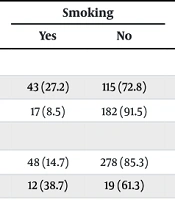
The cigarette smoking rate was significantly higher among males (P < 0.001), married students (P = 0.002), dental and medical students (P < 0.001), fourth-year students (P = 0.035), and those living in student homes (P < 0.001). Moreover, students who had smoker friends and those of higher age were more likely to smoke (P < 0.001) (Tables 3 and 4).
Table 3.
Relationship Between Smoking and Substance Use with Demographic Characteristics a
| Variables | Smoking | P-Value | Substance Use | P-Value | ||
|---|---|---|---|---|---|---|
| Yes | No | Yes | No | |||
| Gender | K2 = 21.96; P < 0.001 b | K2 = 4.54; P = 0.041 b | ||||
| Male | 43 (27.2) | 115 (72.8) | 14 (8.9) | 144 (91.1) | ||
| Female | 17 (8.5) | 182 (91.5) | 7 (3.9) | 192 (96.5) | ||
| Marital status | K2 = 11.64; P = 0.002 b | K2 = 11.13; P = 0.006 b | ||||
| Single | 48 (14.7) | 278 (85.3) | 15 (4.6) | 311 (95.4) | ||
| Married | 12 (38.7) | 19 (61.3) | 6 (19.4) | 25 (80.6) | ||
| School | K2 = 31.71; P < 0.001 b | Fisher’s exact test = 18.94; P = 0.001 b | ||||
| Nursing and midwifery | 7 (8.0) | 81 (92.0) | 1 (1.1) | 87 (98.9) | ||
| Hygiene | 4 (8.3) | 44 (91.7) | 0 (0.0) | 48 (100) | ||
| Pharmacy | 3 (13.6) | 19 (86.4) | 2 (9.1) | 20 (90.9) | ||
| Dental | 16 (41.0) | 23 (59.0) | 6 (15.4) | 33 (84.6) | ||
| Nutrition | 1 (4.2) | 23 (95.8) | 0 (0.0) | 24 (100) | ||
| Paramedical | 11 (14.7) | 64 (85.3) | 4 (5.3) | 71 (94.7) | ||
| Medicine | 18 (29.5) | 43 (70.5) | 8 (13.1) | 53 (86.9) | ||
| Educational year | K2 = 10.29; P = 0.035 b | Fisher’s exact test = 8.29; P = 0.057 | ||||
| First | 10 (10.1) | 89 (89.9) | 2 (2.0) | 97 (98.0) | ||
| Second | 24 (17.3) | 115 (82.7) | 11 (7.9) | 128 (92.1) | ||
| Third | 13 (16.5) | 66 (83.5) | 3 (3.8) | 76 (96.2) | ||
| Fourth | 9 (33.3) | 18 (66.7) | 3 (11.1) | 24 (88.9) | ||
| Fifth and above | 4 (30.8) | 9 (69.2) | 2 (15.4) | 11 (84.6) | ||
| Place of residence | K2 = 15.37; P < 0.001 b | K2 = 6.66; P = 0.035 b | ||||
| Personal home | 16 (10.0) | 144 (90.0) | 5 (3.1) | 155 (96.9) | ||
| Dorm | 39 (20.9) | 148 (79.1) | 14 (7.5) | 173 (92.5) | ||
| Student homes | 5 (50.0) | 5 (50.0) | 2 (20.0) | 8 (80.0) | ||
| Father’s education | K2 = 0.169; P = 0.935 | K2 = 3.48; P = 0.188 | ||||
| Under diploma | 16 (16.5) | 81 (83.5) | 7 (7.2) | 90 (92.8) | ||
| Diploma | 21 (17.9) | 96 (82.1) | 3 (2.6) | 114 (97.4) | ||
| Academic | 23 (16.1) | 120 (83.9) | 11 (7.7) | 132 (92.3) | ||
| Mother’s education | K2 = 0.802; P = 0.685 | K2 = 1.26; P = 0.608 | ||||
| Under diploma | 23 (18.9) | 103 (81.7) | 9 (7.1) | 117 (92.9) | ||
| Diploma | 18 (14.4) | 107 (85.6) | 5 (4.0) | 120 (96.0) | ||
| Academic | 19 (17.9) | 87 (82.1) | 7 (6.6) | 99 (93.4) | ||
| Family history of smoking | K2 = 47.05; P < 0.001 b | Fisher’s exact test = 17.12; P < 0.001 b | ||||
| Friends | 25 (37.3) | 42 (62.7) | 8 (11.9) | 59 (88.1) | ||
| First-degree family | 23 (28.4) | 58 (71.6) | 9 (11.1) | 72 (88.9) | ||
| Second-degree family | 6 (9.2) | 59 (90.8) | 3 (4.6) | 62 (95.4) | ||
| Not smoking | 6 (4.2) | 138 (95.8) | 1 (0.7) | 143 (99.3) | ||
a Values are expressed as No. (%).
b P < 0.05 was considered statistically significant.
Table 4.
The Relationship Between Smoking and Substance Use with Quantitative Variables
| Variables | Smoking | P-Value | Substance Use | P-Value | ||||||
|---|---|---|---|---|---|---|---|---|---|---|
| Yes | No | Yes | No | |||||||
| Mean ± SD | Mean Rank | Mean ± SD | Mean Rank | Mean ± SD | Mean Rank | Mean ± SD | Mean Rank | |||
| Age, y | 23.65 ± 3.59 | 232.23 | 21.75 ± 2.91 | 168.25 | Z = -4.43; P < 0.001 a | 24.19 ± 3.24 | 256.10 | 21.93 ± 3.06 | 174.18 | Z = -3.57; P < 0.001 a |
| Family number | 4.46 ± 1.57 | 176.57 | 4.54 ± 1.32 | 179.49 | Z = -0.202; P = 0.836 | 4.52 ± 1.74 | 179.48 | 4.52 ± 1.34 | 178.97 | Z = -0.023; P = 0.982 |
| Income of family (million tomans) | 4.96 ± 4.43 | 193.47 | 4. 01 ± 3.73 | 176.08 | Z = -1.207; P = 0.227 | 6.71 ± 6.16 | 230.83 | 4.01 ± 3.63 | 175.76 | Z = -2.40; P = 0.016 a |
a P < 0.05 was considered statistically significant.
5. Discussion
This study assessed the prevalence of smoking and substance use among students at Kermanshah University of Medical Sciences. The findings revealed that the prevalence of smoking was 16.8%. In the study by Gorjianzah et al. in Kerman, Iran, the prevalence of smoking among nursing students was 16.2% (20). Similarly, other research in Yemen reported a prevalence of 23.8% among students (21). Additionally, Mbatchou Ngahane et al. conducted a study in Cameroon, where the prevalence of smoking among students was 11.2% (22). Another multicenter study by Balogh et al. found a smoking rate of 19% among students (23).
The varying prevalence rates of smoking could be attributed to contextual factors, including differences in pre-university experiences. As Rafiee et al. reported, 14% of smokers began smoking during their pre-university years (24). Several reasons for smoking among medical students have been identified, such as life and academic pressures (25), stress reduction, social acceptance (3), and attitudes toward smoking (4).
Although medical students are generally aware of the harmful effects of smoking, they often attempt to quit with limited success (3, 25). While the rate of smoking among Iranian medical students is lower than that observed in European countries (approximately 29%) (26), it appears to be increasing, warranting significant attention and action.
In this study, 5.9% of students reported using at least one drug, with Grass being the most commonly used substance. This finding is consistent with the study by Dehghani et al., which also reported an incidence of 5.9% (27). However, Khosravi et al. found that 19% of students had used drugs at least once (28). While the results indicate a lower rate of substance use among students at Kermanshah University of Medical Sciences compared to these studies, the rate is higher than that reported in another survey from Tehran (29). Substance use is a high-risk behavior that can cause significant and lasting harm to the community.
In the present study, there was a significant relationship between gender and cigarette and substance use, with male students having higher rates of use. This finding aligns with the study by Nasser and Zhang, which concluded that smoking is more prevalent among male students (21). Similar results were observed by Gorjianzah et al., who reported higher substance use among male nursing students (20).
In contrast, studies from some European countries, such as Poland, have found that female medical students are more inclined to smoke (26). This discrepancy highlights the influence of cultural and contextual factors. In Iran, while smoking is not illegal, it is considered a taboo for women. Female smokers face significant social and judgmental pressures compared to men (30), which may explain the observed differences in smoking prevalence.
The results showed that married students were more susceptible to cigarette smoking and substance use. However, another study indicated that drug use is more common among single individuals (31). Additionally, Rachiotis et al. found that cigarette smoking is also more prevalent among single students (32). It appears that married students in Iran may experience financial pressures, while single students may face mental, emotional, and relationship-related needs (33), which could contribute to smoking and substance use and warrants further investigation.
Regarding the field of study, dental and medical students had higher smoking rates. This is consistent with the findings of Jalilian et al. in Iran (34). The higher rates of smoking and substance use among medical and dental students may be attributed to the heavy course loads, long class hours, and increased stress and fatigue (34, 35). Smoking and substance use also showed a direct relationship with age, with higher rates observed among senior students. These findings are in line with those of Nasser and Zhang (21) and Sanchez et al. (36).
According to the results of the present study, students living in student homes, followed by those in dormitories, had higher rates of cigarette smoking and substance use compared to those living in personal homes (with their families). Dehghani et al. also found that non-native students had higher rates of substance use and smoking (27). This may be explained by the increased emotional, economic, and social pressures faced by students living in student homes and dormitories, or even by the influence of friends (21). Similar findings have been reported for nursing students in Denmark (37). Living in a supportive family environment with supervision has a significant positive impact on preventing addiction. Conversely, being away from parents, living in a dormitory, and the influence of peers and their behaviors can make individuals more prone to substance abuse (27).
In this study, the role of friends was more significant than other factors in terms of the history of cigarette and substance use. Siyam also showed that the influence of friends on cigarette smoking was greater than that of other groups (31). Students may easily engage in smoking and drug use to fit in with their friends (21). Furthermore, students with higher family incomes were more likely to be drug users, which could be related to their ability to afford expensive narcotics.
Several limitations were encountered in this study. Due to the cross-sectional nature of the study, it was impossible to establish causal relationships between the study variables. Additionally, the self-reported data collection method may have affected the accuracy of the results.
5.1. Conclusions
Cigarette and substance use among students at Kermanshah University of Medical Sciences was at an average level compared to studies conducted in different parts of Iran and the world. In other words, while some studies reported similar levels, others indicated higher or lower rates. The variables of age, sex, marital status, college and field of study, school year, place of residence, history of cigarette smoking, and income all influenced the rates of cigarette smoking and substance use among students.
5.2. Recommendation
Given the significant dangers of cigarette and substance use for students, as well as the irreparable harm it causes to society, it is recommended that university officials, along with parents, increase supervision of students. Additionally, seminars, conferences, and programs should be organized to inform and warn students about the dangers of substance abuse and cigarette smoking. It is also recommended that future studies examine the impact of educational measures on students' attitudes and tendencies toward cigarette and substance use.