Fulltext
The full text of this article is available on PDF.
Journal of Clinical Research in Paramedical Sciences
The Official Journal of Paramedical School, KUMS
Image Credit:J Clin Res Paramed Sci
Authors
Introduction: There is a clear gender differences in the epidemiology, clinical presentation, physiology, responding to diagnostic tests, interventions, as well as the prevalence of non psychological risk factors. This study was conducted to the study of psychological risk factors in cardiac rehabilitation men and women.
Methods: This study is cross-sectional. The study population consisted of all cardiac rehabilitation (CR) patients, who were referred to a CR in the Imam Ali hospital in Kermanshah in 2013. Among the patients selected 212 peoples (106 women and 106 men), as matched. Data were collected through clinical interview, Beck anxiety and depression questionnaires, Hudson marital stress index, and Buss and Perry Anger Questionnaire. The SPSS version 18 was used to analyze the data using methods of MANOVA, Chi-square test and T test.
Results: The mean age was 56.25 ± 9.1 years for women and 57.15 ± 9.1 years for men. The results showed that anxiety and depression is significantly higher in women than men (p<0.01). Conversely, men compared with their female counterparts have higher marital stress and anger (p<0.01).
Conclusion: Psychological risk factors and pathology of the cardiovascular diseases (CVDs) is different in women and men and needs to specific diagnose and treatment strategies to females. Psychological risk factors for cardiac disease appear differently in men and women. Thus, each of these two groups need their own diagnosis and treatment strategies.
© 2016, Journal of Clinical Research in Paramedical Sciences. This open-access article is available under the Creative Commons Attribution-NonCommercial 4.0 (CC BY-NC 4.0) International License (https://creativecommons.org/licenses/by-nc/4.0/), which allows for the copying and redistribution of the material only for noncommercial purposes, provided that the original work is properly cited.
Saeidi M, Soroush A, Komasi S, Moemeni K, Heydarpour B. Attitudes Toward Cardiovascular Disease Risk Factors Among Patients Referred to a Cardiac Rehabilitation Center: Importance of Psychological Attitudes. Shiraz E-Med J. 2015;16(7):e22281. doi: https://doi.org/10.17795/semj22281
Komasi S, Saeidi M. Aging is an Important Cause for a Lack of Understanding of the Main Risk Factor in Cardiac Rehabilitation Patients. Thrita J Neu. 2015;4(4):e32751. doi: https://doi.org/10.5812/thrita.32751
Komasi S, Saeidi M. A Perceived Risk Factor May Lead to Increased Anxiety and Depression in Cardiovascular Patients. Jundishapur J Chronic Dis Care. 2016;5(4):e34159. doi: https://doi.org/10.17795/jjcdc-34159
Shakeri J, Jaberghaderi N, Rezaei M, Saeedi M, Naleini M, et al. Psychosocial risk factors in patients with cardio-vascular diseases in Kermanshah (2006). J Kermanshah Univ Med Sci. 2012;16(3):e78801. doi:
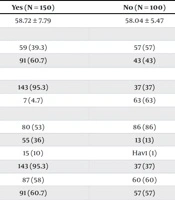
Salari A, Ebadollahian A, Parvaneh S, Fakhrmousavi A, Hasandokht T. Demographic and Social Factors Affecting Participation in Cardiac Rehabilitation: A Cross-Sectional Study. Int J Cardiovasc Pract. 2025;10(1):e158989. doi: https://doi.org/10.5812/intjcardiovascpract-158989
Last Update: 6 days ago
Last Update: 6 days ago
Last Update: 6 days ago
Last Update: 8 hours ago
Last Update: 11 hours ago
Last Update: 5 days ago