
1. Background
Today, knowledge is a vital resource for creating a competitive advantage, and the primary function of organizations is to utilize it (1). In addition, knowledge combines experience, values, information, and expert insights, providing a framework for evaluating and integrating new experiences and information (2). Further, knowledge is categorized into two essential types: Explicit and tacit. Explicit knowledge can be easily transferred to others, while tacit knowledge resides within the minds and hearts of individuals, so transferring it is difficult (3). Polanyi emphasized the nature of tacit knowledge with his famous quote, "We know more than we can tell" (4). In this study, tacit knowledge is always embedded within explicit knowledge (5), and these two types of knowledge are two sides of the same coin, forming the sum of knowledge. Therefore, organizations need both types of knowledge to grow and compete in the knowledge era (6). An organization with a strong knowledge management system increases its chances of success by recognizing its importance. For this reason, documentation and knowledge transfer have interested researchers in recent years (7). In an organization, knowledge is preserved by its human resources, and valuable experiences can be transformed into new knowledge in the form of processed information to prevent the loss of knowledge from experienced and specialized individuals, ensuring that organizations do not suffer from organizational forgetfulness (8).
Research indicates that documentation of experiential knowledge usually emphasizes sharing and exchanging organizational tacit knowledge within workgroups through standardizing work processes. For example, Jamshidi and Heidari demonstrated that transferring employees' experiences before retirement, managers' ownership of intellectual property rights, developing documentation manuals, and publishing documented experiences were essential for knowledge documentation in those centers (9). Shafiee et al. defined knowledge documentation as the systematic availability of empirical information and scientific findings (10). Li and Hu found that documenting experiences transforms individuals' tacit knowledge, which resides in human behavior and perception and emerges from interpersonal interactions, into explicit knowledge to be documented and shared through information technology. In most cases, documentation of experiential knowledge involves sharing and exchanging organizational tacit knowledge within workgroups through standardization of work processes (11). Alias concluded that using social media, expert conversations, problem-solving sessions, and so on are essential tools for knowledge transfer (12).
Libraries and information centers are among the organizations with significant knowledge of documents, records, decisions, and the experiences of employees and managers. Knowledge documentation in libraries and information centers records, evaluates, organizes, preserves, and distributes the knowledge. Studies have shown that knowledge documentation and preservation in university libraries are not in a satisfactory state, and the key reasons include the lack of appropriate models for documentation, the uncertainty of valuable knowledge sources, insufficient understanding of the nature and philosophy of documentation, and lack of necessary conditions and infrastructure. Finally, the lack of necessary mechanisms for developing the documentation process should be mentioned (9). Research is needed to consider the above considerations and the importance of documenting experiences and knowledge in libraries and information centers. Therefore, collecting and documenting the valuable knowledge and experiences of the managers in these centers is necessary, ultimately leading to cost and time savings, human resource efficiency, avoidance of redundancy, and the elimination of past mistakes. The present research addresses the abovementioned issues by analyzing and categorizing knowledge sources and initiating the ranking of knowledge documentation mechanisms in Iranian medical libraries.
2. Objectives
This research aimed to analyze, categorize, and rank knowledge resources in Iranian medical science libraries.
3. Methods
The research methods of this study are survey and correlational. The statistical population of the research consists of 209 managers, heads, and deputies of central and hospital libraries in Iran. The sampling was performed using the proportional stratified random sampling method.
The Kersji and Morgan formula estimated the sample size with a 0.05 error level. The estimated sample size was 132 individuals, of whom 123 (0.92) responded to the questionnaire. In this study, a researcher-made questionnaire was used as a Likert 5-point scale to collect the data. Expert opinions were used to assess the content validity of the tool. Cronbach's alpha (0.7), combined reliability (0.85), and average variance extracted (0.61) were utilized to check the reliability of items and constructs. Descriptive and inferential statistics were used for data analysis. Additionally, the Smart PLS 3.3 software and the partial least squares structural modeling approach were used for data analysis.
4. Results
Exploratory factor analysis was used to summarize variables and create structures in the SPSS software environment. Confirmatory factor analysis was utilized to examine the relationships between observable variables, latent variables, and relationships between latent variables using the Smart PLS software (Partial Least Squares). In the first stage, factor analysis was used to explore the documentation sources of knowledge and categorize them into three groups (Table 1). As shown in Table 1, observable variables x4, x5, x7, x8, x9, x10, x11, x12, x15 are classified under the latent variable of implicit knowledge, variables x1, x3, x13, x14 are classified under the latent variable of explicit knowledge, and variables x2, x6 are classified under the latent variable of web-based electronic knowledge sources.
Table 1.
Exploratory Factor Analysis Results a
| Operator No. | Factor Variables | The Title of the Operating Variables | Factor Load | Cronbach's Alpha | Composite Reliability | Mean Variance Extracted | Suggested Title for Agent |
|---|---|---|---|---|---|---|---|
| 1 | X4 | Applied research and its results | 0.63 | 0.9 | 0.92 | 0.56 | Sources of tacit knowledge |
| X5 | Performance reports such as periodic credit desk reports | 0.78 | |||||
| X7 | Users and their views, perceptions, feedback, and expectations | 0.74 | |||||
| X8 | Information producers such as publishers and authors | 0.52 | |||||
| X9 | Practical experiences from applying a new method | 0.88 | |||||
| X10 | Conversations and discussions between managers and employees | 0.79 | |||||
| X11 | The results of a work process innovation | 0.86 | |||||
| X12 | The important decisions of managers and the knowledge that these decisions arise from | 0.80 | |||||
| X15 | Material learned in a mission or workshop | 0.68 | |||||
| 2 | X1 | Documents such as minutes, letters, circulars, instructions and guides | 0.78 | 0.82 | 0.87 | 0.66 | Sources of objective knowledge |
| X3 | Managers' daily notes | 0.82 | |||||
| X13 | Speeches of managers, retirees, and important people | 0.85 | |||||
| X14 | Organizational stories and anecdotes, such as describing successful experiences and failures | 0.78 | |||||
| 3 | X2 | Databases and software | 0.69 | 0.4 | 0.76 | 0.62 | Electronic knowledge resources Web-based |
| X6 | Internet-based information, such as web pages and content from blogs and wikis, | 0.87 |
a Sample adequacy index (KMO) = 0.86, Bartlett index (BTS) = 729.52, Variance = 62.85.
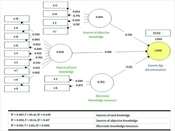
Figure 1 illustrates the factor loadings of the observable variables along with their path coefficients. All factor loadings are above 0.5, indicating a suitable correlation between the observable and latent variables. Generally, the closer a path coefficient is to a positive or negative value, the greater its influence. As observed, the highest impact on knowledge documentation is related to implicit knowledge, with a coefficient of 0.681. In contrast, the lowest impact is related to web-based electronic knowledge, with a coefficient of 0.132. Based on the results, knowledge documentation can be predicted through implicit knowledge sources, explicit knowledge sources, and web-based electronic knowledge sources.
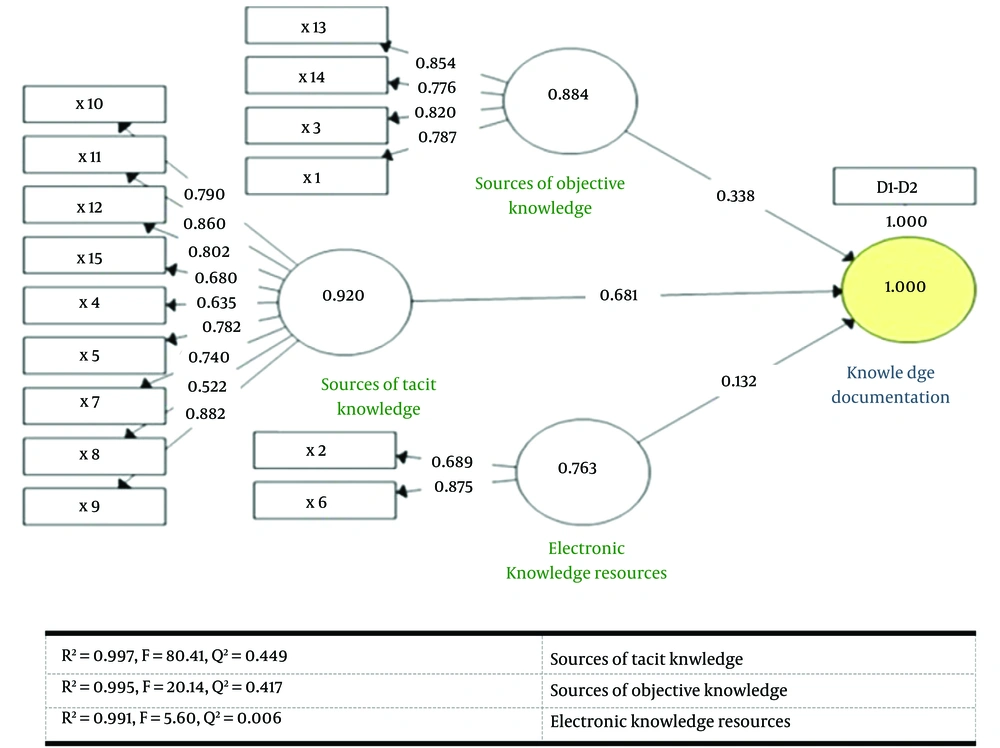
Figure 1.
Reflective measurement model-factor loadings of observable variables
This section used the Friedman non-parametric test to prioritize knowledge documentation mechanisms based on the Mayer and Zack knowledge management model (13). Since the significance level was less than 0.05 in all cases, the null hypothesis (H0) was rejected, indicating that the ranks were unequal. The Mayer and Zack model can be considered with a confidence level of 95%. Table 2 presents the knowledge documentation mechanisms and the achieved ranks for each mechanism. The results of determining the ranks for the knowledge collection stage mechanisms are shown. The current research performed ranking was obtained based on the average scores. According to Table 2, Mechanism 1 (Knowledge collection and registration performed by a knowledge expert), with an average rank of 4.48, ranked first, and Mechanism 11 (It is better to adjust the knowledge registration form according to the manager's experience background) with an average rank of 4.05, ranked eleventh. Since the average of all eleven mechanisms was higher than 3, all mechanisms can be considered essential for knowledge collection.
Table 2.
Ranking of Knowledge Collection Stage Mechanisms
| Documentation Steps | Executive Mechanisms | Rank |
|---|---|---|
| Knowledge collection | It is better to collect and record knowledge through a knowledge expert | 4.48 |
| It is better to collect and record parts of knowledge in interviews with specialists and experts | 4.42 | |
| It is better to collect and record parts of knowledge in educational workshops describing organizational experiences | 4.37 | |
| It is better to use a particular form designed in advance to collect and record knowledge | 4.36 | |
| It is better to record and record the knowledge based on the executive method of collection | 4.31 | |
| It is better to collect and record parts of knowledge with the help of observation and video or digital recording | 4.30 | |
| It is better to collect and record parts of knowledge using expert systems (such as concept modeling) | 4.30 | |
| It is better to collect and record parts of knowledge with the help of listening, summarizing, and interpretation | 4.26 | |
| It is better to collect and record some parts of knowledge in the form of documentary case writing | 4.19 | |
| It is better to collect and record parts of knowledge with the help of listening, summarizing, and interpretation | 4.15 | |
| It is better to prepare a particular form for registering knowledge according to the manager's experience | 4.05 |
The refinement stage involves a deep analysis of the collected knowledge from the previous stage. The data should be structured, organized, searchable, and easily accessible to be evaluated and organized efficiently. Table 3 presents the ranking of mechanisms related to knowledge refinement. Mechanism 1 (selecting appropriate reviewers based on the type of knowledge and expertise) ranked first with an average rank of 3.85. In contrast, Mechanism 24 (editing and sanitizing documents to ensure the anonymity of sources or responsible managers and decision-makers in some unsuccessful experiences) ranked 24th with an average score of 3.29. Since the average of all 24 mechanisms was higher than 3, it can be considered that all mechanisms are essential for refining the collected knowledge.
Table 3.
Ranking of Knowledge Refinement Mechanisms
| Documentation Steps | Executive Mechanisms | Rank |
|---|---|---|
| Knowledge refinement | It is better to select judges according to the type of knowledge and experience. | 3.85 |
| It is better to use a specialized thesaurus/dictionary in the form and content description stage of documents to create uniformity in search and retrieval. | 3.83 | |
| It is better for the aforementioned committee to develop a written policy for the selection and evaluation of knowledge. | 3.83 | |
| It is better to form committees consisting of experts to select and evaluate knowledge. | 3.81 | |
| It is better to describe scientific documents in terms of form using the author's name, title, and the like. | 3.77 | |
| It is better to prepare and describe knowledge documents to facilitate search and retrieval. | 3.77 | |
| It is better for the aforementioned committee to prepare guidelines for choosing and evaluating knowledge. | 3.77 | |
| It is better to perform the initial evaluation of knowledge in terms of form by knowledge experts. | 3.73 | |
| It is better to obtain and consider users' opinions about the validity of knowledge documents in evaluating knowledge. | 3.70 | |
| It is better to describe knowledge documents in terms of content using keywords or subject identifiers. | 3.69 | |
| It is better to prepare a list of selected knowledge at the end of the evaluation and selection stage. | 3.69 | |
| It is better to strengthen knowledge documents by adding additional information from the author/authors in evaluating knowledge. | 3.65 | |
| It is better that the final evaluation of knowledge is done by a panel of judges. | 3.65 | |
| It is better to refine the irrelevant knowledge in the initial collection and evaluation. | 3.63 | |
| It is better to standardize knowledge documents; the content of the documents should be adapted to the standard patterns of "successful experiences" or "failures." | 3.60 | |
| It is better to strengthen knowledge documents by adding additional information from other sources, such as experts, documents, notes, and quotes in evaluating knowledge. | 3.60 | |
| It is better to prepare abstracts of scientific papers in the refining stage using statistical analysis methods. | 3.60 | |
| It is better to grade the relevance or lack of relevance of knowledge documents to the organization's critical issues in evaluating knowledge. | 3.59 | |
| It is better that the rejected knowledge and experiences be reviewed and corrected by the author of the knowledge. | 3.59 | |
| It is better to strengthen knowledge documents using tags or descriptive metadata in evaluating knowledge. | 3.58 | |
| It is better to strengthen knowledge documents using multimedia resources such as images and sound in evaluating knowledge. | 3.51 |
Table 4 displays the rankings for each of the mechanisms related to the knowledge storage and retrieval stage. Mechanism 1 (It is better to store knowledge documents along with bibliographic information and metadata in storage systems such as knowledge management software and knowledge repository) ranked first with an average score of 4.49, and Mechanism 7 (It is better to categorize knowledge documents in terms of document type, subject, and similar criteria in the storage and retrieval stage) ranked 7th with an average score of 3.90. Since the average of the seven mechanisms was higher than 3, all the mechanisms can be considered essential for storing and retrieving refined knowledge.
Table 4
. Ranking of Knowledge Storage and Retrieval Mechanisms
| Documentation Steps | Executive Mechanisms | Rank |
|---|---|---|
| Knowledge storage and retrieval | It is better to store and maintain knowledge documents along with bibliographic information and metadata in storage systems such as knowledge management software and knowledge base. | 4.49 |
| It is better to create descriptive metadata in the storage and retrieval stage to discover and retrieve knowledge documents and add them to the documents or store them in a separate database. | 4.44 | |
| It is better to create and add administrative metadata to the documents or store them in a separate database during the storage and retrieval stage. | 4.40 | |
| It is better in the stage of storage and recovery; the metadata related to the conditions of maintenance is used to link the knowledge documents with other sources and add them to the documents or store them in a separate database. | 4.31 | |
| It is better to create content grading metadata in the stage of storage and retrieval to use the document by specific audiences and add it to the documents or store it in a separate database. | 4.28 | |
| It is better to organize and structure knowledge documents in the form of classification schemes, such as the classification scheme of the Library of Congress, during the storage and retrieval phase. | 4.24 | |
| It is better to categorize knowledge documents according to the type of document, subject, and the like in the stage of storage and retrieval. | 3.90 |
Table 5 shows the rankings for each of the mechanisms related to the knowledge distribution stage. Mechanism 1 (Organizational intranet can effectively distribute and share explicit knowledge) ranked first with an average rank of 4.33, and Mechanism 9 (Internal journals can effectively distribute and share explicit knowledge) ranked 9th with an average rank of 4.08. Additionally, since the average of the eight mechanisms was higher than 3, all the mechanisms can be considered essential for distributing stored knowledge.
Table 5
. Ranking of Knowledge Distribution Mechanisms
| Documentation Steps | Executive Mechanisms | Rank |
|---|---|---|
| Knowledge distribution | Objective knowledge can be effectively distributed and shared through the "organizational intranet." | 4.33 |
| Objective knowledge can be effectively distributed and shared through "meetings and seminars." | 4.30 | |
| Objective knowledge can be effectively distributed and shared through an "organizational portal." | 4.29 | |
| Objective knowledge can be effectively distributed and shared through a "Knowledge Sharing Network." | 4.27 | |
| Objective knowledge can be effectively distributed and shared through "groupware" such as video conferencing and discussion forums | 4.24 | |
| Objective knowledge can be effectively distributed and shared through the "publication of knowledge books." | 4.23 | |
| Objective knowledge can be effectively distributed and shared through e-mail | 4.14 | |
| Objective knowledge can be effectively shared through social networks such as blogs and wikis | 4.13 | |
| Objective knowledge can be effectively distributed and shared through "internal publications." | 4.08 |
The results of ranking the mechanisms related to the knowledge application stage in Table 6 indicate that Mechanism 1 (Effective utilization of knowledge in performing job tasks through a "knowledge management system") ranked first with an average score of 4.36, and Mechanism 8 (Effective utilization of knowledge in performing job tasks through "content personalization") ranked 8th with an average score of 4.10. Additionally, since the average of the eight mechanisms was higher than 3, all the mechanisms can be considered essential for applying distributed knowledge.
Table 6.
Ranking of Knowledge Application Mechanisms
| Documentation Steps | Executive Mechanisms | Rank |
|---|---|---|
| Knowledge application | Through a "Knowledge Management System," knowledge can be used effectively in performing job duties. | 4.36 |
| Through "task analysis," knowledge can be used effectively in performing job tasks. | 4.35 | |
| Through "knowledge support systems" such as "knowledge repositories" and "intranets," knowledge can be used effectively in performing job duties. | 4.34 | |
| Through "categorization" of the content of knowledge documents, knowledge can be used effectively in performing tasks. | 4.31 | |
| Through the "classification of learning stages," knowledge can be used effectively in performing job duties. | 4.26 | |
| Through the "expertise placement system," knowledge can be used effectively in performing job duties. | 4.26 | |
| Knowledge can be used effectively in performing tasks through the "electronic task support system." | 4.23 | |
| Through "personalization of content," knowledge can be used effectively in performing job duties. | 4.10 |
The overall scores and rankings of the documentation stages and mechanisms in the libraries of Iranian Medical Sciences Universities are presented in Table 7.
Table 7.
Overall Ranking of Documentation Stages
| Documentation Steps | No. of Questions in Each Stage | The Total Score of Each Stage | Average Score | Score | Rank |
|---|---|---|---|---|---|
| Knowledge storage | 7 | 71.52 | 4.37 | 369.29 | 1 |
| Gathering knowledge | 11 | 54.33 | 4.29 | 368.73 | 2 |
| Application of knowledge | 8 | 46 | 2.28 | 367.75 | 3 |
| Knowledge distribution | 9 | 33.40 | 4.22 | 363.22 | 4 |
| Refinement of knowledge | 24 | 10.13 | 3.65 | 313.79 | 5 |
5. Discussion
The present research aimed to group and rank knowledge resources in medical sciences libraries in Iran. The research findings showed that knowledge resources in the libraries of Iranian medical science universities were classified into three categories (tacit knowledge, explicit knowledge, and web-based electronic knowledge). Tacit knowledge was recognized as the essential source of knowledge acquisition. Tactic knowledge is an important strategic resource that can help an organization achieve its goals based on the information and opinions we can gather about ourselves. There is little empirical evidence about how tacit knowledge and key backgrounds are acquired internally to gain awareness in organizations, and there is also little empirical evidence about how individuals convert tacit knowledge into innovative solutions through semi-formal or informal social processes (14, 15). Therefore, organizations need to find ways to extract, collect, store, and share tacit knowledge. For this reason, sharing [tacit] knowledge has been recognized as the most essential cornerstone of effective knowledge management (16). The results were similar to those of Colon-Aguirre in tacit knowledge acquisition in the storytelling section. The results showed that organizational storytelling was the essential source of knowledge acquisition, but librarians had a negative attitude towards storytelling and often considered it a kind of gossip (17).
This study also showed that explicit knowledge resources ranked second (0.34) in knowledge acquisition. Some of this knowledge included meeting minutes, letters, circulars, guidelines and manuals, managers' daily notes, managers' speeches, retired people and influential individuals' stories, and organizational stories like describing successful and failed experiences to be easily documented and transferred to other individuals and new library staff. The results of this part of the study were consistent with Maponya and Mutual and Mooko in acquiring knowledge from current reports at the reference desk and lending, and Colon-Aguirre in acquiring knowledge from stories and descriptions of organizational events (17-19).
The third category of resources included electronic and web-based resources, ranked third (0.13) among the sources of knowledge acquisition in the libraries studied. Electronic and web-based resources have many advantages over printed and other physical resources, including remote access, ease of transfer while maintaining the integrity of content, coherence of content and versatility of application, fundamental exchange of content with each other, support for multimedia capabilities, and ease of work and implementation. Electronic resources in this study included information databases, web pages, blogs, and wikis in the web-based electronic knowledge resources section. The results of this part of the research were consistent with those of Ahmed et al. regarding knowledge acquisition from information databases and training workshops (20). The present research also had similarities with Shafiee et al. in the section on classifying knowledge into the three mentioned categories (10). Despite the many advantages cited for electronic and web-based knowledge resources, they were less critical than explicit and tacit knowledge resources; some reasons can be attributed to dependence on information technology and communications, high initial costs, quality control, and complexity of sharing these resources.
Another important research goal was determining and ranking the most critical knowledge documentation mechanisms based on Meyer and Zack's model. The ranking results showed that the mechanisms of knowledge storage, knowledge collection, knowledge application, knowledge distribution, and refinement were ranked in order of importance, and the results of this ranking contradicted the results of Shafiee (10). Based on the current research results, the knowledge storage stage was ranked the highest among the documentation stages, with a score of 369.29. This result differed from Janavi et al., in which knowledge storage had the lowest rank among knowledge management components (21). The second rank among the stages of documenting knowledge was related to collecting and recording knowledge. The results of this part of the research are in line with those of Anvary Rostamy and Shahaei, who believed that to document the experiences of managers and employees of the organization, the organizational mechanisms must include five stages of recording, transferring, evaluating, coding and publishing the experience was similar (22). In the matter of gathering and recording knowledge and experience, it is identical to the studies of Shafiee et al., Alias et al., Baharifar and Elahi, and parts of Aminga's studies (10, 12, 23, 24).
In explaining the results of this part of the research, other knowledge management activities will not be adequately performed until organizational knowledge is recorded. Considering the importance of collecting and recording knowledge in this research, creating an organizational post with the title of knowledge expert is suggested. The knowledge expert will extract individual tacit knowledge via interviews, observation, training workshops, document preparation, listening, interpretation, and the like, and group tacit knowledge through discussions and meetings based on the particular registration form and the managers' experience.
5.1. Limitations
Considering that the questionnaire of this study was designed and presented electronically and online, there was a possibility of problems related to the type of questionnaire.
5.2. Conclusions
There were no specific mechanisms in Iranian medical sciences libraries for documenting knowledge and identifying and grouping knowledge resources. Thus, the present research provided a suitable context for this category of libraries to employ mechanisms for establishing knowledge and discovering knowledge resources. In these libraries, sources of acquiring tacit and explicit knowledge are not specified. On the other hand, the necessary mechanisms for registering, recording, and documenting knowledge have not been defined. Therefore, organizational knowledge documentation is not carried out formally based on the knowledge management model. On this basis, the present research allows for identifying essential sources of knowledge acquisition and mechanisms for extracting and documenting knowledge.