Journal of Inflammatory Diseases
The Official Journal of Qazvin University of Medical Sciences
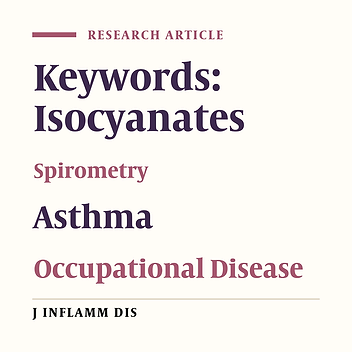
Evaluation of 4,4-methylene diphenyl diisocyanate effects on foam producing workers of car manufacture
Authors
Abstract
Abstract Background: 4,4 - Methylendiphenyl diisocyanate(MDI), is the most widely used chemical in the manufacturing of polyurethanes (a field of plastic industries), and it is one of the major causes of the occupational asthmas. Objective: Assessing the MDI concentration in air and also evaluating the effect of this chemical on eyes, skin, respiratory and gastrointestinal systems in workers of a foam producing section in a car manufacturing company. Methods: The effects of MDI on skin, eyes, respiratory and gastrointestinal systems were evaluated in two 40-person groups of exposed and unexposed workers and the MDI concentration in air was determined. The data were analyzed using t-Student test, pair-t-test, λ2 test, Regression Analyze, and correlation test. Findings: MDI concentration was lower than the threshold limit value while the local ventilation and air conditioning systems were both on, however, it was higher than the expected value when both systems were switched off. Our results showed that the presence of symptoms such as coughing, smart pain and dryness of skin, and the smart pain and itching of eyes in exposed group were significantly different from those in unexposed group(P<0.05). Some of respiratory volumes were indicative of a significant difference between exposed and unexposed groups (P<0.05). Conclusions: Exposure to MDI can result in reduction of respiratory volumes while increasing the occurrence of eye, skin and respiratory symptoms.
Highlights
Copyright
© 2024, Journal of Inflammatory Diseases. This open-access article is available under the Creative Commons Attribution-NonCommercial 4.0 (CC BY-NC 4.0) International License (https://creativecommons.org/licenses/by-nc/4.0/), which allows for the copying and redistribution of the material only for noncommercial purposes, provided that the original work is properly cited.
Similar Articles
Respiratory exposure with acrylonitrile butadiene styrene particle in appliance company workers
saeedabadi H, nikpey A. Respiratory exposure with acrylonitrile butadiene styrene particle in appliance company workers. J Inflamm Dis. 2024;22(1):e156070. doi:
Effect of Contemporary Exposure to Mixed Organic Solvents and Occupational Noise on Hearing Thresholds of Workers
Mohammadi S, Labafinejad Y, Amiri Rigi A, Attarchi M. Effect of Contemporary Exposure to Mixed Organic Solvents and Occupational Noise on Hearing Thresholds of Workers. Zahedan J Res Med Sci. 2010;11(4):e94356. doi:
Assessment the occupational accidents and its related factors in an industrial pipe factory:A case - control study in Iran
Ghods K, Shahinfar H, Razavi M, mirmohammadkhani M, Rajabzadeh AA. Assessment the occupational accidents and its related factors in an industrial pipe factory:A case - control study in Iran. koomesh. 2016;17(4):e151177. doi:
The Study of Noise Pollution in Weaving & Textile Industries in Kermanshah (2001)
Omidvary M, Ne'matian J, Rafighi Z, Chaboksavar N. The Study of Noise Pollution in Weaving & Textile Industries in Kermanshah (2001). J Kermanshah Univ Med Sci. 2005;8(4):e81507. doi:
Evaluation of Volatile Organic Compounds at Petrochemical Complexes in Iran
Moradpour Z, Ghorbani Shahna F, Bahrami A, Soltanian A, Hesam G. Evaluation of Volatile Organic Compounds at Petrochemical Complexes in Iran. Health Scope. 2017;6(4):e62595. doi: https://doi.org/10.5812/jhealthscope.62595
- Scopus by DOI: 0
Last Update: 1 month ago
- Scopus by Title: 0
Last Update: 1 month ago
- Scopus by Title (Ref): 4
Last Update: 1 month ago
- CrossRef: 0
Last Update: 5 days ago
- OpenAlex: 0
Last Update: 51 minutes ago
- OpenCitations: 0
Last Update: 2 days ago