Journal of Inflammatory Diseases
The Official Journal of Qazvin University of Medical Sciences
Prevalence of various phenotypes of polycystic ovarian syndrome among high school girls of Shiraz (2009)
Authors
Abstract
Background: Polycystic ovary syndrome (PCOS) is the most common endocrine disorder in women and cause of infertility due to lack of ovulation. The symptoms of PCOS are observed during puberty and it is assumed that the weight gain during this period to be associated with this syndrome. Objective: To determine the prevalence of phenotypes of polycystic ovary syndrome in adolescents in Shiraz. Methods: This was a cross-sectional study in which 3190 female adolescents aged between 14 to 18 years, randomly selected from high schools in Shiraz, were studied. Diagnosis of PCOS was achieved through taking history and examination based on presence of oligomenorrhea (six times menstrual cycles or less in one year), clinical signs of hyperandrogenism including hirsutism (Ferriman-Gallway scores of 6 or more), severe acne, male pattern hair loss, and ultrasonography. The hormone dehydroepiandrostandion sulfate levels were measured for all subjects. Data were analyzed using the chi square test and Fisher's t exact-test. Findings: The prevalence of PCOS phenotypes were as follows: clinical hyperandrogenism and oligomenorrhea 19.9% (29 cases), clinical hyperandrogenism and polycystic ovary 30.8% (45 cases), oligomenorrhea and polycystic ovary 29.5% (43 cases), and clinical hyperandrogenism with oligomenorrhea and polycystic ovary 14.5% (21 cases). The frequency of highest levels of dehydroepiandrostandion sulfate was observed in patients with oligomenorrhea and hyperandrogenism. Conclusion: The risks of sex hormones turmoil, psychological effects of skin symptoms (acne and hirsutism), and numerous side-effects of this syndrome make it necessary to perform an early investigation in target population.
Highlights
Copyright
© 2024, Journal of Inflammatory Diseases. This open-access article is available under the Creative Commons Attribution-NonCommercial 4.0 (CC BY-NC 4.0) International License (https://creativecommons.org/licenses/by-nc/4.0/), which allows for the copying and redistribution of the material only for noncommercial purposes, provided that the original work is properly cited.
Similar Articles
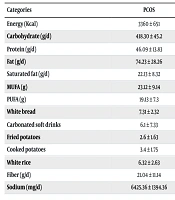
The Relationship Between Nutritional Patterns and Physical Activity in Adolescents with Polycystic Ovary Syndrome
Partash N, Rezaii Ghamsari S, Eidi Shirinbolagh Z, Ebrahimi E. The Relationship Between Nutritional Patterns and Physical Activity in Adolescents with Polycystic Ovary Syndrome. J Nurs Midwifery Sci. 2025;12(1):e153735. doi: https://doi.org/10.5812/jnms-153735
The Relationship between Clinical and Chemical Hyperandrogenism in 14-18-Years- Old Girls
akbarzadeh M, Naderi T, Dabbaghmanesh MH, Tabatabaee H, Zareh Z. The Relationship between Clinical and Chemical Hyperandrogenism in 14-18-Years- Old Girls. Zahedan J Res Med Sci. 2012;14(4):e93469. doi:
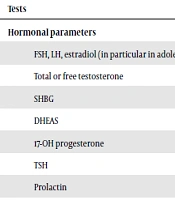
Polycystic Ovary Syndrome in Adolescents: Challenges in Diagnosis and Treatment
Ramezani Tehrani F, Amiri M. Polycystic Ovary Syndrome in Adolescents: Challenges in Diagnosis and Treatment. Int J Endocrinol Metab. 2019;17(3):e91554. doi: https://doi.org/10.5812/ijem.91554
Correlations Between Gonadotropin Hormones and the Manifestations of Polycystic Ovary Syndrome
Fazli D, Moghaddasi SP. Correlations Between Gonadotropin Hormones and the Manifestations of Polycystic Ovary Syndrome. Thrita J Neu. 2022;11(1):e117396. doi: https://doi.org/10.5812/thrita-117396
Anthropometric and Biochemical Characteristics of Polycystic Ovarian Syndrome in South Indian Women Using AES-2006 Criteria
Thathapudi S, Kodati V, Erukkambattu J, Katragadda A, Addepally U, et al. Anthropometric and Biochemical Characteristics of Polycystic Ovarian Syndrome in South Indian Women Using AES-2006 Criteria. Int J Endocrinol Metab. 2014;12(1):e12470. doi: https://doi.org/10.5812/ijem.12470
- Scopus by DOI: 0
Last Update: 3 weeks ago
- Scopus by Title: 0
Last Update: 3 weeks ago
- Scopus by Title (Ref): 0
Last Update: 3 weeks ago
- CrossRef: 0
Last Update: 5 days ago
- OpenAlex: 0
Last Update: 1 day ago
- OpenCitations: 0
Last Update: 4 days ago