Journal of Inflammatory Diseases
The Official Journal of Qazvin University of Medical Sciences
Association of migraine and obesity: A review of literature
Authors
Abstract
Background: Migraine is one of the main reasons for primary and secondary headaches worldwide and has significant effects on patients’ life . Based on recent studies, obesity may affect the severity, frequency and duration of migraine attacks. Objective: This aim of this study was to review the literature on the association of migraine and obesity. Methods: In t his review, databases of PubMed, Scopus, Science Direct and Web of Science were searched using “migraine”, “headache”, “obesity” and “overweight” as keywords. Studies published between 2005 and 2014 were reviewed. Human studies in which migraine was diagnosed based on the International Headache Society (IHS) criteria were included. Articles with non-English languages and studies on headache as the main purpose were excluded. 10 articles met the inclusion criteria. Findings: In most evaluated studies, the association of obesity (BMI≥30) and morbid obesity (BMI≥35) with high frequency of migraine attacks and frequent migraine headaches was significant. This association was more significant in younger subjects and subjects under 55 years old. There was no association between obesity and migraine symptoms (severity, frequency and duration of headache) in only one study. Another study indicated that BMI≤18.5 was associated with migraine. Conclusion: With regards to the results, general and abdominal obesity can increase the frequency of migraine attacks however, more studies are recommended. Citation: Sadeghi O, Nasiri M, Askari Gh, Maghsoudi Z. Association of migraine and obesity: A review of literature. J Qazvin Univ Med Sci. 2015 19 (1): 56-63.
Highlights
Copyright
© 2024, Journal of Inflammatory Diseases. This open-access article is available under the Creative Commons Attribution-NonCommercial 4.0 (CC BY-NC 4.0) International License (https://creativecommons.org/licenses/by-nc/4.0/), which allows for the copying and redistribution of the material only for noncommercial purposes, provided that the original work is properly cited.
Similar Articles
Association of General Obesity With Hyperhomocysteinemia in Patients With Migraine
Sadeghi O, Askari G, Maghsoudi Z, Nasiri M, Khorvash F, et al. Association of General Obesity With Hyperhomocysteinemia in Patients With Migraine. Jundishapur J Chronic Dis Care. 2015;4(1):e26596. doi: https://doi.org/10.5812/jjcdc.26596
Migraine and Risk of Stroke: Review of Current Evidence
Sadeghi O, Askari G, Maghsoudi Z, Nasiri M, Khorvash F. Migraine and Risk of Stroke: Review of Current Evidence. Jundishapur J Chronic Dis Care. 2014;3(3):e93799. doi: https://doi.org/10.17795/jjcdc-21707
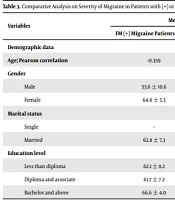
Impact of Fibromyalgia Syndrome on the Severity of Migraine Without Aura
Masaeli H, Golpich M, Akafzadeh Savari M, Yazdi Zahrani R, Dorostkar A, et al. Impact of Fibromyalgia Syndrome on the Severity of Migraine Without Aura. Zahedan J Res Med Sci. 2022;24(3):e108772. doi: https://doi.org/10.5812/zjrms-108772
Association Between Abdominal Obesity Indicators and Serum Levels of Homocysteine in Migraine Patients: A Cross-Sectional Study
Sadeghi O, Maghsoudi Z, Nasiri M, Khorvash F, Ghiasvand R, et al. Association Between Abdominal Obesity Indicators and Serum Levels of Homocysteine in Migraine Patients: A Cross-Sectional Study. Jentashapir J Cell Mol Biol. 2014;5(6):e26653. doi: https://doi.org/10.17795/jjhr-26653

Current Understanding on Pain Mechanism in Migraine and Cluster Headache
Buture A, Gooriah R, Nimeri R, Ahmed F. Current Understanding on Pain Mechanism in Migraine and Cluster Headache. Anesth Pain Med. 2016;6(3):e35190. doi: https://doi.org/10.5812/aapm.35190
- Scopus by DOI: 0
Last Update: 1 week ago
- Scopus by Title: 0
Last Update: 1 week ago
- Scopus by Title (Ref): 0
Last Update: 1 week ago
- CrossRef: 0
Last Update: 4 hours ago
- OpenAlex: 0
Last Update: 7 hours ago
- OpenCitations: 0
Last Update: 5 days ago