Journal of Inflammatory Diseases
The Official Journal of Qazvin University of Medical Sciences
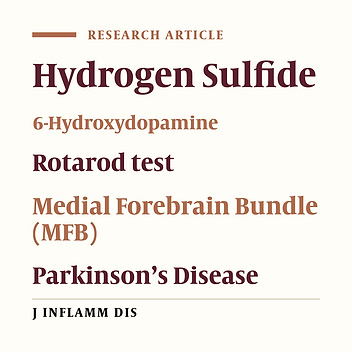
The Effects of Sodium Hydrosulfide on Motor Learning in a Rat Model of Parkinson’s Disease
Authors
Abstract
Background Hydrogen Sulfide (H2S), a novel endogenous gasotransmitter, plays an important role in neuromodulation and memory performance and also protects neurons against neurotoxin-induced neurodegeneration. Objective This study aimed to investigate the potential neuroprotective effects of Sodium Hydrosulfide (NaHS), on motor learning in a unilateral 6-Hydroxydopamine (6-OHDA) rat model of Parkinson’s Disease. Methods Male Wistar rats were subjected to unilateral injection of 6-OHDA (15 μg) into the Medial Forebrain Bundle (MFB) and then treated with NaHS for 25 days. Animals were divided into control, sham, sham plus NaHS, Parkinson (6-OHDA), Parkinson plus vehicle (saline), and Parkinson plus NaHS (2.8 and 5.6 mg/kg, IP) groups, (N=8). One-way ANOVA followed by turkey’s test was applied for statistical analyses of the data. Findings The riding time in fixed and accelerating speed rotarod were significantly decreased in Parkinson rats (6-OHDA group) compared to controls in all training days (P<0.001). Treatment with NaHS (2.8 and 5.6 mg/kg/d) reversed these decreases in a dose-dependent manner, so no significant differences were found in these parameters between the control and Parkinson plus NaHS groups during the accelerating speed rotarod test. Conclusion In the Parkinson rats, NaHS administration enhanced and improved the endurance time in the rotarod test. These results demonstrate that NaHS treatment enhances rat motor balance and coordination and suggest treatment with NaHS attenuates motor impairments in the Parkinson rats.
Highlights
Copyright
© 2024, Journal of Inflammatory Diseases. This open-access article is available under the Creative Commons Attribution-NonCommercial 4.0 (CC BY-NC 4.0) International License (https://creativecommons.org/licenses/by-nc/4.0/), which allows for the copying and redistribution of the material only for noncommercial purposes, provided that the original work is properly cited.
Similar Articles
Hydrogen Sulfide Improves Passive Avoidance Task Performance in a Streptozotocin Rat Model of Alzheimer's Disease
Esmaili M, Haghdoost-Yazdi H, Sofiabadi M. Hydrogen Sulfide Improves Passive Avoidance Task Performance in a Streptozotocin Rat Model of Alzheimer's Disease. J Inflamm Dis. 2025;29(3):e162588. doi: https://doi.org/10.69107/jid-162588
Protective effects of aqueous extract of silybum marianum in 6-hydroxydopamine-induced model of parkinsonism in male rat: a behavioral, biochemical and histological study
Baluchnejadmojarad T, Roghani M, Mafakheri M. Protective effects of aqueous extract of silybum marianum in 6-hydroxydopamine-induced model of parkinsonism in male rat: a behavioral, biochemical and histological study. koomesh. 2011;12(4):e152481. doi:
Effect of Rilmenidine on Substantia Nigra Neurons Injury in a Rat Model of Parkinson's Disease
Keshavarzi H, Darabi S, Zia Z, Sabbaghziarani F. Effect of Rilmenidine on Substantia Nigra Neurons Injury in a Rat Model of Parkinson's Disease. J Inflamm Dis. 2023;27(3):e150909. doi: https://doi.org/10.69107/jid-150909
Effect of potassium channel blocker 4-aminopyridine pretreatment on the 6-OHDA-induced Parkinson's disease in rats
Sofiabadi M, haghdoost-yazdi H, Mahmudi M, Pri H, Dargahi T, et al. Effect of potassium channel blocker 4-aminopyridine pretreatment on the 6-OHDA-induced Parkinson's disease in rats. J Inflamm Dis. 2024;19(2):e155895. doi:
Neuroprotective effect of topiramate against 6-hydroxydopamine-induced cell death in Parkinson’s disease cell mode
Fallah F, Aminzadeh A. Neuroprotective effect of topiramate against 6-hydroxydopamine-induced cell death in Parkinson’s disease cell mode. koomesh. 2019;21(4):e153135. doi:
- Scopus by DOI: 0
Last Update: 1 month ago
- Scopus by Title: 0
Last Update: 1 month ago
- Scopus by Title (Ref): 0
Last Update: 1 month ago
- CrossRef: 0
Last Update: 3 hours ago
- OpenAlex: 0
Last Update: 6 hours ago
- OpenCitations: 0
Last Update: 4 days ago