Journal of Inflammatory Diseases
The Official Journal of Qazvin University of Medical Sciences
Prevalence of Menstrual Disorders and its Relationship With Quality of Life in Female High School Students
Authors

Abstract
Background: Menstrual disorders in female students in the early years after menarche affect their physical, emotional and social functions. Objective: This study aimed to investigate the prevalence of menstrual disorders among female high school students and its relationship with their Quality of Life. Methods: This cross-sectional study was conducted on 1000 high school girls in Qazvin, Iran during 2017-2018. Their menstrual disorders and quality of life were evaluated by a demographic checklist and KIDSCREEN questionnaire, respectively. Data were analyzed using independent t-test. Findings: The mean age of high school girls was 15.9±0.93 years. The most common disorder was Premenstrual Syndrome (PMS) with a prevalence of 60%. Their quality of life had a significant relationship with PMS, menorrhagia, metorrhagia, dysmenorrhea, spotting, hypermenorrhea (P<0.001), polymenorrhea (P=0.005), hypomnorrhea (P=0.002) and amenorrhea (P=0.025). The quality of life of girls with these disorders were poorer compared to the girls with no menstrual disorder. Conclusion: Menstrual disorders are highly prevalent among female students, and have a considerable impact on their quality of life. Since this impact has the potential to have longer-term consequences, more efforts are needed to address and treat menstrual disorders in female students.
Highlights
Copyright
© 2024, Journal of Inflammatory Diseases. This open-access article is available under the Creative Commons Attribution-NonCommercial 4.0 (CC BY-NC 4.0) International License (https://creativecommons.org/licenses/by-nc/4.0/), which allows for the copying and redistribution of the material only for noncommercial purposes, provided that the original work is properly cited.
Similar Articles
Dysmenorrhea and Quality of Life: A Cross-sectional Survey Among Medical Students
Fathi M, Davoodi P, Semyari N, Ildarabadi A, Fayazi N, et al. Dysmenorrhea and Quality of Life: A Cross-sectional Survey Among Medical Students. Interv Pain Med Neuromod. 2022;2(1):e132793. doi: https://doi.org/10.5812/ipmn-132793
Evaluation of menstrual characteristics in students of Isfahan universities
Ramazani Z, Mohamadi F, Yazdi M. Evaluation of menstrual characteristics in students of Isfahan universities. J Clin Res Paramed Sci. 2013;1(4):e82314. doi:
Menstrual Health of high school students of Kermanshah, 2010
Esmaeili K, Kolivand M, Iranfar S, Afkari B, Heidarpour F, et al. Menstrual Health of high school students of Kermanshah, 2010. J Clin Res Paramed Sci. 2013;2(3):e82264. doi:
The Relationship between Age at Menarche and Primary Dysmenorrhea in Female Students of Shiraz Schools
Akbarzadeh M, Tayebi N, Abootalebi M. The Relationship between Age at Menarche and Primary Dysmenorrhea in Female Students of Shiraz Schools. Shiraz E-Med J. 2017;18(9):e14520. doi: https://doi.org/10.5812/semj.14520
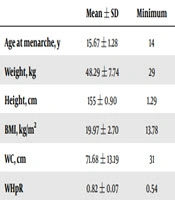
The Relationship Between Age at Menarche and Premenstrual Syndrome with Anthropometric Indices in High School Female Students in Zahedan in 2017
Karajibani M, Montazerifar F, Nazare N, Dashipour AR. The Relationship Between Age at Menarche and Premenstrual Syndrome with Anthropometric Indices in High School Female Students in Zahedan in 2017. Zahedan J Res Med Sci. 2019;22(1):e93862. doi: https://doi.org/10.5812/zjrms.93862
- Scopus by DOI: 0
Last Update: 2 days ago
- Scopus by Title: 0
Last Update: 2 days ago
- Scopus by Title (Ref): 0
Last Update: 2 days ago
- CrossRef: 0
Last Update: 5 days ago
- OpenAlex: 0
Last Update: 2 hours ago
- OpenCitations: 0
Last Update: 3 days ago