Journal of Inflammatory Diseases
The Official Journal of Qazvin University of Medical Sciences
Dyschloremia During Severe COVID‑19 Infection in Intensive Care Unit Patients
Authors

Abstract
Background: Dyschloremia is one of the most prevalent abnormalities that is highly associated with a high level of mortality in intensive care unit (ICU) patients. The current study evaluated serum chloride levels in COVID-19 patients hospitalized in the ICU. Methods: This cross-sectional study was conducted on 245 patients with severe COVID-19 who were admitted to the intensive care unit (ICU). Electrolytes, albumin, liver function test, complete blood count, serum chloride, and VBG were among the laboratory markers compared. The Chi-square, t-test, and logistic regression models were used to examine the relationship between these markers and the key outcomes, which included severity, mortality, intubation, and hospitalization. Findings: The Mean±SD age of patients was 58.16±17 years. The mean serum chloride level in the studied patients was 109.6±5.1 with a range of 100-134. According to the regression logistic model, variables like age, intubation status, pH, and chlorine levels significantly affected the outcome of COVID-19 disease. Patients with acidosis were 4.7 times more likely to die than those with alkalosis (P<0.001). The chance of dying in hyperchloremia is 2.38 times more compared to the normochloremia group (P<0.009). Conclusion: Patients with severe COVID-19 may present with chlorine abnormalities, including hyperchloremia. Hyperchloremia is also associated with poor clinical outcomes and a higher mortality risk. This relationship was independent of acid-base disorder.
Highlights
Copyright
© 2024, Journal of Inflammatory Diseases. This open-access article is available under the Creative Commons Attribution 4.0 (CC BY 4.0) International License (https://creativecommons.org/licenses/by/4.0/), which allows for the copying and redistribution of the material only for noncommercial purposes, provided that the original work is properly cited.
Similar Articles
Assessment of Prevalence and Prognostic Value of Acid-Base and Electrolyte Imbalances in ICU-Admitted Severe COVID-19 Patients
Alaei M, Taebi K, Keshavarz Shahbaz S, Gheraati M, Mirzadeh M, et al. Assessment of Prevalence and Prognostic Value of Acid-Base and Electrolyte Imbalances in ICU-Admitted Severe COVID-19 Patients. J Inflamm Dis. 2024;28(3):e159098. doi: https://doi.org/10.69107/jid-159098
Electrolyte Imbalance and COVID-19 Severity in Hospitalized Patients
Miri M, Badriahmadi S, Shamshirian A, Moodi Ghalibaf A, Mozdourian M. Electrolyte Imbalance and COVID-19 Severity in Hospitalized Patients. Nephro-Urol Mon. 2022;14(3):e128085. doi: https://doi.org/10.5812/numonthly-128085
The Prevalence of Electrolyte Imbalances and Their Relationship with Disease Severity in Hospitalized COVID-19 Patients
Abbaszadeh M, Gorgani F, Javadi Tabrizi S, Khajavi Rad N, Zarei Jalalabadi N, et al. The Prevalence of Electrolyte Imbalances and Their Relationship with Disease Severity in Hospitalized COVID-19 Patients. Arch Clin Infect Dis. 2022;17(3):e112190. doi: https://doi.org/10.5812/archcid-112190
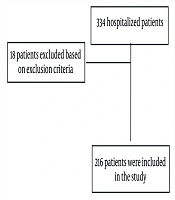
Comparison of Serum Electrolyte Levels at Admission in COVID-19 Patients Based on Outcomes: A Retrospective Study During the Delta Variant Outbreak
Asgharnia M, Yarmohamadi M, Ziari A, Izadi A. Comparison of Serum Electrolyte Levels at Admission in COVID-19 Patients Based on Outcomes: A Retrospective Study During the Delta Variant Outbreak. Middle East J Rehabil Health Stud. 2025;12(4):e159350. doi: https://doi.org/10.5812/mejrh-159350
Hyponatremia at Admission in Hospitalized Patients With COVID-19: Risk Factors and Impact on Prognosis
Davoodi N, gheraati M, Hashemipour S, Badri M, Rastgoo N, et al. Hyponatremia at Admission in Hospitalized Patients With COVID-19: Risk Factors and Impact on Prognosis. J Inflamm Dis. 2024;25(3):e156286. doi:
- Scopus by DOI: 0
Last Update: 3 weeks ago
- Scopus by Title: 0
Last Update: 3 weeks ago
- Scopus by Title (Ref): 0
Last Update: 3 weeks ago
- CrossRef: 0
Last Update: 5 days ago
- OpenAlex: 0
Last Update: 1 hour ago
- OpenCitations: 0
Last Update: 3 days ago
