
1. Background
Work-related musculoskeletal disorders (WMSDs) include symptoms that lead to disruption or exacerbation of musculoskeletal disorders by occupational risk factors such as pain and discomfort, injury, or persistent pain in body structures like the muscles, joints, tendons, ligaments, nerves, bones, and circulatory system (1). Musculoskeletal disorders are among the most common causes of occupational injuries in developing and developed countries (2). In addition, it is one of the most common occupational injuries, with a considerable economic burden, because it accounts for one-third of work-related injuries annually (3). Globally, musculoskeletal disorders and chronic conditions are important problems, with high co- occurrence. Musculoskeletal disorders may contribute to the development of chronic conditions (4). In Switzerland, 8% of the employed population lost their working days due to WMSDs, accounting for 1.4 million days ($ 185 million) (5). Several studies investigated the prevalence of WMSDs in different communities. WMSDs are reported in 25% of European countries (6) and are the leading cause of absenteeism in Western Europe, Canada, and the United States (7). Factors affecting musculoskeletal disorders include age, gender, and occupational risk factors. Among various jobs, medical staff, particularly nurses and operating room personnel, are at increased risk of WMSDs, due to the provision of medical services (e.g., lifting heavy objects, patient lifting and moving, and using inappropriate equipment) and inappropriate physical activity at work (e.g., bending, turning, standing and doing hand activities) (8). Several studies investigated common injuries caused by musculoskeletal disorders in nurses and operating room staff worldwide. For instance, Zamanian et al. reported that 100% of their participants developed at least one musculoskeletal disorder during the past 12 months (2). In the same vein, Karahan et al. reported that 85.7% of nurses suffered from low back pain (LBP) one year after starting their career, which can reduce work efficiency (9). Another study mentioned LBP as the primary reason for job abandonment in 11% of nurses; in addition to LBP, musculoskeletal disorders in other parts of the body, such as the shoulders, neck, and hands, are the other major problem (10). In another survey of nurses, back, neck, and shoulder pains are mentioned as the most common injuries (11). In a study on Iranian nurses, WMSDs are mentioned as the cause of job absence of 7.4% of participants (12). WMSDs can cause many problems such as disability, mental, physical, and occupational problems, leading to a considerable economic burden, indicating the necessity of paying attention to this disorder. Since musculoskeletal disorders are one of the most common causes of occupational diseases, it is necessary to pay special attention to the prevalence of these disorders in work environments, including the medical environment (13). Evidence regarding the prevalence of musculoskeletal disorders among nurses and operating room staff and factors contributing to these disorders play a key role in planning for prevention, training, and making decisions. Also, such evidence pave the way for identifying activities that cause such problems and developing training programs, including the courses on the correct ergonomic principles for transporting the patients and objects.
2. Objectives
According to the authors’ best knowledge, no research has investigated this issue in Larestan. Therefore, this study was conducted to investigate the prevalence of complaints due to musculoskeletal disorders and the factors contributing to this disorder among medical staff working in Emam-Reza hospital of Larestan.
3. Methods
This cross-sectional and descriptive-analytical study was approved by the ethics committee of Larestan University of Medical Sciences (code No: IR.LARUMS.REC.1398.019). Previous studies reported the prevalence of WMSDs among nurses (14) and operating room technicians (15) as 84% and 60%, respectively. The maximum sample size was calculated using a prevalence of 60%.
Initially, the sample size was calculated as 113 subjects. However, to ensure the adequacy of the sample size and considering the possible dropout of participants, the final sample size was determined to be 124 subjects (a 10% increase). Following a simple convenience sampling technique, participants were selected from various hospital departments. Data were collected from August to October 2021 in Emam-Reza hospital of Larestan. After obtaining the approval of hospital managers, participants were selected based on the inclusion criteria from operation room staff (operating room technician, surgeon, anesthesia staff) and nurses (nurses, nursing assistant, and service staff) working at Larestan hospital. Inclusion criteria were not having a second job and willingness to participate in this study. Those with a history of musculoskeletal disorders before joining the hospital or musculoskeletal problems caused by traffic accidents in their limbs were excluded from the study. Informed consent was obtained from all participants before entering the study and after a comprehensive introduction to the study protocol. Data were collected using a demographic information questionnaire and the Nordic Questionnaire. The first part of the Nordic Questionnaire is about the risk factors, including personal characteristics such as age, gender, level of education, and job-related factors (e.g., work experience and field of work). The second part is about musculoskeletal complaints. Data collection was performed following a self-report approach. The Nordic Standard Questionnaire was used to determine the location of complaints in different parts of the body. The standard questionnaire for assessing the prevalence of Nordic musculoskeletal disorders has been widely used in many countries and in various projects (2). The Nordic Questionnaire was used to collect information on the prevalence of musculoskeletal disorders in nine anatomical areas, including the neck, shoulders, back, elbows, waist, hands and wrists, thighs, knees, ankles, and feet (16). Complaints are rated as yes (score of one) and no (score of zero) in this questionnaire. The validity and reliability of this questionnaire are evaluated by Ozgoli et al. They reported a correlation coefficient of 91%, which is reliable (17). The Persian version of the valid and reliable Nordic Questionnaire has been used to assess the musculoskeletal problems of medical staff in various studies (2, 16-18). The results on quantitative variables are described using mean and standard deviation. For qualitative variables, the descriptive results are reported as numbers and percentages. The Kolmogorov-Smirnov test was applied to test for normal distribution, and since the distribution of variables was normal, the independent t-test was used for inter-group comparison of quantitative variables. The qualitative variables were compared using the chi-square test or Fischer’s exact test in various categories. Data analysis was administered using SPSS version 25. Statistical significance was considered when P-value < 0.05.
4. Results
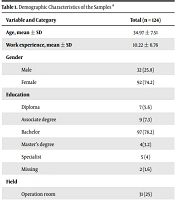
This study was performed on 124 medical staff working in Emam-Reza hospital of Larestan. Ninety-two (74.2%) participants were female. The mean age of the samples was 34.97 ± 7.51 years. The average length of their work experience was 10.22 ± 6.76 years. In terms of education, 78.20% of the participants had a bachelor’s degree; 4.00% were specialists; 3.20% had a master’s degree, 7.30% had an associate degree, and 5.60% had a diploma. Also, 25.00% of participants were operating room personnel, 58.1% nurses, 4.0% services staff, 4.0% nursing assistants, 1.60% surgeons, and 2.40% anesthesia specialists. Table 1 shows the demographic characteristics of participants.
Table 1.
Demographic Characteristics of the Samples a
| Variable and Category | Total (n = 124) |
|---|---|
| Age, mean ± SD | 34.97 ± 7.51 |
| Work experience, mean ± SD | 10.22 ± 6.76 |
| Gender | |
| Male | 32 (25.8) |
| Female | 92 (74.2) |
| Education | |
| Diploma | 7 (5.6) |
| Associate degree | 9 (7.3) |
| Bachelor | 97 (78.2) |
| Master’s degree | 4(3.2) |
| Specialist | 5 (4) |
| Missing | 2 (1.6) |
| Field | |
| Operation room | 31 (25) |
| Nurse | 72 (58.1) |
| Service staff | 5 (4) |
| Nursing assistant | 5 (4) |
| Surgeon | 2 (1.6) |
| Anesthesia staff | 3 (2.4) |
| Missing | 6 (4.8) |
a Values are expressed as No. (%) unless otherwise indicated.
Table 2 shows the distribution of the participants by different body areas. As seen in this table the highest prevalence of musculoskeletal complaints was observed in three areas of the back, one or both knees, and neck during the previous 12 months and 7 days, respectively. Table 3 shows the distribution of musculoskeletal complaints of participants separated by different body areas according to the field of work. As shown in the table for nurses, musculoskeletal complaints in the neck area during the previous 12 months were higher than in other fields, which was statistically significant (P < 0.05). Also, musculoskeletal complaints in the back during the previous 12 months and lumbar complaints during the previous 12 months and 7 days were more common among nurses than others (P < 0.05). The chi-square test and Fisher’s exact test were used to assess the association between the two categorical variables in Table 3. Distribution of the employed personnel with job-related musculoskeletal complaints in different parts of the body showed in Table 4. As seen in the table, the prevalence of musculoskeletal disorders was much higher in women than men for all parts of the body, and this difference was statistically significant (P < 0.05). The chi-square and Fisher’s exact test were applied to analyze the categorical data in Table 4.
Table 2.
Distribution of the Employed Personnel with Job-Related Musculoskeletal Complaints in Different Parts of the Body During the Previous 12 Months and the Previous 7 Days of Larestan Hospital a
| Limb | Frequency | |
|---|---|---|
| Feeling Pain and Discomfort for the Past 12 Months | Feeling Pain and Discomfort for the Past 7 Days | |
| Neck | 64 (51.6) | 35(26.6) |
| Shoulder | 56 (45.2) | 33(26.6) |
| Forearm | 34 (27.4) | 22(17.7) |
| Hands and wrists | 55 (44.4) | 27(21.8) |
| Back | 60 (48.4) | 48(38.7) |
| Waist | 84 (67.7) | 66(53.2) |
| One or both thighs | 31 (25) | 28(22.6) |
| One or both knees | 68 (54.8) | 54(43.50) |
| One or both feet and wrists | 59 (47.6) | 43(34.70) |
a Values are expressed as No. (%).
Table 3.
Distribution of the Employed Personnel with Job-Related Musculoskeletal Complaints in Different Areas of the Body According to the Field of Work During the Previous 12 Months and the Previous 7 Days of Larestan Hospital a
| Limb and Field of Word | Frequency | |
|---|---|---|
| Feeling Pain and Discomfort for the Past 12 Months | Feeling Pain and Discomfort for the Past 7 Days | |
| Neck | ||
| Operation room | 16 (13.6) | 5 (4.2) |
| Nurse | 43 (36.4) | 28 (23.7) |
| Service staff | 0 | 0 |
| Nurse assistant | 3 (2.5) | 1 (0.8) |
| Surgeon | 0 | 0 |
| Anesthesia staff | 0 | 0 |
| P value | 0.027 b | 0.069 |
| Shoulder | ||
| Operation room | 13 (11) | 3 (2.5) |
| Nurse | 39 (33.1) | 26 (22) |
| Service staff | 0 | 1 (0.8) |
| Nurse assistant | 2 (1.7) | 1 (0.8) |
| Surgeon | 0 | 0 |
| Anesthesia staff | 0 | 1 (0.8) |
| P value | 0.570 | 0.118 |
| Forearm | ||
| Operation room | 8 (6.8) | 2 (1.7) |
| Nurse | 24 (20.3) | 18 (15.3) |
| Service staff | 1 (0.8) | 1 (0.8) |
| Nurse assistant | 1 (0.8) | 1 (0.8) |
| Surgeon | 0 | 0 |
| Anesthesia staff | 0 | 0 |
| P value | 0.661 | .0333 |
| Hands and wrists | ||
| Operation room | 14 (11.9) | 5 (4.2) |
| Nurse | 36 (30.5) | 20 (16.9) |
| Service staff | 1 (0.8) | 0 |
| Nurse assistant | 1 (0.8) | 1 (0.8) |
| Surgeon | 1 (0.8) | 0 |
| Anesthesia staff | 0 | 1 (0.8) |
| P value | 0.333 | 0.540 |
| Back | ||
| Operation room | 15 (12.7) | 12 (10.2) |
| Nurse | 41 (34.7) | 32 (27.1) |
| Service staff | 0 | 0 |
| Nurse assistant | 1 (0.8) | 2 (1.7) |
| Surgeon | 0 | 0 |
| Anesthesia staff | 0 | 0 |
| P value | 0.022 b | 0.200 |
| Waist | ||
| Operation room | 21 (17.8) | 15 (12.7) |
| Nurse | 56 (47.5) | 46 (39) |
| Service staff | 1 (0.8) | 0 |
| Nurse assistant | 2 (1.7) | 2 (1.7) |
| Surgeon | 1 (0.8) | 0 |
| Anesthesia staff | 0 | 0 |
| P value | 0.004 b | 0.009 b |
| One or both thighs | ||
| Operation room | 7 (5.9) | 6 (5.1) |
| Nurse | 23 (19.5) | 20 (16.9) |
| Service staff | 0 | 1 (0.8) |
| Nurse assistant | 0 | 0 |
| Surgeon | 0 | 0 |
| Anesthesia staff | 0 | 0 |
| P value | 0.231 | 0.523 |
| One or both knees | ||
| Operation room | 17 (14.4) | 14 (11.9) |
| Nurse | 45 (38.1) | 35 (29.7) |
| Service staff | 2 (1.7) | 1 (0.8) |
| Nurse assistant | 2 (1.7) | 1 (0.8) |
| Surgeon | 0 | 0 |
| Anesthesia staff | 0 | 1 (0.8) |
| P value | 0.124 | 0.456 |
| One or both feet and wrists | ||
| Operation room | 13 (11) | 6 (5.1) |
| Nurse | 39 (33.1) | 31 (26.3) |
| Service staff | 2 (1.7) | 1 (0.8) |
| Nurse assistant | 0 | 0 |
| Surgeon | 0 | 0 |
| Anesthesia staff | 2 (1.7) | 1 (0.8) |
| P value | 0.128 | 0.083 |
a Values are expressed as No. (%).
b P value is calculated by chi-square test and Fisher’s exact test.
Table 4.
Distribution of the Employed Personnel with Job-Related Musculoskeletal Complaints in Different Parts of the Body by Gender During the Previous 12 Months and the Previous 7 Days Larestan Hospital a
| Limb and Gender | Frequency | |
|---|---|---|
| Feeling Pain and Discomfort for the Past 12 Months | Feeling Pain and Discomfort for the Past 7 Days | |
| Neck | ||
| Male | 9 (7.3) | 5 (4) |
| Female | 55 (44.4) | 30 (24.2) |
| P value | 0.002 b | 0.066 |
| Shoulder | ||
| Male | 7 (5.6) | 4 (3.2) |
| Female | 49 (39.5) | 29 (23.4) |
| P value | 0.002 b | 0.036 b |
| Forearm | ||
| Male | 3 (2.4) | 1 (0.8) |
| Female | 31 (25) | 21 (16.9) |
| P value | 0.008 b | 0.012 b |
| Hands and wrists | ||
| Male | 6 (4.8) | 2 (1.6) |
| Female | 49 (39.5) | 25 (20.2) |
| P value | 0.001 b | 0.013 b |
| Back | ||
| Male | 9 (7.3) | 7 (5.6) |
| Female | 51 (41.1) | 41 (33.1) |
| P value | 0.008 b | 0.023 b |
| Waist | ||
| Male | 15 (12.1) | 8 (6.5) |
| Female | 69 (55.6) | 58 (46.8) |
| P value | 0.003 b | > 0.001 |
| One or both thighs | ||
| Male | 2 (1.6) | 3 (2.4) |
| Female | 29 (23.4) | 25 (20.2) |
| P value | 0.004 b | 0.038 b |
| One or both knees | ||
| Male | 11 (8.9) | 10 (8.1) |
| Female | 57 (46) | 44 (35.5) |
| P value | 0.007 b | 0.103 |
| One or both feet and wrists | ||
| Male | 10 (8.1) | 6 (4.8) |
| Female | 49 (39.5) | 37 (29.8) |
| P value | 0.032 b | 0.028 b |
a Values are expressed as No. (%).
b P value is calculated by chi-square test and Fisher’s exact test.
The comparison of age and years of work experience in categories of musculoskeletal disorders in different body areas is shown in Table 5. The two-sample t-test was used to examine the differences of means.
Table 5.
| Limb and Category | Age | Years of Work Experience | ||
|---|---|---|---|---|
| Feeling Pain and Discomfort for the Past 12 Months | Feeling Pain and Discomfort for the Past 7 Days | Feeling Pain and Discomfort for the Past 12 Months | Feeling Pain and Discomfort for the Past 7 Days | |
| Neck | ||||
| Yes | 35.97 ± 7.6 | 36.69 ± 8.65 | 11.46 ± 7.3 | 11.64 ± 8.1 |
| No | 33.9 ± 7.30 | 34.29 ± 6.95 | 8.90 ± 5.81 | 9.66 ± 6.12 |
| P value | 0.126 | 0.111 | 0.035 c | 0.122 |
| Shoulder | ||||
| Yes | 35.11 ± 7.79 | 35.88 ± 8.9 | 10.67 ± 7.2 | 10.35 ± 7.6 |
| No | 34.85 ± 7.34 | 34.64 ± 6.8 | 9.85 ± 6.4 | 10.18 ± 6.5 |
| P value | 0.852 | 0.419 | 0.817 | 0.901 |
| Forearm | ||||
| Yes | 35.53 ± 6.78 | 34.55 ± 7.07 | 11.03 ± 6.7 | 10.18 ± 7.6 |
| No | 34.76 ± 7.8 | 35.06 ± 7.63 | 9.92 ± 6.8 | 10.23 ± 5.6 |
| P value | 0.611 | 0.773 | 0.416 | 0.976 |
| Hands and wrists | ||||
| Yes | 35.29 ± 6.8 | 35.67 ± 6.85 | 10.64 ± 6.4 | 10.85 ± 7.1 |
| No | 34.71 ± 8.10 | 34.77 ± 7.71 | 9.89 ± 7.05 | 10.05 ± 6.7 |
| P value | 0.671 | 0.586 | 0.544 | 0.586 |
| Back | ||||
| Yes | 35.55 ± 8.02 | 36.46 ± 8.5 | 11.14 ± 7.4 | 11.64 ± 7.9 |
| No | 34.42 ± 7.02 | 34.03 ± 6.68 | 9.36 ± 6.03 | 9.33 ± 5.8 |
| P value | 0.406 | 0.079 | 0.143 | 0.085 |
| Waist | ||||
| Yes | 35.06 ± 7.6 | 35.14 ± 7.9 | 10.48 ± 6.6 | 11.01 ± 7.3 |
| No | 34.78 ± 7.4 | 34.78 ± 7.0 | 9.68 ± 7.0 | 9.33 ± 0.1 |
| P value | 0.845 | 0.791 | 0.537 | 0.168 |
| One or both thighs | ||||
| Yes | 34.26 ± 6.7 | 34.07 ± 6.4 | 10.71 ± 6.4 | 10.43 ± 5.97 |
| No | 35.2 ± 7.8 | 35.23± 7.8 | 10.06 ± 6.9 | 10.16 ± 7.0 |
| P value | 0.546 | 0.476 | 0.467 | 0.855 |
| One or both knees | ||||
| Yes | 36.22 ± 8.17 | 36.52 ± 8.3 | 11.35 ± 7.20 | 10.03 ± 6.3 |
| No | 33.45 ± 6.38 | 33.77 ± 6.6 | 8.86 ± 5.96 | 10.39 ± 7.1 |
| P value | 0.040 c | 0.043 c | 0.041 c | 0.77 |
| One or both feet and wrists | ||||
| Yes | 34.9 ± 7.6 | 35.84 ± 8.1 | 10.03 ± 6.3 | 10.88 ± 6.6 |
| No | 35.02 ± 7.5 | 34.51 ± 7.1 | 10.39 ± 7.1 | 9.88 ± 6.8 |
| P value | 0.922 | 0.35 | 0.77 | 0.978 |
a Values are expressed as mean ± SD.
b P value is calculated by two-sample t-test.
c Statistically significant
As shown in Table 5, during the past 12 months, those with musculoskeletal complaints in one or both thighs were on average 2.77 years older than others, and this measure was 2.75 years for 7 days. These differences were statistically significant (P < 0.05). Also, during the previous 12 months, on average, the work experience of those with musculoskeletal complaints in one or both thighs was higher than others by 2.45 years, and this difference was statistically significant (P < 0.05). During the previous 12 months, on average, in samples who had musculoskeletal complaints in the neck, the work experience was 2.56 years higher than others, and this difference was statistically significant (P < 0.05).
5. Discussion
The results of the present study showed that the highest prevalence of musculoskeletal disorders was related to the lumbar region (67.7%), followed by knees (54.80%) and neck (51.6%), respectively, and the lowest was related to the forearms and thighs, respectively. Musculoskeletal complaints in the neck, back, and lumbar region were also more common among nurses than others. Akhlaghi et al.’s study on the prevalence of musculoskeletal disorders among medical staff of Shahid Beheshti hospitals showed that 71.25% of people had musculoskeletal problems in the lumbar region (19). Another study on 180 nurses at Shizajoshang Teaching Hospital in China found that the prevalence of musculoskeletal disorders was 70%, with back pain being 56.7%, shoulder discomfort 38.9%, and neck discomfort 42.8% (20). The nursing profession is stressful due to high physical and mental activities, which may result in dissatisfaction, low efficiency, and burnout, causing damage to the nursing care system (21). The results of the present study showed that the highest prevalence of musculoskeletal disorders was in nurses. Kim et al. found that nurses were more likely to have lumbar injuries when transferring patients due to sudden movements with inappropriate postures. Frequent lifting and moving patients increase the risk of LBP (13). In this study, the distribution of low back complaints in the previous 12 months and 7 days showed that LBP complaints were higher in nurses than in others. Also, a study conducted by Tinubu et al. showed that, during the previous 12 months, the most musculoskeletal complaints were related to the lumbar region (44.1%) (22), all of which are consistent with the results of the present study.
In the study by Abedini et al. on nursing staff, the highest prevalence of musculoskeletal complaints was in the lumbar region (71.5%), followed by legs and arms/wrists. While in the present study, most of the nurses were suffering from musculoskeletal complaints in the neck, followed by back and waist, which is not consistent with the study by Abedini et al. (23). The reason for this can be the fact that nursing staff with more patient handling duties are more upright and also need to use their hands for patient handling activities such as changing position, and lifting and moving the patient. In a study on Korean nurses, Kee and Seo mentioned shoulders as the area with the highest sensitivity to musculoskeletal disorders, followed by the knees, waist, hands/wrists, neck, feet, legs, and fingers. While, in this study, the neck and waist were areas with the highest sensitivity, which is not consistent with the results of Kee and Seo (24). Also, in the study of Zamanian et al., the results showed that most disorders in nurses were in the back, knee, back and shoulder, respectively, which is not consistent with the results of the present study (2).
Injury to the back and the resulting pain occur when the tissues of the functional unit are hurt (19). It seems that the irritation of this tissue in the medical staff is the result of hard work conditions and torsional movements in the spine area in assuming inappropriate physical positions, moving patients and bending for a long time. A study by Munabi et al. on 880 nurses noted lumbar flexion, which is prolonged and excessive, and moving and pushing heavy loads as the causes of back injury (25). High prevalence of back pain among nurses can be attributed to the enduring work pressure and job demands. However, Smith et al. mentioned pain in shoulder and legs as complaints with high prevalence (26). This difference can be attributed to differences in working conditions of medical centers because the number of monthly working hours of nurses in developed countries is lower. Also, medical centers of developed countries are better equipped, including smart beds to change the patient's position and movement.
In the present study, the prevalence of LBP was higher in women (55.6%) than men (12.1%). Also, a significant relationship was observed between the gender and prevalence of musculoskeletal disorders in all parts of the body. In addition, back pain was more likely to occur in women than men (27). Some authors noted the higher prevalence of musculoskeletal disorders in females than males, which can be due to morphological, genetic, and physical-psychological differences (28).
In this study, the prevalence of disorders was higher in women than men, which is consistent with previous studies. The results of the present study are not consistent with the results of Eshaghi Sani et al.’s study, which can be attributed to differences in the nature of women’s jobs in the present study and that conducted by Eshaghi Sani et al. Thus, in Eshaghi Sani et al.’s study, women were more active in the office work, which causes less stress on the lower back in comparison to men who do heavy work in the industrial environment. In contrast, in the present study, the occupational nature of women and men was the same, and due to the lower resistance and strength of women, which leads to their higher vulnerability, back pain was more common among women. The higher prevalence of this disorder can be attributed to factors such as pregnancy and childbirth, which needs further investigations (29). Sharifnia et al. (30) also found that being a woman increases the chance of neck and back pain by 122 and 203 percent, respectively.
According to NIOSH studies, health care workers, including nurses, are exposed to many risk factors for musculoskeletal disorders, including shoulder and neck injuries. These disorders are mostly related to overloading in patients’ manual transport, use of excessive force in pushing and pulling, and inappropriate postures while performing health care. There is no exception to this threat and all health care workers are at risk of such risk factors because all health employees, such as those working at the emergency department, intensive care unit, operating room, are exposed to occupational risk factors (19). Unfortunately, this perspective often causes us to be overwhelmed when we are to start a daily routine. Therefore, this issue highlights the need for sports programs and attention to workplace standards and manpower engineering for hospital officials and managers more than before because physical problems of staff translate into reduced productivity of the organization and low quality of provided services.
Measures taken to reduce these consequences include selecting employees based on their physical capabilities (i.e., tailored to their roles), holding training courses on the correct principles of ergonomics of transporting patients and objects, reducing overtime hours, employing sufficient staff, and job management programs intended to better perform assigned tasks.
5.1. Conclusions
In conclusion, it can be argued that the staff of hospitals and health centers suffer from musculoskeletal pain. The prevalence of musculoskeletal disorders in the lumbar and knee areas in the study population was relatively high; therefore, ergonomics and stress management training in the workplace can be a big step towards improving the health, mental and physical health of employees and reciprocally improving the performance of more services with the better quality delivered to the patients.