


1. Background
Family is the main unit of society in which humans grow and get ready to enter the society. To achieve a healthy society, it is necessary to have a healthy family (1). The family begins with marriage and preoccupation with marital quality is well founded. Satisfaction from a harmonious marriage can play a crucial role in couples’ lives, because this affects their physical and psychological wellbeing (2). Marital adjustment also increases the ability to deal with problems and stressors and improves mental and physical health of spouses and finally members of the society (3).
Husband-wife helping relationships are reported to be important moderators between the experienced stress and individual well-being (4). Some studies indicated that marital status affects health, and its negative aspects indirectly influence the cardiovascular system, immune system, endocrinology, nervous system and psychological mechanisms (5). And there is evidence to suggest that marital dissatisfaction is related to psychiatric disorders (6) including mood (7-10), anxiety (7, 10-12), substance use (7), and alcohol use disorders (7). Research also pointed to the role of marital satisfaction in prediction of pain severity (13). Moreover, marital distress diminishes the physical and/or emotional availability and sensitivity of the parents (14). Parents with more satisfaction with their marital quality, pay more attention to children’s psychological and physical needs and their appropriate training (3).
Marital satisfaction is a multidimensional concept and depends on many factors including general health (15). Some studies indicated that mental health may lead to decline in marital quality (16, 17). For instance, in a study by Ruscher and Gotlib (18) on the couples with depression, and both partners reported experiencing negative mood following the intercourse. They emitted a lower proportion of positive verbal and nonverbal communications during the intercourse, compared to the control group. Nonverbal messages were more negative than verbal communications in individuals with depression.
Najman et al. (2014) found that depression is an important pathway to a decline in quality of martial relationships (16).
As the educated males have an effective role in productive activities, it is essential to present some appropriate perspectives in the field of their mental health and marital satisfaction. The current study aimed at investigating the association between marital satisfaction and mental health in the married male students of Ahvaz Jundishapur University of Medical Sciences, Ahvaz, Iran. Results of the study may have preventative and therapeutic implications in psychology, psychiatry, and family counseling.
2. Methods
The study sample consisted of 100 married male students with the mean ± standard deviation (SD) age of 27.33 ± 6.31 years of Ahvaz Jundishapur University of Medical Sciences selected through the sampling method (all of the married students included the study population). The study was approved by the ethical committee of Ahwaz Jundishapur University of Medical Sciences (Date: March 24, 2011; No. IR.AJUMS.REC.1390.221). Informed consent was obtained from the participants after explaining the procedure and the purpose of the study. They were also asked by a trained and experienced research assistant to complete the Persian version of general health questionnaire (GHQ) and enriching and nurturing relationship issues, communication, and happiness (ENRICH) inventory as well as a questionnaire to obtain demographic data. Data were collected anonymously and information was kept confidential.
2.1. Inclusion and Exclusion Criteria
Students who were married and completed the informed consent form were included; on the other hand, those who answered the questionnaires incompletely were excluded.
2.2. Questionnaires
1) General health questionnaire: The questionnaire was introduced by Goldberg and Hillary to screen non-psychotic psychological disorders, in 1979. It includes 28 items and 4 subscales each of 7 questions. Adham et al., evaluated the validity and reliability of 91% and 88%, respectively. Reliability was calculated by Cronbach’s alpha as a measure of internal consistency. Cronbach’s alpha was 0.84 for physical symptoms, social functioning 79%, depression 81%, and mental health 91% (19).
2) Enriching and nurturing relationship issues, communication, and happiness (ENRICH) inventory: Marital satisfaction of the subjects was measured via the short version of ENRICH inventory (ENRICH; Fowers and Olson, 1993). The questionnaire has 47 items and 12 subscales. Each subscale is related to one of the important fields of the life; to complete the form, a 5-option Likert-scale was used as follows: “strongly agree”, “agree”, “no idea”, “disagree”, and “strongly disagree”. High scores on this scale indicate low satisfaction. Olson (1983) reported the reliability of the questionnaire 0.92, by calculating Cronbach’s alpha as a measure of internal consistency (IC). Cronbach’s alpha was 0.93 in the study conducted by Soleiman Nejad (5).
2.3. Statistical Tests
Data were analyzed using Pearson correlation coefficient. The probability value of 0.05 was considered as level of significance. Statistical analyses were carried out by SPSS version 16.
3. Results
Mean, SD, minimum and maximum scores of marital satisfaction and mental health, and the subscales are shown in Table 1.
Table 1. Mental Health and the Subscales, and Martial Satisfaction Variables
| Variable | Mean ± SD | Minimum | Maximum | N |
|---|---|---|---|---|
| Mental health | 6.76 ± 4.57 | 0 | 20 | 100 |
| Physical symptoms | 7.2 ± 5.15 | 0 | 21 | |
| Anxiety/insomnia | 7.7 ± 3.04 | 0 | 18 | |
| Social dysfunction | 3.2 ± 4.62 | 0 | 19 | |
| Depression | 25.04 ± 13.91 | 3 | 67 | |
| Marital satisfaction | 111.75 ± 29.84 | 57 | 169 |
In the current study, mean ± SD scores of subjects in physical function was 6.74 ± 4.57) that indicated the appropriate status in this field. The mean ± SD score of anxiety, social function, and depression were 7.2 ± 5.15, 7.7 ± 3.04, and 3.2 ± 4.62, respectively. The mean ± SD scores of subjects in general health and marital satisfaction were 25.04 ± 13.91 and 111.75 ± 29.84, respectively.
Ration of the subjects whose scores in different subscales were higher than the cutoff point are shown in Figure 1.
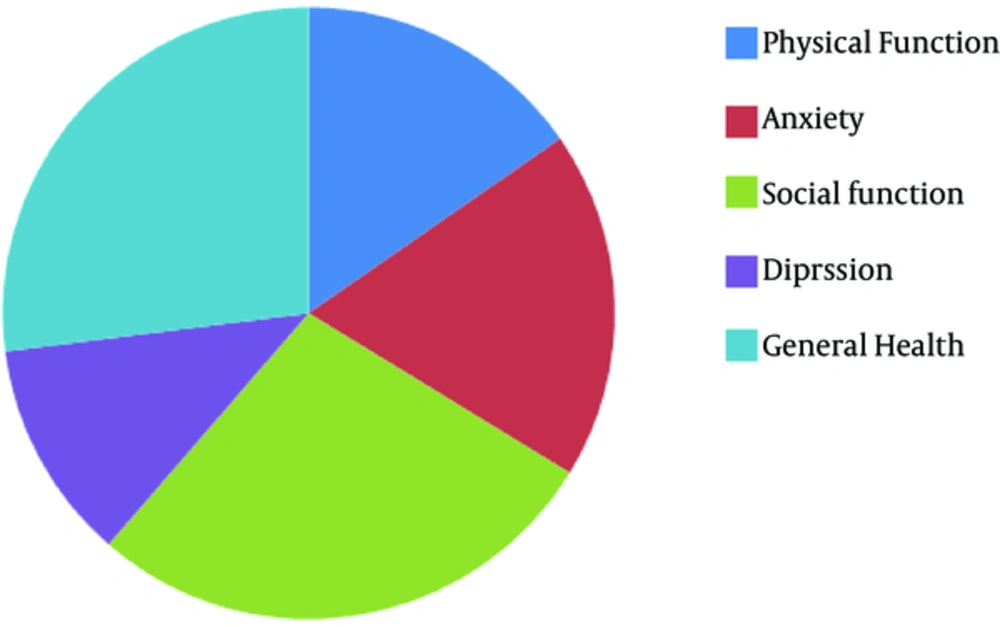
Figure 1.
Ration of the Subjects with Mental Health Scores Higher Than the Cutoff Point
25% of the subjects had higher scores than the cutoff point in physical function; 30% had higher scores in anxiety, 45% in social function, 19% in depression, and 44% in general health (Figure 1).
The correlation coefficient between general health and its subscales, and marital satisfaction are indicated in Table 2.
Table 2. Correlation Between General Health and its Subscales, and Marital Satisfaction
| The Variable | Statistical Index Predictive Variable | R | P Value | N |
|---|---|---|---|---|
| Marital satisfaction | Total score | -0.53 | < 0.001 | 100 |
| Physical symptoms | -0.51 | < 0.001 | ||
| Anxiety/insomnia | -0.49 | < 0.001 | ||
| Social dysfunction | -0.34 | 0.002 | ||
| Depression | -0.33 | 0.002 |
As shown in Table 2 there was statistically significant correlation between the total score of general health and marital satisfaction (r = -0.53, P value = 0.04). The correlation between subscales of general health and marital satisfaction was as fallow:
Physical symptoms (r = -0.51, P value = 0.001), anxiety/insomnia (r = -0.49, P value = 0.001), social dysfunction (r = -0.34, P value = 0.002), and depression (r = -0.33, P value = 0.002).
4. Discussion
The current study aimed at investigating the association between mental health and marital satisfaction. The findings indicated the significant association between these variables that meant marital status may affect and be affected by the mental health. Problems in mental health may lead to marital dissatisfaction and vice versa.
The findings were in line with the results of previous studies in the same area (6-13). In contrast, Thabet et al. (2009) did not find a correlation between marriage satisfaction and depression, and results of the study conducted by Skandari (2008) did not indicate any associations between depression and anxiety with marital satisfaction (17, 20). Shahi et al. found a negative correlation between marital satisfaction and anxiety, depression, and obsession-compulsion, although they did not find a correlation between marital satisfaction and total score of mental health (21).
The current study results were also consistent with the finding that depression and anxiety disorders were related to interpersonal dysfunction (22).
Anxiety may cause interpersonally destructive behaviors, moreover, anxiety disorders tend to precede onset of comorbid depression (22). People with depression may tend to have a negative view toward the world that encompasses their view of their spouse and marital relationship. On the other hand, people with depression experience more complications with their spouse experiencing depression (21). They emit negative verbal and nonverbal messages in their interactions (17). Therefore, the more levels of depression the individuals’ experience, the less satisfaction they have with their marriage and vice versa.
Some investigations suggest that anxiety causes less disruption in relationship than depression (11). But, the current study found more correlation coefficient between the anxiety and marital satisfaction rather than depression (0.49 versus 0.33).
The differences between the studies might be somewhat due to features of subjects and methodological differences in the assessment of psychological factors.
Overall, the current study results indicated that marital dissatisfaction was related to a wide variety of mental health problems. To explain the results, mental disorders decrease the chance of a satisfactory communication (23). People with mental health disorders decrease their communication with family and society (24). Many studies found a large part of communication problems and divorce among people with intense mental disorders, depression, and substance abuse and some anxiety disorders. On the other hand, marital discord can be particularly distressing for spouses as it can lead to an unpleasant emotional climate in the family, and threaten the individuals’ emotional and physical well-being (25). Moreover, people with higher level of marital satisfaction use more effective and useful coping strategies. They experience deeper affection and higher general health.
4.1. Conclusions
In conclusion, the current study results showed that mental health and its subscales including anxiety, depression, social dysfunction, and physical symptoms were some factors that associated with marital dissatisfaction. Therefore, prevention and intervention efforts can focus on the way mental health problems can trigger interpersonal relationships.
Several limitations should, however, be taken into account. The majority of subjects were highly educated, which means the findings should be generalized to other groups or those with a different level of education with caution.
The questionnaires employed in the current study were the self-reporting questionnaires. There is the possibility of underreport or overreport by the respondents; there was no definitive way to confirm the accuracy of the answers. However, participants were assured of anonymity and confidentiality of data before completing the questionnaires. A self-selection bias is also possible as participation in the study was voluntary. Moreover, the study was cross sectional and results showed just the correlation between 2 variables (marital satisfaction and general health), proving the casual relationship needs longitudinal and controlled studies.
