
1. Background
The health and safety of workers in developing countries, such as Iran, which is thinking of industrial growth, is of utmost importance. Physical and/or mental disorders reduce the performance of workers and lead to unemployment (1, 2). Given that society pays attention to physical illness, the occurrence of any abnormalities in this field is well documented. But, unfortunately, mental disorders are often not addressed and late detection or lack of recognition leads to reduction in the quality and quantity of work (3). Therefore, promoting mental health in the workplace has been considered as one of the most important aspects of human resource development in the last few decades and has attracted the attention of organizations to attract healthy physical and intellectual labor forces to increase productivity level (4).
The World Health Organization (WHO) defines mental health as follows: “a state of well-being in which every individual realizes his or her own potential, can cope with the normal stresses of life, can work productively and fruitfully, and is able to make a contribution to her or his community”. The positive dimension of mental health is stressed in WHO’s definition of health as contained in its constitution: “Health is a state of complete physical, mental and social well-being and not merely the absence of disease or infirmity” (5).
Nowadays, mental health problems in the labor force are considered as a major issue, because mental disorders, depression, and occupational burnout affect a large share of workers. In Europe and the United States, it is estimated that the prevalence of mental disorders among employees is between 15% and 20% (6). Studies have shown that mental disorders can have adverse effects on occupational productivity and impose high costs on workplaces. In Japan’s workers associations, it was found that depression reduces occupational performance significantly (7). In Iran, several studies have been carried out on investigating the mental health of employees in various occupations. In the automotive industry, it was found that physical disorders and anxiety symptoms had the highest prevalence (8). According to the results of epidemiological studies, the prevalence of suspected cases of mental disorders in industrial jobs is between 20% and 37% (9-11). In occupations such as firefighting where the safety of personnel is always at risk, the prevalence of mental disorders is estimated at 15% (12).
Working in pharmaceutical companies, especially in the production line of anticancer drugs, due to the direct contact of personnel with cytotoxic materials, despite the use of standard safety covers, is associated with health hazards that can lead to mental distress of employees. Many studies have been carried out on the status of the mental health of the labor force, but these results can’t be generalized for employees working in the industry for the production of anticancer drugs. Only during a study in Canada, it was concluded that workers who were more exposed to chemical, neurotoxic and toxic substances reported more symptoms of mental disorders (13).
2. Objectives
This study was carried out aiming to investigate the status of mental health and its various dimensions (somatic symptoms, anxiety and insomnia, social dysfunction and severe depression) among the employees. The specific objectives of the present study include: (1) determining the relationship between the age of employees with different dimensions of mental health; (2) determining gender differences in terms of different dimensions of mental health; (3) determining the differences between different organizational units in terms of general index of mental health; (4) determining the difference between employees working in supportive and executive departments in terms of different dimensions of mental health; and (5) anticipating the general index of mental health in terms of the work experience inside and outside the company separately. This study provides the first findings from mental health survey and relevant factors in a factory with a production line of cytotoxic drugs. The results of this study can be useful for making decisions in the field of management and preventive interventions for promoting the mental health of employees working in the pharmaceutical industry.
3. Methods
This study, as an observational (non-experimental) and analytical research was carried out using the cross-sectional method. The statistical population included all employees of a pharmaceutical company in the industrial site of the city of Rasht, who were working in 2017 (n = 137). Due to the small size of our population, I have tried to select all the employees working in 10 organizational units of this company (i.e. quality assurance, R&D, planning and warehousing, laboratory, technical-engineering, production/manufacturing, financial-accounting, human resources and managers) using census sampling method. 122 employees (89%) participated in the present study, and other employees were not included in the sample due to leave and assignments outside of the company. Data collection tools in this study included two questionnaires:
(A) The demographic information questionnaire of employees, through which information such as age, gender, age, marital status, level of education, organizational position, organizational unit, work experience in the current company and work experience outside the company were gathered with the approval and coordination of the human resources manager in collaboration with the expert of this department.
(B) 28-item general health questionnaire (GHQ-28): the original text of this questionnaire was developed by Goldberg and Hillier (14). This questionnaire has four 7-item subscales, including somatic symptoms, anxiety and insomnia, social dysfunction and severe depression. The employees under study specified their status regarding questionnaire items based on their health status during the past month. This questionnaire was scored based on the Likert scale (0 - 1 - 2 - 3) in which the range of scores varies from 0 to 84, and higher scores would mean more mental symptoms. I considered the overall score of employees in GHQ-28 in this study as a general indicator of their mental health. The proposed cut-off point for this scoring method for each of the subscales is 6 and for the entire questionnaire is 23 (11, 15, 16). According to the results of the psychometric studies conducted based on the cutoff point of 23, the sensitivity, specificity, and error of general classification of GHQ-28 would be optimal (15). In the present study, the Cronbach’s alpha coefficient of this questionnaire was 0.91, which indicates that the internal consistency of this tool is well in measuring the desired variable. SPSS software (version 22) with acceptable level of P ≤ 0.05 was used to perform all statistical analyses. The tests used included Pearson correlation, Independent t-test, Fisher’s exact test, and multiple regression analysis.
4. Results
101 males and 20 females (n = 122) participated in the present study, their average age was 33.8 ± 4.7, ranging from 23 to 49 years old. According to the results of investigating mental health status in the whole sample, 30 people (24.6%) had somatic symptoms, 26 (21.3%) had symptoms of anxiety and insomnia, 56 people (45.9%) had social dysfunction, 6 People (4.9%) had depressed mood and 21 people (17.2%) were suspected of having a mental disorder. The demographic information of employees according to their mental health status is shown in table-1.
Table 1.
Demographic Information of Employees According to Their Mental Health Status (N = 122)
| Mental Health Statusa | Test (Statistic) | P Value | ||
|---|---|---|---|---|
| Healthy (N = 101) | Suspected (N = 21) | |||
| Age, y | 34.09 ± 4.56 | 32.68 ± 3.48 | t (1.269)b | 0.207 |
| Gender | ||||
| Male | 85 (84.2) | 16 (80) | χ2 (0.647) | 0.742 |
| Female | 16 (15.8) | 4 (20) | ||
| Marital status | ||||
| Single | 18 (19.8) | 5 (31.2) | χ2 (0.303) | 0.328 |
| Married | 73 (80.2) | 11 (68.8) | ||
| Education | ||||
| High school & diploma | 34 (33.7) | 7 (33.3) | χ2 (0.001) | 1.000 |
| Associate | 14 (13.9) | 3 (14.3) | χ2 (0.003) | 1.000 |
| Bachelor’s degree | 26 (25.7) | 7 (33.3) | χ2 (0.196) | 0.589 |
| Postgraduate & higher | 27 (26.7) | 4 (19) | χ2 (0.212) | 0.587 |
| Organizational position | ||||
| Manager & director | 9 (8.9) | 3 (14.3) | χ2 (0.122) | 0.432 |
| Superintendent | 13 (12.9) | 2 (9.5) | χ2 (0.004) | 1.000 |
| Expert | 30 (29.7) | 4 (19) | χ2 (0.532) | 0.427 |
| Technician & operator | 29 (28.7) | 9 (42.9) | χ2 (1.029) | 0.207 |
| Laborer | 20 (19.8) | 3 (14.3) | χ2 (0.137) | 0.763 |
| Work experience (in month) | ||||
| Current company | 51.67 ± 34.29 | 48.94 ± 22.46 | t (0.315)b | 0.753 |
| Previous companies | 32.97 ± 40.93 | 19.88 ± 25.70 | t (1.737)c | 0.092 |
Abbreviation: χ2, Fisher’s exact test.
aValues are expressed as mean ± SD or No. (%).
bIndependent t-test.
cIndependent t-test with unequal variances.
As shown in Table 1, there is no significant difference between the two groups with and without mental problems in terms of age, gender, marital status, educational level, organizational position and work experience. Table 2 shows the relationship between the age of employees with different dimensions of their mental health by calculating Pearson’s correlation coefficient.
Table 2.
Relationship Between Mental Health Dimensions and the Age of Employees (N = 122)
| Dimensions | Somatic Symptoms | Anxiety/Insomnia | Social Dysfunction | Severe Depression | GHQ-28 Total Score |
|---|---|---|---|---|---|
| Pearson’s r | -0.25 | -0.19 | -0.21 | -0.06 | -0.23 |
| P value | 0.005 | 0.039 | 0.018 | 0.460 | 0.011 |
According to Table 2, there is an inverse relationship between the age and the various dimensions of mental health of the employees. That is, as the age increases, the amount of symptoms reduces (especially in the somatic and social dysfunction aspects). In other words, as the age of employees reduces, they report more symptoms in the somatic and social dysfunction aspects. Table 3 shows the results of independent t-test for determining gender differences in terms of different dimensions of mental health.
Table 3.
Comparison of Two Groups of Male and Female Employees in Terms of Mental Status (N = 122)
| Dimensions Gender | No. | Mean ± SD | t | df | P Value |
|---|---|---|---|---|---|
| Somatic symptoms | 0.738 | 120 | 0.426 | ||
| M | 102 | 4.26 ± 3.63 | |||
| F | 20 | 4.90 ± 2.82 | |||
| Anxiety/insomnia | 0.430 | 120 | 0.668 | ||
| M | 102 | 4.20 ± 3.32 | |||
| F | 20 | 4.55 ± 3.02 | |||
| Social dysfunction | 0.506 | 120 | 0.614 | ||
| M | 102 | 6.51 ± 2.83 | |||
| F | 20 | 6.85 ± 2.25 | |||
| Severe depression | -0.466 | 120 | 0.642 | ||
| M | 102 | 1.78 ± 2.52 | |||
| F | 20 | 1.50 ± 2.37 | |||
| GHQ-28 total score | 0.428 | 120 | 0.670 | ||
| M | 102 | 16.76 ± 10.12 | |||
| F | 20 | 17.80 ± 8.61 |
As shown in Table 3, there is no significant difference between male and female employees in terms of mental health and its different dimensions. In other words, there is no significant relationship between the mental health of the factory’s employees regarding their gender (P > 0.05). Figure 1 shows the differences between organizational units in terms of overall mental health. In addition, independent t-test results were calculated in order to compare each organizational unit with the mean overall index of the mental health of the factory (as the basis for comparison).
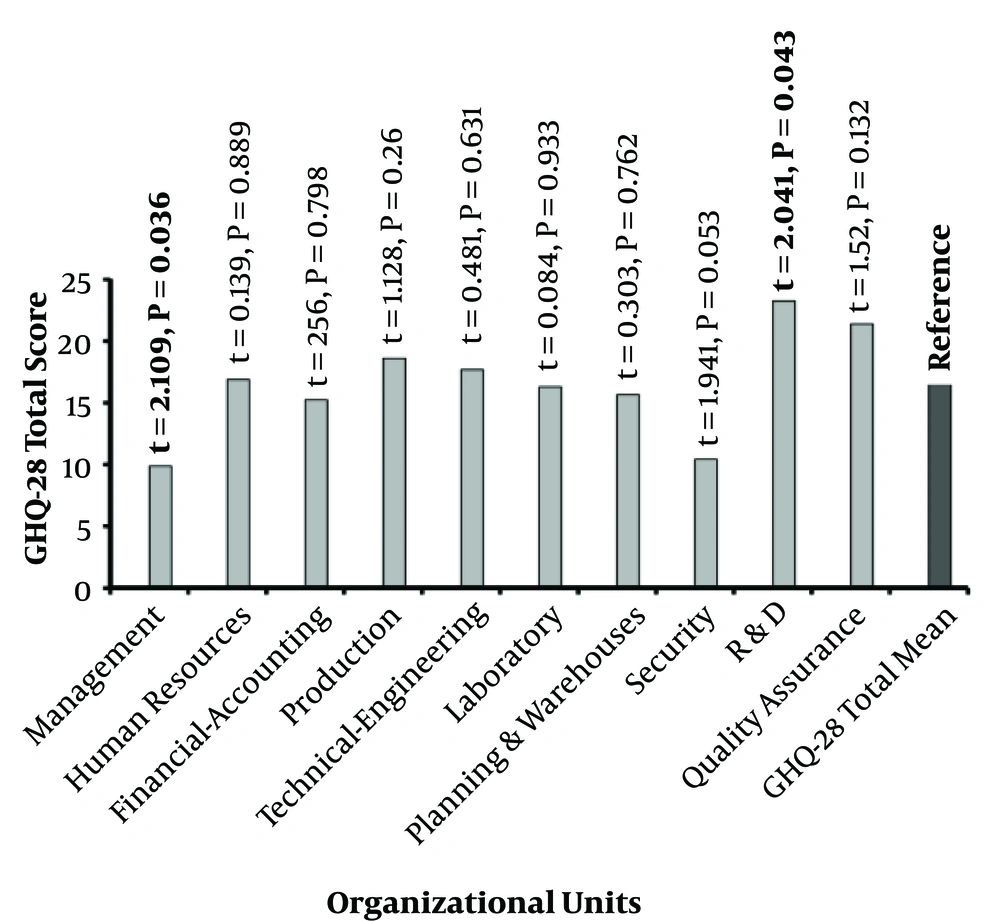
Figure 1.
Difference between organizational units in terms of overall index of mental health (n = 122)
As shown in Figure 1, there is a significant difference between total score of GHQ-28 for the management and R&D departments with the mental health index of the factory (GHQ-28 total mean = 19.93; P < 0.05); that is, managers and employees of R&D department reported the least and the most psychological symptoms. In addition, the t-value for the security unit was just borderline significant (P = 0.053), indicating that the employees of this department experienced symptoms less than the average. Table 4, shows the difference between the employees working in supportive and executive departments in terms of different dimensions of mental health based on independent t-test. Our hypothesis was that employees involved in production who are in direct exposure to products show more mental symptoms. In the present study, the executive department is referred to as a unit that is involved in executive activities such as engineering, laboratory and production. Also, supportive department are units that support the production process to reach the goals of the organization, which include the units of human resources, security, financial-accounting, planning and warehouses units, security, R&D, and quality assurance (Table 4).
Table 4.
Comparison of Employees Working in Executive and Supportive Departments in Terms of Different Dimensions of Mental Health (N = 122)
| Dimensions Units | No. | Mean ± SD | t | df | P Value |
|---|---|---|---|---|---|
| Somatic symptoms | |||||
| Executive | 52 | 4.63 ± 3.90 | 0.71 | 120 | 0.474 |
| Supportive | 70 | 4.17 ± 3.20 | |||
| Anxiety/insomnia | |||||
| Executive | 52 | 4.26 ± 3.62 | 0.02 | 120 | 0.984 |
| Supportive | 70 | 4.25 ± 2.99 | |||
| Social dysfunction | |||||
| Executive | 52 | 6.94 ± 2.82 | 1.31 | 120 | 0.192 |
| Supportive | 70 | 6.28 ± 2.66 | |||
| Severe depression | |||||
| Executive | 52 | 1.82 ± 2.69 | 0.34 | 120 | 0.734 |
| Supportive | 70 | 1.67 ± 2.34 | |||
| GHQ-28 total score | |||||
| Executive | 52 | 17.67 ± 10.77 | 0.71 | 120 | 0.478 |
| Supportive | 70 | 16.38 ± 9.16 |
According to Table 4, there is no difference in terms of mental health between the two groups of the employees of executive and supportive departments. In other words, there is no relationship between the mental health status of employees and their job departments. The results of multiple regression analysis (enter method) including determination coefficient (R2), standard error of estimation (SEE), t-values, β coefficients, significance level and variance inflation factor (VIF), in which two variables of work experience inside and outside the company (in month) are used to predict the total score of mental health.
Table 5.
Determining the Relationship and Prediction of Mental Health in Terms of the Work Experience Inside and Outside the Company (N = 122)
| Work Experience (in Month) | SEE | β | t | P Value | VIF | Durbin-Watson |
|---|---|---|---|---|---|---|
| Current company | 0.029 | 0.059 | 0.616 | 0.539 | 1.035 | 1.760 |
| Previous companies | 0.024 | -0.210 | -2.187 | 0.031 | 1.035 | |
| Model summary | R = 0.21 , R2 = 0.04 , F (2, 107) = 2.42, P = 0.094 | |||||
According to Table 5 for the Durbin-Watson test, the assumption of the independence of errors is true for performing regression analysis. Also, the values of VIF is less than 2 which indicates an absence of multicollinearity. However, there was a weak multivariate relationship between work experience and mental health levels of employees (R = 0.21). Also, the duration of work experience inside the company does not predict the level of mental health. Instead, there is a significant and inverse relationship between work experience outside the company and the mental health of the employees (β = -0.21, P = 0.031). That is, the employees with less work experience outside the company (or without work experience) experience more psychological symptoms after entering the company, and on the contrary, employees with more work experience outside the company, experience less psychological symptoms after entering the company.
5. Discussion
This study was carried out aiming to investigate the mental health status and related demographic features among employees of a pharmaceutical company. By using a standard mental health measurement tool (15) in the Iranian community (GHQ-28), I concluded that the prevalence of suspected mental disorders in this company was less than one-fifth (17.2%). This result was consistent with some studies on the employees of the oil refining industry (9) and jobs threatening safety such as firefighting (12), and was inconsistent with some other studies that reported a higher prevalence of mental disorders among the employees of the nuclear industry (17), the porcelain manufacturing companies (10), and the mine (11). The reason for this variety of results can be attributed to the nature of the industry involved, the use of different mental health measurement tools with different cut-off points, age and educational level of the samples under study.
Participants in this study reported social dysfunction as the most common symptom in mental health assessment (45.9%). Surveys taken on the employees in the printing industry (18) and miners (11) confirm this finding, but a study conducted on the oil refining industry has introduced depression as the most common mental disorder of workers (19). It is understandable to achieve these different results due to the unique conditions needed for each industrial business. However, according to our results, in order to improve social functioning, I suggest industrial managers to plan a qualitative needs assessment to determine the factors affecting disrupting the interpersonal relationships between employers and workers.
According to the results of studies which were consistent with this study (19), it was concluded that younger employees experience more mental symptoms (especially in the field of somatic and social dysfunction), although, some studies were inconsistent with these results (10). However, it is suggested that, in order to ensure the mental safety of the younger employees, the manager, supervisor and highly experienced individuals in the relevant organizational unit, protect younger employees and to help them adapt and socialize within the factory. According to the results, the presence of a highly experienced educator/mentor in the organization can help improve the mental status of vulnerable people (20, 21).
Another interesting result was that no difference was observed between men and women in terms of the different dimensions of mental health. This finding suggests that the managerial trends governing this factory have sought to remove gender discrimination which is common in other work environments (22) and inhibit the vulnerability of the women, which are more likely to experience mental discomfort in male working environments who are suffering from gender discrimination in other male-driven work places (23).
Along with past mental health surveys in the industry (8), I thought that, compared to supportive employees, employees involved in manufacturing/executing units would suffer more mental health symptoms (especially in depression, somatic and anxiety aspects), but observing the lack of the difference in these two groups in this study suggests that the expert, health/safety and managerial processes in the factory have succeeded in eliminating the differences between the two groups in terms of psychological symptoms (in other words, it plays a protective role for the employees of the executive-manufacturing units). However, after investigating the mental health index of each organizational unit by the factory average, it was concluded that the security and management units had the least mental disorders and the employees of the R&D unit had the most psychological symptoms. These differences may be due to job expectations, and the organizational role of employees. In any case, it is suggested that for groups with the most psychological symptoms, classes be organized for occupational problem solving. Previous research findings have made clear that these kinds of educational interventions help reduce work-related mental problems (24).
According to the latest result of this study, having more work experience outside the company (and other industries) could play a protective role against the onset of psychological symptoms after hiring inside the factory, but the variables of work experience inside the factory did not play a serious role. These two variables are not differentiated by previous studies, and generally have concluded that an increase in work experience is associated with a higher frequency of mental disorder (12) or there is no significant relationship between them and mental health (9). Differences in the samples and jobs under study prevent providing a clear interpretation of this result. However, according to this result, it can be expected that employees with no previous work experience outside the company will experience more severe psychological symptoms upon arrival/hiring than employees with previous work experience. It is suggested that, due to the importance and the sensitivity of producing anticancer drug-related jobs, this result is to be considered while recruiting new labor forces and employees hired are to be experienced in the related industries. Some major constraints of this study include small sample size, especially in intergroup demographic comparisons, the lack of generalizability of the findings of this study to other industrial occupations.
5.1. Conclusions
According to the results of the present study, younger employees and those with no work experience (or with less work experience) may be more at risk of mental disorder. But in terms of gender, the type of occupation (executive and supportive departments), no significant difference was observed in terms of the different aspects of mental health. Also, less than one in five (17%) suffer from mental distress. Therefore, it is essential, in view of the importance of the services provided by the pharmaceutical industry, those working in these environments periodically undergo screening and psychological interventions to prevent their mental health.