Fulltext
Fulltext is available in pdf file.
Jentashapir Journal of Cellular and Molecular Biology
Official Journal of Ahvaz Jundishapur University of Medical Sciences
Image Credit:Jentashapir J Cell Mol Biol
Authors
Background: Although advances in technology and increased use of production machinery have decreased manpower role, many industrial sites have exposed human resources to various dangers and a small mistake can often cause irreversible injuries. The purpose of this study was to analyze certain jobs and to detect the possible human errors in the steam boiler room of dairy industry using the PHEA method.
Materials and Methods: In this study data were collected through two steps: In the first step, using observation, investigation, and documentation techniques, all tasks of involved employees in process were identified. Then, with respect to the obtained results, critical tasks were selected to analyze the human errors. In the second step, the error description (and consequences resulted from it) were determined. Several action plans for mitigation and elimination of human errors are also recommended.
Results: The results have shown that most errors were characterized as "control is not true," with 110 repetitions, and the second type of errors "does not do the control" were obtained with 108 repetitions. For identified errors, 11 cases with 453 frequencies were identified. Most human-error causes were found as the forgotten, negligence and busy factors with the frequencies of 117,111, 111, respectively.
Conclusion: The results showed that PHEA technique can be used as an effective method to detect human errors and assess the consequences of the hazards resulted from the errors in the complex tasks.
© 2013, Jentashapir Journal of Cellular and Molecular Biology. This open-access article is available under the Creative Commons Attribution-NonCommercial 4.0 (CC BY-NC 4.0) International License (https://creativecommons.org/licenses/by-nc/4.0/), which allows for the copying and redistribution of the material only for noncommercial purposes, provided that the original work is properly cited.
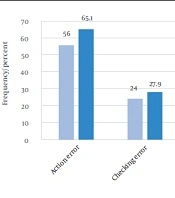
Mohammadi Sarableh H, Moradi Z, Ghanbari M, Elyasi H, Emami K. Prediction and Assessment of Human Errors in Control Room of a Steam Power Plant by SHERPA Method in 2021. J Health Rep Technol. 2023;9(2):e132572. doi: https://doi.org/10.5812/jhrt-132572
Mortazavi B, Mahdavi S, Asilian H, Arghami S, Gholamnia R. Identification and Assessment of Human Errors in SRP Unit of Control Room of Tehran Oil Refinery Using HEIST Technique)2007(. J Kermanshah Univ Med Sci. 2008;12(3):e79969. doi:
Khandan M, Yusefi S, Sahranavard R, Koohpaei A. SHERPA Technique as an Approach to Healthcare Error Management and Patient Safety Improvement: A Case Study among Nurses. Health Scope. 2017;6(2):e37463. doi: https://doi.org/10.5812/jhealthscope.37463

Asilian H, Valadkhani A, Mortazavi S, Salem M, Khavanin A. Assessment of factors associated with explosion of gas-fuel in fire-tube boilers. J Inflamm Dis. 2024;10(4):e155266. doi:

Kherkhah A, Gholamnia R, Kavousi A. Evaluation of the Establishment of the Emergency Management System Based on Health, Safety, and the Environment Management System and Oil and Gas Producers Standards. J Inflamm Dis. 2024;23(1):e156146. doi:
More by these authors
Last Update: 1 week ago
Last Update: 1 week ago
Last Update: 1 week ago
Last Update: 5 hours ago
Last Update: 9 hours ago
Last Update: 5 days ago