Journal of Kermanshah University of Medical Sciences
Peer-reviewed Medical Quarterly
e-ISSN 2588-2570
p-ISSN 2588-2562
Image Credit:J Kermanshah Univ Med Sci
Outline
Epidemiologic aspects of cutaneous Leishmaniasis and trapeutic effect of traditional ointment containing onion juice compared with Amphotricin B
Authors
1Dept. of Vet. Pathology, School of Veterinary, Ilam University, Ilam, Iran
2Dept. of Clinical Epidemiology, Ilam University of Medical Sciences, Ilam, Iran
3Dept. of Biology, Payam Nour University, Ilam, Iran
*Corresponding Author: Corresponding author: Ali Mohammad Bahrami, Dept. of Vet. Pathology, School of Veterinary, Ilam University, Ilam, Iran, Tel: +98 841 2224308 Email: am_bahram2002@yahoo.com
Published online:Nov 19, 2011
Article type:Research Article
Received:Aug 15, 2010
Accepted:Dec 07, 2010
How to Cite:Bahrami AM, Delpisheh A, Zamandousti A. Epidemiologic aspects of cutaneous Leishmaniasis and trapeutic effect of traditional ointment containing onion juice compared with Amphotricin B. J Kermanshah Univ Med Sci. 2011;15(4):e79304. doi:
Abstract
Background: Leishmaniasis including visceral and cutaneous types is an endemic disease in some parts of our country. The current study aimed to investigate some epidemiologic aspects of Cutaneous Leishmaniasis (CL) and comparing the effects of a traditional ointment and Amphotricin B.
Methods: This prospective longitudinal cohort study was conducted to evaluate epidemiologic pattern of CL and comparing different trapeutic agents including Amphotricin B and local traditional ointment containing onion juice in Mehran- Ilam province, Western Iran during 2003-2008. 150 confirmed cases (40 case in topical treatment group and 100 cases in Amphotricin group) out of 925 suspected patients were enrolled into the study. Diagnosis criteria were based on biopsy and microscopic findings.
Results: CL prevalence was significantly increased from 16% in 2003 to 25.3% in 2008 (P<0.001). Mean age of patients was 23.1±6.4 years and male gender and age 16 to 24 years were risk factors to involving CL (P=0.05). Healing period was 133±15 days for patients who administered traditional ointment and 120±12 days for Amphotericin B group (P<0.02). Local itching was observed more frequently in Amphotericin B than traditional ointment (P=0.04).
Conclusion: Increasing CL trend in this tropical area is a real threat for shifting from an endemic to an epidemic disease, which needs serious attention. It seems that the traditional medicine have noticeable effects on CL treatment, so it can be a potential alternative medicine after achieving appropriate technology and performing randomized clinical trials.
Highlights
References
- 1.The references of this article is available on PDF.
Copyright
© 2011, Journal of Kermanshah University of Medical Sciences. This open-access article is available under the Creative Commons Attribution-NonCommercial 4.0 (CC BY-NC 4.0) International License (https://creativecommons.org/licenses/by-nc/4.0/), which allows for the copying and redistribution of the material only for noncommercial purposes, provided that the original work is properly cited.
Similar Articles
19
Oct
2014
Cutaneous Leishmaniasis in Isfahan Province, Iran, During 2001-2011
Mohammad Ali Nilforoushzadeh,
Leila Shirani Bidabadi,
Sayed Mohsen Hosseini,
Reza Fadaei Nobari,
Fariba Jaffary
Nilforoushzadeh MA, Shirani Bidabadi L, Hosseini SM, Fadaei Nobari R, Jaffary F. Cutaneous Leishmaniasis in Isfahan Province, Iran, During 2001-2011. J Skin Stem Cell. 2014;1(2):e23303. doi: https://doi.org/10.17795/jssc23303
25
Jul
2015
Epidemiological Aspects of Cutaneous Leishmaniasis in Iran
Salman Khazaei,
Abdollah Mohammadian Hafshejani,
Mohammad Saatchi,
Hamid Salehiniya,
Shahrzad Nematollahi
Khazaei S, Mohammadian Hafshejani A, Saatchi M, Salehiniya H, Nematollahi S. Epidemiological Aspects of Cutaneous Leishmaniasis in Iran. Arch Clin Infect Dis. 2015;10(3):e28511. doi: https://doi.org/10.5812/archcid.28511
28
Dec
2011
Cutaneous leishmaniasis in Hamadan, Iran (2004-2010)
Mansour Nazari
Nazari M. Cutaneous leishmaniasis in Hamadan, Iran (2004-2010). Zahedan J Res Med Sci. 2012;13(9):e93714. doi:
27
Jan
2021
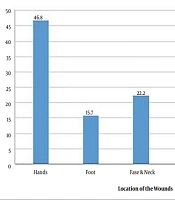
Epidemiological Status of Cutaneous Leishmaniasis in Mashhad, Northeastern Iran, During 2015 - 2019
Abdolmajid Fata,
Behzad Kiani,
Amene Raouf Rahmati,
Maryam Tayefi,
Faezaeh Moradinejad,
Elham Moghaddas
Fata A, Kiani B, Raouf Rahmati A, Tayefi M, Moradinejad F, et al. Epidemiological Status of Cutaneous Leishmaniasis in Mashhad, Northeastern Iran, During 2015 - 2019. Zahedan J Res Med Sci. 2021;23(1):e91191. doi: https://doi.org/10.5812/zjrms.91191
29
Dec
2013
The Analytical study of Cutaneous Leishmaniasis in Kermanshah (2011-2012)
Yazdan Hamzavi,
Nahid Khademi
Hamzavi Y, Khademi N. The Analytical study of Cutaneous Leishmaniasis in Kermanshah (2011-2012). J Kermanshah Univ Med Sci. 2013;17(9):e74344. doi:
More by these authors
Cited by
- Scopus by DOI: 0
Last Update: 2 weeks ago
- Scopus by Title: 0
Last Update: 2 weeks ago
- Scopus by Title (Ref): 2
Last Update: 2 weeks ago
- CrossRef: 0
Last Update: 6 hours ago
- OpenAlex: 0
Last Update: 1 day ago
- OpenCitations: 0
Last Update: 4 days ago
Comments
Number of Comments:0