Journal of Kermanshah University of Medical Sciences
Peer-reviewed Medical Quarterly
e-ISSN 2588-2570
p-ISSN 2588-2562
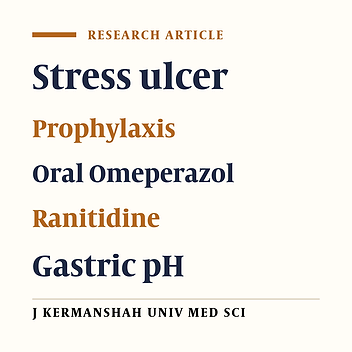
Image Credit:J Kermanshah Univ Med Sci
Outline
The effect of Omeprazol and Ranitidine on gastric acidity in ICU patients
Authors
1Dept. of Internal Ward, School of Medicine Kermanshah University of Medical Sciences, Kermanshah, Iran
*Corresponding Author: Corresponding author: Ghobad Salimi, Dept. of Internal Ward, School of Medicine Kermanshah University of Medical Sciences, Kermanshah, Iran, Tel: +98 831 7278759 Email: ghsalimi2002@yahoo.com
Published online:Mar 19, 2010
Article type:Research Article
Received:May 19, 2009
Accepted:Sep 22, 2009
How to Cite:Salimi G, Navabi SJ, Jangi Oskoie N. The effect of Omeprazol and Ranitidine on gastric acidity in ICU patients. J Kermanshah Univ Med Sci. 2010;13(4):e79580. doi:
Abstract
Background: ICU patients especially those under mechanical ventilation or with a history of coagulation disorders are at the risk of stress ulcer development and related GI bleeding. Typically H2 blockers administration showed prophylactic role to control gastric acidity. Preliminary studies have shown that administration of intravenous Omeperazol is effective. The object of this study was to compare the effect of oral rout administration of Omeprazol with intravenous Ranitidine on gastric pH.
Methods: In this experimental study 40 ICU patients under mechanical ventilation allocated into same conditions and matched Ranitidine and Omeprazol groups (20 subjects in each group). First group received 50 mg intravenous Ranitidine twice per day and the second group received 40 mg oral Omeperazol once a day. The gastric acidity was monitored using Chorning method. Gastric pH was determined before administration and three times per day after drugs administration then followed for three consequent days. Data was analysed using T-test and SPSS software.
Results: The mean gastric pH in the Ranitidin group was 2.07±0.79 before and 2.80±0.85 after drug administration. In the Omeperazol group gastric pH was 2.01±1.52 before and 3.90± 1.52 after drug administration. The oral Omeperazol administration was significantly effective than intravenous Ranitidine administration (p <0.005).
Conclusion: Our data suggest that in critically ill patients oral rout administration of Omeperazol is more effective than intravenous H2 blocker (Ranitidine) to decrease gastric acidity and may prevent from stress ulcer.
Highlights
References
- 1.The references of this article is available on PDF.
Copyright
© 2010, Journal of Kermanshah University of Medical Sciences. This open-access article is available under the Creative Commons Attribution-NonCommercial 4.0 (CC BY-NC 4.0) International License (https://creativecommons.org/licenses/by-nc/4.0/), which allows for the copying and redistribution of the material only for noncommercial purposes, provided that the original work is properly cited.
Similar Articles
30
Dec
2010
Comparison of Oral Pantoprazole and Famotidine on Gastric Vol-ume and Ph in Elective Surgeries
Hamzeh Hosseinzadeh,
Mohamad Hossein Somi,
Jafar Rahimipanahi,
MahMahmood Eidi
Hosseinzadeh H, Somi MH, Rahimipanahi J, Eidi M. Comparison of Oral Pantoprazole and Famotidine on Gastric Vol-ume and Ph in Elective Surgeries. Shiraz E-Med J. 2010;12(2):. doi:
31
Oct
2012
Effects of Pantoprazole on Systemic and Gastric Pro- and Anti-inflammatory Cytokines in Critically Ill Patients
Hamed Tabeefar,
Mohammad Taghi Beigmohammadi,
Mohammad Reza Javadi,
Mohammad Abdollahi,
Ata Mahmoodpoor,
Arezoo Ahmadi
,et al.Tabeefar H, Beigmohammadi MT, Javadi MR, Abdollahi M, Mahmoodpoor A, et al. Effects of Pantoprazole on Systemic and Gastric Pro- and Anti-inflammatory Cytokines in Critically Ill Patients. Iran J Pharm Res. 2012;11(4):e125879. doi: https://doi.org/10.22037/ijpr.2012.1196
6
Mar
2005
The effect of prophylaxis therapy on prevention from gastrointestinal bleeding in ICU in patients
SK Nezam,
Shahram Borjian Boroojeny,
Omid Rahati
Nezam S, Borjian Boroojeny S, Rahati O. The effect of prophylaxis therapy on prevention from gastrointestinal bleeding in ICU in patients. Zahedan J Res Med Sci. 2005;7(3):e94935. doi:
13
Oct
2020
Ultrasonographic Assessment of Metoclopramide Administration Effectiveness in Accelerating Gastric Emptying Before Urgent Surgery in Patients with Insufficient NPO Time
Shahram Sayyadi,
Masoomeh Raoufi,
Ali Arhami Dolatabadi,
Marzieh Rostami,
Elham Memary
Sayyadi S, Raoufi M, Arhami Dolatabadi A, Rostami M, Memary E. Ultrasonographic Assessment of Metoclopramide Administration Effectiveness in Accelerating Gastric Emptying Before Urgent Surgery in Patients with Insufficient NPO Time. Anesth Pain Med. 2020;10(5):e107331. doi: https://doi.org/10.5812/aapm.107331
6
Dec
2013
Magnesium Can Decrease Postoperative Physiological Ileus and Postoperative Pain in Major non Laparoscopic Gastrointestinal Surgeries: A Randomized Controlled Trial
Reza Shariat Moharari,
Majid Motalebi,
Atabak Najafi,
Mohammad Mahdi Zamani,
Farsad Imani,
Farhad Etezadi
,et al.Shariat Moharari R, Motalebi M, Najafi A, Zamani MM, Imani F, et al. Magnesium Can Decrease Postoperative Physiological Ileus and Postoperative Pain in Major non Laparoscopic Gastrointestinal Surgeries: A Randomized Controlled Trial. Anesth Pain Med. 2014;4(1):e12750. doi: https://doi.org/10.5812/aapm.12750
More by these authors
Cited by
- Scopus by DOI: 0
Last Update: 3 weeks ago
- Scopus by Title: 0
Last Update: 3 weeks ago
- Scopus by Title (Ref): 1
Last Update: 3 weeks ago
- CrossRef: 0
Last Update: 9 hours ago
- OpenAlex: 0
Last Update: 1 day ago
- OpenCitations: 0
Last Update: 4 days ago
Comments
Number of Comments:0