Fulltext
The full text of this article is available on PDF
Journal of Kermanshah University of Medical Sciences
Peer-reviewed Medical Quarterly
Authors
Introduction: Prostatic specific antigen (PSA) is an important tumor marker of prostatic cancer and antigenic determinant of prostatic tissue. However, recently, results of several researches have proposed existence of PSA in non- prostatic tumors, extracts . In this study, our goal was to find that if patients with non-prostatic cancers synthesize PSA.
Materials & Methods: The sample was selected from patients reffered to Imam Khomeini Hospital of Tehran, Institute Center for Cancer Research and Talaghani Hospital of Kermanshah during 2000-2001 , and some healthy subjects. They were 167, including 29 healthy subjects and 138 patients (62 female and 76 male), who suffered from 23 sorts of non–prostate cancers and prostate cancer. To measure PSA, the Immuno Radiometric Assay (IRMA) method was employed. The obtained data were analyzed by descriptive and inferential statistics (Mann–Wittny and indepcndant T– test were employed).
Results: It was showed that the mean of Serum PSA (SPSA) was 66.31±29.21(ng/ml) in men with prostate cancer, 11.84±11.7 in men with colon cancer, 0.96±0.65 in men with other non-prostatic cancers and 1.38±0.96 in healthy men. In women with breast cancer it was 0.2±0.11, in women with the other cancers, 0.2±0.11 and in healthy women 0.045±0.035.
Comparing the mean of SPSA in men with prostate cancer and those with non-prostate cancers, It was indicated that the difference between the means was statistically significant (P<0.001). By the way, the results also showed that the difference between the mean of PSA in colon cancer with that of non-prostate cancers was
statistically significant (P<0.04). Finally it was indicated that the difference between the mean of SPSA in healthy scancerous women was statistically significant too.
Conclusion: These data not only confirm the particular role of SPSA assay in diagnosis and follow up of prostate cancer as a specific tumor marker, but also, suggest usefulness of SPSA assay in prediciting prognosis and diagnosis of some non-prostatic cancers.
© 2004, Journal of Kermanshah University of Medical Sciences. This open-access article is available under the Creative Commons Attribution-NonCommercial 4.0 (CC BY-NC 4.0) International License (https://creativecommons.org/licenses/by-nc/4.0/), which allows for the copying and redistribution of the material only for noncommercial purposes, provided that the original work is properly cited.
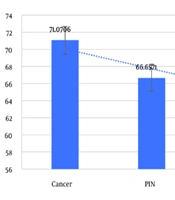
Mohseni Rad H, Hosseinkhani A, Hosseinkhani E, Aali M. Investigation of the Relationship Between Prostate-Specific Antigen Levels and Prostate Cancer in Patients Attending a Urology Clinic from 2014 to 2023. Nephro-Urol Mon. 2024;16(3):e147023. doi: https://doi.org/10.5812/numonthly-147023
Shirazi M, Ariafar A, Zeyghami S, Hosseini MM, Khezri AA. Association of Diet With Prostate Specific Antigen and Prostate Volume. Nephro-Urol Mon. 2014;6(4):e19411. doi: https://doi.org/10.5812/numonthly.19411
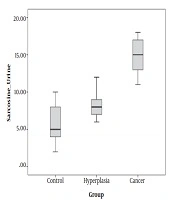
Yousefi M, Qujeq D, Shafi H, Tilaki KH. Serum and Urine Levels of Sarcosine in Benign Prostatic Hyperplasia and Newly Diagnosed Prostate Cancer Patients. J Kermanshah Univ Med Sci. 2020;24(1):e97000. doi: https://doi.org/10.5812/jkums.97000
Fayazpour A, Bagheri S, Kheradmand P, Mansouri E, Seyedtabib M. Diagnostic and Prognostic Role of Prostate-Specific Antigen Immunologic Staining in Prostate Cancer. Shiraz E-Med J. 2023;24(4):e127269. doi: https://doi.org/10.5812/semj-127269

Sirousbakht S, Rezakhaniha B. Effect of Colonoscopy on Prostate-Specific Antigen; New Words about an Old Subject. Int J Cancer Manag. 2018;11(7):e68919. doi: https://doi.org/10.5812/ijcm.68919
Last Update: 3 weeks ago
Last Update: 3 weeks ago
Last Update: 3 weeks ago
Last Update: 4 hours ago
Last Update: 8 hours ago
Last Update: 4 days ago