
1. Background
Waterborne and food borne diseases are major public health concerns, which are associated with significant mortality each year worldwide (1). The globalization phenomenon, increased traveling, tourism development, and increased outdoor consumption of food and water in different communities have rendered foodborne diseases a global health issue (2).
Norovirus (NoV) was first identified after an outbreak of intestinal flu in 1968 in Norwalk, Ohio (USA). In general, NoVs cause acute gastroenteritis. In all age groups, the disease outset is associated with nausea, acute-onset vomiting, and diarrhea with abdominal cramps within 12 - 48 hours. Notably, NoVs are highly infectious, and as few as 10 virus particles are needed to cause infections (3).
NoVs are also the main cause of foodborne diseases worldwide, as well as the most common cause of acute gastroenteritis in children. While the disease is characteristically self-limiting, it could lead to a more stable and severe disease courses in immunocompromised patients, children, and the elderly, causing dehydration, weight loss, renal failure, disseminated intravascular coagulation, month-long chronic diarrhea, malnutrition, and even death (4). NoVs have three pathogenic genogroups in humans, and genogroups I and II are considered to be responsible for major human infections (5). However, GII. 4 strains (genogroup II genotype 4) have been reported to cause most cases of NoV outbreaks across the world (6).
NoVs are primarily transmitted via the fecal-oral route through direct person-to-person spread or the consumption of food or water contaminated with feces (7). The Norwalk virus is a subspecies of a group of viruses known as Caliciviridae. The Caliciviridae virus family includes the genera norovirus and sapovirus. Until 2-3 years ago, NoVs and sapovirus could not be propagated in vitro (8), while the culture of NoVs is currently possible (9).
In developed countries, acute gastroenteritis is often caused by viruses (87%), with rotavirus considered to be the most common type of the disease. Bacteria (mainly Campylobacter, Shigella, Salmonella, and Escherichia coli) have been reported to be the other common causes in this regard. Statistics suggest that bacterial pathogens are more prevalent in low-income countries (10).
NoVs are the most important intestinal viruses that cause acute gastrointestinal issues. Since the virus is easily spread in closed environments, it has high infectivity and gives rise to widespread epidemics in various regions in the world (11). According to the World Health Organization (WHO), nearly 1.7 billion cases of diarrhea are recorded each year globally, and the disease is responsible for the death of 760,000 children aged less than five years annually (12). The prevalence of the virus among children in Pakistan, India, Brazil, and pediatric hospitals of Italy has been reported to be 9.9%, 11.9%, 12%, and 48.4%, respectively. These rates highlight the importance of the virus in the diagnosis of NoV gastroenteritis in children (11).
As stated earlier, NoVs are the second most frequent cause of severe gastroenteritis in children aged less than five years, preceded only by rotaviruses. In addition, NoVs are the cause of 12% of gastroenteritis cases in hospitalized children aged less than five years (4). Furthermore, NoVs are associated with 700 million disease cases each year worldwide, with 21 million cases reported in the United States, as well as over 200,000 deaths in children aged less than five years in developing countries (9). NoV is also a leading cause of waterborne diseases (13, 14). The Norwalk virus in groundwater could remain detectable for over three years and infectious for a minimum of 61 days (15). Since the late 2012, Scotland has witnessed a significant increase in NoV activity, and the NoV season has begun earlier than usual (16). However, no systematic reviews have evaluated the role of NoVs in acute viral gastroenteritis in the Middle East and North Africa (MENA). Therefore, a comprehensive review was conducted in 24 MENA countries over 15 years (2000 - 2015).
The reported NoV infection rates in MENA countries are within the range of 0.82% - 36.84%. Genogroup II genotype four is considered to be the dominant genotype identified in the stool samples of the patients (6). Moreover, the outbreaks recorded for foodborne diseases in South Khorasan province (Iran) have indicated that most of the cases have been in children aged less than five years (28.9%). The obtained results in this regard have indicated five hospitalization cases and no mortality. However, the most common clinical symptoms have been reported to be abdominal cramps (86%) and vomiting and diarrhea (64.9%). Furthermore, 27 patients have been diagnosed with bloody diarrhea (23.9%). The most common treatments have been antibiotic therapy (57.5%) and oral rehydration therapy (23.9%), with cotrimoxazole and ciprofloxacin used as the most frequent antibiotics (17).
In this regard, Hatami et al. conducted a study entitled “The outbreak of gastroenteritis caused by NoV in Pardis city”, reporting that 5,064 out of 40,000 individuals were diagnosed with the disease. In addition, the level of invasion was estimated at 12.6, and 59.7% of the patients were aged less than 27 years. In the mentioned study, 57.8% of the patients were female, and the remaining cases were male. In the studied hospital, approximately 94.9% of the patients had vomiting, 37.7% had diarrhea, 18.8% had abdominal cramps, and 0.6% had fever. Nonetheless, the disease severity was the main cause of hospitalization or mortality. Furthermore, 126 human samples were examined in vitro, 42.2% of which were collected from the male patients, and the remaining cases were obtained from the female patients. According to the results, hepatitis E (IgM-HEV), hepatitis A (IgM-HAV), and real-time polymerase chain reaction (RT-PCR) molecular tests were negative for hepatitis E and A, respectively. On the other hand, six out of the nine stool samples were positive for NoV based on the RT-PCR molecular test (10).
In April 2016, there was an outbreak of gastroenteritis caused by NoV in Eslamabad-e Gharb, located in Kermanshah province, Iran (population: 140,000), which led to the referral of 3,362 patients to the comprehensive healthcare centers and public and private clinics in the region.
2. Objectives
The present study aimed to evaluate the epidemiological, clinical, and laboratory status of the disease in this area.
3. Methods
This descriptive, cross-sectional study was conducted on the patients with gastroenteritis who referred to the public and private healthcare centers and clinics in Eslamabad-e-Gharb, Iran in 2016 based on descriptive epidemiology standards, observations, and clinical findings. In the disease outbreak, the data of 3,362 patients had been recorded by the physicians of the public and private healthcare centers.
The inclusion criterion of the study was the referral of individuals to public and private healthcare centers and clinics with the diagnosis of gastroenteritis during the epidemic, and the exclusion criterion was incomplete data. Data were completed through the laboratory examination of 87 microbial water samples, 205 chlorine assessment samples, and 293 human samples. In total, 271 samples were obtained from the laboratory in Eslamabad-e-Gharb, while 12 and 10 samples were obtained from Alebouyeh Laboratory in Kermanshah province and Tehran national Alebouyeh Laboratory, respectively. The samples were assessed in terms of parasitic agents, NoVs, infection with E. coli and Shigella, and bacterial agents.
Data were collected using the linear list of the patients, which consisted of data on the name, age, gender, date, place of residence (rural/urban regions of Eslamabad-e-Gharb), common clinical signs and symptoms, and laboratory test results.
Data analysis was performed in Excel and SPSS version 21 using frequency and chi-square. Notably, the research was conducted using the model of “How to review and report epidemics?”, which is further described in the following sections.
3.1. Confirmation of the Disease Epidemic Incidence
Considering that gastroenteritis was not formerly observed in Kermanshah province to such extent within the past three years (especially in Eslamabad-e-Gharb), the incidence was considered a disease outbreak in the region. Therefore, the substantial epidemic of NoV gastroenteritis and 'new emergence' of the disease in the region were confirmed.
3.2. Confirmation of the Disease Diagnosis
Gastroenteritis was diagnosed based on clinical, epidemiological, and laboratory findings.
3.3. High-risk Populations
All the population in Eslamabad-e-Gharb (n = 140,000) were considered high-risk for gastroenteritis. All the individuals referring to the public and private clinics of the region were interviewed and examined, and laboratory samples were retrieved from some of the patients. The disease cases were only those who referred to the public and private clinics and healthcare centers. Although all the patients were urged to immediately refer to the clinics in case of the emergence of the symptoms in the other family members, no secondary cases were reported.
1. Evaluation of the ecological factors: The required assessment was carried out regarding the status of the water wells in the studied area, as well as the water treatment and piping network of the city.
2. Evaluation of the high-risk populations: The process was carried out through medical examinations and therapeutic/paraclinical measures, while the high-risk populations were also informed by the healthcare staff and those referring to the healthcare centers. In addition, the related organizations (e.g., governorate) were informed of the issue so as to improve the environment.
3. Data analysis: The epidemics were assessed and reported based on the research model.
4. Results
In total, 3,362 patients were assessed during a three-week interval (April 13 - May 5, 2016), and their data were recorded in the gastroenteritis outbreak curve (Figure 1). As can be seen, most of the cases were observed on the fourth day of the outbreak (April 16, 2016). During the outbreak, the level of invasion was estimated at 2.4% in a high-risk population of 140,000. The majority of the patients (21.1%) were within the age range of 20 - 29 years, and more than 59% were aged 1 - 29 years. In addition, the mean age of the patients was 26.8 years, and the age range of the patients was 1 - 105 years (Figure 2). Among the patients, 57.1% were female, and 42.9% were male. The findings indicated that 73.4% of the patients had diarrhea, while 3.2%, 73%, 50%, 48.8%, 29.1%, and 30.6% had blood diarrhea, vomiting, nausea, abdominal cramps, fever, and headaches, respectively. However, no hospitalization or mortality was recorded.
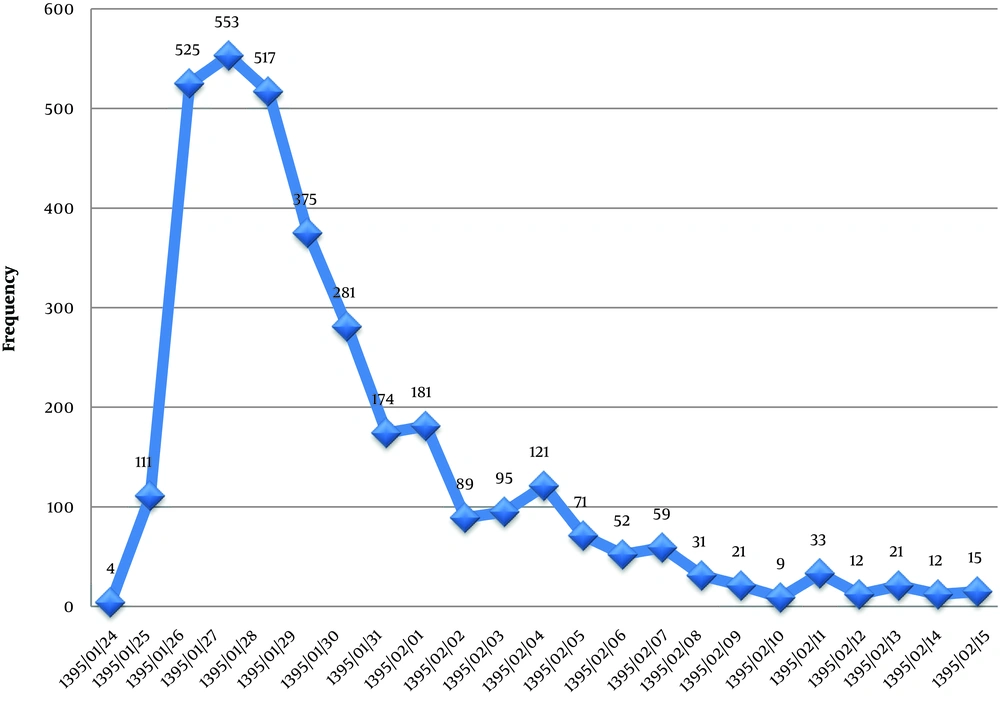
Figure 1.
Gastroenteritis outbreak curve of Eslamabad-e-Gharb, Iran in 2016
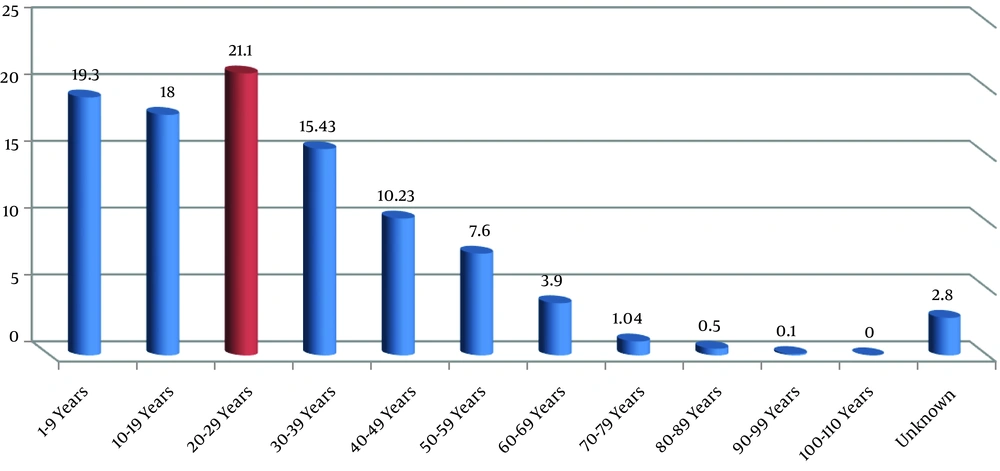
Figure 2.
Age distribution of patients with gastroenteritis in Eslamabad-e-Gharb in 2016
In total, 293 human samples were evaluated in vitro, 38.2% of which were collected from the male patients, and the remaining cases were obtained from the female patients. In addition, 271 fecal samples were examined at the laboratory of Eslamabad-e-Gharb, while 12 and 10 samples were evaluated at the comprehensive laboratory of Kermanshah province and national Alebouyeh Laboratory, respectively. The results obtained from the samples of Eslamabad-e-Gharb and Kermanshah province were indicative of non-pathogenic E. coli, as well as one positive case of Shigella. Furthermore, 10 blood samples and 10 fecal samples were evaluated at the national Alebouyeh Laboratory.
Among 10 stool samples, six were identified as non-pathogenic E. coli, which is a fecal coliform and a normal stool flora. On the other hand, three samples were positive for NoV based on RT-PCR. In addition, 10 water samples were sent to Dr. Alebouyeh Virology Laboratory, which were evaluated in terms of the fecal contamination index bacteria, vibrio, other anthropogenic bacteria, and parasites. According to the obtained results, bacteria were observed in none of these samples. Finally, all the samples (n = 87) prepared from various urban and rural regions in Eslamabad-e-Gharb were not infected with thermotolerant coliforms. Furthermore, the evaluation of four chemical samples indicated that the nitrite and nitrate levels were within the permissible limits.
4.1. Evaluation of the Water Supply Status in the Region
The water supply sources in Eslamabad-e-Gharb include 17 deep water wells with the approximate depth of 150 meters, which work 24 hours a day. However, three water wells are constantly in the resting mode. Moreover, three concrete storage and disinfection tanks (5,000 m3) are responsible for the drinking water balance of the city; the capacity of the tanks in the operating circuit is 15,000 m3. Notably, the drinking water in Eslamabad-e-Gharb is chlorinated at 17 points around the clock, and the main water reservoirs include Sarab Sharafabad and Badrei reservoirs, with the capacity of 15,000 m3, including two water wells in Shafarabad, each with the capacity of 5000 m3, as well another reservoir in Badrei (5000 m3). There are no residential homes, landfills, sewage, industries, and cemeteries in the vicinity of most of these water wells, with the exception of Aliabad well, which is near residential homes and agricultural lands. There is also a fence or a chamber around the water wells, and the sealing of the wells is standard.
5. Discussion
NoVs are the most important intestinal viruses, which could cause acute gastrointestinal complications. These pathogens could easily spread in closed environments and are highly infectious, giving rise to widespread epidemics across the world (11). According to reports, 900,000 gastroenteritis cases in children in industrial countries are attributed to these pathogens, as well as 218,000 mortalities in developing countries annually (4). In this regard, the findings of the current research are in line with the results obtained by Bijari et al., Hatami et al., and Ooka et al. (10, 17, 18).
In the studied outbreak in Eslamabad-e-Gharb, there were three positive cases of NoVs in the fecal samples based on the RT-PCR molecular test. Considering the high infectious dose even with the low counts of NoVs and their rapid spread in the community and with the presumption of experimental antibiotic use by the patients, viral contamination from environmental sources appears to have been the major cause of this outbreak. In total, 10 samples were sent to Alebouyeh Laboratory, where the water samples are assessed in terms of the fecal contamination index bacteria, vibrio, other anthropogenic bacteria, and parasites, while none of the cases were observed in the samples.
According to the results of the present study, the clinical and epidemiological features of the outbreak were more similar to the NoV patterns compared to infectious or non-infectious factors. In addition, the results were positive for NoV in one-third of the examined samples, and it was speculated that the disease outbreak was probably due to NoVs (19). Considering the widespread epidemic and the fact that the only common factor among all the studied populations was drinking water rather than other contacts (e.g., shared food, person-to-person contact), and since all the reported outbreaks of the disease in developing countries have resulted from waterborne infections, ruling out the other etiological factors and clinical (more frequently nausea and vomiting, followed by diarrhea, cramps, and fever) and epidemiological arguments (especially age, seasonal distribution, and self-limitation of the disease), NoV was undoubtedly the only etiological agent identified in the current research.
In a study aiming to evaluate the frequency of NoV infections and the dominant genogroup in the children with acute gastroenteritis referring to a specialized pediatric hospital in Tehran (Iran), Romani et al. assessed 204 fecal samples obtained from children aged less than 10 years over a period of one year. According to the findings, NoV RNA was detected in 23 fecal samples (11.3%) (11). Since the late 2012, Scotland has witnessed a significant increase in NoV activity, and NoV season has begun earlier than usual (12). In addition, most cases of NoV infections are observed in cold months (October to April) (20).
Acute gastroenteritis is often self-limiting, and most of the patients (especially adults) tend to recover with no specific treatments. In the present study, 99% of the cases were treated as outpatients, which is consistent with the previous studies in this regard (10). According to the WHO report in 2008, the mortality rate associated with waterborne diseases is more than five million cases per year, and the risk of microbial infections is mostly attributed to the human activities that lead to the contamination of water sources (21-23).
Considering that the increased prevalence of waterborne diseases could threaten public health, the recognition and control of pathogens and their transmission from water to humans are of utmost importance. Therefore, timely and effective measures should be taken regarding water and sanitation using regulatory systems. Furthermore, health education can play a key role in raising awareness and enhance the health performance of individuals in the community (24). In a research in this regard, Lee and Greg evaluated 121 gastroenteritis outbreaks in various schools during 10 years, reporting a significant reduction in the risk of foodborne diseases when children washed their hands and received health certificates after proper health education programs (25).
5.1. Conclusions
According to the results, no microbial infections were observed in the drinking water of Eslamabad-e-Gharb. However, NoVs were detected in the human samples obtained from Alebouyeh Laboratory in Tehran. The review of the studies conducted in this regard across the world demonstrated that NoVs are a major cause of extensive gastroenteritis outbreaks. Considering the heavy rainfalls and flooding in Eslamabad-e-Gharb a few days before the outbreak, the increased microbial load in water resources (especially the water wells) could be considered a major cause of the epidemic. On the other hand, floods and rising water levels in many of the urban and rural areas of Eslamabad-e-Gharb led to the drowning of some areas of pipelines and water distribution networks. The flood might have penetrated the pipelines, thereby increasing microbial contamination in water. Based on the reports of the healthcare centers in Eslamabad-e-Gharb and laboratory examinations, NoVs were the most probable cause of the gastroenteritis outbreak in this city in 2016.
5.2. Limitations of the Study
Due to the magnitude of the sudden epidemic in the studied area, there might have been some errors in the recording of the data collected during the outbreak. Additionally, it was not possible to fully examine and complete some of the questionnaires.