
1. Background
Metallo-β-lactamases are Ambler class B β-lactamases that require zinc ions for activity. They can hydrolyze β-lactam antibiotics, including carbapenems, thereby conferring high-level resistance and making infections more difficult to treat. These enzymes are often encoded on mobile genetic elements. They represent a key mechanism of carbapenem resistance in Gram-negative bacteria and are increasingly reported in clinical isolates worldwide as important causes of multidrug resistance and therapeutic failure in serious infections (1, 2).
Urinary tract infections are among the most common bacterial infections worldwide and are primarily caused by Gram-negative uropathogens, including Escherichia coli, Pseudomonas aeruginosa, and Klebsiella pneumoniae. Carbapenemase and MBL production have been reported in these organisms (3). These organisms have been detected in urine and other clinical specimens in studies from Nigeria and other African settings, with prevalence estimates of approximately 7%-13% in some patient populations (4). Several studies have reported that carbapenemase-producing uropathogens are resistant to many commonly used antibiotics, limiting therapeutic options and underscoring the role of carbapenems as last-resort antibiotics (5, 6).
The prevalence and spread of MBL-producing bacteria in Africa, particularly in Nigeria, have been identified as important public health concerns requiring surveillance, antibiotic stewardship, and infection-control measures (7). Despite findings from hospital- and general-population studies, limited information is available on the prevalence and resistance patterns of MBL-producing uropathogens among young, apparently healthy cohorts who may serve as unrecognized community reservoirs of highly resistant organisms.
2. Objectives
This study investigated the occurrence of metallo-β-lactamase-producing Gram-negative uropathogens among newly admitted students at the Federal University of Agriculture, Abeokuta, Nigeria.
3. Methods
3.1. Study Design and Location
A descriptive cross-sectional study was conducted among newly admitted students at the Federal University of Agriculture, Abeokuta (FUNAAB), in southwestern Nigeria, between September 2024 and February 2025.
3.2. Sample Size and Sampling Technique
A total of 170 newly admitted first-year students from the eight colleges of the Federal University of Agriculture, Abeokuta, were approached during the admission and registration period. Participants were informed about the study objectives and procedures before enrollment. Participants received a consent form explaining the study and confirming that participation was voluntary, with a mandatory question to document their consent. Structured screening questions were used to collect sociodemographic data and relevant clinical information, including urinary symptoms, recent hospitalization, recent antibiotic use, current antibiotic medication, and a history of urinary tract disease. Apparently healthy and asymptomatic students without known urinary tract infections were included. Students currently receiving antibiotic therapy, those recently hospitalized, and those with recent antibiotic use, urinary symptoms, or known urinary tract disease were excluded. Of the 170 students approached, 47 declined participation and 123 consented. Overall, 100 participants who met the inclusion criteria were recruited, whereas the remaining participants were excluded because of non-consent or failure to meet the inclusion criteria.
3.3. Urine Sample Collection
A total of 100 midstream clean-catch urine samples (10 - 20 mL) were collected into sterile, wide-mouthed containers after participants received instructions on perineal hygiene and on discarding the initial urine stream (8). Samples were transported to the laboratory within 1 - 2 hours of collection and processed within 6 hours when delays occurred.
3.4. Culture and Isolation of Uropathogens
Samples were thoroughly mixed and inoculated by the streak method onto cystine lactose electrolyte-deficient (CLED) agar and MacConkey agar using a calibrated loop under aseptic conditions. Plates were incubated aerobically at 35 - 37 °C for 18 - 24 hours. Significant bacteriuria was determined using standard colony-count thresholds, and mixed or contaminated cultures were documented.
3.5. Identification of Bacterial Isolates
Distinct colonies were sub-cultured to obtain pure cultures. Identification was based on colony morphology and biochemical tests, including oxidase, indole, citrate utilization, urease activity, triple sugar iron reactions, motility, and carbohydrate fermentation, with interpretation based on standard microbiological manuals.
3.6. Antimicrobial Susceptibility Testing
Antimicrobial susceptibility testing (AST) was performed on all isolates (n = 120) using the Kirby-Bauer disk diffusion method on Mueller-Hinton agar (MHA), in accordance with CLSI guidelines. Standardized bacterial inocula were prepared by adjusting pure isolates to a 0.5 McFarland turbidity standard and streaking them over the surface of MHA plates using a sterile swab. A commercially available Gram-negative multidisc antibiotic panel (Abtek Biologicals Ltd., UK) containing 10 antibiotics across 6 antimicrobial classes was applied to the inoculated plates. The listed agents were β-lactams (Ampiclox, 30 µg; penicillin, 10 µg), a cephalosporin (ceftriaxone, 30 µg), a quinolone (nalidixic acid, 30 µg), fluoroquinolones (levofloxacin, 5 µg; ciprofloxacin, 30 µg; ofloxacin, 5 µg), aminoglycosides (gentamicin, 10 µg; streptomycin, 10 µg), chloramphenicol (30 µg), and tetracycline (30 µg). Plates were incubated at 37 °C for 16 - 24 hours. Zones of inhibition were measured in millimeters and interpreted as susceptible, intermediate, or resistant according to CLSI performance standards for antimicrobial susceptibility testing (M100, 2020). Isolates showing non-susceptibility to at least one agent in 3 or more antimicrobial classes were classified as MDR in accordance with CLSI-recommended criteria.
3.7. Screening for Carbapenem Resistance
MDR isolates were further screened for carbapenemase production using the Modified Hodge Test (MHT). A 0.5 McFarland suspension of Escherichia coli ATCC 25922 was lawn-cultured on MHA, after which a meropenem disc (10 µg) was placed at the center of the plate. Test isolates were streaked from the edge of the disc toward the periphery of the agar plate and incubated at 35 °C for 16 - 24 hours. A cloverleaf-like indentation was interpreted as positive for carbapenemase production.
3.8. Phenotypic Detection of Metallo-Β-Lactamase Production
Because MHT is a general screening method for carbapenemase activity and does not specifically identify MBL producers, all isolates that tested positive were further subjected to EDTA-based combined disc diffusion test for phenotypic confirmation of MBL production. For the confirmatory test, a 0.5 McFarland suspension of each isolate was prepared and lawn-inoculated onto MHA. Two imipenem discs (10 µg) were placed 20 mm apart on the agar surface, and 10 µL of 0.5 M EDTA solution was added to one disc. Plates were incubated at 35 - 37 °C for 18 - 24 hours. An increase of ≥ 7 mm in the inhibition-zone diameter around the imipenem-EDTA disc compared with the imipenem-only disc was interpreted as phenotypic confirmation of MBL production.
3.9. Statistical Analysis
Data were analyzed using descriptive statistics, including frequencies and percentages. No inferential statistical comparisons were performed. Percentages of bacterial species were calculated using the total number of isolates (n = 120), whereas MDR proportions were based on MDR isolates (n = 47). Similarly, MBL prevalence was determined among MDR isolates (n = 47) because phenotypic MBL screening was performed on resistant bacteria.
3.10. Ethical Considerations
Ethical approval was obtained from the University Research and Ethics Committee before commencement of the study, and an ethical approval letter was issued with reference number 1910 - 5631 - 2801. Participation was voluntary. Participants received a consent form explaining the study and confirming that participation was voluntary, with a mandatory question to document their consent.
4. Results
4.1. Participant Characteristics and Bacterial Isolates
The participant cohort comprised 55% males and 45% females. Regarding age distribution, 48% were aged 16 - 20 years, 37% were aged 21 - 25 years, and 15% were aged 26 - 30 years (Table 1).
Table 1.
Demographic Characteristics of Study Participants
| Demographics | No. (%) |
|---|---|
| Gender | |
| Male | 55 (55) |
| Female | 45 (45) |
| Age group (y) | |
| 16 - 20 | 48 (48) |
| 21 - 25 | 37 (37) |
| 26 - 30 | 15 (15) |
All 100 urine samples yielded bacterial growth, resulting in a sample-level prevalence of 100% (n = 100). A total of 120 Gram-negative bacterial isolates were obtained using two selective culture media. Analyses of organism distribution and antimicrobial resistance were based on the total number of isolates (n = 120). Of these, 33% were Escherichia coli, followed by Klebsiella pneumoniae (27%), Pseudomonas spp. (17%), Proteus vulgaris (12%), and Enterobacter spp. (11%) (Figure 1).
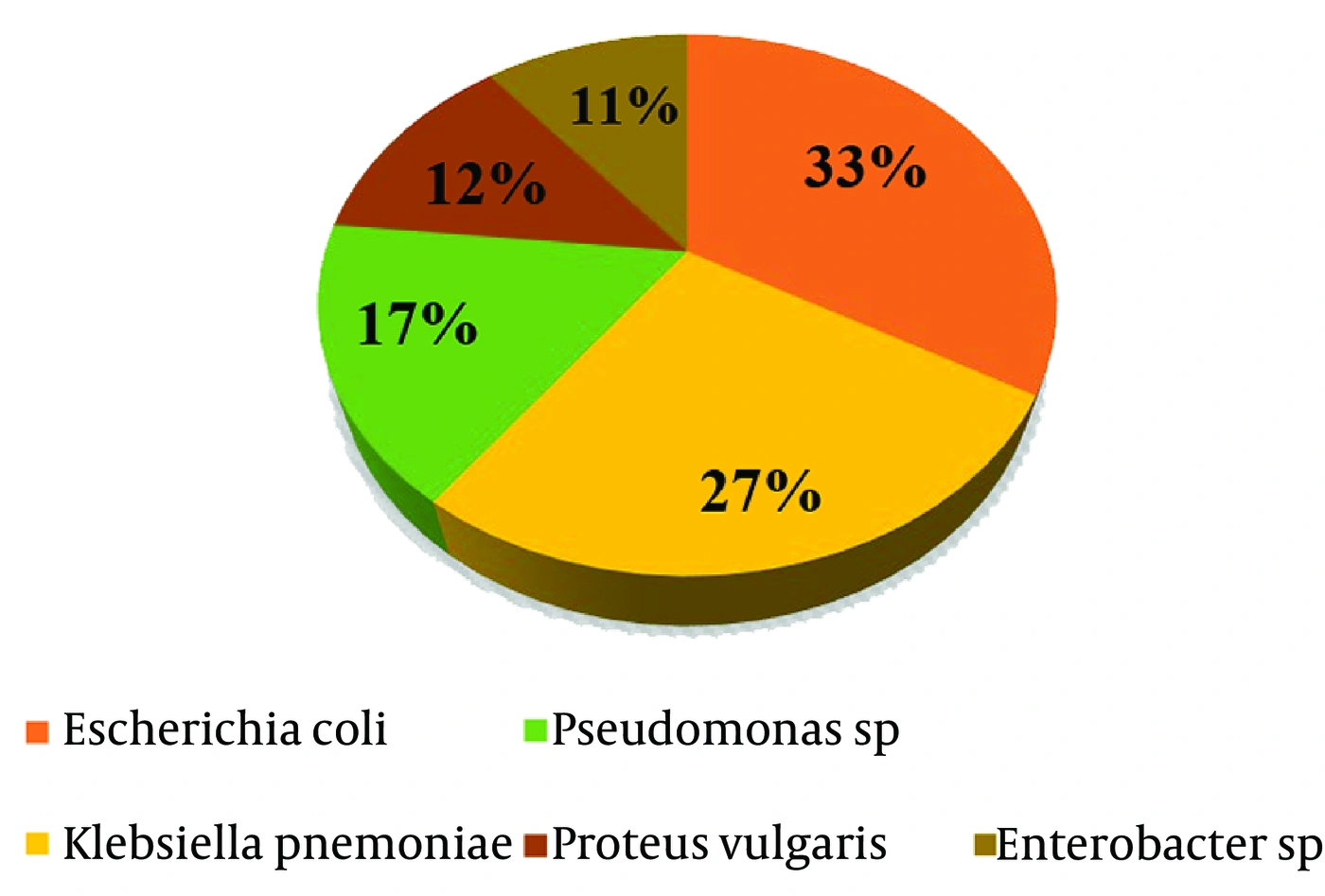
Figure 1.
Percentage Distribution of Gram-Negative Bacterial Isolates Recovered From Urine Samples of Participants (n = 120)
The number of Gram-negative bacterial isolates was higher in males than in females (Figure 2). Escherichia coli was the most common isolate in both sexes, with a higher occurrence in males (24 isolates) than in females (16 isolates). Klebsiella pneumoniae, Pseudomonas spp., and Proteus vulgaris were also isolated in both sexes, whereas Enterobacter spp. showed the lowest occurrence, particularly in females.
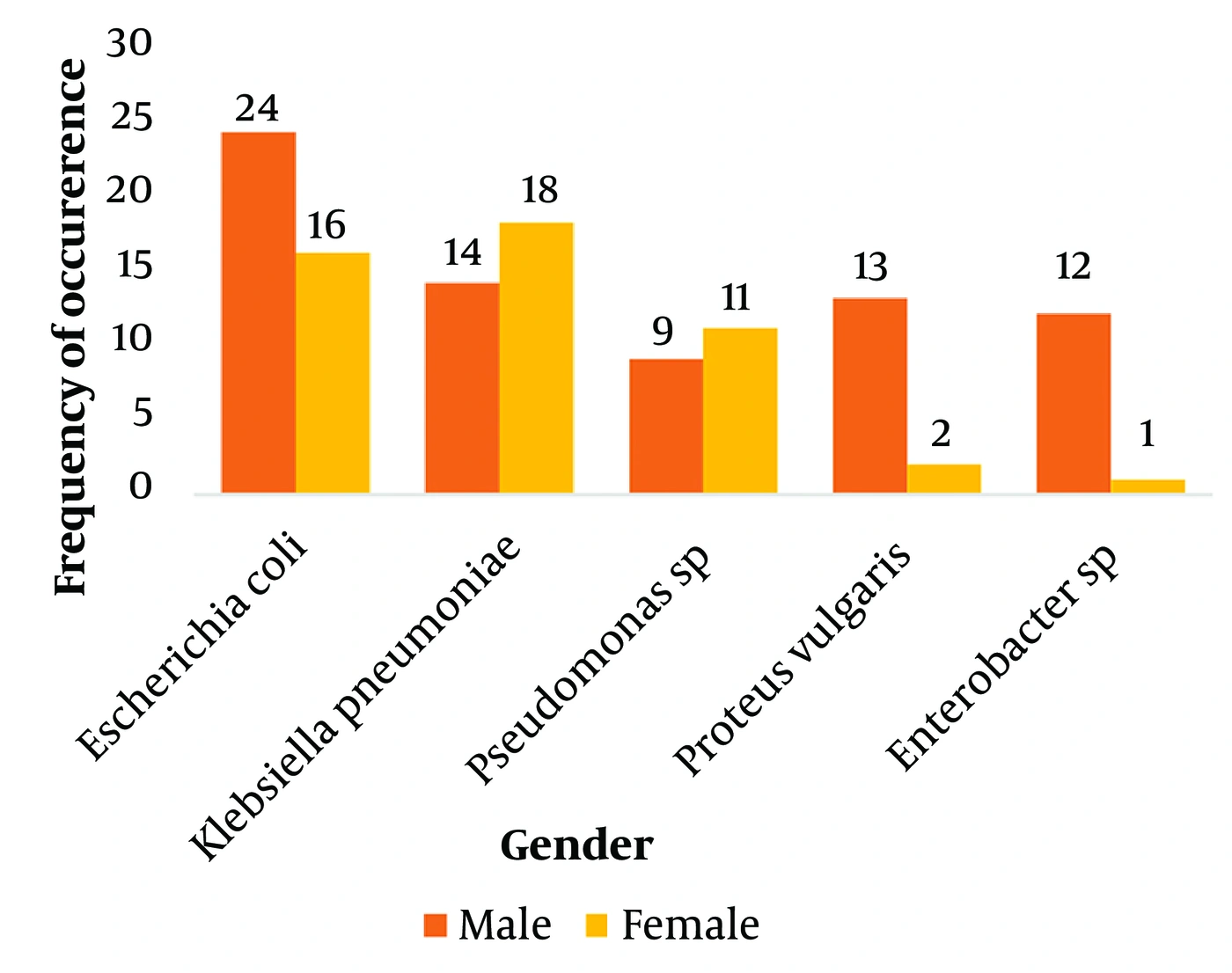
Figure 2.
Frequency of Gram-Negative Bacterial Isolates Among Male and Female Participants. (Values represent the number of isolates recovered from male and female participants).
4.2. Antimicrobial Susceptibility and Multidrug Resistance
Considering the total number of isolates (n = 120), resistance, susceptibility, and intermediate responses across the selected antimicrobial classes indicated generally high resistance (Table 2).
Table 2.
Antimicrobial Susceptibility Profile of Uropathogenic Bacterial Isolates to Selected Classes of Antibiotics a
| Antimicrobial class | E. coli | K. pneumoniae | Pseudomonas spp. | P. vulgaris | Enterobacter spp. | ||||||||||
|---|---|---|---|---|---|---|---|---|---|---|---|---|---|---|---|
| R | S | I | R | S | I | R | S | I | R | S | I | R | S | I | |
| Aminoglycosides | 13 (10.8) | 5 (4.2) | 15 (12.5) | 9 (7.5) | 6 (5.0) | 12 (10) | 5 (4.2) | 7 (5.8) | 4 (3.3) | 9 (7.5) | 9 (7.5) | 3 (2.5) | 10 (8.3) | 6 (5.0) | 7 (5.8) |
| Penicillins | 14 (11.7) | 6 (5.0) | 8 (6.7) | 19 (15.8) | 3 (2.5) | 10 (8.3) | 11 (9.1) | 4 (3.3) | 3 (2.5) | 16 (13.3) | 7 (5.8) | 2 (1.7) | 11 (9.2) | 3 (2.5) | 3 (2.5) |
| Quinolines | 7 (5.8) | 9 (7.5) | 11 (9.1) | 10 (8.3) | 7 (5.8) | 13 (10.8) | 0 (0) | 4 (3.3) | 5 (4.2) | 9 (7.5) | 5 (4.2) | 6 (5.0) | 8 (6.7) | 20 (16.7) | 6 (5.0) |
| Cephalosporins | 10 (8.3) | 8 (6.7) | 12 (10) | 9 (7.5) | 9 (7.5) | 15 (12.5) | 8 (6.7) | 7 (5.8) | 11 (9.1) | 3 (2.5) | 5 (4.2) | 5 (4.2) | 8 (6.7) | 2 (1.7) | 8 (6.7) |
| Fluoroquinolones | 12 (10) | 7 (5.8) | 8 (6.7) | 23 (19.2) | 4 (3.3) | 7 (5.8) | 1 (0.8) | 6 (5.0) | 3 (2.5) | 16 (13.3) | 4 (3.3) | 2 (1.7) | 10 (8.3) | 12 (10) | 5 (4.2) |
| Chloramphenicol | 20 (16.7) | 3 (2.5) | 10 (8.3) | 12 (10) | 9 (7.5) | 7 (5.8) | 5 (4.2) | 6 (5.0) | 2 (1.7) | 17 (14.1) | 4 (3.3) | 4 (3.3) | 13 (10.8) | 4 (3.3) | 4 (3.3) |
| Tetracyclines | 9 (7.5) | 1 (0.8) | 8 (6.7) | 25 (20.8) | 3 (2.5) | 12 (10) | 24 (20) | 7 (5.8) | 8 (6.7) | 7 (5.8) | 4 (3.3) | 2 (1.7) | 2 (1.7) | 6 (5.0) | 2 (1.7) |
a Values are expressed as No. (%). Percentages were calculated based on the total number of Gram-negative bacterial isolates recovered (n = 120). Abbreviations: R, resistant; S, susceptible; I, intermediate.
Escherichia coli exhibited substantial resistance to chloramphenicol (16.7%) and aminoglycosides (10.8%), with the lowest sensitivity observed for chloramphenicol. Klebsiella pneumoniae demonstrated high resistance to fluoroquinolones (19.2%) and tetracyclines (20.8%), with lower resistance to cephalosporins (7.5%) and chloramphenicol (7.5%). Pseudomonas spp. displayed relatively low resistance overall, with notable resistance to chloramphenicol (4.2%) and cephalosporins (6.7%). Proteus vulgaris showed moderate susceptibility to most antibiotics but high resistance to chloramphenicol (14.1%) and fluoroquinolones (13.3%). Enterobacter spp. demonstrated the highest resistance to fluoroquinolones and aminoglycosides (8.3% each) among the antibiotic classes tested.
Among the 120 Gram-negative bacterial isolates, 47 (39.2%) were identified as MDR. Klebsiella pneumoniae accounted for the highest proportion of MDR organisms (36.1%), followed by Escherichia coli (34.0%) and Pseudomonas spp. (8.5%). Proteus vulgaris and Enterobacter spp. each exhibited lower MDR frequencies (10.6%). Regarding age distribution, MDR E. coli was highest among students aged 21 - 25 years (14.9%). MDR K. pneumoniae was relatively evenly distributed across age groups, with the highest proportions observed in males aged 21 - 25 years (12.7%) and females aged 16 - 20 years (10.6%) (Table 3).
Table 3.
Distribution of Multidrug-Resistant Gram-Negative Bacterial Isolates Across Age Groups and Sex of Participants a
| Variables | Age Group (y) | Total (%) | |||||
|---|---|---|---|---|---|---|---|
| 16 - 20 | 21 - 25 | 26 - 30 | |||||
| Bacteria | Male | Female | Male | Female | Male | Female | |
| Escherichia coli | 3 (6.3) | 2 (4.3) | 4 (8.5) | 7 (14.9) | 0 (0.0) | 0 (0.0) | 16 (34.0) |
| Klebsiella pneumoniae | 2 (4.3) | 5 (10.6) | 6 (12.7) | 3 (6.3) | 1 (2.1) | 0 (0.0) | 17 (36.1) |
| Pseudomonas spp. | 1 (2.1) | 2 (4.3) | 1 (2.1) | 0 (0.0) | 0 (0.0) | 0 (0.0) | 4 (8.5) |
| Proteus vulgaris | 0 (0.0) | 1 (2.1) | 2 (4.3) | 2 (4.3) | 0 (0.0) | 0 (0.0) | 5 (10.6) |
| Enterobacter spp. | 1 (2.1) | 1 (2.1) | 2 (4.3) | 0 (0.0) | 0 (0.0) | 1 (2.1) | 5 (10.6) |
| Total | 7 (14.9) | 11 (23.4) | 15 (31.9) | 12 (25.5) | 1 (2.1) | 1 (2.1) | 47 |
a Values are expressed as No. (%). Percentages were calculated based on the total number of MDR Gram-negative bacterial isolates recovered (n = 47).
4.3. Metallo-Β-Lactamase Production
Phenotypic screening identified 18 (38.3%) MDR bacterial isolates as MBL producers, representing 15% of all Gram-negative bacterial isolates. Klebsiella pneumoniae (26.8%) had the largest proportion of MBL producers, followed by E. coli (24.3%) and Proteus vulgaris (18.2%), whereas Pseudomonas spp. (10.4%) and Enterobacter spp. (11.1%) had the lowest proportions (Table 4).
Table 4.
Prevalence of Metallo-Β-Lactamase Production Among Multidrug-Resistant Gram-Negative Bacterial Isolates a
| Organisms | Total MDR (%) | Total MBL Producers (%) |
|---|---|---|
| Escherichia coli | 16 (34.0) | 4 (8.5) |
| Klebsiella pneumoniae | 17 (36.1) | 8 (17.0) |
| Pseudomonas spp. | 4 (8.5) | 1 (2.1) |
| Proteus vulgaris | 5 (10.6) | 4 (8.5) |
| Enterobacter spp. | 5 (10.6) | 1 (2.1) |
| Total | 47 | 18 (38.3) |
a Values are expressed as No. (%). n = 47. Abbreviations: MDR, multidrug resistant; MBL, metallo-β-lactamase.
5. Discussion
Metallo-β-lactamase-producing Gram-negative bacteria are clinically important carbapenem-resistant pathogens that produce enzymes capable of hydrolyzing most β-lactam antibiotics, resulting in limited treatment options and rapid dissemination in healthcare settings. MBL-producing clinical Enterobacteriaceae have been reported worldwide and often exhibit extensive antimicrobial resistance (9). Studying MBL-producing uropathogens in an apparently healthy university population is important, particularly given the high degree of social mixing, frequent empiric antibiotic use, and limited routine screening in such environments (10). In these settings, individuals may act as community reservoirs for highly resistant uropathogenic strains.
Hospital- and community-based studies have consistently indicated that E. coli is the most common uropathogen, closely followed by Klebsiella pneumoniae (11). Studies from Cameroon, Ghana, and Bangladesh have similarly identified E. coli as a predominant uropathogen, with K. pneumoniae frequently among the most prevalent organisms (12-14). Research focusing on Nigerian student groups has also reported E. coli as a common isolate, although some studies have noted relatively high rates of Klebsiella (15). These species are important MBL-producing organisms and may contribute to antimicrobial resistance reservoirs (12).
High resistance to penicillins, tetracyclines, and chloramphenicol, as well as substantial resistance to cephalosporins and fluoroquinolones, was observed, particularly among E. coli and K. pneumoniae. Similar multidrug resistance in uropathogens has been reported in other settings (14, 16). In many low- and middle-income countries, long-term, low-cost, and sometimes unregulated use of these agents in human medicine and agriculture may have contributed to increased resistance and a high prevalence of resistance determinants in the environment (17). The moderate susceptibility patterns to quinolones and high resistance to fluoroquinolones, particularly among K. pneumoniae and Proteus spp., are consistent with findings reported by Shanta et al. (13). The resistance profile observed in this population may reflect previous antimicrobial exposure, self-medication, and the circulation of antimicrobial resistance determinants, particularly among Enterobacterales (17). The reduced effectiveness of older, less expensive agents may compromise empirical therapy and increase the risk of treatment failure, prolonged illness, and onward transmission.
The presence of 18 MBL-producing isolates among 47 MDR strains, mainly K. pneumoniae and E. coli, is a major clinical concern. These findings indicate that MBL production occurs among MDR uropathogens in this apparently healthy student population. The detection of MBL-producing Proteus, Pseudomonas, and Enterobacter spp. further demonstrates that phenotypic MBL production was distributed across several Gram-negative genera in the study sample.
5.1. Study Limitations
The study was conducted at a single university and used a descriptive cross-sectional design, which may limit the generalizability of the findings. Risk factor analysis was also limited because of consecutive sampling and the restricted participant-level risk factor data collected. Furthermore, the isolate-level findings were not molecularly confirmed, and the results may not reflect the prevalence of MBL carriage at the participant level.
5.2. Conclusions
This study demonstrated the presence of MBL-producing Gram-negative uropathogens among sampled first-year students at the Federal University of Agriculture, Abeokuta, with Escherichia coli and Klebsiella pneumoniae as the predominant organisms. The observed resistance patterns suggest reduced treatment options and possible inappropriate antibiotic use within the community.