
Fulltext
Full-text is available in PDF format.
Journal of Nursing and Midwifery Sciences
The Official Journal of Mazandaran University of Medical Sciences
Authors
Context: Drug use during pregnancy is an important issue that is frequently encountered and difficult to decide on as it is closely related to the health of both the mother and the fetus.
Aim: This study was conducted to identify the relationship between the health literacy level and drug use in pregnant women.
Settings and Design: This was a descriptive cross‑sectional study in a state hospital’s outpatient department in Turkey in 2017.
Materials and Methods: In this study, 469 pregnant women were included with simple random sampling. The data collection form included sociodemographic characteristics and drug use behavior of pregnant women and the Health Literacy Scale (HLS).
Statistical Analysis: Descriptive statistics, t‑test, Mann–Whitney U, Kruskal–Wallis, ANOVA, Bonferroni, and multiple regression analysis were used.
Results: The mean HLS subdimension scores were access 21.7 ± 3.4, understanding 28.1 ± 4.8, appraisal 34.2 ± 5.0, application 22.5 ± 2.9, and total score was 106.6 ± 14.01. We found that 49% of the variance related to the HLS score was associated with using the drugs recommended by the physician regularly (beta = −1.665, P < 0.05) and knowing the foods that should not be consumed with the drugs (beta = −4.024, P < 0.05).
Conclusions: The health literacy levels of pregnant women were found to be relatively adequate. The increase in the level of health literacy of pregnant women affects their drug use behavior positively. Therefore, planning for the improvement of pregnant women’s health literacy is recommended.
© 2022, Author(s). This open-access article is available under the Creative Commons Attribution 4.0 (CC BY 4.0) International License (https://creativecommons.org/licenses/by/4.0/), which allows for unrestricted use, distribution, and reproduction in any medium, provided that the original work is properly cited.
Taheri S, Tavousi M, Momenimovahed Z, Direkvand-Moghadam A, Rezaei N, et al. Determining Health Literacy Level and Its Related Factors Among Pregnant Women Referred to Medical and Health Centers of Tehran in 2019: A Cross-sectional Study. Shiraz E-Med J. 2021;22(10):e109592. doi: https://doi.org/10.5812/semj.109592
Hajiseidjavadi E. Knowledge of pregnant women on drug use during pregnancy. J Inflamm Dis. 2024;9(3):e155150. doi:
Peiravian F, Rasekh HR, Jahani Hashemi H, Mohammadi N, Jafari N, et al. Drug Literacy in Iran: the Experience of Using “The Single Item Health Literacy Screening (SILS) Tool”. Iran J Pharm Res. 2014;13(Suppl):e125426. doi: https://doi.org/10.22037/ijpr.2014.1477
Jamali B, Massomie R, Tavousi M, Haeri Mehrizi AA, Zarei F. The status of sexual health literacy in Iranian women: A cross-sectional study. J Nurs Midwifery Sci. 2022;9(2):e140607. doi: https://doi.org/10.4103/jnms.jnms_87_21
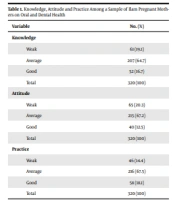
Daneshvar S, Ghazanfari Z, Hoseiny-Rad M, Aivazi N, Aivazi AA. Oral Health Among Pregnant Women at Ilam, Iran: A KAP Study. J Health Rep Technol. 2023;9(2):e130772. doi: https://doi.org/10.5812/jhrt-130772
Last Update: 1 month ago
Last Update: 1 month ago
Last Update: 1 month ago
Last Update: 6 days ago
Last Update: 1 day ago
Last Update: 4 days ago

