
Fulltext
Full-text is available in PDF format.
Journal of Nursing and Midwifery Sciences
The Official Journal of Mazandaran University of Medical Sciences
Authors
Context: Self‑care plays a vital role in the management of diabetes. Commitment to medical adherence in diabetes care is linked with lower morbidity, mortality, and treatment cost.
Aim: This study aimed on investigating the mediating role of illness perception concerning the relationship between psychosocial elements and medical adherence among patients with type II diabetes.
Setting and Design: This is a correlational study that is conducted based on a well‑framed equation modeling path analysis method. The study’s statistical population consisted of all patients diagnosed with diabetes who referred to the International Iranian Diabetes Control and Prevention Foundation located in the Milad Clinic, in Mashhad during the first half of 2018 (n = 5600).
Material ans Methods: Using the convenience sampling method, 392 eligible cases were selected among 5600 patients. Participants assessed with illness perception questionnaire, Lazarus and Folkman stress coping inventory, Tangney’s self‑Control scale, the multidimensional scale of perceived social support, patient–doctor relationship questionnaire‑9, and the medication adherence rating scale‑5.
Statistical Analysis Used: SPSS20 and AMOS software were used to process and analyze the gathered data using structural equation modeling path analysis and the Sobel test.
Results: Findings confirmed the mediating role of illness perception concerning the relationship between psychosocial factors and medical adherence in patients diagnosed with type II diabetes (P < 0.05). Social support can positively impact patients’ illness perception (β= 0.2). The emotion‑focused coping style has a significant, negative, and direct effect on illness perception (β= 0.13). It was found that self‑control, problem‑focused style, and the doctor‑patient relationship had no significant effect on illness perception (P > 0.05).
Conclusion: This study’s findings suggest psychosocial factors including stress coping styles, social support, the patient–doctor relationship, and self‑control associated with medical adherence. Moreover, the impact of psychological factors on medical adherence increases with higher illness perception.
© 2021, Author(s). This open-access article is available under the Creative Commons Attribution 4.0 (CC BY 4.0) International License (https://creativecommons.org/licenses/by/4.0/), which allows for unrestricted use, distribution, and reproduction in any medium, provided that the original work is properly cited.
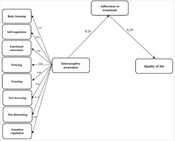
Hosseini SM, Makvandi B, Sevari K, Bakhtiarpour S. The Mediating Role of Adherence to Treatment in the Relationship between Interoceptive Awareness and Quality of Life in Patients with Diabetes. J Health Rep Technol. 2023;9(4):e140210. doi: https://doi.org/10.5812/jhrt-140210
Khalooei A, Hasheminejad Z. Association of Diabetes Management Self-efficacy with Adherence to Medication, Glycemic Control, and Disease Outcomes Among Type 2 Diabetes Patients. Shiraz E-Med J. 2023;24(10):e138227. doi: https://doi.org/10.5812/semj-138227
Ghodrati Mirkouhi M, Rahimian-Boogar I. Predicting diabetes management self-efficacy base on hardiness and coping strategies in patients with type 2 diabetes mellitus. J Inflamm Dis. 2024;20(4):e155981. doi:
Benrazavy L, Khalooei A. Medication Adherence and its Predictors in Type 2 Diabetic Patients Referring to Urban Primary Health Care Centers in Kerman City, Southeastern Iran. Shiraz E-Med J. 2019;20(7):e84746. doi: https://doi.org/10.5812/semj.84746
Akbari F, Molavynejad S, Rokhafroz D, Sharif Nia H. Effect of Diabetes Distress and Self-care Activities on the Quality of Life of Type 2 Diabetic Patients: A Structural Equation Model. Jundishapur J Chronic Dis Care. 2022;11(1):e119982. doi: https://doi.org/10.5812/jjcdc.119982
Last Update: 1 month ago
Last Update: 1 month ago
Last Update: 1 month ago
Last Update: 6 days ago
Last Update: 1 day ago
Last Update: 4 days ago

