Fulltext
Full-text is available in PDF format.
Journal of Nursing and Midwifery Sciences
The Official Journal of Mazandaran University of Medical Sciences
Authors
Context: In the recent years, unprecedented reduction in fertility occurred in many countries that affected by demographic, economic, social, political, cultural, and familial factors.
Aims: The aim of this study is to evaluate studies those determine the correlation between spousal relationship and childbearing.
Setting and Design: In this review study, to find both published Persian and English articles, database of Scopus, PubMed/Medline, Google Scholar, Scientific Information Database, and Magiran were searched using keywords of Spousal OR Marital OR Couple AND Relationship AND Childbearing OR Sex Behavior OR Reproductive Behavior that were selected from the MeSH Glossary. There was no limitation about place and study design.
Materials and Methods: Two researchers conducted the electronic search on mentioned databases. The reliability of the data collection method was examined by a third researcher who had good knowledge of the subject but was not aware of the name of journal and the authors.
Statistical Analysis Used: No.
Results: Of the 30 studies reviewed, 20 papers directly (increase interaction between spouses increased willingness to childbearing), 9 articles inversely (increase interaction between spouses increased use of contraception and reduced fertility), and one study mutually were shown relationship between spousal relationship and childbearing.
Conclusion: It can be said that marital interactions and spousal relationships have a significant correlation with childbearing, and most of the studies mention that there is a direct relationship between them. Fertility growth is impossible without the promotion of individual, social, and familial factors, such as couples’ emotional relationships, and policymakers should pay attention to this and plan accordingly.
2018 Journal of Nursing and Midwifery Sciences. This is an open access journal, and articles are distributed under the terms of the Creative Commons Attribution‑NonCommercial‑ShareAlike 4.0 License, which allows others to remix, tweak, and build upon the work non‑commercially, as long as appropriate credit is given and the new creations are licensed under the identical terms.
ghezelbashyan Z, Arefi M. Material intimacy and material satisfaction in infertile and normal women. J Clin Res Paramed Sci. 2016;4(4):e82078. doi:
Hasan Zahraee R, shafiee K, Bashrdoost N, Reihany M, Jabery P. Study of the related factors in couples’ sexual relationship during pregnancy. J Inflamm Dis. 2024;5(4):e154851. doi:
Kardan-Souraki M, Khani S, Hamzehgardeshi Z, Mohammadpour RA. Socio-Demographic Factors Predicting Marital Intimacy in a Sample of Iranian Couples: A Cross-Sectional Study. Iran J Psychiatry Behav Sci. 2018;12(3):e9023. doi: https://doi.org/10.5812/ijpbs.9023
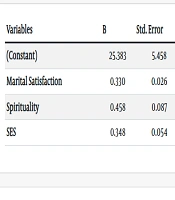
Sarsharbeidokhti P, Bagherzadeh Ledari R, Bagheri M. The Role of Spirituality, Marital Satisfaction and Socio-Economic Status on Attitudes Toward Childbearing Among Married Women Without the Intention and History of Pregnancy: A Cross-Sectional Study. J Nurs Midwifery Sci. 2024;11(4):e154615. doi: https://doi.org/10.5812/jnms-154615
Bahrami N, Sattarzadeh N, Ghojazadeh M, Soleymani M, Sadeghi T, et al. Relation between infertility and sexual satisfaction in couples. J Inflamm Dis. 2024;14(2):e155526. doi:
More by these authors
Last Update: 1 month ago
Last Update: 1 month ago
Last Update: 1 month ago
Last Update: 1 week ago
Last Update: 2 days ago
Last Update: 4 days ago
