
Fulltext
Full-text is available in PDF format.
Journal of Nursing and Midwifery Sciences
The Official Journal of Mazandaran University of Medical Sciences
Authors
Background and Purpose: One landmark of adolescence is the increasing value young people place on friendship and relationship with peers.The aim of this study was to determine adolescents and key informants’ perceptions and experiences regarding to importance of peer groups.
Methods: Sixty-seven female adolescents (12–19 years) and 11 key informants, recruited from urban and rural areas from Sari in the North of Iran using non-probability sampling, participated in eight focus group discussions and semi structured interviews. All tape-recorded data was fully transcribed and thematic analysis was done to identify key themes.
Results: Qualitative content analysis demonstrated five original categories related to importance of peer group in adolescents health including:Acceptance in peer group, Support from friends, Providing the appropriate conditions for healthy relationships with the opposite sex, Positive patterns of friendship and Avoiding from unfavorablefriends.
Conclusion: Peers can have either positive or negative effects on adolescent’s health. To have the most positive impact on adolescent health, parents and community organizations must work together in a comprehensive approach.
2022 Journal of Nursing and Midwifery Sciences. This work is licensed under a Creative Commons Attribution-NonCommercial 3.0 Unported License which allows users to read, copy, distribute and make derivative works for non-commercial purposes from the material, as long as the author of the original work is cited properly. https://jnms.mazums.ac.ir/ https://wiki.creativecommons.org/wiki/License_Versions
Karimi M, Kaveh MH, Morowatisharifabad MA. The Viewpoints of Urban High School Male Students, Parents and Teachers About Cigarette Smoking by Adolescents: A Social Marketing-Based Qualitative Study, Shiraz, Iran. Shiraz E-Med J. 2020;21(10):e98541. doi: https://doi.org/10.5812/semj.98541
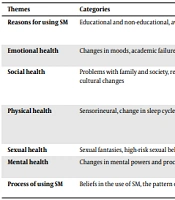
Kamalikhah T, Bajalan M, Sabzmakan L, Mehri A. The Impacts of Excessive Use of Social Media on Iranian Adolescents’ Health: A Qualitative Study. Middle East J Rehabil Health Stud. 2021;8(4):e109561. doi: https://doi.org/10.5812/mejrh.109561
Salehi S, Patel A, Taghavi M, Pooravari M. Primary School Teachers and Parents Perception of Peer Bullying Among Children in Iran: A Qualitative Study. Iran J Psychiatry Behav Sci. 2016;10(3):e1865. doi: https://doi.org/10.17795/ijpbs-1865
Bazrafshan M, Jahangir F, Shokrpour N. What Protects Adolescents from Suicidal Attempt: A Qualitative Study. Shiraz E-Med J. 2017;18(9):e57574. doi: https://doi.org/10.5812/semj.57574
Ahmadi K, Khodadadi Sangdeh J, Aminimanesh S, Mollazamani A, Khanzade M. The Role of Parental Monitoring and Affiliation with Deviant Peers in Adolescents’ Sexual Risk Taking: Toward an Interactional Model. Int J High Risk Behav Addict. 2013;2(1):e93552. doi: https://doi.org/10.5812/ijhrba.8554
More by these authors
Last Update: 1 week ago
Last Update: 1 week ago
Last Update: 1 week ago
Last Update: 8 hours ago
Last Update: 10 hours ago
Last Update: 5 days ago