Evaluation of the Matrix-forming Ability of Chrysophyllum albidum Linn Fruit Gum in Sustained-release Tablet Formulations
Authors
Abstract
Background and Purpose: Muscari Miller. (Asparagaceae family) contains about 50 species worldwide, which are distributed in the Central and Southeastern Europe, Southern Russia, Africa, and some area of Asia such as Iran, Iraq, Afghanistan, Anatolia, and Syria. This study was designed to assess the antioxidant and antimalarial activities of Muscari inconstrictum Rech. f. seeds as one of the Iranian species of Muscari genus. In addition, preliminary phytochemical analysis of the extracts with different polarities was performed.
Materials and Methods: The essential oil of M. inconstrictum seeds was prepared using Clevenger and extracted with n-hexane, chloroform, and methanol (MeOH) by Soxhlet apparatus. Gas chromatography-mass spectrometry (GC-MS) was used for the characterization of essential oil. Total phenol and flavonoid contents were measured using Folin–Ciocalteu and aluminum chloride reagents. Free radical scavenging and antimalarial activities were investigated via 2, 2-diphenyl-1-picrylhydrazyl (DPPH) and cell-free ß-hematin formation methods.
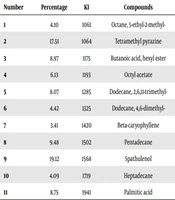
Results: GC-MS analysis of the volatile oil of seeds demonstrated the presence of sesquiterpenoid, alkanes, fatty acid, and linear alcohol structures as the main constituents. Among different extracts of M. inconstrictum seeds, the methanolic extract showed significant antioxidant activity, which can be related to the presence of flavonoid and other phenolic structures. Furthermore, chloroform extract is introduced as the most potent antimalarial part.
Conclusion: It seems that further studies on the M. inconstrictum seeds are necessary to focus on pure compounds and their biological activities.
Copyright
© 2021, Author(s). This open-access article is available under the Creative Commons Attribution 4.0 (CC BY 4.0) International License (https://creativecommons.org/licenses/by/4.0/), which allows for unrestricted use, distribution, and reproduction in any medium, provided that the original work is properly cited.
Similar Articles
Phytochemical and Biological Studies on Muscari inconstrictum Seeds Distributed in Iran
Kazemnezhad M, Torbati M, Asnaashari S, Heshmati Afshar F. Phytochemical and Biological Studies on Muscari inconstrictum Seeds Distributed in Iran. J Rep Pharm Sci. 2021;10(1):e146973. doi: https://doi.org/10.4103/jrptps.JRPTPS_49_19
Anti-Oxidant, Anti-Malarial, and Phytochemical Studies on Muscari inconstrictum Bulbs Distributed in Iran
Heshmati Afshar F, Torbati M, Bamdad S, Asnaashari S. Anti-Oxidant, Anti-Malarial, and Phytochemical Studies on Muscari inconstrictum Bulbs Distributed in Iran. Jundishapur J Nat Pharm Prod. 2019;15(2):e92219. doi: https://doi.org/10.5812/jjnpp.92219
Evaluation of Total Phenolics, Flavonoids, and Antioxidant and Cytotoxic Potential of Ailanthus altissima (Mill.) Swingle Leaves
Mohamed HR, El-Wakil E, Abdel-Hameed E, El-Hashash M, shemis M. Evaluation of Total Phenolics, Flavonoids, and Antioxidant and Cytotoxic Potential of Ailanthus altissima (Mill.) Swingle Leaves. J Rep Pharm Sci. 2021;10(1):e147103. doi: https://doi.org/10.4103/jrptps.JRPTPS_7_21
Isolation of Aurantiamides from Gomphrena Celosioides C. Mart
Olutola Dosumu O, Onocha P, Ekundayo O, Ali M. Isolation of Aurantiamides from Gomphrena Celosioides C. Mart. Iran J Pharm Res. 2014;13(1):e125450. doi: https://doi.org/10.22037/ijpr.2014.1415
Essential Oil of Arial Parts of Adiantum capillus-veneris: Chemical Composition and Antioxidant Activity
Khodaie L, Esnaashari S, Bamdad Moghaddam S. Essential Oil of Arial Parts of Adiantum capillus-veneris: Chemical Composition and Antioxidant Activity. Jundishapur J Nat Pharm Prod. 2015;10(4):e21968. doi: https://doi.org/10.17795/jjnpp-21968
- Scopus by DOI: 0
Last Update: 1 month ago
- Scopus by Title: 0
Last Update: 1 month ago
- Scopus by Title (Ref): 0
Last Update: 1 month ago
- CrossRef: 0
Last Update: 6 days ago
- OpenAlex: 0
Last Update: 8 hours ago
- OpenCitations: 0
Last Update: 4 days ago
