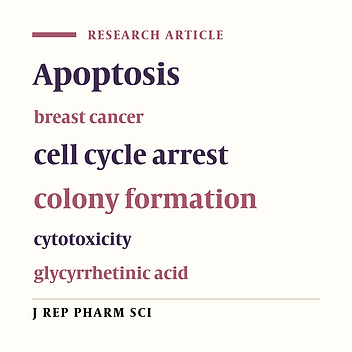
Acetyl Glycyrrhetinic Acid Methyl Ester as a Promising Glycyrrhizin Derivative against the Breast Cancer Cells (MCF-7)
Authors
Abstract
Background: Breast cancer remains the most potent threat to women’s life worldwide. So far, no ideal drug for treatment of breast cancer, all available drugs exhibit severe side effects, poor therapeutic index, and high cost.
Objective: Therefore, this study aimed to investigate the potential use of the natural pentacyclic triterpenoids such as Boswellic, Betulinic (BA), Urosolic, Oleanolic acids, Glycyrrhizin and their derivatives for treatment of breast cancer.
Materials and methods: The cell viability was firstly determined after treatment with 50 μM of each compound. The effect of the treatment on cell cycle, apoptosis, cell migration and colony formation was evaluated. The ability of the new glycyrrhizin derivative to activate p53 was investigated by flow cytometry.
Results: The cytotoxicity assay revealed that glycyrrhizin derivative AM-GA (3-acetyl-18β-glycyrrhetinic-30-methyl ester) and BA were the most cytotoxic against breast cancer cell line MCF-7 with IC50 values 4.5±0.1 and 4±0.1 μM, respectively. Both AM-GA and BA were selective towards breast cancer cells rather than the normal lung fibroblast cell line WI-38. Both AM-GA and BA were able to inhibit the cancer cell migration in the wound healing assay and inhibited colony formation. Studying the mechanism of action revealed that AM-GA inhibited the growth of the breast cancer cells via cell cycle arrest at sub-G1 phase, induction of apoptosis and activation of the tumor suppressor protein p53.
Conclusion: This work highlights the unique role of AM-GA against breast cancer via different mechanisms and will be the gate for new potent analogues and fights different cancer types.
Highlights
Copyright
© 2019, Author(s). This open-access article is available under the Creative Commons Attribution 4.0 (CC BY 4.0) International License (https://creativecommons.org/licenses/by/4.0/), which allows for unrestricted use, distribution, and reproduction in any medium, provided that the original work is properly cited.
Similar Articles
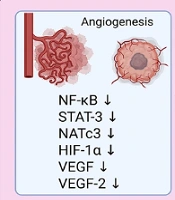
Isoliquiritigenin in Breast Cancer: A Systematic Review of Its Preventive and Anti-metastatic Mechanisms
Xue Y, Wang M. Isoliquiritigenin in Breast Cancer: A Systematic Review of Its Preventive and Anti-metastatic Mechanisms. Iran J Pharm Res. 2025;24(1):e165301. doi: https://doi.org/10.5812/ijpr-165301
Exploring Herbal Compounds as Targeted Therapies for Breast Cancer: Insights from Network Pharmacology, Molecular Docking, MD Simulation, ADME-Toxicity and DFT Profiles
Zhang H. Exploring Herbal Compounds as Targeted Therapies for Breast Cancer: Insights from Network Pharmacology, Molecular Docking, MD Simulation, ADME-Toxicity and DFT Profiles. Iran J Pharm Res. 2024;23(1):e153579. doi: https://doi.org/10.5812/ijpr-153579
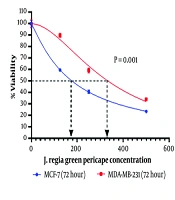
Anti-neoplastic Effects of Juglans Regia L. Green Fruit Pericarp on Breast Cancer Cell Lines
Mirzad E, Javanmardi M, Haidarizadeh M, Abdi M. Anti-neoplastic Effects of Juglans Regia L. Green Fruit Pericarp on Breast Cancer Cell Lines. Jentashapir J Cell Mol Biol. 2024;15(4):e151858. doi: https://doi.org/10.5812/jjcmb-151858
Cytotoxicity of Fractions of Dracontium spruceanum Chloroform Extract in MDA-MB-231 and MCF-7 Breast Cancer Cell Lines
Rodriguez-Huamani A, Medina-Calderon M, Alvarez-Vega S, Tapia-Rojas S, Fukusaki-Yoshizawa A, et al. Cytotoxicity of Fractions of Dracontium spruceanum Chloroform Extract in MDA-MB-231 and MCF-7 Breast Cancer Cell Lines. Jundishapur J Nat Pharm Prod. 2024;19(3):e145843. doi: https://doi.org/10.5812/jjnpp-145843
Antiulcer properties of Glycyrrhiza glabra L. extract on experimental models of gastric ulcer in mice
Jalilzadeh-Amin G, Najarnezhad V, Anassori E, Mostafavi M, Keshipour H. Antiulcer properties of Glycyrrhiza glabra L. extract on experimental models of gastric ulcer in mice. Iran J Pharm Res. 2015;14(4):e125376. doi: https://doi.org/10.22037/ijpr.2015.1752
- Scopus by DOI: 6
Last Update: 1 month ago
- Scopus by Title: 3
Last Update: 1 month ago
- Scopus by Title (Ref): 6
Last Update: 1 month ago
- CrossRef: 0
Last Update: 6 days ago
- OpenAlex: 7
Last Update: 9 hours ago
- OpenCitations: 5
Last Update: 4 days ago
