Design and Evaluation of Soluble Ocular Insert For Controlled Release of Chloramphenicol
Authors

Abstract
Soluble ocular inserts of chloramphenicol were prepared with the aim of achieving once a day administration. Drug reservoir was prepared using hydrophilic polymer and rate-controlling hydrophobic polymer; Eudragit L100, Eudragit S100, Eudragit RL100. All the formulations indicated no interaction between drug and polymer in FTIR studies. The Inserts were evaluated for the several parameters, viscosity, drug–polymer interaction, in vitro drug release, sterility testing. They were also evaluated for % moisture loss, % moisture uptake,thickness, and tensile strength. Ophthalmic inserts provide that prolonged and sustained drug release. Ocular inserts prepared were smooth and passed all the evaluation tests performed. Mechanical properties and in vitro drug release were dependent on film composition. The release profile of all the formulations showed a steady, controlled drug release. Ocular inserts formulated also passed the test for sterility. In vitro studies demonstrated that P5 insert can ensure a sustained drug release on the ocular surface for a prolonged over 20 hours’ time period. Also, reduction in frequency of administration, may improve the patient compliance.
Highlights
Copyright
© 2017, Author(s). This open-access article is available under the Creative Commons Attribution 4.0 (CC BY 4.0) International License (https://creativecommons.org/licenses/by/4.0/), which allows for unrestricted use, distribution, and reproduction in any medium, provided that the original work is properly cited.
Similar Articles
Formulation and In-Vitro Evaluation of Ocular Ciprofloxacin-Containing Minitablets Prepared with Different Combinations of Carbopol 974P and Various Cellulose Derivatives
Mortazavi SA, Jaffariazar Z, Damercheli E. Formulation and In-Vitro Evaluation of Ocular Ciprofloxacin-Containing Minitablets Prepared with Different Combinations of Carbopol 974P and Various Cellulose Derivatives. Iran J Pharm Res. 2010;9(2):e126062. doi: https://doi.org/10.22037/ijpr.2010.844
Improvement of Ocular Efficacy of Levofloxacin by Bioadhesive Chitosan Coated PLGA Nanoparticles: Box-behnken Design, In-vitro Characterization, Antibacterial Evaluation and Scintigraphy Study
Ameeduzzafar , Khan N, Alruwaili NK, Bukhari SNA, Alsuwayt B, et al. Improvement of Ocular Efficacy of Levofloxacin by Bioadhesive Chitosan Coated PLGA Nanoparticles: Box-behnken Design, In-vitro Characterization, Antibacterial Evaluation and Scintigraphy Study. Iran J Pharm Res. 2020;19(1):e124564. doi: https://doi.org/10.22037/ijpr.2019.15318.13016
Design and Evaluation of Ocular Controlled Delivery System for Diclofenac Sodium
Jafariazar Z, Jamalinia N, Ghorbani-Bidkorbeh F, Mortazavi SA. Design and Evaluation of Ocular Controlled Delivery System for Diclofenac Sodium. Iran J Pharm Res. 2015;14(Suppl):e125276. doi: https://doi.org/10.22037/ijpr.2015.1709
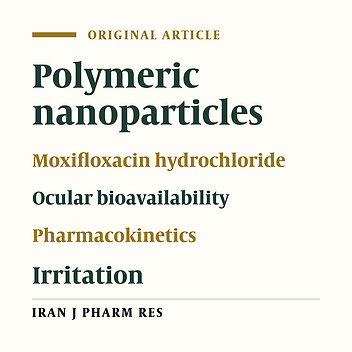
Improved Ocular Bioavailability of Moxifloxacin HCl using PLGA Nanoparticles: Fabrication, Characterization, In-vitro and In-vivo Evaluation
Khan FU, Nasir F, Iqbal Z, Neau S, Khan I, et al. Improved Ocular Bioavailability of Moxifloxacin HCl using PLGA Nanoparticles: Fabrication, Characterization, In-vitro and In-vivo Evaluation. Iran J Pharm Res. 2021;20(3):e124496. doi: https://doi.org/10.22037/ijpr.2021.114478.15054
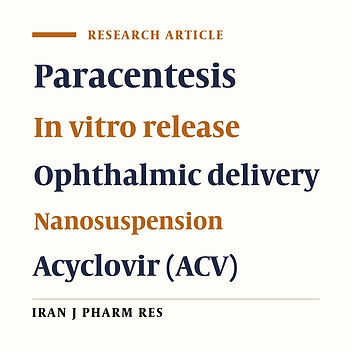
Polymeric ocular nanosuspension for controlled release of acyclovir: in vitro release and ocular distribution
Dandagi P, Kerur S, Mastiholimath V, Gadad A, Kulkarni A. Polymeric ocular nanosuspension for controlled release of acyclovir: in vitro release and ocular distribution. Iran J Pharm Res. 2022;8(2):e128620. doi: https://doi.org/10.22037/ijpr.2010.793
- Scopus by DOI: 0
Last Update: 2 days ago
- Scopus by Title: 12
Last Update: 2 days ago
- Scopus by Title (Ref): 12
Last Update: 2 days ago
- CrossRef: 0
Last Update: 12 hours ago
- OpenAlex: 0
Last Update: 14 hours ago
- OpenCitations: 0
Last Update: 5 days ago