Effect of Scopolamine and Mecamylamine on Antidepressant Effect of Rivastigmine in a Behavioral Despair Test in Mice
Authors
Abstract
Rivastigmine can decrease the severity of depression in Alzheimer’s disease patients. Apart from the monoamines hypothesis of despair, it is well known that the cholinergic system is also responsible. Thus regarding the antidepressant effect of rivastigmine, the aim was evaluating the influence of scopolamine (muscarinic cholinergic receptors antagonist) and/or mecamylamine (nicotinic cholinergic receptors antagonist) co-administration with rivastigmine on depression outcome. Depression was evaluated by the tail suspension test (TST) in male mice. Immobility time was recorded manually which represents the time that animal stops attempts for escape from the unpleasant situation. Imipramine as the reference antidepressant decreased this time by increasing the hope for escape in the animal. Rivastigmine (0.75 mg/kg,sc), scopolamine and/or mecamylamine (0.5 and 1 mg/kg, ip, respectively) were injected before the TST. Rivastigmine considerably reduced the immobility time compared with the control group which indicated its antidepressant effects. The combination treatment of rivastigmine and scopolamine also reduced the immobility time compared with control. Mecamylamine co-administration with rivastigmine increased the immobility time which indicated that it prevented the antidepressant effects of rivastigmine. Ultimately by using the drugs all together the immobility time notably decreased. Therefore our results proved that nicotine cholinergic receptorstimulation is prominent in the antidepressant effects of rivastigmine. Thus nicotine receptor direct or indirect stimulants could be considered for further researches regarding antidepressants.
Highlights
Copyright
© 2017, Author(s). This open-access article is available under the Creative Commons Attribution 4.0 (CC BY 4.0) International License (https://creativecommons.org/licenses/by/4.0/), which allows for unrestricted use, distribution, and reproduction in any medium, provided that the original work is properly cited.
Similar Articles
Donepezil and Rivastigmine: Pharmacokinetic Profile and Brain-targeting After Intramuscular Administration in Rats
Karasova JZ, Hrabinova M, Krejciova M, Jun D, Kuca K. Donepezil and Rivastigmine: Pharmacokinetic Profile and Brain-targeting After Intramuscular Administration in Rats. Iran J Pharm Res. 2020;19(3):e124386. doi: https://doi.org/10.22037/ijpr.2019.1100723
Involvement of muscarinic system of the dorsal hippocampus on acute stress-induced spatial learning and memory enhancement in male mice
Tehrani Farzin F, Bananej M, Sahraei H. Involvement of muscarinic system of the dorsal hippocampus on acute stress-induced spatial learning and memory enhancement in male mice. koomesh. 2021;23(6):e154085. doi:
The interaction of nicotine and dopamine D1 receptors of the dorsal hippocampus in the perforated plate anxiety test
Piri M, Nasehi M, Mafi F, Shahin M, Zarrindast M. The interaction of nicotine and dopamine D1 receptors of the dorsal hippocampus in the perforated plate anxiety test. J Inflamm Dis. 2024;16(2):e155695. doi:
Effects of mecamylamine (a nicotinic receptor antagonist) on harman induced-amnesia in an inhibitory avoidance test
bionasehi@gmail.com M, Piri M, Sharifi S, Shahin M, ZarinDast M. Effects of mecamylamine (a nicotinic receptor antagonist) on harman induced-amnesia in an inhibitory avoidance test. koomesh. 2011;13(1):e152495. doi:
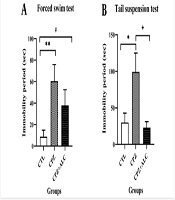
Acetyl-L-carnitine Improves Depressive-like Behaviors Through Nitric Oxide Modulation in the Cuprizone Intoxication Mouse Model of Multiple Sclerosis
Zare D, Omidi A, Javan M. Acetyl-L-carnitine Improves Depressive-like Behaviors Through Nitric Oxide Modulation in the Cuprizone Intoxication Mouse Model of Multiple Sclerosis. Jundishapur J Nat Pharm Prod. 2024;19(3):e146086. doi: https://doi.org/10.5812/jjnpp-146086
More by these authors
- Scopus by DOI: 0
Last Update: 3 days ago
- Scopus by Title: 5
Last Update: 3 days ago
- Scopus by Title (Ref): 5
Last Update: 3 days ago
- CrossRef: 0
Last Update: 6 hours ago
- OpenAlex: 0
Last Update: 8 hours ago
- OpenCitations: 0
Last Update: 4 days ago