Journal of Semnan University of Medical Sciences
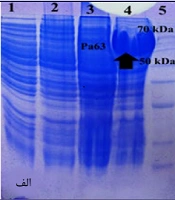
Image Credit:Koomesh
Outline
Investigating the Immunogenicity of PA63 Antigen in Free form and Loaded in PLGA Nanoparticle in Mice
Authors

Abstract
Background: So far, an ideal vaccine for anthrax has not been approved. PA63 antigen has antigenic properties, and scientists use this antigen to produce new generations of vaccines. The main aim of this research is to investigate the ability to produce antibodies and immunogenicity of PA63 recombinant antigen-loaded in PLGA nanoparticles in mice as a potential vaccine candidate.
Methods: In this experimental study, the vector containing the PA63 gene was introduced into DE3 BL21 E. coli bacteria, and their transformation and protein expression levels were evaluated by PAGE-SDS. After purifying the recombinant proteins with column chromatography, the recombinant proteins were loaded in PLGA polymer and injected into mice three times in a row to study immunogenicity.
Results: The size and zeta potential of nanoparticles containing nanoparticles containing PA63 protein were measured as 261.9 nm and -34.4 mV. Electron photographs of nanoparticles show the spherical shape of nanoparticles and the correct size and zeta potential. The mean antibody titer produced against PA63 recombinant protein was increased in the loaded form compared to the free one.
Conclusion: In this research, due to the advantages of nanoparticle systems in reducing possible protein risks and also the possibility of increasing its immunogenicity as new delivery systems of protein vaccines, nanoparticles based on natural and synthetic polymers containing PA63 protein were used. PLGA nanoparticles with different characteristics in terms of different physicochemical properties, release patterns, synthesis methods, and loading rates were studied to determine the best form of polymer for protein loading.
Highlights
References
- 1.Schmidt TR, Scott EJ, Dyer DW. Whole-genome phylogenies of the family Bacillaceae and expansion of the sigma factor gene family in the Bacillus cereus species-group. BMC Genomics. 2011;12:430. [PubMed ID:21864360]. [PubMed Central ID:PMC3171730]. https://doi.org/10.1186/1471-2164-12-430.
- 2.Koehler TM. Bacillus anthracis physiology and genetics. Mol Aspects Med. 2009;30(6):386-96. [PubMed ID:19654018]. [PubMed Central ID:PMC2784286]. https://doi.org/10.1016/j.mam.2009.07.004.
- 3.Caugant DA, Johansen HA, Fouet A, Mock M, et al. Bacillus anthracis, Bacillus cereus, and Bacillus thuringiensis--one species on the basis of genetic evidence. Appl Environ Microbiol. 2000;66(6):2627-30. [PubMed ID:10831447]. [PubMed Central ID:PMC110590]. https://doi.org/10.1128/AEM.66.6.2627-2630.2000.
- 4.Kumari A, Yadav SK, Yadav SC. Biodegradable polymeric nanoparticles based drug delivery systems. Colloids Surf B Biointerfaces. 2010;75(1):1-18. [PubMed ID:19782542]. https://doi.org/10.1016/j.colsurfb.2009.09.001.
- 5.Mirhaj H, Honari H, Zamani E. Evaluation of immune response to recombinant Bacillus anthracis LFD1-PA4 chimeric protein. Iran J Vet Res. 2019;20(2):112-9. [PubMed ID:31531033]. [PubMed Central ID:PMC6716276].
- 6.Brey RN. Molecular basis for improved anthrax vaccines. Adv Drug Deliv Rev. 2005;57(9):1266-92. [PubMed ID:15935874]. https://doi.org/10.1016/j.addr.2005.01.028.
- 7.Gordon VM, Klimpel KR, Arora N, Henderson MA, Leppla SH. Proteolytic activation of bacterial toxins by eukaryotic cells is performed by furin and by additional cellular proteases. Infect Immun. 1995;63(1):82-7. [PubMed ID:7806387]. [PubMed Central ID:PMC172960]. https://doi.org/10.1128/iai.63.1.82-87.1995.
- 8.Friedlander AM. Tackling anthrax. Nature. 2001;414(6860):160-1. [PubMed ID:11700539]. https://doi.org/10.1038/35102660.
- 9.Hicks CW, Sweeney DA, Cui X, Li Y, Eichacker PQ. An overview of anthrax infection including the recently identified form of disease in injection drug users. Intensive Care Med. 2012;38(7):1092-104. [PubMed ID:22527064]. [PubMed Central ID:PMC3523299]. https://doi.org/10.1007/s00134-012-2541-0.
- 10.Mahapatro A, Singh DK. Biodegradable nanoparticles are excellent vehicle for site directed in-vivo delivery of drugs and vaccines. J Nanobiotechnol. 2011;9:55. [PubMed ID:22123084]. [PubMed Central ID:PMC3238292]. https://doi.org/10.1186/1477-3155-9-55.
- 11.Reis CP, Neufeld RJ, Ribeiro AJ, Veiga F. Nanoencapsulation I. Methods for preparation of drug-loaded polymeric nanoparticles. Nanomedicine. 2006;2(1):8-21. [PubMed ID:17292111]. https://doi.org/10.1016/j.nano.2005.12.003.
- 12.Honari H, Mojtabaaghaie S, Hoseinzadeh M. [C-CfTXA-STxB chimeric antigen loading in PLA-PEG-PLA tri-block copolymers and its immunization in mice]. Koomesh. 2022;24(4):e152763. Persian.
- 13.Houchin ML, Topp EM. Chemical degradation of peptides and proteins in PLGA: a review of reactions and mechanisms. J Pharm Sci. 2008;97(7):2395-404. [PubMed ID:17828756]. https://doi.org/10.1002/jps.21176.
- 14.Wang H, Lin PH, Yao Q, et al. Current advances in research and clinical applications of PLGA-based nanotechnology. Expert Rev Mol Diagn. 2009;9(4):325-41. [PubMed ID:19435455]. [PubMed Central ID:PMC2701163]. https://doi.org/10.1586/erm.09.15.
- 15.Jensen DK, Maltesen MJ, Bunker M, Whiteside P, Scurr D, et al. High loading efficiency and sustained release of siRNA encapsulated in PLGA nanoparticles: quality by design optimization and characterization. Eur J Pharm Biopharm. 2011;77(1):26-35. [PubMed ID:21093589]. https://doi.org/10.1016/j.ejpb.2010.11.008.
- 16.Freitas S, Merkle HP, Gander B. Microencapsulation by solvent extraction/evaporation: reviewing the state of the art of microsphere preparation process technology. J Control Release. 2005;102(2):313-32. [PubMed ID:15653154]. https://doi.org/10.1016/j.jconrel.2004.10.015.
- 17.Sahoo SK, Panyam J, Prabha S, Labhasetwar V. Residual polyvinyl alcohol associated with poly (D,L-lactide-co-glycolide) nanoparticles affects their physical properties and cellular uptake. J Control Release. 2002;82(1):105-14. [PubMed ID:12106981]. https://doi.org/10.1016/s0168-3659(02)00127-x.
- 18.Eldridge JH, Hammond CJ, Meulbroek JA, Staas JK, Gilley RM, Tice TR. Controlled vaccine release in the gut-associated lymphoid tissues. I. Orally administered biodegradable microspheres target the peyer's patches. J Controlled Release. 1990;11(1-3):205-14. https://doi.org/10.1016/0168-3659(90)90133-e.
- 19.Norris DA, Puri N, Sinko PJ. The effect of physical barriers and properties on the oral absorption of particulates. Adv Drug Deliv Rev. 1998;34(2-3):135-54. [PubMed ID:10837675]. https://doi.org/10.1016/s0169-409x(98)00037-4.
- 20.Halayqa M, Domanska U. PLGA biodegradable nanoparticles containing perphenazine or chlorpromazine hydrochloride: effect of formulation and release. Int J Mol Sci. 2014;15(12):23909-23. [PubMed ID:25535080]. [PubMed Central ID:PMC4284797]. https://doi.org/10.3390/ijms151223909.
- 21.Nazarian S, Gargari SL, Rasooli I, Hasannia S, Pirooznia N. A PLGA-encapsulated chimeric protein protects against adherence and toxicity of enterotoxigenic Escherichia coli. Microbiol Res. 2014;169(2-3):205-12. [PubMed ID:23906742]. https://doi.org/10.1016/j.micres.2013.06.005.
- 22.Diwan M, Tafaghodi M, Samuel J. Enhancement of immune responses by co-delivery of a CpG oligodeoxynucleotide and tetanus toxoid in biodegradable nanospheres. J Control Release. 2002;85(1-3):247-62. [PubMed ID:12480329]. https://doi.org/10.1016/s0168-3659(02)00275-4.
- 23.Honari H, Minaei M, Mirhaj H, Etemad- Ayoubi SM. [Antibody titers of PEG-PLA block copolymer nanosphere containing chimeric recombinant protein of protective antigen and lethal factor of Bacillus anthracis]. Koomesh. 2021;23(4):441-8. Persian. https://doi.org/10.52547/koomesh.23.4.441.
- 24.Thomas C, Rawat A, Hope-Weeks L, Ahsan F. Aerosolized PLA and PLGA nanoparticles enhance humoral, mucosal and cytokine responses to hepatitis B vaccine. Mol Pharm. 2011;8(2):405-15. [PubMed ID:21189035]. https://doi.org/10.1021/mp100255c.
- 25.Bershteyn A, Hanson MC, Crespo MP, Moon JJ, Li AV, Suh H, et al. Robust IgG responses to nanograms of antigen using a biomimetic lipid-coated particle vaccine. J Control Release. 2012;157(3):354-65. [PubMed ID:21820024]. [PubMed Central ID:PMC3811132]. https://doi.org/10.1016/j.jconrel.2011.07.029.
- 26.Danhier F, Ansorena E, Silva JM, Coco R, Le Breton A, Preat V. PLGA-based nanoparticles: an overview of biomedical applications. J Control Release. 2012;161(2):505-22. [PubMed ID:22353619]. https://doi.org/10.1016/j.jconrel.2012.01.043.
Copyright
© 2024, Author(s). This open-access article is available under the Creative Commons Attribution 4.0 (CC BY 4.0) International License (https://creativecommons.org/licenses/by/4.0/), which allows for unrestricted use, distribution, and reproduction in any medium, provided that the original work is properly cited.
Similar Articles
Antibody titers of PEG-PLA block copolymer nanosphere containing chimeric recombinant protein of protective antigen and lethal factor of Bacillus anthracis
Honari H, Minaei M, Mirhaj H, EtemadAyoubi SM. Antibody titers of PEG-PLA block copolymer nanosphere containing chimeric recombinant protein of protective antigen and lethal factor of Bacillus anthracis. koomesh. 2021;23(4):e153272. doi:
Antibody Response is Differentially Influenced by PLGA-PAD4 Particle Characteristics
Manish M, Bhatnagar R. Antibody Response is Differentially Influenced by PLGA-PAD4 Particle Characteristics. Int J Infect. 2017;4(4):e15594. doi: https://doi.org/10.5812/iji.15594
C-CfTXA-STxB chimeric antigen loading in PLA-PEG-PLA tri-block copolymers and its immunization in mice
Honari H, mojtabaaghaie S, Hoseinzadeh M. C-CfTXA-STxB chimeric antigen loading in PLA-PEG-PLA tri-block copolymers and its immunization in mice. koomesh. 2022;24(4):e152763. doi:
Development of Multi-epitope Subunit Vaccine Against Pseudomonas aeruginosa Using OprF/OprI and PopB Proteins
Sabzehali F, Goudarzi H, Salimi Chirani A, Yoosefi Izad MH, Goudarzi M. Development of Multi-epitope Subunit Vaccine Against Pseudomonas aeruginosa Using OprF/OprI and PopB Proteins. Arch Clin Infect Dis. 2021;16(4):e118243. doi: https://doi.org/10.5812/archcid.118243
Formulation and Optimization of a New Cationic Lipid-Modified PLGA Nanoparticle as Delivery System for Mycobacterium tuberculosis HspX/EsxS Fusion Protein: An Experimental Design
Khademi F, Yousefi-Avarvand A, Derakhshan M, Abbaspour MR, Sadri K, et al. Formulation and Optimization of a New Cationic Lipid-Modified PLGA Nanoparticle as Delivery System for Mycobacterium tuberculosis HspX/EsxS Fusion Protein: An Experimental Design. Iran J Pharm Res. 2019;18(1):e126122. doi: https://doi.org/10.22037/ijpr.2019.2329
- Scopus by DOI: 0
Last Update: 2 weeks ago
- Scopus by Title: 0
Last Update: 2 weeks ago
- Scopus by Title (Ref): 0
Last Update: 2 weeks ago
- CrossRef: 0
Last Update: 6 days ago
- OpenAlex: 0
Last Update: 1 day ago
- OpenCitations: 0
Last Update: 4 days ago

