Journal of Semnan University of Medical Sciences
Image Credit:Koomesh
Outline
Healing potential of fibroblast cells cultured on a PLA/CS nanofibrous scaffold in skin regeneration in Wistar rat
Authors

Abstract
Introduction: Chronic wound treatment has become a major health issue in developed countries, because of their increasing elderly populations. Although chronic wounds are common problem in all population, treatment for these disabling conditions remains limited and largely ineffective. In this study, we examined the benefits of transplantation of fibroblast cells, cultured on PLA/CS (Poly lactic acid/ Chitosan) scaffold, in wound healing. Materials and Methods: In this study, fibroblast cells were cultured on nanofibrous PLA/CS scaffold then transplanted in rat. The PLA/CS scaffold was prepared by electrospinning method. Also histological staining methods were used to evaluate cell density and amount of collagen. Results: The macroscopic observations and histological staining showed that the wound healed much quicker in PLA/CS scaffold in compare to control group. In vivo assessment showed that treatment with fibroblast cell loaded scaffolds significantly promoted cell density and amount of collagen in rat compared to control group. Conclusion: These results indicated that the capacity of nanofibrous PLA/CS scaffold cultured with fibroblast cells in vivo wound healing.
Highlights
References
- 1.Atiyeh BS, Hayek SN, Gunn SW. New technologies for burn wound closure and healing--review of the literature. Burns 2005; 31: 944-956.
- 2.Heunis TD, Dicks LM. Nanofibers offer alternative ways to the treatment of skin infections. J Biomed Biotechnol 2010; 2010.
- 3.Tangsadthakun C, Kanokpanont S, Sanchavanakit N, Pichyangkura R, Banaprasert T, Tabata Y, et al. The influence of molecular weight of chitosan on the physical and biological properties of collagen/chitosan scaffolds. J Biomater Sci Polym Ed 2007; 18: 147-163.
- 4.van den Berg LM, Zijlstra-Willems EM, Richters CD, Ulrich MM, Geijtenbeek TB. Dectin-1 activation induces proliferation and migration of human keratinocytes enhancing wound re-epithelialization. Cell Immunol 2014; 289: 49-54.
- 5.Raja, Sivamani K, Garcia MS, Isseroff RR. Wound re-epithelialization: modulating keratinocyte migration in wound healing. Front Biosci 2007; 12: 2849-2868.
- 6.Sivamani RK, Pullar CE, Manabat-Hidalgo CG, Rocke DM, Carlsen RC, Greenhalgh DG, et al. Stress-mediated increases in systemic and local epinephrine impair skin wound healing: potential new indication for beta blockers. PLoS Med 2009; 6: e12.
- 7.Hoveizi E, Nabiuni M, Parivar K, Rajabi-Zeleti S, Tavakol S. Functionalisation and surface modification of electrospun polylactic acid scaffold for tissue engineering. Cell Biol Int 2014; 38: 41-49.
- 8.Xing ZC, Han SJ, Shin YS, Kang IK. Fabrication of biodegradable polyester nanocomposites by electrospinning for tissue engineering. Biomaterials 2008; 29: 4065-4073.
- 9.Meng ZX, Wang YS, Ma C, Zheng W, Li L, Zheng YF. Electrospinning of PLGA/gelatin randomly-oriented and aligned nanofibers as potential scaffold in tissue engineering. Mater Sci Eng 2010; 30:1204-1210.
- 10.Kim HW, Yu HS, Lee HH. Nanofibrous matrices of poly (lactic acid) and gelatin polymeric blends for the improvement of cellular responses. J Biomed Mater Res A 2008; 87: 25-32.
- 11.Pham QP, Sharma U, Mikos AG. Electrospinning of polymeric nanofibers for tissue engineering applications: a review. Tissue Eng 2006; 12: 1197-1211.
- 12.Chao G, Xiaobo S, Chenglin C, Yinsheng D, Yuepu P, Pinghua L. A cellular automaton simulation of the degradation of porous polylactide scaffold: I. Effect of porosity. Mater Sci Eng 2009; 29: 1950-1958.
- 13.Chai JH, Wu QS. Electrospinning preparation and electrical and biological properties of ferrocene/poly (vinylpyrrolidone) composite nanofibers. Beilstein J Nanotechnol 2013; 4: 189-197.
- 14.Prabhakaran MP, Vatankhah E, Ramakrishna S. Electrospun aligned PHBV/Collagen nanofibers as substrates for nerve tissue engineering. Biotechnol Bioeng 2013; 110: 2775-2784.
- 15.Kang X, Xie Y, Powell HM, James Lee L, Belury MA, Lannutti JJ, et al. Adipogenesis of murine embryonic stem cells in a three-dimensional culture system using electrospun polymer scaffolds. Biomater 2007; 28: 450-458.
- 16.Wu L, Ding J. Effects of porosity and pore size on in vitro degradation of three-dimensional porous poly (D,L-lactide-co-glycolide) scaffolds for tissue engineering. J Biomed Mater Res A. 2005; 75: 767-777.
- 17.Wu Y, Chen L, Scott PG, Tredget EE. Mesenchymal stem cells enhance wound healing through differentiation and angiogenesis. Stem Cell 2007; 25: 2648-2659.
- 18.Huang S, Xu Y, Wu C, Sha D, Fu X. In vitro constitution and in vivo implantation of engineered skin constructs with sweat glands. Biomater 2010; 31: 5520-5525.
- 19.Zhang C, Wang N, Chen H, Zhou G, Zhang G, Han B. [Experimental study on repairing full-thickness cutaneous deficiency with tissue engineered skin]. Zhongguo Xiu Fu Chong Jian Wai Ke Za Zhi 2008; 22: 196-201.
- 20.Chlapanidas T, Tosca MC, Farago S, Perteghella S, Galuzzi M, Lucconi G, et al. Formulation and characterization of silk fibroin films as a scaffold for adipose-derived stem cells in skin tissue engineering. Int J Immunopathol Pharmacol 2013; 26: 43-49.
- 21.Gillette BM, Rossen NS, Das N, Leong D, Wang M, Dugar A, et al. Engineering extracellular matrix structure in 3D multiphase tissues. Biomater 2011; 32: 8067-8076.
- 22.Hoveizi E, Khodadadi S, Tavakol S, Karima O, Nasiri-Khalili MA. Small molecules differentiate definitive endoderm from human induced pluripotent stem cells on PCL scaffold. Appl Biochem Biotechnol 2014; 173: 1727-1736.
- 23.Zhang S, Gelain F, Zhao X. Designer self-assembling peptide nanofiber scaffolds for 3D tissue cell cultures. Semin Cancer Biol 2005; 15: 413-420.
- 24.Hoveizi E, Nabiuni M, Parivar K, Ai J, Massumi M. Definitive endoderm differentiation of human-induced pluripotent stem cells using signaling molecules and IDE1 in three-dimensional polymer scaffold. J Biomed Mater Res A. 2014; 102: 4027-4036.
- 25.Hoveizi E, Nabiuni M, Parivar K, Ai J, Massumi M. Definitive endoderm differentiation of human induced pluripotent stem cells (hiPSCs) using signaling molecules and IDE1 in three-dimensional polymer scaffold. J Biomed Mater Res A 2014; 102: 4027-4036.
- 26.Hoveizi E, Tavakol S, Ebrahimi-Barough S. Neuroprotective effect of transplanted neural precursors embedded on PLA/CS scaffold in an animal model of multiple sclerosis. Mol Neurobio 2015; 51: 1334-1342.
- 27.Fang P, Gao Q, Liu WJ, Qi XX, Li GB, Zhang J, et al. Survival and differentiation of neuroepithelial stem cells on chitosan bicomponent fibers. Chin J Physiol 2010; 53: 208-214.
- 28.Pezeshki-Modaress M, Rajabi-Zeleti S, Zandi M, Mirzadeh H, Sodeifi N, Nekookar A, et al. Cell-loaded gelatin/chitosan scaffolds fabricated by salt-leaching/lyophilization for skin tissue engineering: In vitro and in vivo study. J Biomed Mater Res A 2014; 102: 3908-3917.
- 29.Massumi M, Hoveizi E, Baktash P, Hooti A, Ghazizadeh L, Nadri S, et al. Efficient programming of human eye conjunctiva-derived induced pluripotent stem (ECiPS) cells into definitive endoderm-like cells. Exper Cell Res 2014; 322: 51-61.
Copyright
© 2016, Author(s). This open-access article is available under the Creative Commons Attribution 4.0 (CC BY 4.0) International License (https://creativecommons.org/licenses/by/4.0/), which allows for unrestricted use, distribution, and reproduction in any medium, provided that the original work is properly cited.
Similar Articles
Study of Fibroblast cells Behavior on Supramolecular Polycaprolactone Nanofibers Coated with Gelatin
Shakeri Shemirani Z, Zandi M, Shokrollahi P, Irani S. Study of Fibroblast cells Behavior on Supramolecular Polycaprolactone Nanofibers Coated with Gelatin. J Clin Res Paramed Sci. 2015;4(1):e81538. doi:
Rapid repair of skin ulcers in diabetic rats using polycaproplactone /gelatin nanon-fiber scaffold
Zafari F, Sadeghi M, Bakhtiyari M, teimourian S. Rapid repair of skin ulcers in diabetic rats using polycaproplactone /gelatin nanon-fiber scaffold. koomesh. 2019;21(3):e153113. doi:
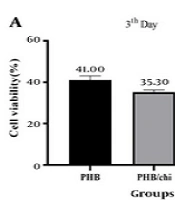
Investigating the Viability of Human Gingival Fibroblast Cells in a Polyhydroxybutyrate/Chitosan/Bioglass Nanoparticles Scaffold
Heidary F, Karbasi S, Khoroushi M, Moradi Gharibvand N, Mohammadrezaforough M, et al. Investigating the Viability of Human Gingival Fibroblast Cells in a Polyhydroxybutyrate/Chitosan/Bioglass Nanoparticles Scaffold. Compr Health Biomed Stud. 2023;1(4):e143990. doi: https://doi.org/10.5812/chbs-143990
A Novel Composite Nano-scaffold with Potential Usage as Skin Dermo-epidermal Grafts for Chronic Wound Treatment
Moradi S, Nilforoushzadeh MA, Zargan J, Nazarian S, Brouki Milan P. A Novel Composite Nano-scaffold with Potential Usage as Skin Dermo-epidermal Grafts for Chronic Wound Treatment. J Skin Stem Cell. 2022;9(4):e133976. doi: https://doi.org/10.5812/jssc-133976
Novel Wound Dressing Based on Postbiotic/Chitosan Film Accelerates Cutaneous Wound Healing
Jamaran S, Jafari P, Marjani A, Akbari N, Feizabad MM. Novel Wound Dressing Based on Postbiotic/Chitosan Film Accelerates Cutaneous Wound Healing. Jundishapur J Microbiol. 2021;14(12):e120806. doi: https://doi.org/10.5812/jjm.120806
- Scopus by DOI: 0
Last Update: 4 days ago
- Scopus by Title: 5
Last Update: 4 days ago
- Scopus by Title (Ref): 5
Last Update: 4 days ago
- CrossRef: 0
Last Update: 5 hours ago
- OpenAlex: 0
Last Update: 7 hours ago
- OpenCitations: 0
Last Update: 4 days ago