Journal of Semnan University of Medical Sciences
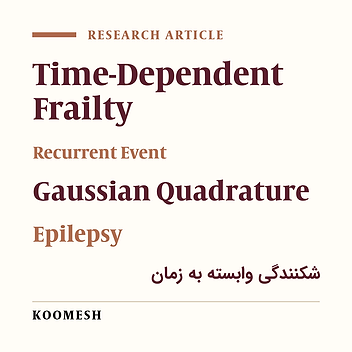
Image Credit:Koomesh
Outline
Time-dependent frailty model to gap times between recurrent events with application to epilepsy data
Authors
 ,*, Soghrat Faghihzadeh, Mehdi Rahgozar, Ebrahim Hajizadeh, Seyed Sohrab Hashemi Fesharaki, Marzieh Gharakhani
Abstract
Introduction: In recurrent event a specific event occur repeatedly over time for a person. The frailty models take into account this correlation and provide efficient inferences. The frailties are assumed to be constant over time that it may be insufficient. Therefore time-varying frailty models are more realistic models. The aim of this study was to fit a time-dependent frailty model in the gap time between recurrent events. Materials and methods: In this study, a time-dependent frailty model was introduced in the gap time between recurrent events, that was a generalization of the Wintrebert (2004) model in cluster data (center-effect). The parameters were estimated by Gaussian quadrature method. The model was applied to epilepsy data. Results: The time-dependent frailty model fitted better in compare to shared frailty model. The observation time for IED on EEG in 56 patients (%73 male, %34 veteran status) with epilepsy was studied. Age and veteran status were the two risk factors in the gap time between IEDs. Variance of frailty was significant too. Conclusion: The result of time-dependent frailty model was reliable when there were unknown time-dependent factors in medical data and make changes on times of occurring recurrent events. The Gaussian quadrature was an applied method to fit a time-dependent frailty model. The programming for this method was comfortable hence this method can cause time-dependent fraility models to be more practical in medical studies.
Highlights
References
- 1.Kelly PJ, Lim LL. Survival analysis for recurrent event data: an application to childhood infectious diseases. Stat Med 2000; 19: 13-33.
- 2.Wang MC, Gin J, Chiang CT. Analysis recurrent event data with informative censoring. J Am Stat Assoc 2001; 96: 1057-1065.
- 3.Lim HJ, Liu J, Melzer-Lange M. Comparison of methods for analyzing recurrent events data: application to the emergency department visits of pediatric firearm victims. Accid Anal Prev 2007; 39: 290-299.
- 4.Huang X, Liu L. A joint frailty model for survival and gap times between recurrent events. Biometrics 2007; 63: 389-397.
- 5.Amorim LD, Cai J, Zeng D, Barreto ML. Regression splines in the time-dependent coefficient rates model for recurrent event data. Stat Med 2008; 27: 5890-5906.
- 6.Wang MC, Chiang CT. Non-parametric methods for recurrent event data with informative and non-informative censorings. Stat Med 2002; 21: 445-456.
- 7.King TM, Beaty TH, Liang KY. Comparison of methods for survival analysis of dependent data. Genet Epidemiol 1996; 13: 139-158.
- 8.Vandebosch A, Goetghebeur E, Damme LV. Structural accelerated failure time models for the effects of observed exposures on repeated events in a clinical trial. Stat Med 2005; 24: 1029-1046.
- 9.Wintrebert CM, Putter H, Zwinderman AH, Van Houwelingen JC. Centre-effect on survival after bone marrow transplantation: Application of time-dependent frailty models. Biomet J 2004; 46: 512-525.
- 10.Box-Steffensmeier JM, De Boef S. Repeated events survival models: the conditional frailty model. Stat Med 2006; 25: 3518-3533.
- 11.Olesen AV, Parner ET. Correcting for selection using frailty models. Stat Med 2006; 25: 1672-1684.
- 12.Liu D, Kalbfleisch JD, Schaubel DE. A positive stable frailty model for clustered failure time data with covariate-dependent frailty. Biometrics 2011; 67: 8-17.
- 13.McGilchrist CA, Yau KK. Survival analysis with time dependent frailty using a longitudinal model. Aust N Z J Stat 1996; 38: 53-60.
- 14.Yau KK, McGilchrist CA. ML and REML estimation in survival analysis with time dependent correlated frailty. Stat Med 1998; 17: 1201-1213.
- 15.Manda SOM, Meyer R. Bayesian inference for recurrent events data using time-dependent frailty. Stat Med 2005; 24: 1263-1274.
- 16.Lei L, Xuelin H. The use of Gaussian quadrature for estimation in frailty proportional hazards models. Stat Med 2008; 27: 2665-2683.
- 17.Danesh F. Epilepsy disorders. Tehran: Iran university 1998 (Persian).
- 18.Pillai J, Sperling M. Interictal EEG and the diagnosis of epilepsy. Epilepsia 2006; 47: 14-22.
- 19.Narayanan JT, Labar DR, Schaul N. Latency to first spike in the EEG of epilepsy patients. Seizure 2008; 17: 34-41.
- 20.Ribai P, Tugendhaft P, Legros B. Usefulness of prolonged video-EEG monitoring and provocative procedure with saline injection for the diagnosis of non epileptic seizures of psychogenic origin. J Neurol 2006; 253: 328-332.
- 21.Zhang Y, Bromfield E, Hurwitz S. Comparison of outcome of video EEG monitoring between patients with epileptic seizure and those with psychogenic nonepileptic seizures. Epilepsy Behav 2009; 15: 303-307.
- 22.Eisenman L, Attarian H, Fessler A. Self-reported seizure frequency and time to first event in the seizure monitoring unit. Epilepsia 2005; 46: 664-668.
- 23.Losey T, Uber-Zak L. Time to first interictal epileptiform discharge in extended recording EEGs. Clin Neurophys 2008; 25: 357-360.
- 24.Rabe-Hesketh S, Skrondal A, Pickles A. Maximum likelihood estimation of limited and discrete dependent variable models with nested random effects. J Econom 2005; 128: 301-323.
- 25.Lossius M, Stavem K, Gjerstad L. Predictors for recurrence of epileptic seizures in a general epilepsy population. Seizure 1999; 8: 476-479.
- 26.Ghacibeh G, Smith J, Roper S, Gilmore R, Eisenschenk S. Seizure recurrence following epilepsy surgery: is post-operative EEG helpful? Seizure 2009; 18: 193-196.
- 27.Lim SH. Epidemiology and etiology of seizures and epilepsy in the elderly in Asia. Neurol Asia 2004; 9: 31-32.
- 28.Bozorg A, Lacayo J, Benbadis S. The yield of routine outpatient electroencephalograms in the veteran population. J Clin Neurophysiol 2010; 27: 191-192.
- 29.Phillips Jm, Teylor PJ. Theory and numerical analysis applications. 1, editor. Tehran Academic Publication Center; 1985 (Persian).
- 30.Givens GH, Hoeting JA. Computational statistics. New jersy: Wiley; 2005.
Copyright
© 2016, Author(s). This open-access article is available under the Creative Commons Attribution 4.0 (CC BY 4.0) International License (https://creativecommons.org/licenses/by/4.0/), which allows for unrestricted use, distribution, and reproduction in any medium, provided that the original work is properly cited.
Similar Articles

Analyzing Relationship Between Local and Metastasis Relapses with Survival of Patients with Breast Cancer: A Study Using Joint Frailty Model
Osmani F, Hajizadeh E, Rasekhi A, Akbari ME. Analyzing Relationship Between Local and Metastasis Relapses with Survival of Patients with Breast Cancer: A Study Using Joint Frailty Model. Int J Cancer Manag. 2018;11(12):e81783. doi: https://doi.org/10.5812/ijcm.81783
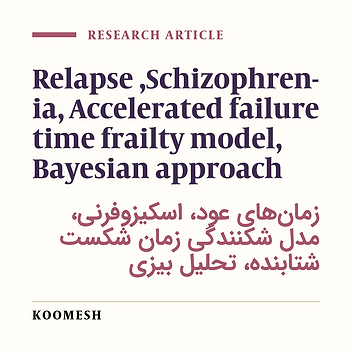
Applying accelerated failure time frailty model using Bayesian approach to identify some risk factors of time to relapses in schizophrenia patients
Rahmati M, Rahgozar M, Bakhshi E, Farzaneh N, Fadaei F, et al. Applying accelerated failure time frailty model using Bayesian approach to identify some risk factors of time to relapses in schizophrenia patients. koomesh. 2014;15(3):e152649. doi:

Simultaneous modeling of multiple recurrences in breast cancer patients
Osmani F, Rasekhi A, HajiZadeh E, Akbari H. Simultaneous modeling of multiple recurrences in breast cancer patients. koomesh. 2020;22(2):e153189. doi:

Joint modeling factors affecting interictal epileptiform discharge and seizure occurrence among epileptic patients
Sadati M, Faghihzadeh S, HashemiFesharaki S, Gharakhani M. Joint modeling factors affecting interictal epileptiform discharge and seizure occurrence among epileptic patients. koomesh. 2012;14(1):e152545. doi:
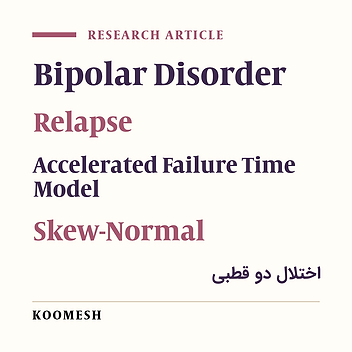
Identification of some individual and social factors on relapse intervals in bipolar disorder:Bayesian analysis of log-skew-normal accelerated failure time model
Gholizadeh A, Kheiri S, Sedehi M, Esmaily H, Arab Borzou Z. Identification of some individual and social factors on relapse intervals in bipolar disorder:Bayesian analysis of log-skew-normal accelerated failure time model. koomesh. 2018;20(2):e152969. doi:
- Scopus by DOI: 0
Last Update: 4 days ago
- Scopus by Title: 0
Last Update: 4 days ago
- Scopus by Title (Ref): 0
Last Update: 4 days ago
- CrossRef: 0
Last Update: 7 hours ago
- OpenAlex: 0
Last Update: 9 hours ago
- OpenCitations: 0
Last Update: 4 days ago