Journal of Semnan University of Medical Sciences
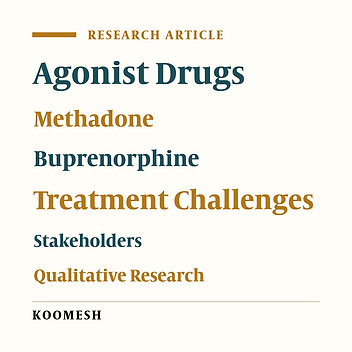
Image Credit:Koomesh
Outline
Challenges of addiction treatment with opioid agonist drugs from the perspective of stakeholders: A qualitative study
Authors

Abstract
Introduction: Drug use disorder and dependency is one of the most challenging problems in the world. One of the most common therapy for opioid use disorder is agonist maintenance therapy especially methadone maintenance treatment and buprenorphine maintenance treatment. The study aimed to investigate the challenges of providing agonist therapy from the perspective of stakeholders. Materials and Methods: The present study is a qualitative study with a content analysis method that has used exploratory and semi-structured interviews and purposeful sampling. Interviews were conducted individually to collect data from the view of stakeholders including some of the physicians as service providers and a group of patients as service recipients. Sampling reached saturation with 21 people. The data were analyzed based on the Graneheim and Lundman model. Results: Data analysis revealed eight important challenges and barriers, including travel and time spent, availability of agonist drugs (used in maintenance therapy) illegally, take-home dose ( home dose of methadone), trust and confidentiality of authorities, the cost of treatment and income and expenditure, policy and cultural issues of the centers, file filing process, and family factors. Conclusion: The current pattern and the process of treatment with the agonist drugs reasonably have been well received. If the obstacles and problems of this treatment method are not considered, its useful results can face challenges.
Highlights
References
- 1.Hemmati A, Yaghoobi SF, Hatami H, Shadnoush M, Baniasadi M. Assessing anthropometric indices changes and related factors in patients under methadone maintenance therapy. Koomesh 2018; 20: 447-452. (Persian).
- 2.Eskandarieh S, Jafari F, Yazdani S, Hazrati N, Saberi-Zafarghandi MB. Compulsory maintenance treatment program amongst Iranian injection drug users and its side effects. Int J High Risk Behav Addict 2014; 3: e21765.https://doi.org/10.5812/ijhrba.21765PMid:25741482 PMCid:PMC4331656.
- 3.Roshanpajouh M, Mirkazemi R, Ehterami M, Narenjiha H, Afzali HM, Sarrami H, et al. The prevalence of drug and stimulant substance abuse among households in Tehran Province, Iran. J Sch Publ Health Instit Publ Health Res 2019; 16. (Persian).
- 4.United Nations Office on Drugs and Crime: World Drug Report 2021. https://www.unodc.org/unodc/en/data-and-analysis/wdr2021.html.
- 5.Saberi-Zafarghandi MB, Jadidi M, Khalili N. Iran's activities on prevention, treatment and harm reduction of drug abuse. Int J High Risk Behav Addict 2015; 4.https://doi.org/10.5812/ijhrba.22863PMid:26870709 PMCid:PMC4744908##.
- 6.Sotodehasl N, Mahigir S, Paknazar F, Mirmohammadkhani M. A comparative study of the attitude of patients participating in narcotics anonymous program and undergoing methadone maintenance therapy towards substance abuse. Koomesh 2020; 22: 550-555. (Persian).https://doi.org/10.29252/koomesh.22.3.550.
- 7.Mokri A, Noruzi A. Protocol on management of opioid dependence with methadone. office of prevention and treatment of substance abuse; office of mental, social and addiction Health; Third Edition, Fall 2014. (Persian).
- 8.Saberi Zafarghandi M. Some of the challenges of mental health and addiction in Iran. Iran J Psychiatr Clin Psychol 2011; 17: 161-157. (Persian).
- 9.Dehkohneh SG, Azadi S, Rasouali-Azad M, Jalilian J, Ghasemineghad A, Vahed N, et al. Oxidative stress, glycemic control, inflammation, and lipid profiles in substance abuse disorders: Current knowledge and future perspectives. Int J Pharmac Res 2020; 12: 1062-1071.
- 10.Shanmugam PK. Exploring trends and challenges from mandated treatment to voluntary treatment outcomes in addiction treatment in Malaysia: moving toward a person-centered service provision. J Subst Use 2020; 25: 141-145.https://doi.org/10.1080/14659891.2019.1664669.
- 11.Lin C, Wu Z, Rou K, Pang L, Cao X, Shoptaw S, et al. Challenges in providing services in methadone maintenance therapy clinics in China: service providers' perceptions. Int J Drug Policy 2010; 21: 173-178.https://doi.org/10.1016/j.drugpo.2009.09.002PMid:19818591 PMCid:PMC2847064.
- 12.Bobrova N, Rughnikov U, Neifeld E, Rhodes T, Alcorn R, Kirichenko S, et al. Challenges in providing drug user treatment services in Russia: providers' views. Subst Use Misuse 2008, 43: 13.https://doi.org/10.1080/10826080802289291PMid:19016164.
- 13.Zamani S. Methadone Maintenance Treatment (MMT) for drug-using prisoners in Ghezel Hesar Prison, Karaj, Iran. A qualitative study Kyoto, Japan: UNAIDS/Collaborating Centre on Socio-Epidemiological HIV Research, Kyoto University. 2008. https://www.unodc.org/documents/islamicrepublicofiran/publications/Sub-programme2Documents/17may2015QualitativerepMMTGhezelHesarprison.pdf.
- 14.Jeske CP, O'Byrne P. Perceptions and experiences of methadone Maintenance treatment: a qualitative descriptive research study. J Addic Nurs 2019; 30: 24853.https://doi.org/10.1097/JAN.0000000000000307PMid:31800515.
- 15.Tong A, Sainsbury P, Craig J. Consolidated criteria for reporting qualitative research (COREQ): a 32-item checklist for interviews and focus groups. Int J Qual Health Care 2007; 19: 349-357.https://doi.org/10.1093/intqhc/mzm042PMid:17872937.
- 16.Graneheim UH, Lundman B. Qualitative content analysis in nursing research: concepts, procedures and measures to achieve trustworthiness. Nurse Educ Today 2004; 24: 105-112.https://doi.org/10.1016/j.nedt.2003.10.001PMid:14769454.
- 17.Hsieh HF, Shannon SE. Three approaches to qualitative content analysis. Qual Health Res 2005; 15: 1277-1288.https://doi.org/10.1177/1049732305276687PMid:16204405.
- 18.Andryushchenko V, Kalish N, Kurdil N. The features of the course of combined poisonings with "street" methadone. Emer Med 2018; 136-141.
- 19.Reddon H, Ho J, DeBeck K, Milloy M-J, Liu Y, Dong H, et al. Increasing diversion of methadone in Vancouver, Canada, 2005-2015. J Subst Abuse Treat 2018; 85: 10-16.https://doi.org/10.1016/j.jsat.2017.11.010PMid:29291766 PMCid:PMC5753607.
- 20.Riahi A, Khanjani N, Ahmadipoor H. Factors related to treatment failure in patients under methadone treatment at drug rehabilitation centers. J Health Base Res 2015; 1: 115-122.
- 21.Peyrovi H, Seyedfatemi N, Jalali A. The role of family atmosphere in the relapse behavior of Iranian opiate users: a qualitative study. J Caring Sci 2015; 4: 189.https://doi.org/10.15171/jcs.2015.019PMid:26464835 PMCid:PMC4591608.
- 22.Llanes C, lvarez AI, Pastor MT, Garzn M, Gonzlez-Garca N, Montejo L. Sexual dysfunction and quality of life in chronic heroin-dependent individuals on methadone maintenance treatment. J Clin Med 2019; 8: 321.https://doi.org/10.3390/jcm8030321PMid:30866482 PMCid:PMC6463066.
- 23.Yee A, Loh HS, Loh HH, Riahi S, Ng CG, bin Sulaiman AH. A comparison of sexual desire in opiate-dependent men receiving methadone and buprenorphine maintenance treatment. Ann Gen Psychiatry 2019; 18: 1-8.https://doi.org/10.1186/s12991-019-0249-zPMid:31649742 PMCid:PMC6805364.
- 24.Ezzati E, Jalali A, Hasanpour-Dehkordi A. Exploring the effectiveness of methadone treatment from the perspective of drug users and their families: a qualitative study in Iran. J Soc Work Pract Addict 2020; 20: 230-237. (Persian).https://doi.org/10.1080/1533256X.2020.1793065.
Copyright
© 2022, Author(s). This open-access article is available under the Creative Commons Attribution 4.0 (CC BY 4.0) International License (https://creativecommons.org/licenses/by/4.0/), which allows for unrestricted use, distribution, and reproduction in any medium, provided that the original work is properly cited.
Similar Articles
Opioid Use among Women on a Stable Methadone Dose
Alammehrjerdi Z, Massah O, Farhoudian A, Shishehgar S, Moradi A, et al. Opioid Use among Women on a Stable Methadone Dose. Iran J Psychiatry Behav Sci. 2017;11(3):e9867. doi: https://doi.org/10.5812/ijpbs.9867
A comparative study of the attitude of patients participating in narcotics anonymous program and undergoing methadone maintenance therapy towards substance abuse
Sotodeh Asl N, Mahigir S, Paknazar F, Mirmohammadkhani M. A comparative study of the attitude of patients participating in narcotics anonymous program and undergoing methadone maintenance therapy towards substance abuse. koomesh. 2020;22(3):e153213. doi:
Experiences and Perspectives of Patients Treated with Methadone on Mental Health Aspect of Lifestyle: A Qualitative Study
Amini F, Vaziri S, Amini Z. Experiences and Perspectives of Patients Treated with Methadone on Mental Health Aspect of Lifestyle: A Qualitative Study. Iran J Psychiatry Behav Sci. 2022;16(4):e128804. doi: https://doi.org/10.5812/ijpbs-128804
Methamphetamine Use Among Patients Undergoing Methadone Maintenance Treatment in Iran; a Threat for Harm Reduction and Treatment Strategies: A Qualitative Study
Radfar SR, Cousins SJ, Shariatirad S, Noroozi A, Rawson RA. Methamphetamine Use Among Patients Undergoing Methadone Maintenance Treatment in Iran; a Threat for Harm Reduction and Treatment Strategies: A Qualitative Study. Int J High Risk Behav Addict. 2016;5(4):e30327. doi: https://doi.org/10.5812/ijhrba.30327
Demographic Features of Patients in Methadone Maintenance Treatment, Referred To Private Mmt Clinic, Sari-Iran (2009-2010)
Hosseini SH, Taghipour M, Tavakkoli M, Hamta A. Demographic Features of Patients in Methadone Maintenance Treatment, Referred To Private Mmt Clinic, Sari-Iran (2009-2010). Shiraz E-Med J. 2012;13(3):. doi:
- Scopus by DOI: 0
Last Update: 0 months ago
- Scopus by Title: 3
Last Update: 0 months ago
- Scopus by Title (Ref): 3
Last Update: 0 months ago
- CrossRef: 0
Last Update: 7 hours ago
- OpenAlex: 0
Last Update: 9 hours ago
- OpenCitations: 0
Last Update: 4 days ago
