Journal of Semnan University of Medical Sciences
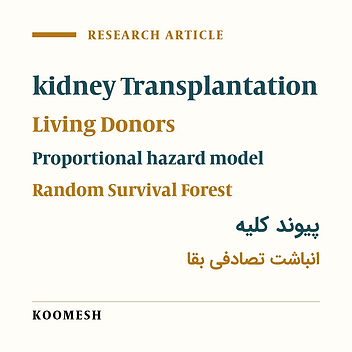
Image Credit:Koomesh
Outline
Determining affected factors on survival of kidney transplant in living donor patients using a random survival forest
Authors
Abstract
Introduction: The common method for estimating survival indices is the Cox model. In the data with high volume, different order of interaction in the model is predictable. In that case, performance of the Cox model is not properly. Correspondingly, random survival forest (RSF) model is an alternative to the Cox model in this situation. The aim of this study is to determine factors that affected survival of patients with kidney transplant using RSF. Materials and Methods: This historical cohort study carried on 459 kidney transplant recipients of living donor during of 1993- 2011 in Hamadan (Iran). Time between kidney transplant and irreversible transplant rejection was considered as a response. Modeling of determinants of survival was performed using Cox and RSF models and they were compared. Results: The survival rate of 5, 10 and 15 years were 91.6%, 85.3% and 74.9% respectively. Important variables selected based on various criteria in RSF were age of transplant recipient, the patient;#39s condition at discharge, hemoglobin of receptor, the last Creatinine and the use of immunosuppressive drugs (inhibitors drug) in RSF model. Age of recipient, the patient;#39s condition at discharge and the use of immunosuppressive drugs in the Cox model were significant. Conclusion: Age of recipient, the patient;#39s condition at discharge and the use of immunosuppressive drugs are determined as risk factors in Cox regression while the RSF method with less limited assumptions is able to determine risk factors of survival rate more precisely.
Highlights
References
- 1.Mahdavi-Mazdeh M, Heidari- Rouchi A, Aghighi M, Rajolani H. Organ and tissue transplantation in Iran. Saudi J Kidney Dis Transpl 2008; 19: 127-131.
- 2.Mahdavi- Mazdeh M, Heidary Rouchi A, Norouzi S, Aghighi M, Rajolani H, Ahrabi S. Renal replacement therapy in Iran. Urol J 2007; 4: 66-70.
- 3.Meier-Kriesche HU, Port FK, Ojo AO, Rudich SM, Hanson JA, Cibrik DM, et al. Effect of waiting time on renal transplant outcome. Kidney Int 2000; 58: 1311-1317.
- 4.Shrestha BM, Haylor JL. Factors influencing long- term outcomes following renal transplantation: a review. J Nepal Med Assoc 2007; 46: 136-142.
- 5.Kleinbaum DG. Survival Analysis, a SelfLearning Text. Biometrical J 1998; 40: 107-108.
- 6.Cox D. Regression models and life-tables. J Royal Stat Soc 1972; 34: 187-220.
- 7.Breiman L. Random forests. Machine learn 2001; 45: 5-32.
- 8.Miao F, Cai YP, Zhang YT, Li CY. Is random survival forest an alternative to cox proportional model on predicting cardiovascular disease? 6th European Conference of the International Federation for Medical and Biological Engineering; 2015: Springer.
- 9.Meng J, Li P, Zhang Q, Yang Z, Fu S. A four-long non-coding RNA signature in predicting breast cancer survival. J Exp Clin Cancer Res 2014; 33: 84.
- 10.Kawaguchi A, Yajima N, Tsuchiya N, Homma J, Sano M, Natsumeda M, et al. Gene expression signaturebased prognostic risk score in patients with glioblastoma. Cancer Sci 2013; 104: 1205-1210.
- 11.Friedel G, Fritz P, Goletz S, Kristen R, Brinkmann F, Dierkesmann R, et al. Postoperative survival of lung cancer patients: are there predictors beyond TNM? Anticancer Res 2013; 33: 1609-1619.
- 12.Datema FR, Moya A, Krause P, Bck T, Willmes L, Langeveld T, et al. Novel head and neck cancer survival analysis approach: Random survival forests versus cox proportional hazards regression. Head Neck 2012; 34: 50-58.
- 13.Klin M, Cima I, Schiess R, Fankhauser N, Powles T, Wild P, et al. Novel prognostic markers in the serum of patients with castration-resistant prostate cancer derived from quantitative analysis of the Pten conditional knockout mouse proteome. Eur Urol 2011; 60: 1235-1243.
- 14.Noori S, Nourijelyani K, Mohammad K, Niknam M, Mahmoudi M, Andonian L, et al. Random forests analysis: A modern statistical method for screening in high-dimensional studies and its application in a population-based genetic association study. 2012; 3: 93-101. (Persian).
- 15.Datema FR, Moya A, Krause P, Bck T, Willmes L, Langeveld T, et al. Novel head and neck cancer survival analysis approach: Random survival forests versus cox proportional hazards regression. Head Neck 2012; 34: 50-58.
- 16.Prosperi MC, Di Giambenedetto S, Fanti I, Meini G, Bruzzone B, Callegaro A, et al. A prognostic model for estimating the time to virologic failure in HIV-1 infected patients undergoing a new combination antiretroviral therapy regimen. BMC Med Inform Decis Mak 2011; 11: 2-9.
- 17.Mnaco DC, Dilernia DA, Fiore-Gartland A, Yu T, Prince JL, Dennis KK, et al. Balance between transmitted HLA preadapted and nonassociated polymorphisms is a major determinant of HIV-1 disease progression. J Exp Med 2016; 213: 2049-2063.
- 18.shwaran H, Kogalur UB. Random survival forests for R. R News. 2007; 7: 25-31.
- 19.Brier GW. Verification of forecasts expressed in terms of probability. Monthly Weather Rev 1950; 78: 1-3.
- 20.Gerds T, Schumacher M. Consistent estimation of the expected brier score in general survival models with right-censored event times. Biometrical J 2006; 48: 1029-1040.
- 21.Ashrafi M, Hamidi Beheshti MGh, Shahidi Sh, Ashrafi F. Application of artificial neural network to predict graft survival after kidney transplantation: Reports of 22 years follow up of 316 patients in Isfahan. Tehran Univ Med J 2009; 67: 353-359. (Persian).
- 22.Courtney AE, Mc Namee PT, Maxwell AP.The evolution of renal transplantationin clinical practice: for better, for worse? Q J M 2008; 101: 967-978.
- 23.Briganti EM, Wolfe R, Russ GR, Evis JM, Walker RG, Mc Nell JJ. Graft loss following renal transplantation in Australia: Is there a center effect? Nephrol Dial Transplant 2002; 17: 1099-1104.
- 24.Feyssa E, Jones-Burton Ch, Ellison G, Philosophe B, Howel Ch. Racial/Ethnic disparity in kidney transplantation outcomes: influence of donor and recipient characteristics. J Natl Med Assoc 2009; 101: 111-115.
- 25.Mange KC, Joffe M, Feldman HI. Effect of the use or nonuse of long term dialysis on the subsequent survival of renal transplans from living donor. N Engl J Med 2001; 344: 726-731.
- 26.Almasi Hashiani A, Rajaeefard A, Hassanzadeh J, Salahi H. Survival analysis of renal transplantation and its relationship with age and sex. Koomesh 2010; 11: 302-307 (Persian).
- 27.Kwon OJ, Kwak JY, Kanga CM. The impact of gender and age matching for long-term graft survival in living donor renal transplantation. Transplant Proc 2005; 37: 726-728.
- 28.Gyda M, Wodarczyk Z, Czapiewski W. Results of renal transplantation from expanded criteria deceased donors a single-center experience. Ann Transplant 2012; 17: 35-42.
- 29.Tetaz R, Trocm C, Roustit M, Pinel N, Bayle F, Toussaint B, Zaoui P. Predictive diagnostic of chronic allograft dysfunction usingurinary proteomics analysis. Ann Transplant 2012; 17: 52-60.
- 30.Pang H, George SL, Hui K, Tong T. Gene selection using iterative feature elimination random forests for survival outcomes. IEEE/ACM Trans Comput Biol Bioinform 2012; 9: 1422-1431.
- 31.Prosperi MC, Di Giambenedetto S, Fanti I, Meini G, Bruzzone B, Callegaro A, et al. A prognostic model for estimating the time to virologic failure in HIV-1 infected patients undergoing a new combination antiretroviral therapy regimen. BMC Med Inform Decision Mak 2011; 11: 40.
- 32.Datema FR, Moya A, Krause P, Bck T, Willmes L, Langeveld T, et al. Novel head and neck cancer survival analysis approach: Random survival forests versus cox proportional hazards regression. Head Neck 2012; 34: 50-58.
- 33.Omurlu IK, Ture M, Tokatli F. The comparisons of random survival forests and Cox regression analysis with simulation and an application related to breast cancer. Expert Systems with Applications 2009; 36: 8582-8588.##.
Copyright
© 2018, Author(s). This open-access article is available under the Creative Commons Attribution 4.0 (CC BY 4.0) International License (https://creativecommons.org/licenses/by/4.0/), which allows for unrestricted use, distribution, and reproduction in any medium, provided that the original work is properly cited.
Similar Articles
Estimating survival rate of kidney transplants by using data mining
Borhani A, Shahmoradi L, Pourmand G, Aghsaei fard PD, Borhani A. Estimating survival rate of kidney transplants by using data mining. koomesh. 2017;19(2):e151077. doi:
Patient Survival in Renal Allograft Failure: A Time-dependent Analysis
Mirzaee M, Azmandian J, Zeraati H, Mahmoodi M, Mohammad K, et al. Patient Survival in Renal Allograft Failure: A Time-dependent Analysis. Nephro-Urol Mon. 2014;6(1):e13589. doi: https://doi.org/10.5812/numonthly.13589
Five Years Survival of Patients After Liver Transplantation and Its Effective Factors by Neural Network and Cox Poroportional Hazard Regression Models
Khosravi B, Pourahmad S, Bahreini A, Nikeghbalian S, Mehrdad G. Five Years Survival of Patients After Liver Transplantation and Its Effective Factors by Neural Network and Cox Poroportional Hazard Regression Models. Hepat Mon. 2015;15(9):e25164. doi: https://doi.org/10.5812/hepatmon.25164
Chronic Graft Loss and Death in Patients With Post-Transplant Malignancy in Living Kidney Transplantation: A Competing Risk Analysis
Salesi M, Rostami Z, Rahimi Foroushani A, Mehrazmay AR, Mohammadi J, et al. Chronic Graft Loss and Death in Patients With Post-Transplant Malignancy in Living Kidney Transplantation: A Competing Risk Analysis. Nephro-Urol Mon. 2014;6(2):e14302. doi: https://doi.org/10.5812/numonthly.14302
Survival analysis of renal transplantation and its relationship with age and sex
Almasi A, RajaeiFard A, HasanZadeh J, Salahi H. Survival analysis of renal transplantation and its relationship with age and sex. koomesh. 2024;11(4):e153851. doi:
- Scopus by DOI: 0
Last Update: 1 month ago
- Scopus by Title: 9
Last Update: 1 month ago
- Scopus by Title (Ref): 9
Last Update: 1 month ago
- CrossRef: 0
Last Update: 5 hours ago
- OpenAlex: 0
Last Update: 7 hours ago
- OpenCitations: 0
Last Update: 4 days ago