
1. Background
Percutaneous coronary intervention (PCI) is extensively used as an effective treatment in patients with acute coronary syndromes (ACSs) and other clinically indicated conditions. The goal of dual antiplatelet therapy (DAPT), both Acetyl Salicylic Acid (ASA) and additional inhibitors of the platelet receptor P2Y12 in the months following stent placement is to prevent local thrombotic and systemic thromboembolic events (1). Evidence from randomized controlled trials suggest a minimum of 3 to 6 months DAPT duration, however, extension of DAPT beyond 12 months has contradictory results (2).
Dual antiplatelet therapy discontinuation following PCI is common, in which the physician-directed withdrawal is the most frequent mode within 2 years of stent implantation (3). The second major reason of DAPT discontinuation is drug disruption due to bleeding or non-compliance, and the third reason is the interruption due to surgical indication (3). Various comorbidities such as chronic obstructive pulmonary disease and previous myocardial infarction (MI) has been observed to be associated with DAPT non-adherence (4, 5). On the other hand, socioeconomically deprived individuals, i.e. ones with lower education, are also prone to DAPT non-adherence (6).
In the searching for cardinal complications of post-PCI DAPT non-adherence, major adverse cardiovascular events (MACE) have been extensively studied. MACE include MI, indicated re-angioplasty, cardiac death and stent thrombosis (3). Interestingly, the majority of adverse events occurred in individuals who were entirely adherent to the DAPT; yet, disruption owing to poor compliance or significant bleeding enhanced the MACE risk in non-adherent patients (3).
2. Objectives
Here we attempted to study the association of cardiovascular events (MI, acute coronary syndrome (ACS), indicated re-angioplasty, coronary artery bypass grafting (CABG)) with the level of ASA and Clopidogrel adherence, 6 and 12 months following coronary artery stenting. We used the Persian version of the 8-item Morisky Medication Adherence Scale (MMAS-8) to evaluate the level of DAPT adherence.
3. Methods
3.1. Patients and Methods
This work was designed as a cross-sectional study. A total of 150 adult patients from Modarres Hospital undergoing successful stent implantation in at least one or more native coronary artery and discharged on DAPT were included and patients’ baseline demographic data and phone number were recorded. Adherence to DAPT following angioplasty were determined via telephone at 6 and 12 months by Persian version of the MMAS-8 [validated by Moharamzad et al. (7)]. Demographic information and other variables about past medical history and CAD risk factors were also gathered during the study by means of specific check lists. We recorded the occurrence of STEMI, ACS, CABG and re-angioplasty 12 months after discharge given that one year is the recommended duration for effects of DAPT.
The 8-item Morisky Medication Adherence Scale has eight questions, as shown in Appendix 1 in Supplementary File, with the eighth being a Likert-type question. Total score is from 0 to 8 that is categorized as follows: Less than 6 (low adherence), 6 or 7 (moderate adherence), and 8 (high adherence).
3.2. Sample Size
According to the data from “PARIS Registry: Patterns of Non-Adherence to Anti-Platelet Regimens in Stented Patients” (8) and using the formula N = 1.96 × P (1-P), we calculate 150 as our sample size.
3.3. Data Analysis
Descriptive indexes, including mean and standard deviation were used to express quantitative data. Qualitative data were expressed by frequency and percentage. Continuous variables were analyzed by t-test and nominal variables were analyzed by chi square test. All analyses were done by the SPSS software for Windows (ver. 20.0.0) and significance level was set at 0.05.
4. Results
4.1. Patient Demographics
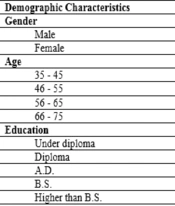
During the trial, 150 patients were scheduled for follow-up, however 50 were missed due to failure to complete the MMAS-8 check list record at 6- and 12-months post-angioplasty. Demographic data of 100 enrolled patients are displayed in Table 1. Table 2 provides the data from recorded DAPT adherence scores of patients, divided by ASA and Clopidogrel, each one in 6 and 12-months post-angioplasty.
Table 1.
Demographic Data
| Demographic Characteristics | Percentage |
|---|---|
| Gender | |
| Male | 64 |
| Female | 36 |
| Age | |
| 35 - 45 | 11 |
| 46 - 55 | 30 |
| 56 - 65 | 38 |
| 66 - 75 | 21 |
| Education | |
| Under diploma | 47 |
| Diploma | 28 |
| A.D. | 4 |
| B.S. | 17 |
| Higher than B.S. | 4 |
| Job | |
| Business | 36 |
| Employee | 17 |
| Housewife | 29 |
| Retried | 18 |
| Risk factors | |
| Obesity | 2 |
| Drug addiction | 4 |
| Family history of early atherosclerosis | 37 |
| Hypertension | 51 |
| Diabetes | 40 |
| Hyperlipidemia | 44 |
| Smoking | 41 |
| Past medical history | |
| Angioplasty | 32 |
| Myocardial infarction | 37 |
| Acute coronary syndrome | 38 |
| CABG | 2 |
| Place of living | |
| City | 96 |
| Village | 4 |
Abbreviations: AD, after diploma; BS, bachelor of science; CABG, coronary arteries bypass grafting.
Table 2.
Antiplatelet Adherence Mean Scores Based on MMAS-8 and Frequency of Low, Moderate and High Adherence to ASA/Clopidogrel at 6- and 12-Months Post-PCI
| Variables | Mean Scores | Low-Adherence (MMAS-8 Score < 6) | Moderate-Adherence (MMAS-8 Score = 6 or 7) | High-Adherence (MMAS-8 Score = 8) |
|---|---|---|---|---|
| ASA (6 mo) | 6 ± 1.78 | 36 | 46 | 18 |
| ASA (12 mo) | 5.55 ± 1.77 | 55 | 33 | 12 |
| Clopidogrel (6 mo) | 6.01 ± 1.86 | 38 | 38 | 24 |
| Clopidogrel (12 mo) | 5.04 ± 2.13 | 63 | 20 | 17 |
Abbreviation: ASA, acetyl salicylic acid.
4.2. Cardiovascular Events in Post-PCI Patients and Adherence to the DAPT
Major adverse cardiovascular events have been used extensively to indicate the association of post-PCI DAPT adherence and adverse complications. Major adverse cardiovascular events were defined as the composite of cardiac death, definite or probable stent thrombosis, spontaneous myocardial infarction, or clinically indicated target lesion revascularization. Here, we attempted to use STEMI, ACS, CABG and re-angioplasty as cardiovascular events and analyzed their relation to the level of DAPT adherence 6 and 12-months post-angioplasty. Table 3 indicated frequency of post-PCI cardiovascular events among the patients.
Table 3.
Frequency of Post-PCI Cardiovascular Events
| Post-PCI Events | Numbers Recorded |
|---|---|
| Re-angioplasty | 24 |
| Stent Thrombosis | 3 |
| STEMI | 21 |
| Bleeding | 2 |
| Acute Coronary Syndrome | 27 |
| CABG | 4 |
Abbreviations: STEMI, ST segment elevation myocardial infarction; CABG, coronary artery bypass grafting.
Table 4 shows the scores of MMAS-8 of DAPT adherence in 6 and 12-month post-PCI, which were divided to low, moderate and high adherence to antiplatelet agents, in respect to clinically indicated re-angioplasty during 6 and 12-months post-PCI.
Table 4.
Re-angioplasty by Level of Adherence
| Re-Angioplasty | Low-Adherence (MMAS-8 Score < 6) | Moderate-Adherence (MMAS-8 score = 6 or 7) | High-Adherence (MMAS-8 score = 8) | P-Value |
|---|---|---|---|---|
| ASA (6 mo, Fq) | 0.503 | |||
| Yes | 11 | 9 | 4 | |
| No | 25 | 37 | 14 | |
| ASA (12 mo, Fq) | 0.01 a | |||
| Yes | 8 | 14 | 2 | |
| No | 47 | 19 | 10 | |
| Clopidogrel (6 mo, Fq) | 0.007 a | |||
| Yes | 11 | 3 | 10 | |
| No | 27 | 35 | 14 | |
| Clopidogrel (12 mo, Fq) | 0.04 a | |||
| Yes | 11 | 5 | 8 | |
| No | 52 | 15 | 9 |
Abbreviation: ASA, acetyl salicylic acid.
a P < 0.05 was considered statistically significant.
Data analysis demonstrated that low adherence to DAPT in 12-months following angioplasty were associated with significantly lower rate of re-angioplasty in comparison to the moderate adherence to these agents at one-year follow-up (15% and 17% of patients on ASA and Clopidogrel respectively in low adherence group, compared to 42% and 2 % of patients on ASA and Clopidogrel in moderate adherence group, respectively. P-value < 0.05, Table 4). This pattern is also observed in 12-months followed up post-PCI patients with ACS and CABG events (0 - 16% of patients on DAPT in low adherence group, compared to 12 - 55% of patients on DAPT in moderate adherence group. P-value < 0.05, Tables 5 and 6). Interestingly, no patient required CABG in either low or high adherence to DAPT in the 12-month post-PCI period (Table 6).
Table 5.
Comparison of All Patients Whether They Had Acute Coronary Syndrome Event or Not at 6- and 12-Months Post-PCI with Their Respective Level of Aspirin/Plavix Adherence
| Acute Coronary Syndrome | Low-Adherence (MMAS-8 Score < 6) | Moderate-Adherence (MMAS-8 Score = 6 or 7) | High-Adherence (MMAS-8 Score = 8) | P-Value |
|---|---|---|---|---|
| ASA (6 mo, Fq) | 0.45 | |||
| Yes | 14 | 7 | 6 | |
| No | 22 | 39 | 12 | |
| ASA (12 mo, Fq) | 0.049 | |||
| Yes | 11 | 14 | 2 | |
| No | 44 | 19 | 10 | |
| Clopidogrel (6 mo, Fq) | 0.015 | |||
| Yes | 14 | 4 | 9 | |
| No | 24 | 34 | 15 | |
| Clopidogrel (12 mo, Fq) | 0.004 | |||
| Yes | 11 | 11 | 5 | |
| No | 52 | 9 | 12 |
Abbreviation: ASA, acetyl salicylic acid.
Table 6.
Comparison of All Patients Whether They Underwent CABG or Not at 6- and 12-Months Post-PCI with Their Respective Level of ASA/Clopidogrel Adherence
| CABG | Low-Adherence (MMAS-8 Score < 6) | Moderate-Adherence (MMAS-8 Score = 6 or 7) | High-Adherence (MMAS-8 Score = 8) | P-Value |
|---|---|---|---|---|
| ASA (6 mo, Fq) | 0.143 | |||
| Yes | 0 | 2 | 2 | |
| No | 36 | 44 | 16 | |
| ASA (12 mo, Fq) | 0.015 | |||
| Yes | 0 | 4 | 0 | |
| No | 55 | 29 | 12 | |
| Clopidogrel (6 mo, Fq) | 0.233 | |||
| Yes | 0 | 2 | 2 | |
| No | 38 | 36 | 22 | |
| Clopidogrel (12 mo, Fq) | 0.001 | |||
| Yes | 0 | 4 | 0 | |
| No | 63 | 16 | 17 |
Abbreviation: ASA, acetyl salicylic acid.
On the other hand, high adherence to the DAPT in 12 months post-PCI was accompanied with significantly lower rate of ACS and CABG in comparison to moderate adherence group (16 % and 29 % of patients on ASA and Clopidogrel in low adherence group, compared to 42 % and 55 % of patients on ASA and Clopidogrel in moderate adherence group, respectively. P-value < 0.05, Tables 5 and 6). This pattern was also observed in patients who underwent re-angioplasty, as well as high adherence to aspirin at 12 months post-PCI (Table 4).
In all cardiovascular event groups, there were no significant difference between ASA adherence level in association with the rate of cardiovascular events at 6-month post-PCI (Tables 4 - 6). However, 6-month post-PCI analysis revealed that moderate adherence to Clopidogrel had a significantly lower association with the rate of cardiovascular events, except CABG, in relation to low and high-adherence groups (7 - 10% of patients on Clopidogrel in moderate adherence group, compared to 28 - 42% of patients on Clopidogrel in low/high adherence group. P-value < 0.05, Tables 4 - 6).
5. Discussion
Long-term DAPT following coronary stenting has highlighted the importance of drug adherence (9). Also, significant association of DAPT adherence with post-angioplasty cardiovascular events has been reported and emphasized the evaluation of rate and cause of poor adherence to antiplatelet agents (3). Multiple factors were shown to be associated with drug non-adherence including communication barriers, socioeconomic factors and motivational circumstances (10). Here we observed an important association of low and high DAPT adherence with lower cardiovascular events at 12 months post-PCI. However, at 6 months post-PCI, there was a minor cardiovascular event in patients with moderate DAPT adherence.
Ferreira-González et al. evaluated 1 622 patients who underwent PCI with drug-eluting stents and discovered that discontinuing anti-platelet therapy after the first month of coronary stenting was transitory and did not significantly increase the incidence of MACE (11). Furthermore, recent medical history has been linked to a higher risk of DAPT cessation in patients who had undergone PCI 12. Individuals who had no prior MI or CABG and had less cardiovascular risk factors, such as diabetes, were more likely to terminate their DAPT (12).
Our data suggest that low adherence to the antiplatelet therapy at one year following PCI was associated with lower rate of cardiovascular events, which was later than first month of stenting and may be among patients with low risk past medical history. Although we noted patient’s medical record, they were not adjusted by post-PCI cardiovascular events in our study. Since we had a large number of patients lost to follow up (50 persons), this should be noted that poor follow up by the patients itself in the low adherence group could be resulted in fewer cardiovascular events in relation to moderate adherence group.
High adherence to antiplatelet therapy was almost always associated with lower MACE (11). Still, important hemorrhage consequences are the major adverse results of long-term DAPT. Our data indicated a significant lower rate of cardiovascular events among the patients with high adherence to DAPT. This effect was observed at 12 months post-PCI, however, there was no significant difference between adherence groups and STEMI occurrence. Majority of previous studies have not specifically considered STEMI, independent of other cardiovascular events following PCI (3, 13, 14).
Interestingly, we noted a significant interrelation between moderate Clopidogrel adherence and lower number of cardiovascular events at 6-month post PCI, compared to low/high drug adherence. Comparing moderate and high DAPT adherence, the impact of cardiovascular risk factors and past medical history could be notable as we mentioned above (12). Sun et al. (15) reported a direct association of high adherence to P2Y12 antagonists with lower risk of MACE. This is not consistent with our results, nevertheless, patients with high adherence to DAPT composed a small portion of our studied patients. Another point of view is that moderate adherence patients scored 6 or 7 on the MMAS-8 scale, which is higher than our mean Plavix adherence scores at 6 months post-PCI and might be deemed moderate-to-high adherence.
Overall, here we introduced an important impact of drug adherence along with patient’s risk factors in a course of antiplatelet therapy following coronary stenting. Still our data were limited and require further studies to evaluate the impact of patient’s demographics on the risk of post-PCI cardiovascular events and also carefully adjust the confounding factors. Other important limitation of this study was the large number of patients lost to follow up that may be due to telephone-only data gathering way and resulted in inaccessibility to mortality data.