1. Background
Today, cancer is a worldwide health problem that is one of the top priorities of the health system. The growing prevalence of this disease, especially in Iran, has become a health problem with 98 daily deaths due to cancer (1). In 2015, it was reported that 2% of children and adolescents under the age of 15 suffer from the disease (2). Furthermore, in 2019, about 5,000 teens between the ages of 15 and 19 in the United States are reported to inflict with cancer and about 600 teens die due to cancer annually (3). In 2017, it was reported that among the death of adolescents, cancer was the third leading cause of death (1) which makes up about 4% of infant mortality under 5 years and 13% of mortality of 5 to 15 years old in the Iranian population and is a chronic and life-threatening disease, which is associated with a long course and uncertainty about the outcome of the disease and leads to a great deal of stress in adolescents (4). Diagnosis and treatments are associated with high levels of stress and other psychological symptoms that affect all aspects of personal life, work, daily activities, communication, and family roles. Moreover, cancer can seriously endanger the spiritual health of patients (4). The results of the study conducted by Heidari Sangelaji et al. (5) showed that spirituality integrates different physical and psychological dimensions and provides patients with a sense of worth, purpose, vitality and satisfaction and, as a defense shield, helps patients and their careers to fight the disease in a positive, effective, and purposeful manner.
Spiritual health is one of the most important aspects of human health that provides a harmonious and interconnected relationship between internal forces and the attributes of stability in life, peace, proportion and harmony, a sense of close connection with self, God, society, and the environment. Spiritual health, also, determines one’s integrity and is the only force that coordinates physical, psychological, and social dimensions (6). Spiritual health has two dimensions: the vertical dimension, which includes communication with the transcendental and the horizontal dimension involving the communication with others and the environment. Accordingly, spiritual health is a spiritual experience in two different dimensions. The religious health dimension, which focuses on how individuals perceive health in their spiritual lives, when associated with a higher power as well as the existential health dimension, which discusses how individuals adapt to themselves, society, or the environment (7). Studies have shown that spiritual health correlates with a shorter hospital stay, lower anxiety, and hopelessness, and overall health improvement (8-10). The study performed by Ghanbari Afra et al. (11) revealed a relationship between anxiety, stress, and depression in patients with acute coronary syndrome. They showed that those who had higher spiritual health experienced less anxiety, stress, and depression.
However, the diagnosis of cancer is accompanied by considerable stress, which often results in acute or chronic adverse psychological reactions. One of the age groups with cancer is the age group of children and adolescents (12). Adolescence is a critical period in one’s life because, in addition to physical changes, there is a fundamental change in one’s emotions, feelings, desires, and imaginations (13). New situations in the lives of patients with cancer force them to use appropriate coping mechanisms such as seeking social support, spirituality, cognitive reconstruction, intervening with illness, and making changes in problem-solving (1). Spiritual care is an appropriate intervention according to the cultural context of Iran (14). Spirituality, as an accepted mechanism in the contemporary culture of society, has become widely accepted in the field of care. Spirituality helps the patient to define health and survival despite pain and fatigue and to find a sense of well-being (15). The results of the study by Hedayati et al. (16) also showed that spiritual religious skills are an effective and useful method for improving anxiety and stress in patients (16). Patients, who believe they can play a role in controlling their illness, engage in behaviors such as praying and mentioning God to improve their qol and survival (17). According to the study by Salsman et al. (18), an important factor in decision making about illness and treatment is belief in God that is more effective than treatment effect. Spiritual care may include meditation, freedom of feelings, spiritual disclosure, diaries, prayers, or reciting the holy book and inspirational recitation (19). Although most nurses view spiritual care as holistic care (20), 87% of them believe that patients’ spiritual needs should be taken into account, and 42% of them think that these practices are performed in their ward (21). Only 27% of nurses perform them regularly and about half of them rarely practice it, and in most cases, such care is ignored (20). Recent researches suggest that support for spiritual care, spiritual health, and a relationship with a higher power are beneficial to survival. Moreover, the improved qol increased interpersonal support, decreased severity of psychological symptoms, then increased medical outcomes and increased recovery process (22, 23). A study by Torabi et al. (24) reported that spiritual care is effective in adolescents with cancer. Therefore, the use of coping strategies and mechanisms plays an important role in one’s physical and mental health (25).
Given the prevalence of psychological problems in refractory patients and the important role of nurses in the psychological support of patients, the use of interventional methods and complementary therapies such as spiritual care can cope with the stresses and complications of the disease (26). On the other hand, given the paucity of research on the impact of spiritual care on the mental status of adolescents with cancer, and with regard to the prevalence of psychological problems in these patients (27), less attention is paid to support interventions and psychological support, including spiritual care.
2. Objectives
The purpose of this study was to determine the effect of spiritual care on the spiritual health of adolescents with cancer in the pediatric hematology ward of Ali Ibne Abitaleb Hospital in Zahedan, Iran. This is the largest hospital as the multi-specialty and supra specialty at the Sistan and Baluchestan Province.
3. Methods
This single-group pre-experimental study was performed after receiving the ethics code (ir.zaums.rec. 1398.64) in pediatric hematology ward of Imam Ali Teaching Hospital in Zahedan on adolescents with cancer from May to September 2019.
Given the lack of title-related study and considering the role of religious beliefs and spirituality in coping with crises and illnesses, the mean and standard deviation score taken by Torabi et al. (24) study were considered the closest and the most relevant study for the sample size used. The mean and standard deviation (SD) was the direct adaptation index score in Torabi et al. (24) study as 5.59 ± 122.7. Thus the sample size was estimated 15 subjects with 95% confidence and 95% statistical test power. In order to ensure the adequacy of sample size and to consider possible downfall in the study, the final sample size was finally determined as 35 subjects. Sampling was done using convenient sampling technique and based on the inclusion criteria. The inclusion criteria were literacy, adolescents, family knowledge of cancer, hematology admission, prior hospitalization, age range of 11 to 18 years old, at least 6 months history of cancer, being at late stage of the disease, the disease had not led to disability, living with parents, no severe stressor event such as a parent’s divorce, the death of a loved one in the past year other than cancer, and having a spiritual health score (20 - 99), as well as low and medium spiritual health. The exclusion criteria were unwillingness to participate in the study, and hospital discharge during the intervention period.
Data collection tools included demographic information questionnaire (age, sex, education level of parents and adolescents, birth rate, type of cancer, duration of cancer, number of hospitalizations, age of diagnosis, living with parents, ethnicity, religion) and 20-item Paloutzian and Ellison Spiritual Health questionnaire. The Palotzin and Ellison Spiritual Health questionnaire consisted of 20 items (10 items on religious health and 10 items on existential health). The total score of Spiritual Health is the sum of scores of these two subgroups, which ranges from 20 to 120. In the affirmative phrases, the answers “strongly agree” score 6, “agree” score 5, “fairly agree” score 4, “fairly disagree” score 3, “disagree” score 2, “strongly disagree” score 1 were assigned. However, in the negative sentences, the answers “strongly agree” score 1, “agree” score 2, “fairly agree” score 3, “fairly disagree” score 4, “disagree” score 5, “strongly disagree” score 6 were assigned. This questionnaire has good validity and reliability which has been reviewed and confirmed in previous studies (7, 16, 28, 29). Abbasi et al. examined this questionnaire and determined its reliability using Cronbach’s alpha coefficient of 82% (30). In the present study, the reliability of the instrument was determined by internal consistency analysis using Cronbach’s alpha coefficient, which was 95%, indicating its desirable reliability.
Spiritual care training was performed as face-to-face and individualized, based on patient need, next to the patient’s bed, including four consecutive sessions (twice a week) for 45 minutes per session, after the visit of the physician and before chemotherapy and was administered only to the patient at 10 AM. The spiritual care program was designed based on the intervention of other researchers and with the help of defining the concept of spirituality (24, 31). After the end of the fourth session of spiritual care intervention, spiritual health questionnaire was completed. Prior to the intervention, written informed consent form, Paloutzian and Ellison Demographic and Spiritual Health questionnaires were completed. The summary of the intervention sessions program offered is as follows: session 1, getting to know the teenager and communicating verbally and non-verbally, listening to the teenager’s talks and concerns, and giving a questionnaire; session 2, encouraging the patients to express their religious beliefs and providing facilities for performing religious activities (saying a prayer, prayer, Quran, etc.); session 3, performing daily religious activities and responsibilities; session 4, conclusion and encouraging the adolescent to express their views and questions on spiritual care, closing the sessions and re-submitting the questionnaire (Table 1).
Table 1.
Spiritual Care Intervention Sessions
| Sessions | Subjects | Details |
|---|---|---|
| Session 1 | Supportive Presence (non-religious rituals) | 1) Building trust, empathy, and honesty between the nurse and the client to communicate properly; 2) listening to teenagers’ talk and their worries and anxieties and encouraging the patient to express emotion and active listening; 3) providing psychological support to patients; 4) strengthening people’s hope and inner strength; 5) using positive sentences and foster positive and productive thinking; 6) communicating verbally and non-verbally with the patient; 7) answering patients’ questions and explaining treatment process, giving patients information and awareness about the disease to reduce physical and emotional stress; 8) encouraging patients to make daily notes, use recreational and sightseeing activities, and exercise according to the physician’s opinion |
| Session 2 | Support for religious rituals of the patient | 1) Helping the client find the meaning of life and note that none of the events of life is out of whack; 2) providing the necessary facilities for performing religious activities; 3) encouraging the patient to read prayer, remembrance, prayer and the Quran (according to the patient’s own wishes); 4) encouraging the patient to express their religious beliefs; 5) encouraging patients to refer to religious clergy |
| Session 3 | Using support systems | 1) Encouraging the patients to refer to people they can feel comfortable with; 2) emotional support of patients by their peers and medical staff; 3) advising the patient’s companions on assisting the patient in performing his or her daily routine of religious activities and responsibilities, such as home and school work |
| Session 4 | Summary | The materials collected during the past three sessions were summarized and patients were asked to express their views and questions about the spiritual care provided, and in case of any ambiguity in the provided education, patient’s confusion was removed |
The data were analyzed using SPSS 21 software and Shapiro-Wilcoxon tests, paired t-test at a significance level of less than 0.05.
4. Results
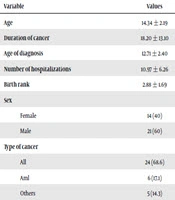
Finally, 35 participants completed the study. Results showed that 60% of the participants were male and 40% were female. The mean age of the participants was 14.34 ± 2.19 years old. In terms of education level, 94.3% of them were under diploma. Also, most participants i.e. 94.3% of them lived with both parents and 57.1% were Balouch (Table 2).
Table 2.
Demographic and Clinical Information of Adolescents with Cancera
| Variable | Values |
|---|---|
| Age | 14.34 ± 2.19 |
| Duration of cancer | 18.20 ± 13.10 |
| Age of diagnosis | 12.71 ± 2.40 |
| Number of hospitalizations | 10.97 ± 6.26 |
| Birth rank | 2.88 ± 1.69 |
| Sex | |
| Female | 14 (40) |
| Male | 21 (60) |
| Type of cancer | |
| All | 24 (68.6) |
| Aml | 6 (17.1) |
| Others | 5 (14.3) |
| Level of education | |
| Under diploma | 33 (94.3) |
| Diploma | 2 (5.7) |
| Father’s level of education | |
| Illiterate | 2 (5.7) |
| Under diploma | 19 (54.2) |
| Diploma and higher | 14 (40.1) |
| Mother’s level of education | |
| Illiterate | 8 (22.9) |
| Under diploma | 17 (48.6) |
| Diploma and higher | 10 (28.5) |
| Living with parents | |
| Both | 33 (94.3) |
| Mother | 2 (5.7) |
| Race | |
| Fars | 15 (42.9) |
| Balouch | 20 (57.1) |
| Religion | |
| Shia | 15 (42.9) |
| sunny | 20 (57.1) |
aValues are expressed as mean ± SD or No. (%).
The mean score of spiritual, religious, existential and total spiritual health of the participants before and after the intervention showed a significant difference (P = 0.001*). The post-test score was higher than the pre-test score. In fact, the mean spiritual health score increased significantly (Table 3).
Table 3.
Comparison of Spiritual Health (Religious, Existential, Total) Before and After the Intervention in Adolescents with Cancer
| Variable | Pre-Test | Post-Test | P Value |
|---|---|---|---|
| Religious-spiritual health | 26.31 ± 3.91 | 51.42 ± 4.02 | 0.001b |
| Existential-spiritual health | 25.68 ± 4.35 | 50.57 ± 3.85 | 0.001b |
| Overall spiritual health | 52 ± 7.34 | 102 ± 6.57 | 0.001b |
aValues are expressed as mean ± SD.
bpaired-t.
5. Discussion
The results of this study showed that the scores of existential spiritual health, religious-spiritual health score and overall spiritual health of adolescents increased after the intervention and showed a positive effect of the intervention on spiritual health. In this regard, the results of some studies show the positive effects of spiritual care on adaptation (24), anxiety (32) and self-confidence (33), which are in line with the present study.
Bamdad et al. (34) also investigated the impact of spiritual care on spiritual well-being in people with amphetamine dependence and showed that by implementing spiritual care, overall spiritual health would be improved and spiritual care would be improved. In the study of Memari et al. (35), where daily spiritual care is applied to elderly hospitalized in Kahrizak Charity Sanctuary, the mean score of spiritual health of the intervention group was significantly higher than that of the control group, and spiritual care improved the spiritual health of hospitalized elderly. The findings of this study are in line with the results of the present study and reinforce the results of our study. However, it was not consistent with the results of the study by Ghahari et al. (36), which aimed to determine the effect of religious-semantic and cognitive-behavioral intervention on anxiety and depression in women with breast cancer. The difference in outcomes can be due to illness conditions, underlying problems and lack of emotional support or differences in society. Gholami and Beshlideh (37) also reported in their study, spiritual therapy affected divorced mental health, that spirituality had no effect on depression and social functioning of divorced women, which is inconsistent with the results of the present study and the cause of the difference may be related to the research community, type of care plan, and cultural differences. In another study that Azimian et al. (38) conducted to determine the effect of spiritual care on cardiac death anxiety, there was no significant change in the mean anxiety score of test group patients before and after the intervention. It is not consistent with the findings of the present study and the possible cause of the difference may be due to the type of illness, spiritual care program, and social and cultural conditions.
Therefore, it can be concluded that spirituality and spiritual interventions can have a positive effect on recovery and health, and thus they have an impact on spiritual health, which is one of the aspects of health. Since technical interventions in relation to life-threatening diseases have not been fully explained to address the problems of patients with advanced diseases, attention should be paid to strong parameters such as spirituality, religion and hope in developing countries. Nurses as health care providers are more accessible to patients and can play an important role in the patient’s inner peace and hope (1). One of the limitations of the study was the design of the study as a single group with no control group, which is suggested to be considered in future studies. It is also recommended to conduct more extensive research into the impact of spiritual care on the anxiety of adolescents with chronic illnesses, the impact of spiritual care in different age groups, and the impact of spiritual care in various religions separately.
5.1. Conclusions
Based on the current study, the results of this study showed the positive effects of spiritual care on the spiritual health of adolescents with cancer. Given the special status of spirituality in the Iranian Community, it is recommended that in nursing care, spiritual health dimensions should be taken into account, especially in people with cancer.