
1. Background
Today, coronary artery disease (CAD) is the leading cause of mortality in developed countries (1). In Iran, the prevalence of cardiovascular diseases has increased remarkably, and the mortality rate has risen from 22% to 32% (2). Anxiety and stressful living conditions in modern communities have turned cardiovascular diseases into the leading cause of premature death. Besides threatening the lives of millions of people in both developed and developing countries, CAD imposes billions of dollars on patients and healthcare systems annually due to the associated mortality and morbidities (3). In Iran, CAD is the leading cause of death in people over 33 years and accounts for 40% of all deaths (4).
To diagnose CAD, more advanced and novel methods are employed. One of the safest and most definitive methods is coronary angiography, which is a common invasive diagnostic test. About 16,000 to 18,000 cases of angiography are performed annually in Iran (5). In most cases, invasive diagnostic tests cause major stress and anxiety in patients. In this regard, a study by Uzun et al. (6) showed that 24% of patients experienced pre-angiographic anxiety, which increased the plasma concentrations of epinephrine and norepinephrine, myocardial oxygen consumption, blood pressure, irregular heartbeat, interstitial damage, and platelet aggregation, exposing them to further risks in the operating room.
Moreover, stress can threaten the recovery and survival of patients, cause physical and mental problems, and hamper the patient’s adaptation to the existing conditions (7). Accordingly, measures must be taken to reduce the stress and anxiety of patients undergoing angiography. The main goal of preoperative care is to maximize the physiological and mental health of patients. Anxiety reduction is an important goal of treatment and is accepted as a component of preoperative nursing care. Overall, the nurses’ use of non-pharmacological methods can reduce the patients’ anxiety, lower the possible risks and hazards, and reduce their drug use or even eliminate it (8).
Nursing consultation is one of the approaches used for stress relief and control. It is recognized as an important component of nursing care services and is considered effective in reducing anxiety during medical procedures, such as endoscopy and radiotherapy (9). The importance of counseling has been addressed in nursing models, including Peplau’s theory of interpersonal relations, which considers the nurse’s role as a counselor and supporter in the patient-nurse relationship in the exploitation stage (10). According to this theory, the patient-nurse relationship aims at providing effective nursing care that promotes and maintains the patient’s health.
Peplau argued that the nurse-patient relationship is structured based on trust and that nurses play an important role in reducing patient anxiety. He also claimed that the nurse-patient relationship significantly affects the treatment outcomes (11). Therefore, the development of an effective consultation program can reduce anxiety and increase satisfaction in patients. Generally, the purpose of nursing consultation is to help clients achieve the necessary competencies to participate in treatment. A consulting nurse with sufficient knowledge and skills can communicate with patients and enable them to express their doubts and fears and find possible solutions to their problems (12).
Another effective approach to deal with stressors is guided imagery that can be used to eliminate the adverse physiological effects of stress. In this approach, the patient imagines a scene in which he/she feels safe and free from tension and anxiety. Besides, by using the power of imagination, the patient finds him/herself in a situation that has not happened yet and imagines having or doing positive things. An area of the brain that is involved in experiencing an event is activated for imagination. In other words, through imagination, individuals can create a stream of thoughts, where they can see, hear, feel, or smell what they wish to feel at that specific time. The use of this technique does not require any special equipment or extensive training. It is a non-invasive, safe, uncomplicated, and cost-effective technique that can be used to reduce treatment costs and increase patient satisfaction (13).
Besides the lack of awareness and knowledge in patients, the frightening environment of the cardiac angiography unit can also be stressful. Previous studies have shown that large equipment and devices, masks and gowns of the medical staff, the dim lighting of the angiography suite, and noise of the angiography system increase the level of stress among patients (14). Therefore, it seems that nursing consultation about angiography and providing information about the equipment and environment of the cardiac angiography suite can reduce the patients’ anxiety and stress.
Overall, a large number of patients with cardiac diseases require coronary angiography. On the other hand, it is important to prevent the adverse psychological effects of anxiety.
2. Objectives
Considering the importance of nurses’ role in caring for these patients and the significance of using non-drug interventions, besides the lack of relevant studies, the present study aimed to compare the effectiveness of nursing consultation and guided imagery on the level of stress and anxiety in patients undergoing coronary angiography.
3. Methods
This clinical trial was conducted after obtaining permission from the Ethics Committee of Zabol University of Medical Sciences (code: IR.ZBMU.REC.1397.204). The study sample included 60 patients undergoing angiography in the coronary care unit (CCU) of Ali-Ibn Abi-Taleb Hospital in Zahedan, located in southeast of Iran. Sixty patients who met the inclusion criteria were randomly selected and assigned to three groups (20 subjects per group), including two intervention groups and a control group. The inclusion criteria were as follows: having a physician order for coronary angiography at least one day before the procedure; being in the age range of 30 to 60 years; having the ability to speak and understand Persian; having minimum literacy; having no visual or hearing impairment; no history of angiography; not using sleeping pills, sedatives, or strong analgesics; having no severe pain due to the nature of the disease, and having no history of known psychological problems or anxiety disorders. On the other hand, the exclusion criteria were leaving the study, having an emergency angiography order, and patient’s death at any stage of the study.
The instruments used to collect the data included a demographic information form and the Depression, Anxiety, and Stress scale (DASS-21). The demographic information form documented the participant’s age, gender, occupation, years of education, and marital status. Moreover, the stress and anxiety subscales of DASS-21 were used in this study. Each subscale contained seven items, scored on a four-point Likert scale (from “very untrue of me” = 0 to “very true of me” = 3). A higher score on this scale indicates higher levels of anxiety and stress in the patient. The reliability of the anxiety and stress subscales was estimated at 0.81 and 0.89, respectively, based on Cronbach’s alpha method (15). The corresponding values reported by Brown et al. (16) were 0.89 and 0.93, respectively, and the values reported by Siamak Samani (17) were 0.75 and 0.87, respectively. In the present study, Cronbach’s alpha coefficients for the two subscales of anxiety and stress were 0.79 and 0.92, respectively.
The patients who met the inclusion criteria were selected using convenience sampling. The participants were randomly assigned to the nursing consultation, guided imagery, and control groups after providing their written consent. The DASS-21 was completed on the first day of hospitalization and before the intervention for each patient. The participants in the nursing consultation group received face-to-face training individually and orally on the day before angiography. The training program content included instructions about the anatomy and physiology of blood and heart circulation, pathophysiology of CAD, risk factors, elective treatments (including angiography), possible risks and complications of angiography, length of hospital stay, and expected results. The maximum duration of training was two hours, depending on the needs of the hospitalized patient.
The guided imagery audio file (including relaxing music, visualization of beautiful seaside landscapes with a positive accent for increasing mental health, and repetition of relaxing words, such as God, love, beauty, and cheerfulness), prepared by the researcher, was played using headphones for each participant in the guided imagery group 20 minutes before angiography. To control for intervening factors, such as noise in the ward, the intervention was performed in a quiet environment in the researcher’s presence. Before angiography, DASS-21 was completed by the participants in the three groups as the post-test.
The collected data were analyzed in SPSS version 25 using statistical tests, such as analysis of variance (ANOVA), Tukey’s post-hoc test, analysis of covariance (ANCOVA), paired samples t-test, Fisher’s exact test, and chi-square test at a significance level of 0.05 (P < 0.05).
4. Results
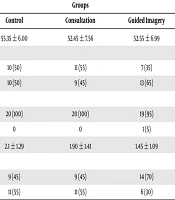
The results of the Shapiro-Wilk test showed the normal distribution of data; therefore, parametric tests were used in this study. The mean (SD) age of the participants in the counseling, guided imagery, and control groups was 52.45 (7.56), 52.55 (6.99), and 55.35 (6.00) years, respectively. The results of the ANOVA test did not show any significant difference between the three groups in terms of age (P = 0.32). Besides, as shown in Table 1, the three groups were not significantly different in terms of other demographic characteristics (P > 0.05).
Table 1.
The Demographic Characteristics of the Patients in the Three Groupsa
| Variables | Groups | P-Value | ||
|---|---|---|---|---|
| Control | Consultation | Guided Imagery | ||
| Age, y | 55.35 ± 6.00 | 52.45 ± 7.56 | 52.55 ± 6.99 | 0.32b |
| Gender | 0.41c | |||
| Female | 10 (50) | 11 (55) | 7 (35) | |
| Male | 10 (50) | 9 (45) | 13 (65) | |
| Marital status | 0.33d | |||
| Married | 20 (100) | 20 (100) | 19 (95) | |
| Single | 0 | 0 | 1 (5) | |
| Years of education | 2.1 ± 1.29 | 1.90 ± 1.41 | 1.45 ± 1.09 | 0.26b |
| Occupation | 0.18c | |||
| Employed | 9 (45) | 9 (45) | 14 (70) | |
| Unemployed | 11 (55) | 11 (55) | 6 (30) | |
aValues are expressed as mean ± SD or No. (%).
bANOVA.
cChi-square test.
dFisher’s exact test.
The results of the ANOVA test, comparing the mean pre-intervention scores of stress between the control group (15.5 ± 09.40), consultation group (26.90 ± 6.75), and guided imagery group (25.70 ± 5.32), showed significant differences between the three groups (P < 0.001). Similarly, the control (18.60 ± 9.88), consultation (12.20 ± 8.90), and guided imagery (9.80 ± 9.17) groups showed significant differences after the intervention in terms of stress (P = 0.01) (Table 2). Moreover, the results of Tukey’s post hoc test showed that the level of stress in control and guided imagery groups was significantly different before the intervention (P < 0.01). Likewise, the intervention groups were significantly different from the control group regarding the level of stress after the intervention (P < 0.01). However, the two intervention techniques were not significantly different in reducing stress among patients (P = 1).
Table 2.
Comparison of Pre-Intervention and Post-Intervention Stress Scores in the Three Groups
| Stress | Groups | F | P-Valueb | ||
|---|---|---|---|---|---|
| Control | Consultation | Guided Imagery | |||
| Pre-intervention | 15.50 ± 9.40 | 26.90 ± 6.75 | 25.70 ± 5.32 | 14.50 | P < 0.001 |
| Post-intervention | 18.60 ± 9.88 | 12.20 ± 8.96 | 9.80 ± 9.17 | 4.73 | 0.01 |
| P-valuec | P < 0.001 | P < 0.001 | P < 0.001 | ||
aValues are expressed as mean ± SD.
bANOVA
cPaired samples t-test.
Since the assumptions of normality and homogeneity of variance were confirmed in this study, an ANCOVA test was performed to control for the significant effect of pretest stress scores; the results showed that the mean stress scores were significantly different among the three groups after the intervention (P < 0.001) (Table 3). Comparison of the mean pre-intervention scores of anxiety between the control (13.50 ± 09.10), consultation (28.20 ± 4.93), and guided imagery (25.80 ± 4.14) groups showed significant differences between these groups (P < 0.001). Similarly, the control (18.80 ± 9.74), consultation (13.20 ± 9.38), and guided imagery (12.10 ± 5.78) groups showed significant differences after the intervention in terms of anxiety (P = 0.03) (Table 4).
Table 3.
The Results of ANCOVA Test Regarding the Stress Scores of Participants in the Three Groups
| Source of Change | Sum of Changes | df | Mean | f | Sig. | Effect Size | Test Power |
|---|---|---|---|---|---|---|---|
| Pretest | 3355.06 | 1 | 3355.06 | 115.398 | P < 0.001 | 0.67 | 1 |
| Group | 3188.21 | 2 | 1594.10 | 54.83 | P < 0.001 | 0.62 | 1 |
| Error level | 1328.13 | 56 | 29.07 | ||||
| Sum | 16800 | 60 |
Table 4.
Comparison of Pre-Intervention and Post-Intervention Anxiety Scores in the Three Groups
| Stress | Groups | F | P-Valueb | ||
|---|---|---|---|---|---|
| Control | Consultation | Guided Imagery | |||
| Pre-intervention | 13.50 ± 9.10 | 28.20 ± 4.93 | 25.80 ± 4.14 | 29.97 | P < 0.001 |
| Post-intervention | 18.80 ± 9.74 | 13.20 ± 9.38 | 12.10 ± 5.78 | 3.75 | 0.03 |
| Pc | P < 0.001 | P < 0.001 | P < 0.001 | ||
aValues are expressed as mean ± SD.
bANOVA.
cPaired samples t-test.
Moreover, the results of Tukey’s post-hoc test showed a significant difference in the level of anxiety between the control and guided imagery groups before the intervention (P < 0.04). Similarly, the intervention groups were significantly different from the control group in terms of anxiety after the intervention (P < 0.001). However, the two interventions were not significantly different in terms of effectiveness in reducing anxiety (P = 1). Since the assumptions of approximate normality and homogeneity of variance were confirmed, an ANCOVA test was performed to control for the significant effect of pretest anxiety scores, which showed that the mean anxiety scores were significantly different among the three groups after the intervention (P < 0.001) (Table 5).
Table 5.
The Results of ANCOVA Test Regarding the Anxiety Scores of the Patients In The Three Groups
| Source of Change | Sum of Changes | df | Mean | f | Sig. | Effect size | Test Power |
|---|---|---|---|---|---|---|---|
| Pretest | 2649.87 | 1 | 2649.87 | 101.33 | P < 0.001 | 0.64 | 1 |
| Group | 2749.02 | 2 | 1374.51 | 52.56 | P < 0.001 | 0.65 | 1 |
| Error | 1464.32 | 56 | 26.14 | ||||
| Sum | 17596 | 60 |
5. Discussion
The present study showed that nursing consultation and guided imagery interventions could effectively reduce stress and anxiety among patients undergoing coronary angiography. Given the importance of anxiety and its management via invasive procedures, various studies have applied different interventions to reduce stress and anxiety in these patients. Generally, these studies involved face-to-face verbal communication or applied interventions with written and audio-visual aids, such as pamphlets, multimedia software, or a combination of both. In line with the present study, Mohammadi et al. (18) reported that angiography is anxiety-inducing and stressful for most people and that group counseling can reduce the anxiety of patients hospitalized for coronary angiography. Besides, nursing consultation was shown to reduce anxiety among family members of patients undergoing tracheostomy (19).
Moreover, Bolourchifard et al. (20) found that nursing consultation reduces anxiety and depression in elderly patients undergoing open-heart surgery. Likewise, Farzadmehr et al. (21) and Tayyari-Kalajahi and Panah-Ali et al. (22) found that nursing consultation was effective in reducing and managing psychological complications caused by hospital procedures in most patients. Evidence suggests that anxiety experienced by many patients is due to their lack of information about the disease and the process of angiography. Therefore, effective training not only reduces the psychological complications but also increases the patient’s involvement in treatment. In other words, proper training in cardiac rehabilitation programs can be effective in reducing the patients’ anxiety and stress.
It can be argued that nursing consultation is an effective nursing approach to reduce procedural anxiety in patients. An interesting point of previous studies in this area is the attention paid to the nature of the interventions implemented. For example, in face-to-face counseling, face-to-face communication is one of the main reasons for reducing patient anxiety. However, if the required information is not provided to the patient in a structured manner, nursing consultation cannot be effective; even incomplete and unclear information may lead to increased patient anxiety.
Although many studies have addressed the effect of guided imagery on different patient groups, no study was found to confirm its effectiveness against stress and anxiety in patients undergoing coronary angiography; accordingly, studies addressing similar issues were selected. For instance, Vagnoli et al. (23) showed that guided imagery reduces preoperative anxiety and postoperative pain in children. Another study by Nasiri et al. (24) on pregnant women also showed the effectiveness of muscle relaxation and guided imagery in reducing anxiety and stress in pregnant women. Moreover, Felix et al. (25) revealed the effectiveness of guided imagery in reducing preoperative anxiety and blood cortisol levels in patients undergoing laparoscopic surgery. Also, a review of the literature indicated no studies on the effectiveness of nursing consultation. Nevertheless, Ko et al. (26) indicated the ineffectiveness of guided imagery in children’s anxiety in dental procedures. The discrepancy between the results may be due to differences in the studied age groups, medical procedures, and pain anxiety.
The present study showed that the level of anxiety increased significantly in patients who received routine interventions, suggesting the inadequacy of routine care programs to control anxiety and stress. Since nurses are key members of the treatment team and are in constant and direct contact with the patients at all stages of the procedure, they can play a special role by using effective techniques to reduce anxiety and stress. Besides, it is essential to consider measures that can be performed independently by nurses, without exposing the patients to risks or imposing financial costs, to help them gain professional independence. Therefore, considering the importance of the nursing role in controlling anxiety and providing hemodynamic stability, besides the need to reduce the use of painkillers and sedatives in patients due to their complications and costs, it is recommended that systematic education and counseling be incorporated in care programs for angiography candidates.
5.1. Limitations
There are some limitations in the present study. First, the participants were only selected from a single medical center; therefore, the findings may not be generalizable to other patients. It is suggested that future studies include larger samples of patients from several medical centers. Second, the patients’ stress and anxiety were measured only once after receiving the interventions. To obtain more reliable results, the patients’ stress and anxiety must be measured several times after the interventions in future studies to explore their long-term effects on the patients’ stress and anxiety. Finally, it is suggested that future studies investigate the effects of nursing interventions on the physiological parameters and vital signs of patients undergoing other procedures.
5.2. Conclusions
The present study showed that the implementation of nursing consultation and guided imagery interventions reduced the stress and anxiety of patients undergoing angiography. The effectiveness of the two interventions was comparable, and both techniques had positive effects on the mental health of angiography candidates. Therefore, nursing consultation and guided imagery interventions are recommended to reduce stress and anxiety in angiography candidates, depending on their ease of use by nurses and the conditions. The present findings contribute to the available nursing knowledge and have some implications for improving the nurses’ performance in clinical practice. Also, organizers and administrators of nursing education can use these findings to develop and implement training programs for familiarizing the nursing staff and students with the concept of non-pharmacological methods, as well as the effects of nursing interventions on the consequences of medical procedures (e.g., stress and anxiety). Moreover, these results can be used to take effective steps for improving the clinical status of patients and reducing their stress and anxiety during surgeries by providing proper systematic care.