



1. Introduction
Chemical burns contain a small percentage of all burns (10.7%), but constitute nearly one-third of all burns-related deaths (1). Today caustic chemicals can be found in many household and industrial products, which its damage spectrum ranges from surface damage to life-threatening injuries. The burns caused by these agents, especially in children, are rising. Most chemical-related deaths are due to the ingestion of chemical substances (2, 3). Batteries are the most available source of such caustic chemicals. Nowadays, batteries are commonly used in electronic toys and domestic instruments (4). The compounds in batteries can create thermal reactions that lead to severe damage and the burning of adjacent tissues (5). This report examined a case of a one-year-old child with tissue damage caused by skin contact with a leaky button cell battery in the scrotum area.
2. Case Presentation
2.1. Case Referral and Narrative Statements
The patient is a one-year-old infant, without a history of hospitalization or underlying disease, which a small button cell battery was found in his diaper. The last time of replacing the diaper had been about 10 hours before the battery was seen. According to the parents’ statements, a battery used in the laser toy, possibly entered into the diaper while playing, then located on the surface of the scrotum and causing skin lesions in the area.
2.2. Illustrated Evidence and Early Diagnosis
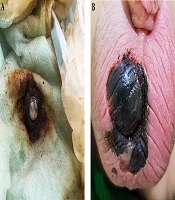
Given the picture provided by the parents about the battery found in the diaper, there was some leakage (battery leakage) around the battery. Considering the battery images (Figure 1A), an alkaline button battery (model; LR44) with 11.4 mm (0.45 in) in diameter, which produces 1.5 volts, was the cause of the complication. At the primary state of diagnosis, a necrotic wound with dimensions of 1.5 × 1.5 cm was proved through an examination by a dermatologist counselor. The wound was completely rounded edges and located at the center of the scrotum (Figure 1B). No sign of infection was not found around the lesion. The lesion was dry and did not have any discharge.
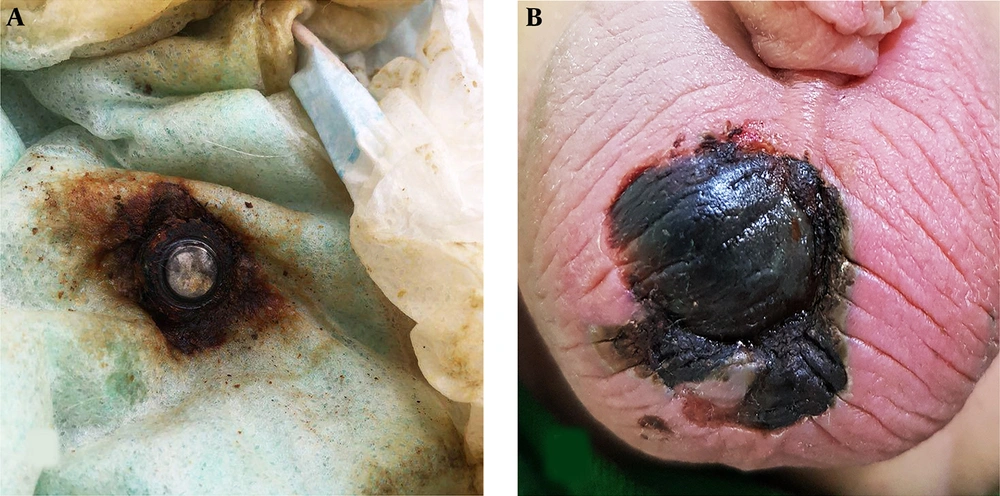
Figure 1.
Pictures provided by the parents. A, Battery and its leakage in baby diaper; B, the rounded wound at the center of the scrotum
2.3. Ultrasound Findings
Ultrasound was performed from the scrotal area to investigate the conditions of the testicles and measuring the severity and the depth of the damage. Based on the ultrasound report, the scrotal thickness at the lesion area was increased up to 18 mm on the left and 17 mm to the right. The edema and inflammation were also observed in the scrotum area. In the site of the lesion, the edema was more intense, and a linear echogenic region was seen due to the gas focus. However, no evidence of gangrene was observed. Both testicles and epididymis were normal, and no hydrocele was seen.
2.4. Treatment Procedure and Follow-Up
According to the prescription given by a dermatologist, the following treatment procedure was administered. Mupirocin ointment; every 8 hours, Cicalfate Avene cleanser; twice a day, Fibrinolysin ointment (elastic ointment); 2 - 3 times daily and a wet-dry compress; three times a day to remove dead tissue from the site of the lesion.
No lab test or intervention was performed on the patient. The patient was discharged with parental consent after a few hours of admission to the emergency room. The patient did not have any referral in person after discharge and was virtually linked to the doctor by sending photos. Short-term follow up using a series of photos over interval times revealed that after a week, an eschar tissue was created at the burned site (Figure 2B), and after one month, a healed skin with no wound symptoms was formed in the site (Figure 2D).

Figure 2.
Images of the site of the lesion after A, two days; B, one week; C, two weeks; and D, one month after the start of treatment. As the pictures clearly show, the patient has passed a recovery process and no wound symptoms are observed in the site after one month of treatment initiation.
3. Discussion
Chemical burns are generally divided into two groups of acidic and alkaline burns (6, 7). Acids with a pH lower than 2 cause coagulative necrosis on the skin. On the contrary, alkaline agents with a pH higher than 11.5 can cause severe skin damage by creating liquefactive necrosis that causes saponification of lipids and denaturation of proteins. So the burns caused by the alkaline agents are expected to be much more severe than the acid. Chemical burns in children account for low frequent burns. In a study by Hardwicke et al., only 1.1% (24 out of 2054) of the burns examined during an eight years period were chemical burns in children (under 16), and only two cases were caused by the battery (6). Studies reported that lithium and alkaline batteries can cause more severe damages than other types of batteries (5). Batteries that do not leak can also cause damage by creating local electrical current in the tissue, hydroxyl accumulation, and regional hydrolysis. In 2005, it was reported that a 32.2 mm manganese battery (alkaline battery) was entered into the vagina of a 12-year-old girl and was remained there for 3 days. Although the battery did not leak, but a wound was seen in the vaginal wall, which was adjacent to the positive and negative poles of the battery (8). Foreign body ingestion, such as battery ingestion, also commonly occurs in children. Battery ingestion can lead to some complications, such as severe internal bleeding, aortophagal fistula, bilateral vocal cord paralysis, heavy metals toxicity, fever, nausea, bloody stool, loss of appetite, abdominal pain, and severe vomiting (5, 9-11). In the case discussed in this report, the lack of clinical signs such as abdominal pain, severe cough, diarrhea, severe nausea, and vomiting, as well as the lack of changes in the digestive status of the patient and the absence of feces and diarrhea around the battery in baby’s diaper (Figure 1A), rejected the possibility of battery ingestion. Therefore through a rational argument, the battery accidentally has dropped in the diaper while the infant was playing with a laser light toy. Subsequently, the proximity of alkaline leaky battery to scrotum caused such damage to the infant. Chemical burn of the scrotum with the battery leakage may lead to complications such as congestive necrosis in the testicles, infection, and abscess, or even sepsis. In such cases, the probability of testicular damages is very high. However, given that the diaper of infants should frequently be changed, the causative agent does not remain in contact with the skin for a long time; the depth and severity of burning are slight. Accordingly, in such cases, like thermal burns, local treatment procedures will be effective. However, more deep studies with more important details are needed to complete a comprehensive concept around chemical burn injury in the scrotal area.