
Cover image of the article: Penile Necrosis Following Condom Sheath Improper Use: A Case Report and Literature Review

Image Credit:Nephro-Urol Mon

Penile Necrosis Following Condom Sheath Improper Use: A Case Report and Literature Review

Authors

Hamed Mohseni RadHamed Mohseni Rad ORCID1,*

Abstract

Ischemia of the penis is not common due to its excellent collateral vessels. Our patient was an 89-year-old man with dementia without any vascular disease wearing a condom sheath because of urinary incontinence for many months. Lack of precise genitalia care resulted in strangulation of the penis and complete necrosis probably in 10 days. Following resuscitation, we performed a complete penectomy and urethrostomy. The patient has acceptable voiding from the penis remnant after 6 months. Penile condom sheaths in neglected old patients must be used cautiously; however, diaper appliances may be safer.

Highlights

How to Cite:Mohseni Rad H. Penile Necrosis Following Condom Sheath Improper Use: A Case Report and Literature Review. Nephro-Urol Mon. 2023;15(2):e137503. doi: https://doi.org/10.5812/numonthly-137503

1. Introduction

Strangulation means the neck compression of any organ or tissue that impedes blood perfusion. Penile necrosis can be associated with health problems like circulatory disorders and disseminated infections. Penis ischemia is uncommon due to its excellent collateral vessels (1). Surgical procedures, like penectomy, may be the only therapeutic strategy. Penile necrosis may be seen in end-stage renal disease in 1% - 4 % of patients accompanied by calciphylaxis, which succumb to death in 70% with a very short life expectancy (2). However, we report a case of complete penile necrosis in a neglected man because of strangulation of an uncared-for condom sheath without kidney disease or calciphylaxis.

2. Case Presentation

The patient was a man aged 89 with dementia without any vascular disease wearing a condom sheath because of urinary incontinence for many months. Lack of precise genitalia care resulted in strangulation of the penis and complete necrosis (Figure 1). He had urinary incontinence for at least 3 years using a condom sheath. The patient was referred to the clinic with a fever and urinary retention. His penile necrotic tissue was dry and involved completely without discharge or numbness. Following resuscitation, we performed a complete penectomy and urethrostomy (Figure 2). His son completed the informed consent to excision of a non-viable penis. All of the necrotic tissue is excised until healthy, viable tissue. Then urethral mucosa was sutured to the penile base skin with a separate 4 - 0 Vicryl suture. He was discharged 3 days later in good condition with Cephalexin 500 mg every 6-hours and local Zinc Oxide ointment every 12-hour prescription. The patient has acceptable voiding from the penis remnant after 6 months.
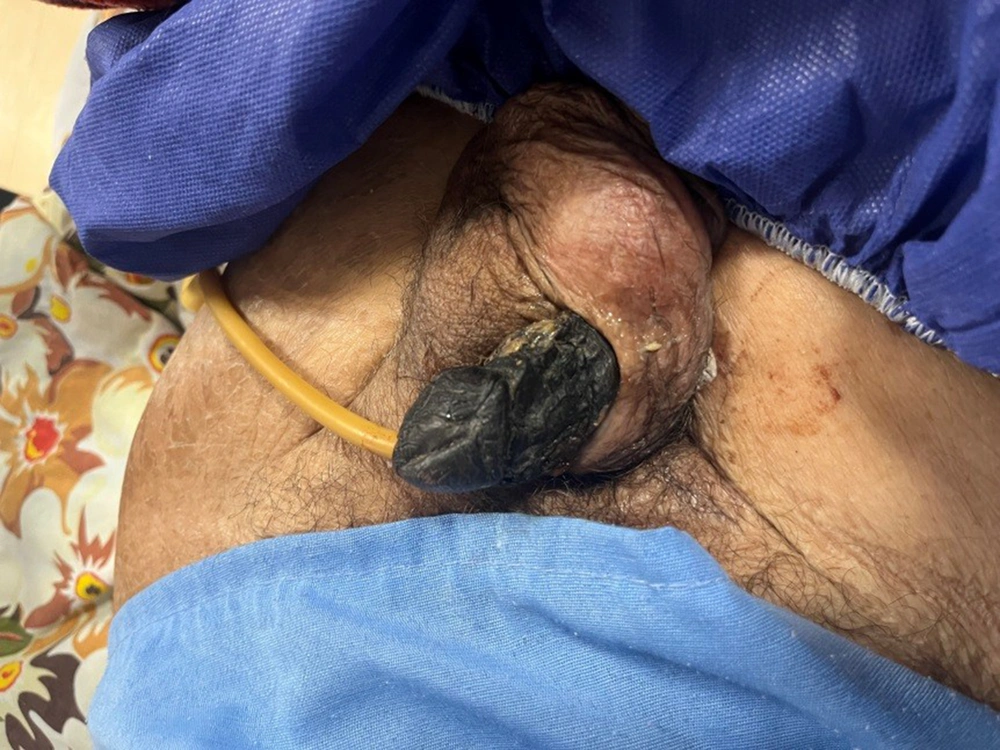
Penile total necrosis following missed condom sheath use
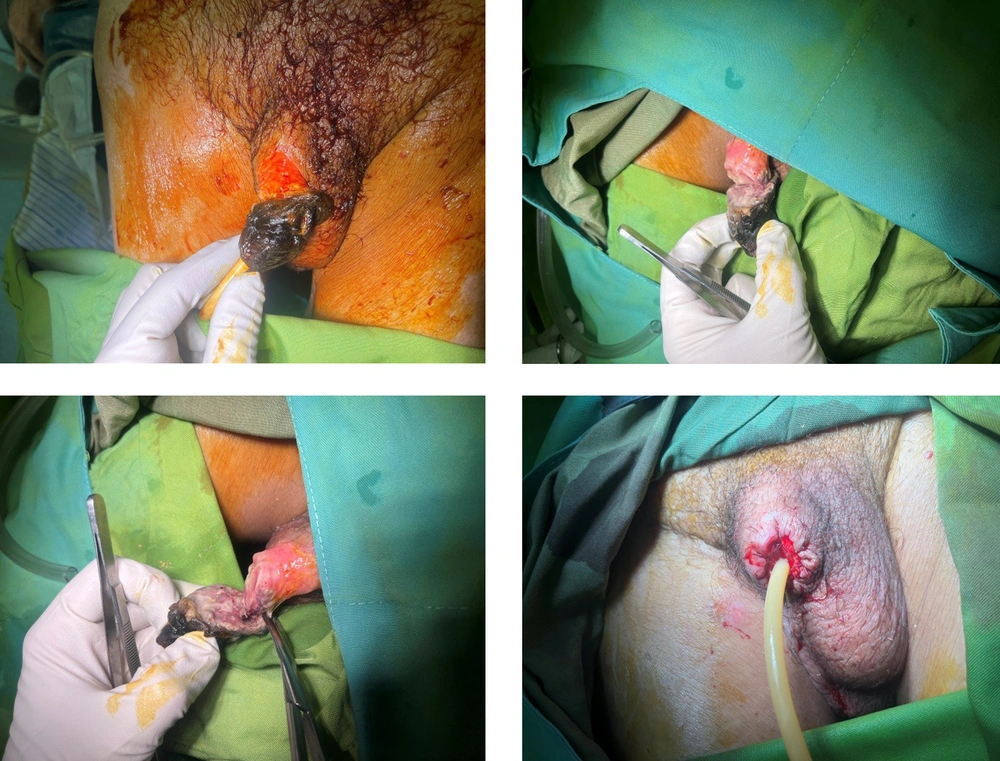
Figure 1.
Penile total necrosis following missed condom sheath use
Total penectomy and urethrostomy
Figure 2.
Total penectomy and urethrostomy

3. Discussion

Penile necrosis ischemia is due to severe Diabetes Mellitus, thrombotic phenomena, penile prosthesis, and calcium deposits in dialysis patients. Penile mortification is uncommon due to its abundant blood circulation (1). Penile gangrene can be provoked by vascular compromise resulting in severe complications. Penile gangrene is commonly caused by DM or end-stage renal disease, but recently, its incidence due to penile strangulation has increased because of constricting tools for sexual stimulation (3). About our patient, strangulation was because of neglected and forgotten condom sheath strangling. A patient with dry gangrene is more likely to have a problem earlier; however, they may feel ashamed of their situation or have psychological problems.
A thin layer of fibrous tissue covers the corpus spongiosum and urethra, making them vulnerable to mechanical injury. Nonetheless, gangrene is not common, possibly because each corpus cavernosum has its artery, and Buck’s fascia and corporeal tissue thickness can resist pressure on the deep vessels (4).
Penile gangrene can be cured surgically or conservatively. The surgery prognosis is more favorable and has been reported (5). Clinical differentiation between dry gangrene because of wet gangrene and ischemic disease with infection is important in choosing an appropriate treatment. Wet gangrene is originally infectious, and prompt surgery can reduce associated mortality and morbidity. Sepsis, progressive tissue destruction, and death can be expected if left untreated. Total or partial penectomy is the treatment of choice (6).
This patient has no specific diseases like Diabetes Mellitus, chronic kidney disease, or calciphylaxis, which are more prevalent in rare penile ischemia cases.

3.1. Conclusions

Penile condom sheaths in neglected old patients must be used cautiously because of possible catastrophic results. So diaper appliances may be safer, especially for incontinent males.
Footnotes

  • Authors' Contribution: Hamed Mohseni Rad is the only author of the article, and the study was solely carried out by him.

  • Conflict of Interests: The authors are employed at Ardabil University of Medical Science.

  • Funding/Support: The authors declared no funding or support.

  • Informed Consent: Written informed consent was obtained.

References

Copyright

Copyright © 2023, Author(s). This is an open-access article distributed under the terms of the Creative Commons Attribution-NonCommercial 4.0 International License (http://creativecommons.org/licenses/by-nc/4.0/) which permits copy and redistribute the material just in noncommercial usages, provided the original work is properly cited.

Similar Articles

1
Jul
2008
Role of Ultrasound in Diagnostic Aid of a Case of Penile Fracture

Role of Ultrasound in Diagnostic Aid of a Case of Penile Fracture

Masoud Shariat,
M Sufian

Shariat M, Sufian M. Role of Ultrasound in Diagnostic Aid of a Case of Penile Fracture. Shiraz E-Med J. 2008;9(3):. doi:

22
Jul
2017
Penile Hair Tourniquet Syndrome Due to a Coil of Hair: First Report in Iran

Penile Hair Tourniquet Syndrome Due to a Coil of Hair: First Report in Iran

Mohammad Sobhan Sheikh Andalibi,
Anoush Azarfar,
Mohammad Esmaeeli,
Nazanin Sheykh Andalibi,
Anahita Alizadeh,
Yalda Ravanshad

Sheikh Andalibi MS, Azarfar A, Esmaeeli M, Sheykh Andalibi N, Alizadeh A, et al. Penile Hair Tourniquet Syndrome Due to a Coil of Hair: First Report in Iran. Nephro-Urol Mon. 2017;9(4):e59788. doi: https://doi.org/10.5812/numonthly.59788

28
May
2013
Primary Non-Hodgkin’s Lymphoma of Penis Masquerading as a Non-Healing Ulcer in the Penile Shaft

Primary Non-Hodgkin’s Lymphoma of Penis Masquerading as a Non-Healing Ulcer in the Penile Shaft

Kushal Karki,
Rehan Mohsin,
Muhammad Mubarak,
Altaf Hashmi

Karki K, Mohsin R, Mubarak M, Hashmi A. Primary Non-Hodgkin’s Lymphoma of Penis Masquerading as a Non-Healing Ulcer in the Penile Shaft. Nephro-Urol Mon. 2013;5(3):e93986. doi: https://doi.org/10.5812/numonthly.6885

31
Dec
2012
Primary Kaposi Sarcoma of Penis in HIV Negative Patient

Primary Kaposi Sarcoma of Penis in HIV Negative Patient

Hossein Karami,
Alireza Bagher-Tabrizi,
Mohammad Yaghoobi

Karami H, Bagher-Tabrizi A, Yaghoobi M. Primary Kaposi Sarcoma of Penis in HIV Negative Patient. Int J Cancer Manag. 2012;5(4):e80841. doi:

30
Sep
2013
Lucky Guy Knife Assault

Lucky Guy Knife Assault

Farideh Roshanali,
Mohammad Hossein Mandegar,
Bahieh Moradi

Roshanali F, Mandegar MH, Moradi B. Lucky Guy Knife Assault. Int Cardiovasc Res J. 2017;7(3):e12429. doi:

More by these authors

Hamed Mohseni RadPubMedScholar
Share
Cited by
Metrics
Indexed in