
1. Background
End-stage kidney disease (ESKD) is an advanced manifestation of chronic kidney disease that affects a growing global population (1). For these patients, maintenance hemodialysis remains an essential, life-sustaining intervention (2). This renal replacement modality is fundamental for clearing metabolic toxins and maintaining fluid homeostasis during total renal failure (3). The clinical success of this therapy relies heavily on establishing stable vascular access, which serves as the vital interface between the patient’s circulatory system and the dialysis machinery (4). Consequently, compromised vascular access remains a primary driver of increased morbidity, mortality, and healthcare expenditure in this patient cohort (5).
Tunneled cuffed catheters (TCCs) are frequently used as a necessary alternative when arteriovenous fistulae or grafts are clinically unfeasible or awaiting maturation (6). However, TCCs carry a high complication burden, most notably catheter-directed thrombosis, which precipitates access dysfunction and exacerbates patient morbidity (7). The pathogenesis of this thrombosis is multifactorial and is driven by Virchow’s triad of altered hemodynamics (blood stasis), contact activation on catheter biomaterials, and the hypercoagulable state of uremia, with prevalence rates reaching up to 40% in dialysis cohorts (8).
Standard prophylactic regimens rely predominantly on interdialytic catheter lock solutions, such as citrate or unfractionated heparin (9). However, these localized lock regimens have inherent pharmacological limitations: they act exclusively within the internal catheter lumen between dialysis sessions, leaving pericatheter fibrin sheath deposition, mural tip thrombosis, and systemic prothrombotic activity unaddressed (9, 10). Conversely, traditional systemic anticoagulants such as warfarin are severely limited in ESKD by unpredictable pharmacokinetics, the requirement for routine INR monitoring, increased risks of major bleeding, and accelerated vascular calcification and calciphylaxis (10, 11).
Direct oral anticoagulants (DOACs) present a compelling alternative therapeutic approach (12). Among available DOACs, apixaban has a favorable pharmacokinetic profile in ESKD because it has the lowest renal elimination fraction (~27%) compared with dabigatran (~80%) or rivaroxaban (~36%) (11-14). Apixaban provides predictable Factor Xa inhibition without requiring routine coagulation monitoring and has demonstrated superior safety, with lower bleeding risks than warfarin, in advanced kidney disease (11, 15). Although recent landmark trials (such as AXADIA-AFNET 8) evaluated apixaban for stroke prevention in hemodialysis patients with atrial fibrillation (15), a critical evidence gap remains: prospective, randomized clinical trial data evaluating systemic low-dose oral apixaban specifically for the primary prevention of TCC thrombosis and vascular access preservation are lacking (13, 14, 16).
2. Objectives
This prospective, double-blind randomized controlled trial was designed to address this specific gap in the literature. The primary objective was to evaluate the efficacy of daily low-dose oral apixaban (2.5 mg) versus matching placebo in preventing TCC-related thrombosis causing catheter dysfunction (blood flow rate Qb < 300 mL/min) over a 6-month follow-up period. The secondary objectives were to compare catheter replacement rates, hemorrhagic events classified according to International Society on Thrombosis and Haemostasis (ISTH) criteria, and functional catheter duration. By evaluating a systemic oral prophylactic strategy, this study differs fundamentally from local lock trials and seeks to establish a novel, noninvasive approach to prolong vascular access longevity, minimize invasive catheter interventions, and reduce the overall healthcare burden in ESKD.
3. Methods
3.1. Study Design and Setting
This prospective, double-blind, randomized controlled clinical trial was conducted at Imam Khomeini Hospital in Urmia, Iran, from 2023 to 2024 and was approved by the Ethics Committee of Urmia University of Medical Sciences (code: IR.UMSU.HIMAM.REC.1402.127). Before participant enrollment, the trial was registered with the Iranian Clinical Trial Registry (Registration ID: IRCT20240228061124N1). All participants provided written informed consent before inclusion, and the study strictly adhered to the principles of the Declaration of Helsinki.
3.2. Study Population
Participants were adults aged > 18 years with ESKD who were receiving hemodialysis via a tunneled cuffed central venous catheter (BD Bard, HemoStar™ Long-Term Hemodialysis Catheter).
Eligibility criteria included a life expectancy > 3 months, normal baseline coagulation parameters (PTT, PT, INR), and no concurrent use of other anticoagulant or antiplatelet medications. Exclusion criteria included known coagulation disorders, uncontrolled hypertension (HTN) (> 180/110 mm Hg), active malignancy, pregnancy, lactation, active infectious disease, liver failure, severe hepatic impairment (Child-Pugh Class B/C), a history of pulmonary embolism, or known hypersensitivity to apixaban.
3.3. Sample Size Determination
The sample size was calculated before trial initiation using STATA 17 (StataCorp, College Station, TX, USA) based on the primary efficacy endpoint of TCC thrombotic dysfunction at 6 months. Based on published clinical literature and historical institutional data for chronic hemodialysis patients receiving standard post-dialysis heparin locks (17, 18), the expected 6-month catheter thrombotic dysfunction rate in the control group was estimated at 30% (p1 = 0.30). Daily low-dose oral apixaban prophylaxis was hypothesized to reduce the event rate to 8% (p2 = 0.08) in the experimental arm, representing an anticipated absolute risk reduction of 22%. Assuming a two-sided significance level (α) of 0.05 and a statistical power (1 - β) of 80% (0.80), a minimum sample size of 43 participants per arm was required to detect a statistically significant difference between treatment groups. To account for a potential dropout or loss-to-follow-up rate of up to 15%, a total of 100 participants (50 per treatment arm) were enrolled in the trial.
3.4. Catheter Placement
After administration of local anesthesia, percutaneous cannulation of the internal jugular vein was performed under ultrasound guidance for all TCC placements. The catheters were then routed through a subcutaneous tunnel, and fluoroscopy was used to verify accurate positioning of the distal tips, either within the right atrium or at the cavoatrial junction.
3.5. Randomization and Allocation Concealment
Eligible participants were randomly assigned in a 1:1 ratio to receive either active low-dose oral apixaban or a matching placebo. Sequence generation was performed before trial initiation by an independent biostatistician using STATA 17 (StataCorp, College Station, TX, USA). To ensure group balance while minimizing assignment predictability, a permuted block design with randomly varying block sizes of four and six was used.
Allocation concealment was maintained using sequentially numbered, opaque, sealed envelopes. After baseline screening and written informed consent were obtained by trial nephrologists, an independent ward nurse, who was not involved in patient recruitment, clinical management, or outcome evaluation, opened the sequential envelopes to determine group assignment.
3.6. Study Interventions and Standard Care Protocol
Pharmacological interventions were initiated within 24 hours after successful, ultrasound- and fluoroscopy-guided, TCC insertion. Participants were allocated to one of two 6-month treatment regimens:
1) Intervention group: Oral apixaban 2.5 mg once daily.
2) Control group: An identical, matching oral placebo tablet once daily (manufactured and packaged by Abidi Pharmaceutical Co., Tehran, Iran).
Both cohorts received identical institutional standard-of-care catheter maintenance and monitoring, including:
1) Catheter locking: Post-dialysis instillation of unfractionated heparin (5,000 IU/mL) into each catheter lumen, filled strictly to the designated internal priming volume, after every thrice-weekly, 4-hour hemodialysis session.
2) Aspiration and flushing: Complete pre-dialysis aspiration of the heparin lock, followed by a 10 mL flush of 0.9% sterile normal saline per lumen before vascular circuit connection.
3) Exit-site care and hemodynamic monitoring: Aseptic exit-site dressing changes using chlorhexidine gluconate, with routine inspection for localized infection or catheter dislodgement during each dialysis session. Real-time arterial/venous dynamic pressures and blood flow rates (Qb) were continuously monitored throughout each treatment.
4) Co-intervention management: Intra-dialytic systemic anticoagulation (standardized intravenous unfractionated heparin boluses prescribed per routine dialysis protocol) was permitted equally in both arms. Concomitant maintenance therapy with systemic oral/parenteral anticoagulants (e.g., warfarin, low-molecular-weight heparin) or antiplatelet agents (e.g., aspirin, clopidogrel) was strictly prohibited.
3.7. Blinding Procedures
To maintain strict double-blind integrity throughout the trial, active low-dose apixaban (2.5 mg) and placebo tablets were formulated to be physically indistinguishable in size, shape, color, weight, texture, and taste. Placebo tablets were custom manufactured, packaged, and supplied by Abidi Pharmaceutical Co. (Tehran, Iran). Investigational products were prepared and dispensed by the institutional research pharmacy in identical, sequentially numbered, opaque, light-resistant containers.
Complete blinding was maintained at all levels of trial execution:
Trial Participants: Patients were fully masked to treatment allocation.
Clinical Care Team: Attending nephrologists, bedside dialysis nursing staff, and interventional operators managing vascular access were blinded to intervention assignment.
Outcome Assessors and Biostatisticians: Clinical investigators, event adjudicators, and trial statisticians conducting data analysis remained masked to treatment groups.
Only an independent research ward nurse, not involved in participant recruitment, clinical management, or outcome assessment, opened the sequential envelopes and dispensed the assigned medication containers. The master randomization key was securely maintained in a locked, encrypted file by the unblinded research nurse and was broken only after final database lockdown and completion of the primary statistical analyses.
3.8. Adherence Monitoring
Medication adherence was systematically monitored biweekly during routine hemodialysis visits using pill counts of returned medication containers, cross-validated against participant compliance diaries. Adequate adherence was operationalized as ingestion of ≥ 80% of prescribed doses. Protocol adherence was high and comparable between groups (96.2% in the apixaban cohort vs 95.8% in the placebo cohort; P = 0.78). No premature drug discontinuations, major protocol violations, or treatment crossovers occurred during the 6-month trial period.
3.9. Outcome Measures and Diagnostic Criteria
Primary endpoint: The primary composite efficacy outcome was TCC-related catheter dysfunction due to thrombosis within the 6-month follow-up period. In accordance with the National Kidney Foundation’s Kidney Disease Outcomes Quality Initiative guidelines, catheter dysfunction was clinically operationalized as the inability to maintain a target blood flow rate (Qb) of ≥ 300 mL/min during two consecutive hemodialysis sessions despite positioning maneuvers and saline flushes.
TCC thrombosis was definitively diagnosed when at least one of the following criteria was met:
1) Complete intraluminal occlusion or persistent inability to aspirate blood from one or both lumens.
2) Radiographic confirmation of an intraluminal or pericatheter tip thrombus by contrast venography or Doppler ultrasonography.
3) Visual demonstration of thrombotic material during endovascular salvage procedures or upon catheter explantation.
Secondary endpoints:
1) Catheter replacement rate: The proportion of patients requiring complete catheter exchange or removal due to refractory thrombotic dysfunction.
2) Hemorrhagic events: Evaluated using the ISTH criteria and categorized as major bleeding (fatal bleeding, bleeding into critical anatomical sites, or bleeding leading to a ≥ 2 g/dL hemoglobin drop or requiring transfusion of ≥ 2 units of packed red blood cells) or minor bleeding.
3) Catheter longevity (functional duration): Defined as the cumulative total number of days of functional catheter viability recorded per patient within the fixed 180-day (6-month) study observation window. For catheters replaced or explanted due to refractory thrombosis before Day 180, functional duration was calculated up to the exact day of access failure.
4) Systemic thromboembolism: Radiologically verified deep vein thrombosis, pulmonary embolism, or central venous stenosis.
3.10. Safety Assessment and Event Adjudication Procedures
Participants were systematically screened for hemorrhagic manifestations and adverse events by trained clinical research nurses during each thrice-weekly hemodialysis session using a standardized checklist. Hemorrhagic events were classified in strict accordance with ISTH criteria as major bleeding (fatal bleeding, bleeding into critical anatomical sites, or bleeding causing a hemoglobin drop of 2 g/dL or requiring transfusion of 2 units of packed red blood cells) or minor bleeding.
All suspected bleeding episodes, vascular access thromboses, and adverse events were documented with exact post-randomization timing, clinical severity, and required management. An independent, blinded Clinical Event Committee, consisting of a consultant hematologist and a senior nephrologist not involved in trial execution or patient care, reviewed and adjudicated all clinical endpoints and safety events while remaining masked to treatment assignment.
3.11. Statistical Analysis
All statistical evaluations followed the Intention-to-Treat principle, with all 100 randomized participants analyzed according to their initial allocation. Descriptive statistics were presented as mean ± standard deviation (SD) for continuous variables and frequencies (%) for categorical variables. Continuous variables were compared using independent-samples t-tests, and categorical outcomes (thrombosis, replacement, bleeding) were compared using chi-square (χ2) or Fisher exact tests. Effect sizes were expressed as odds ratios (OR), relative risks (RR), and risk differences (RD), with two-sided 95% confidence intervals (95% CIs). A multivariable logistic regression model was constructed to identify independent predictors of TCC thrombosis, reporting adjusted odds ratios (aOR = eβ) with 95% CIs. Statistical significance was set at P < 0.05. Analyses were conducted using SPSS Version 20.0 (IBM Corp., Armonk, NY, USA).
4. Results
4.1. Participant Flow and CONSORT Governance
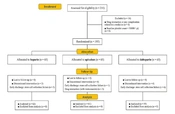
A total of 124 adult patients with ESKD undergoing TCC placement were screened for trial eligibility at Imam Khomeini Hospital in Urmia, Iran, between 2023 and 2024. Of these, 24 individuals were excluded before randomization: 16 did not meet the inclusion criteria (severe hepatic impairment, n = 4; baseline coagulopathy, n = 5; concurrent antiplatelet or oral anticoagulant therapy, n = 7), and 8 declined to participate.
The remaining 100 eligible participants were enrolled and randomized in a 1:1 ratio to receive either low-dose oral apixaban (n = 50) or a matching oral placebo (n = 50). All 100 randomized participants received their allocated intervention. Over the 6-month (180-day) follow-up period, there were no losses to follow-up, treatment discontinuations, major protocol deviations, or crossovers between arms. Consequently, 100% of allocated participants (n = 50 per group) completed the trial and were included in the primary ITT efficacy and safety analyses (Figure 1).
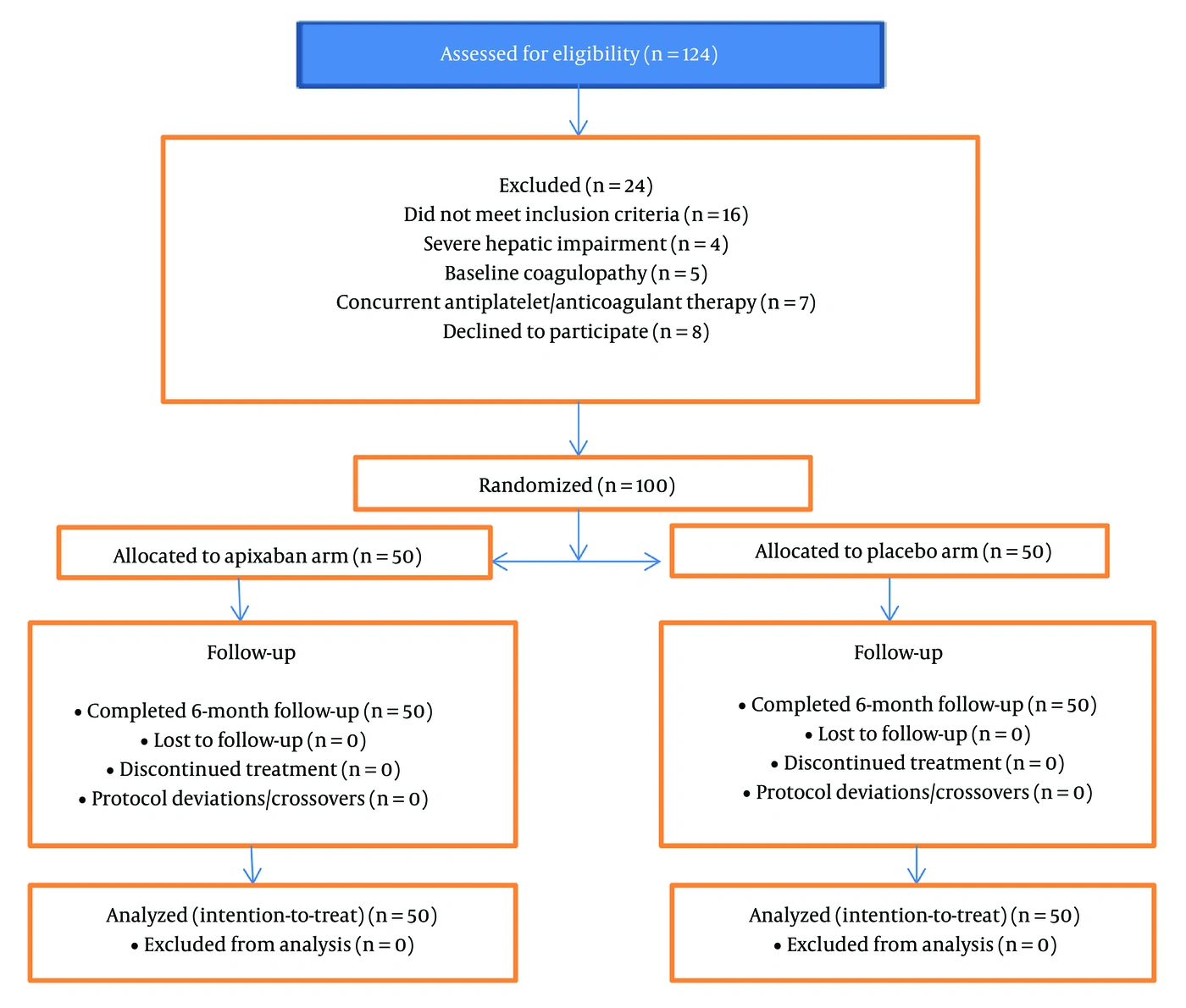
Figure 1.
CONSORT flow diagram showing patient screening, enrollment, allocation, follow-up, and analysis.
4.2. Baseline Characteristics
The trial enrolled 100 patients requiring maintenance hemodialysis, who were allocated equally (n = 50 per arm) to either the experimental group receiving apixaban or the standard care control group (Abidipharma, a daily matching placebo tablet plus institutional standard catheter flushing and maintenance). The mean age of participants was 59.94 ± 6.50 years (range, 50 to 70 years). Statistical analysis confirmed comparable age distributions between the two cohorts (P = 0.99), minimizing potential age-related confounding (Table 1).
Table 1.
Demographic Characteristics of Study Participants a
| Variables | Apixaban Group (n = 50) | Control Group (n = 50) | P-Value |
|---|---|---|---|
| Mean age (y) | 60.52 ± 6.35 | 59.36 ± 6.65 | 0.99 b |
| Gender | 0.99 c | ||
| Male | 20 (40) | 19 (38) | |
| Female | 30 (60) | 31 (62) | |
| Underlying disease | 0.809 c | ||
| Hypertension | 45 (90) | 46 (92) | |
| Diabetes mellitus | 32 (64) | 35 (70) | |
| Ischemic heart disease | 28 (56) | 25 (50) |
a Values are expressed as mean ± SD or No. (%). Abbreviations: DM, diabetes mellitus; HTN, hypertension; IHD, ischemic heart disease.
b Independent-samples t-tests.
c Chi-square test.
Regarding sex distribution, the apixaban arm included 30 female (60%) and 20 male (40%) participants, closely mirroring the control arm, which included 31 female (62%) and 19 male (38%) participants. This balanced distribution was statistically confirmed (P = 0.99), indicating no significant between-group differences in sex (Table 1).
Baseline clinical assessments also evaluated comorbidities, including ischemic heart disease, diabetes mellitus, and hypertension (HTN). No statistically significant differences were observed in the overall distribution of these comorbidities between the experimental and control groups (P = 0.809). However, minor differences in the prevalence of individual conditions prompted statistical adjustment in subsequent analyses to mitigate potential residual confounding (Table 1).
4.3. Clinical Outcomes
As summarized in Table 2, low-dose apixaban (2.5 mg daily) significantly reduced the incidence of the primary composite endpoint of catheter dysfunction due to TCC thrombosis compared with the control group (8% [n = 4] vs 28% [n = 14]; P = 0.0196). This corresponded to a 78% reduction in the odds of catheter thrombosis (OR = 0.22, 95% CI: 0.07 to 0.75), a 71% reduction in relative risk (RR = 0.29, 95% CI: 0.10 to 0.81), and an absolute risk reduction of 20.0% (RD = -20.0%, 95% CI: -34.8% to -5.2%).
Table 2.
Clinical Outcomes of Apixaban vs Control at 6-Month Follow-Up a
| Outcome Measure | Apixaban Group (n = 50) | Control Group (n = 50) | Effect estimate (95% CI) | P-Value |
|---|---|---|---|---|
| Primary endpoint | ||||
| Catheter dysfunction due to TCC thrombosis | 4 (8) | 14 (28) | OR: 0.22 (0.07 to 0.75); RR: 0.29 (0.10 to 0.81); RD: -20.0% (-34.8% to -5.2%) | 0.0196 b |
| Secondary endpoints | ||||
| Catheter replacement required | 3 (6) | 10 (20) | OR: 0.26 (0.07 to 0.99); RR: 0.30 (0.09 to 1.02); RD: -14.0% (-27.1% to -0.9%) | 0.0353 b |
| Total bleeding events (major/minor) | 1 (2) | 3 (6) | OR: 0.32 (0.03 to 3.19); RR: 0.33 (0.04 to 3.10); RD: -4.0% (-11.8% to 3.8%) | 0.6098 b |
| Mean catheter functional duration (d) | 158.2 ± 35.4 | 160.8 ± 33.9 | Mean difference: -2.60 (-16.32 to 11.12) | 0.7760 c |
| Safety endpoints (ISTH framework) | ||||
| ISTH major bleeding | 0 (0) | 0 (0) | N/A | > 0.99 |
| ISTH minor bleeding | 1 (2) | 3 (6) | OR: 0.32 (0.03 to 3.19) | 0.6098 b |
| Total bleeding events | 1 (2) | 3 (6) | N/A | 0.6098 b |
| Permanent study drug discontinuation due to AEs | 0 (0) | 0 (0) | N/A | > 0.99 |
a Values are expressed as No. (%) or mean ± SD unless otherwise indicated. Statistical testing was not performed for specific event subtypes or zero-count categories because of small sample sizes and descriptive subgrouping. Abbreviations: AE, adverse event; CI, confidence interval; ISTH, International Society on Thrombosis and Haemostasis; N/A, not applicable; OR, odds ratio; RD, risk difference; RR, relative risk; TCC, tunneled cuffed catheter.
b Chi-square test.
c Independent-samples t-tests. Follow-up: 180 days (6 months).
Similarly, the secondary endpoint of required catheter replacement was lower in the apixaban arm (6% [n = 3] vs 20% [n = 10]; P = 0.0353), indicating a significant reduction in the need for intervention (OR = 0.26, 95% CI: 0.07 to 0.99; RR = 0.30, 95% CI: 0.09 to 1.02; RD = -14.0%, 95% CI: -27.1% to -0.9%).
Regarding safety, bleeding event frequencies did not differ significantly between the apixaban and control cohorts (2% [n = 1] vs 6% [n = 3]; P = 0.6098), and no major bleeding events were observed. The mean functional catheter duration over the 6-month observation period was comparable between groups (158.2 ± 35.4 days for apixaban vs 160.8 ± 33.9 days for control; P = 0.7760).
Total bleeding event frequencies also did not differ statistically between the apixaban and control cohorts (2% [n = 1] vs 6% [n = 3]; P = 0.6098) (OR = 0.32, 95% CI: 0.03 to 3.19; RD = -4.0%, 95% CI: -11.8% to 3.8%). Zero ISTH major bleeding events were recorded in either group (0%). Moreover, the mean functional catheter duration over the 180-day observation window remained comparable between arms (158.2 ± 35.4 days for apixaban vs 160.8 ± 33.9 days for control; mean difference: -2.60 days, 95% CI: -16.32 to 11.12; P = 0.7760) (Table 2).
4.4. Safety Outcomes
Over the 180-day follow-up period, zero ISTH major bleeding episodes, fatal hemorrhagic events, or critical-site bleeding events were observed in either treatment arm (0%, Table 3). ISTH minor bleeding occurred in 1 participant (2%) in the apixaban group and 3 participants (6%) in the control group (P = 0.6098; RD = -4.0%, 95% CI: -11.8% to 3.8%).
Table 3.
Granular Safety, Bleeding Characteristics, and Adjudication Breakdown a
| Safety Metrics and Features | Apixaban Group (n = 50) | Control Group (n = 50) | Risk Difference (%) (95% CI) | P-Value |
|---|---|---|---|---|
| ISTH major bleeding | 0 (0) | 0 (0) | 0.0% (-7.1% to 7.1%) | > 0.99 |
| ISTH minor bleeding | 1 (2) | 3 (6) | -4.0% (-11.8% to 3.8%) | 0.6098 b |
| Specific event breakdown and timing | ||||
| Transient epistaxis (Day 42) | 1 (2) | 0 (0) | N/A | N/A |
| AV access post-dialysis oozing (Days 18, 88) | 0 (0) | 2 (4) | N/A | N/A |
| Gingival bleeding during brushing (Day 115) | 0 (0) | 1 (2) | N/A | N/A |
| Event severity and clinical management | ||||
| Mild/self-limiting (no intervention required) | 1 (2) | 1 (33.3) | N/A | N/A |
| Managed with local pressure/compression | 0 (0) | 2 (4) | N/A | N/A |
| Requiring blood transfusion/hemostatic agents | 0 (0) | 0 (0) | N/A | N/A |
| Hospitalization or critical-site involvement | 0 (0) | 0 (0) | N/A | N/A |
| Intervention status and adjudication | ||||
| Temporary study drug hold | 0 (0) | 0 (0) | N/A | > 0.99 |
| Permanent study drug discontinuation due to AE | 0 (0) | 0 (0) | N/A | > 0.99 |
| Confirmed/adjudicated by blinded CEC | 1 (100) | 3 (6) | N/A | > 0.99 |
a Values are expressed as No. (%) unless otherwise indicated. Abbreviations: AE, adverse event; AV, arteriovenous; CEC, Clinical Event Committee; CI, confidence interval; ISTH, International Society on Thrombosis and Haemostasis; N/A, not applicable.
b Fisher exact test. Follow-up: 180 days. Statistical testing was not performed for specific event subtypes or zero-count categories because of small sample sizes and descriptive subgrouping.
Apixaban group (n = 1): A 62-year-old male experienced a single episode of mild, self-limiting epistaxis on Day 42 post-randomization. The event resolved spontaneously within 30 minutes without local packing, medical intervention, or interruption of the study drug.
Control group (n = 3): Two participants experienced prolonged oozing from arteriovenous access cannulation sites after hemodialysis needle removal on Days 18 and 88; both resolved with extended manual compression. A third participant experienced minor gingival bleeding during routine toothbrushing on Day 115, which resolved without intervention.
All four minor bleeding episodes were formally reviewed and adjudicated by the independent, blinded CEC. No events required blood transfusion, temporary study drug holds, or permanent study drug discontinuation, and all participants completed the 6-month protocol without safety-related deviations (Table 3).
4.5. Multivariable Logistic Regression
Table 4 summarizes the results of a multivariate logistic regression analysis evaluating factors associated with the incidence of TCC thrombosis in patients undergoing hemodialysis. The independent variables included apixaban administration, patient age, and duration of catheter treatment. A detailed description of each variable, including its regression coefficient (β), P value, and statistical interpretation, is provided below:
Table 4.
Multivariable Logistic Regression Analysis
| Variables | Coefficient (β) | Standard Error | Adjusted Odds Ratio | 95% Confidence Interval | P Value |
|---|---|---|---|---|---|
| Apixaban administration | -3.296 | 1.272 | 0.037 | 0.003 to 0.446 | 0.0119 |
| Age (y) | -0.015 | 0.063 | 0.985 | 0.871 to 1.114 | 0.8115 |
| Duration of catheter treatment (d) | -0.0299 | 0.008 | 0.971 | 0.955 to 0.987 | 0.0003 |
Coefficient (β): -3.296
P value: 0.0119
Interpretation: The negative coefficient and a P value less than 0.05 indicate a statistically significant association between apixaban use and a lower likelihood of TCC thrombosis. This finding suggests that apixaban administration significantly reduces the risk of catheter-related thrombosis in hemodialysis patients.
Coefficient (β): -0.015
P value: 0.8115
Interpretation: With a P value greater than 0.05, patient age is not significantly associated with the incidence of TCC thrombosis. Thus, age does not appear to influence the likelihood of thrombosis in this population.
Coefficient (β): -0.0299
P value: 0.0003
Interpretation: The negative coefficient and a P value less than 0.001 indicate a statistically significant association between a longer duration of catheter treatment and a lower likelihood of TCC thrombosis. This suggests that longer catheter use is associated with a reduced risk of thrombosis.
Multivariable logistic regression was performed using TCC thrombosis as the dependent outcome and including apixaban administration, patient age, and duration of catheter treatment as covariates (Table 4). Overall model fit was robust (R2 = 0.412; Hosmer-Lemeshow Goodness-of-Fit χ2 = 5.01, P = 0.748).
Daily apixaban administration was independently associated with a lower likelihood of TCC thrombosis (β = -3.296; adjusted OR = 0.037, 95% CI: 0.003 to 0.446; P = 0.0119). Each additional day of recorded catheter treatment was also associated with a lower likelihood of thrombosis (β = -0.0299; adjusted OR = 0.971, 95% CI: 0.955 to 0.987; P = 0.0003). Patient age was not a statistically significant predictor (β = -0.015; adjusted OR = 0.985, 95% CI: 0.871 to 1.114; P = 0.8115) (Table 4).
5. Discussion
TCC thrombosis severely compromises hemodialysis adequacy and frequently precipitates invasive salvage interventions (19). In this 100-patient randomized controlled trial, daily low-dose apixaban (2.5 mg) combined with standard heparin locks significantly reduced the incidence of TCC thrombotic dysfunction over a 6-month follow-up period compared with placebo. Importantly, this reduction in thrombotic events occurred without a corresponding increase in major bleeding complications. While previous studies have highlighted the burden of catheter failure (20), our findings provide specific prospective evidence that targeting Factor Xa can mitigate intraluminal fibrin accretion. By directly blunting thrombin generation at the catheter tip, oral low-dose apixaban addresses a core element of Virchow's triad inherent to foreign-body vascular access.
Randomization resulted in well-balanced intervention and control groups. There were no statistically significant differences in mean age or sex distribution. Furthermore, underlying comorbidities, including hypertension, diabetes mellitus, and ischemic heart disease, were comparable between the two arms. This baseline balance minimizes the risk of confounding and supports the internal validity of the between-group comparisons. The demographic profile, characterized by middle-to-late adulthood and a high prevalence of comorbidities, reflects the complex patient population typically undergoing chronic hemodialysis with central venous catheters (21).
The primary finding of this investigation is the statistically significant reduction in TCC thrombosis in the apixaban group (8%) compared with the control group. This demonstrates that apixaban administration effectively mitigated the risk of this critical complication. This finding is clinically relevant because TCC thrombosis is a major cause of catheter dysfunction, often leading to inadequate dialysis and increased patient morbidity (17). This result contributes to the literature on vascular access management, in which the benefit of prophylactic anticoagulation has long been debated. Previous studies using traditional anticoagulants, such as warfarin or intravenous unfractionated heparin, for TCC prophylaxis have yielded inconsistent results (18), often showing marginal benefit at the expense of a significantly increased bleeding risk, leading many guidelines to favor standard flushing protocols (22).
Our findings align with a growing body of evidence supporting the use of DOACs for thrombosis prophylaxis in high-risk settings, including recent, albeit limited, studies exploring DOACs for central line management in hemodialysis patients. The high thrombotic risk in hemodialysis patients is multifactorial, stemming from repeated endothelial injury, sluggish blood flow within the catheter lumen, and the pro-coagulant state induced by ESKD (23). The efficacy of apixaban, a Factor Xa inhibitor, in this highly uremic environment is consistent with its mechanism of action in reducing fibrin accumulation and clot formation specific to the TCC (24). The biological plausibility of low-dose apixaban in this setting is rooted in its targeted disruption of the multifactorial drivers of catheter thrombosis. In chronic hemodialysis patients, TCC thrombosis is governed by Virchow’s triad: mechanical shear stress from turbulent catheter blood flow, contact activation on foreign catheter biomaterials, and a persistent uremic hypercoagulable state characterized by elevated tissue factor expression and ongoing thrombin generation (7, 8). As a selective direct Factor Xa inhibitor, apixaban acts at the pivotal convergence of the intrinsic and extrinsic coagulation cascades (12, 24).
The clinical significance of reduced thrombosis was further supported by the secondary outcome: the incidence of catheter replacement was also significantly lower in the apixaban group. This finding is important because TCC thrombosis is a leading cause of catheter dysfunction, directly necessitating replacement or complex interventions that substantially increase morbidity and healthcare costs (25). Our 70% reduction in the need for catheter replacement suggests a potential downstream clinical and resource-utilization benefit.
The observed reduction in catheter replacement rates is framed strictly as an encouraging preliminary signal suggesting potential downstream clinical and resource-utilization benefits that require formal evaluation in future health economics and outcome studies. Preventing initial thrombus formation may avert the cascade of complications, such as poor flow and loss of access, that ultimately necessitates invasive catheter exchange. However, these preliminary observations remain exploratory, and confirmatory data from larger trial cohorts are essential. Similar studies focusing on prophylaxis have often struggled to show a clear translational benefit. For instance, while some research on low-molecular-weight heparins has suggested improved patency (26), the magnitude of the reduction in replacement rate has frequently been less pronounced or statistically insignificant because of confounding factors or limited sample size (27). Conversely, randomized trials attempting to use unfractionated heparin infusions often showed a reduction in thrombotic events but failed to demonstrate a significant difference in replacement rates over the long term, partly because the high risk of infectious complications confounded the need for removal. By demonstrating a significant decrease in the downstream requirement for catheter replacement alongside reduced thrombosis, our study provides an encouraging preliminary signal regarding the potential clinical utility of apixaban prophylaxis in preserving catheter function. It suggests that preventing initial thrombus formation may avoid the cascade of complications, including infection, poor flow, and loss of access, which ultimately necessitates the invasive and costly procedure of catheter exchange (28). These preliminary observations suggest that low-dose oral apixaban represents a promising candidate strategy for maintaining vascular access integrity, pending validation in larger clinical trials.
Bleeding events were rare in both the intervention and control groups, with no statistically significant difference between them. These safety findings are important in the hemodialysis population, in which traditional anticoagulants, such as warfarin, are often avoided or used with caution because of the heightened risk of bleeding and the potential for calciphylaxis (29). The multivariate logistic regression analysis provided critical insights into independent risk factors for TCC thrombosis. The analysis confirmed that apixaban administration was independently associated with a reduced likelihood of TCC thrombosis within this study population. Patient age was not a significant predictor, which is consistent with the primary drivers of catheter thrombosis being mechanical and hemodynamic rather than strictly systemic aging factors (30).
A notable statistical finding in our multivariable model was the inverse association between catheter treatment duration and TCC thrombosis. At first glance, a longer duration of catheter exposure might be expected to increase cumulative thrombotic risk because of continuous contact activation, turbulent flow, and biofouling. However, this negative correlation should not be interpreted as a causal protective effect; rather, it represents a classic survivor (selection) bias. Catheters that develop early thrombotic dysfunction or mechanical failure are explanted or replaced rapidly, yielding brief total durations of exposure for the affected cohort (7). Conversely, catheters with optimal anatomical positioning, superior hemodynamics, and favorable baseline patient profiles maintain patency longer and accumulate greater functional duration (31). Therefore, catheter duration serves as a marker of underlying access longevity rather than a modifiable protective factor against thrombosis.
5.1. Study Limitations
Several limitations of this study should be considered when interpreting our findings. First, the single-center study design and relatively small cohort size (n = 100) inherently limit the external applicability and generalizability of our results to broader, geographically diverse ESKD populations with varying dialysis protocols. Furthermore, although the trial was adequately powered for its primary efficacy endpoint of catheter thrombotic dysfunction, the small absolute event numbers and sample size provided limited statistical power to detect rare safety outcomes, such as major bleeding events defined by ISTH criteria. Second, while medication adherence was systematically monitored biweekly using pill counts of returned containers cross-validated with participant diaries (achieving > 95% compliance), serum apixaban trough concentrations or therapeutic anti-Factor Xa activity levels were not routinely measured to biochemically verify drug compliance or systemic exposure. Finally, the 6-month (180-day) follow-up window was relatively short for chronic hemodialysis patients who frequently depend on long-term central venous vascular access for extended periods. Consequently, the long-term safety, sustained efficacy, potential cumulative bleeding risks, and durability of catheter patency under low-dose apixaban prophylaxis remain unassessed and warrant further investigation in larger, prospective, multicenter clinical trials.
5.2. Conclusions
In this single-center pilot cohort, low-dose oral apixaban combined with standard heparin locks demonstrated a promising efficacy signal in reducing TCC-related thrombosis and catheter exchange rates, with a favorable short-term safety profile. However, given the limited sample size and pilot nature of the study, these findings must be considered preliminary. Routine clinical implementation cannot be recommended until these results are confirmed in adequately powered, prospective, multicenter randomized controlled trials.