1. Background
Hemodialysis (HD) is one of the commonly used renal replacement therapies (RRT). With the advent of HD, mortality of patients with end stage renal disease decreased significantly. As inadequate dialysis results in insufficient response to erythropoietin stimulating agents, inflammation, and increased risk of mortality and hospitalization, dialysis prescription and assessing the appropriateness of treatment are crucial. Single pool Kt/V (spKt/V) has been used for decades as an index for assessing whether patients received the prescribed dialysis and for evaluating sufficient solute removal (1). KDOQI CLINICAL PRACTICE GUIDELINE recently recommended a target spKt/V of 1.4 per hemodialysis session for patients treated thrice weekly, with a minimum acceptable delivered spKt/V of 1.2 (2). The delivered dialysis is a function of blood flow rate (BFR), dialysate flow rate, ultrafiltration rate (UF), dialyzer mass transfer coefficient and membrane surface area (KoA) and duration of dialysis session (3). Thus, failing to reach the target Kt/V could have multiple reasons, including inability to provide the prescribed BFR due to inefficient access, error in estimating dry weight, inaccurate dialyzer specified clearance, clotting in the dialyzer, shorter dialysis sessions and inappropriate dialyzer selection (4).
2. Objectives
In this study, we evaluated dialysis adequacy among 7,009 dialysis patients in Iran and identified the explanations for under dialyzed states, and finally estimated the most needed dialyzer based on KoA.
3. Methods
3.1. Patients and Data Collection
In this multicenter cross- sectional prospective study, 7,009 point-prevalent hemodialysis patients from 21 provinces of Iran (80 centers) were included. The sample size from each province was proportional to the share of that province from the total hemodialysis patients. A cluster sampling system was designed to reach the anticipated sample size.
The ethic committee of chronic kidney disease research center (CKDRC), Shahid Beheshti University of Medical Sciences, approved the study. Informed consent was obtained from all the participants.
Patients older than 18 years, who were on hemodialysis for at least three months, were included into the study.
Demographic data, cause of ESRD, time on dialysis, body mass index (BMI), estimated total body water (V), using the Watson equation, BFR, dialyzer KoA, ultrafiltration and time per session of dialysis and adequacy (pre and post blood urea nitrogen, spKt/V) were recorded monthly for three consecutive months. Trained nurses collected the records; and data were entered into specifically designed software.
3.2. Statistical Analysis
The results were presented as mean ± standard deviation for quantitative variables and were summarized as frequencies and percentages for categorical variables. Quantitative and qualitative variables were measured by t- test and chi square, respectively. Correlation between the quantitative variables was examined, using the Pearson correlation coefficient test. Regression model and multivariate analysis were conducted and the findings were interpreted based on the clinical logics. The SPSS software (Version 21) was used for statistical analysis. P value less than 0.05 was considered statistically significant.
4. Results
4.1. The Baseline Demographic Characteristics
From 80 centers across the country, 7,009 prevalent hemodialysis patients were enrolled in the study from January 2015 to December 2015.
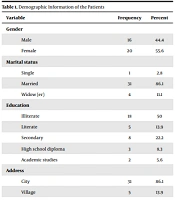
The baseline characteristics and the demographic data of the patients are demonstrated in Table 1.
The mean age of the patients was 57.2 ± 14.9 years, and 62.3% of them were older than 55 years; 58.4% were male; the mean age of the male and female patients was not significantly different (56.8 ± 15.2 vs. 57.8 ± 14.4 years, respectively). Dialysis vintage was 40 ± 35.2 months, with 37% of the patients on dialysis for 12 to 36 months.
4.2. Dialysis Sessions Characteristics
The characteristics of three monthly dialysis sessions of patients were extracted from the dialysis sheets. About 90% of the patients had three sessions of dialysis per week, whereas others had been dialyzed only two times a week. The mean Kt/V during the study period was 1.24 ± 0.18. Only 27.4% of the patients reached the target of more than 1.4, while 58.4% had the minimum delivered spKt/V of 1.2.
To assess the factors affecting Kt/V, we evaluated BFR, UF, session duration and dialyzer KOA. The mean BFR was 297.58 ± 28.6 cc/min, which was 4.66 ± 0.84 cc/min/kg body weights. About 23.6% of the dialysis patients were dialyzed with a BFR more than 300 cc/min. Ultrafiltration rate was 3.87 ± 0.86 % of the body weight. The mean KOA of dialyzers was 787.28 ± 137.19 cc/min. About 75% of the patients were dialyzed by high-flux dialyzers (KoA > 700 cc/min). The characteristics of dialysis sessions are demonstrated in Table 2.
With the aim of revealing factors influencing dialysis adequacy, we compared patients with target Kt/V of 1.4 and those failed to achieve the target (Table 3). As evident within the groups, among those with Kt/V > 1.4, BFR was higher (300.8 ± 27.4 vs. 296 ± 28.9 cc/min, P < 0.001), while these patients had lower TBW (34.4 ± 5.5 vs. 36.2 ± 5.5 Lit, P < 0.001).
As more than 70% of our patients failed to reach target Kt/V > 1.4 and BFR was much lower than 400 cc/min, to improve dialysis adequacy, we estimated the required dialyzer and blood flow rate for an adequate three times a week dialysis.
In about 6.7% of the patients with the required clearance of less than 160 cc/min and the blood flow rate of 250 to 300 cc/min (considering their low body weight (mean 50.4 ± 4.5 kg)), we required a dialyzer with KoA of 400 mL/min. To reach the clearance of 160 to 180 cc/min, which was needed in 15% of the dialysis patients, a dialyzer with KoA of 600 cc/min is necessary.
A dialyzer with KoA of 700 cc/min was necessary for adequate dialysis for 42% of our dialysis population, with the minimum BFR of 300 cc/min.
As the body size and total body water increased, 18.4% of the patients required dialyzer with KoA of 800 to 1000 cc/min if BFR was 400 and 350 cc/min, respectively. In 17.8% of the patients, we had to use either higher BFR (≥ 400 cc/min) and KoA (≥ 1400 cc/min), or had to dialyze them for at least four sessions per week; however, the latter seemed more feasible (Table 4).
Table 1.
The Baseline Characteristics and Demographic Data
| Parameters | n = 7009 |
|---|---|
| Age, mean (SD), y | 57.2 (14.9) |
| Male gender, % | 58.4 |
| Dry weight, Kg, mean (SD) | 65.6 (11.4) |
| BMI, Kg/m2, mean (SD) | 24.1 (3.5) |
| TBW, liter, mean (SD) | 35.7 (5.6) |
| Dialysis vintage, month mean (SD) | 40 (35.2) |
| Cause of ESRD | |
| Diabetes, % | 37.2 |
| Hypertension, % | 34.2 |
| Glomerulonephritis, % | 7.8 |
| ADPKD, % | 3.7 |
| Others, % | 11.9 |
| Unknown, % | 5.2 |
Abbreviations: ADPKD, autosomal dominant polycystic kidney disease; BMI, body mass index; ESRD, end stage renal disease; SD, standard deviation; TBW, total body water.
Table 2.
Dialysis Session Characteristicsa
| Parameter | Value |
|---|---|
| Weight, Kg | 65.58 ± 11.44 |
| TBW, L | 35.71± 5.59 |
| BMI, Kg/m2 | 24.10 ± 3.50 |
| BFR, cc/min | 297.58 ± 28.16 |
| BFR/ weight, cc/min/kg | 4.66 ± 0.84 |
| Weekly time of dialysis, hour | 11.23 ± 1.42 |
| KoA, cc/min | 787.28 ± 137.19 |
Abbreviations: BFR, blood flow rate; BMI, body mass index; Kg, kilogram body weight; TBW, total body water.
aValues are expressed as mean ± SD.
Table 3.
Differences Among Patients Who Reached the Target Kt/V of 1.4 and Those Who Did Nota
| Parameters | Kt/V > 1.4 | Kt/V ≤ 1.4 | P Value |
|---|---|---|---|
| Age, y | 56.4 ± 15.2 | 57.5 ± 14.8 | < 0.001 |
| BMI, Kg/m2 | 23.9 ± 3.5 | 24.2 ± 3.5 | < 0.05 |
| TBW, L | 34.4 ± 5.5 | 36.2 ± 5.5 | < 0.001 |
| BFR, cc/min | 300.8 ± 27.4 | 296 ± 28.9 | < 0.001 |
| BFR/kg, cc/min/kg | 4.85 ± 0.84 | 4.58 ± 0.83 | < 0.001 |
| Time per week, hour | 11.25 ± 1.4 | 11.22 ± 1.4 | > 0.05 |
| KoA, cc/min | 790 ± 126.9 | 786 ± 140.8 | > 0.05 |
| UF/kg % | 3.9 ± 0.9 | 3.8 ± 0.8 | < 0.001 |
Abbreviations: BFR, blood flow rate; BMI, body mass index; Kg, kilogram body weight; TBW, total body water; UF, ultrafiltration.
aValues are expressed as mean ± SD.
Table 4.
KoA and BFR Needed to Achieve Kt/V = 1.4 among Dialysis Population in Irana
| Desired Clearance (cc/min) | Number (%) of Patients | Weight (kg) | TBW (Lit) | BFR (cc/min) | KOA (cc/min) |
|---|---|---|---|---|---|
| < 160 | 469 (6.7) | 50.4 ± 4.5 | 25.5 ± 1.6 | 250 - 300 | 400 |
| 160 to <180 | 1053 (15) | 56.5 ± 5.6 | 29.4 ± 0.9 | 250 - 300 | 600 |
| 180 to < 200 | 1354 (19.3) | 60.2 ± 7 | 32.7 ± 1 | 300 - 350 | 700 |
| 200 to < 220 | 1593 (22.7) | 64.9 ± 8.6 | 36 ± 0.9 | 300 - 350 | 700 |
| 220 to <240 | 1289 (18.4) | 70 ± 6.7 | 39.4 ± 0.9 | 350 | 1000 |
| 240 to <260 | 827 (11.8) | 77.3 ± 5.6 | 42.6 ± 1 | 400 | 1100 |
| 260 to <280 | 346 (4.9) | 86.8 ± 5.1 | 46 ± 1 | 400 | 1400 |
| 280 to 300 | 78 (1.1) | 95.2 ± 3.8 | 49.4 ± 1.2 | 400 | > 1600 |
Abbreviations: BFR, blood flow rate; TBW, total body water.
aValues are expressed as mean ± SD.
5. Discussion
In this study, we evaluated approximately 7,000 hemodialysis patients by the means of delivered Kt/V, and we looked for the barriers of reaching the target Kt/V of > 1.4, and the solutions and strategies to overcome this problem.
Although the percentage of patients with Kt/V > 1.2 increased during the past five years from 43.3% in the study by Amini et al. (1) to 58.4%, less than 30% of our dialysis patients had reached the target of 1.4, which was far less than expected.
The barriers to deliver adequate dialysis were as follows: Patients’ noncompliance, access type or malfunction, low BFR, short dialysis sessions, and inappropriate dialyzer selection (5).
Most of our patients (90%) were dialyzed three times a week, and about 82% of them had the session length of four hours (mean session length was 232.2 ± 16.8 minutes).
When comparing with those who did not achieve the target of 1.4, we found that those who did achieve the target were younger with lower body weight and were dialyzed with significantly higher BFR per kilogram of body weight. However, there were no significant differences in the KoA of dialyzer and session length between the two groups. Far more, in the previous report (1), only 2.4% of the dialysis treatments were with high-flux dialyzer, while in our study about 75% of the dialysis sessions were with dialyzer with KoA > 700 cc/min.
This finding pointed to the fact that despite the more frequent use of high-flux dialyzer, the adequacy did not improve; and this might have been due to the fact that dialysis prescription (BFR, session length, and number of dialysis per week) was not precise.
Data suggested that BFR less than 300 cc/min might be insufficient (5), and in our study the mean BFR was less than or equal to 300 cc/min in 76.4% of the patients. It seemed that despite improvement in BFR, compared to the previously mentioned study (1), it was not adequate. Dialysis staff should be trained to evaluate the access and overcome the barriers facing the higher BFR set-up. The question was as follows: What would be the appropriate BFR and KoA to accomplish the goal of 1.4?
We extracted the desired clearance in four-hour sessions three times a week to achieve Kt/V > 1.4 among our cohort and estimated the required BFR and KoA, using the nomogram to assesss the in vivo urea clearance from dialyzer mass transfer area coefficient (KoA) (6).
Only 21.7% of our patients, who required a clearance of less than 200 cc/min, could be dialyzed with a BFR of less than 300 cc/min and a low-flux dialyzer (KoA < 700 cc/min). They were patients with the total body water (V based on Watson equation) of less than 30 liters. Therefore, low BFR seems to be only sufficient in smaller patients.
Additionally, to reach the target in about 80% of the patients, we needed to increase the BFR towards 350 cc/min and use high-flux dialyzer (KoA > 700 cc/min). However, if patients needed a clearance of more than 240 cc/min, they had to be dialyzed with BFR of 400 cc/min and a KoA > 1100 cc/min. Therefore, it would be more reasonable to maintain dialysis adequacy in these patients with four times a week dialysis prescription. These data could be used by the policy makers to estimate the needs of dialyzer, reduce the cost, and at the same time attain the goal Kt/V.
Our study had some limitations. First, we did not evaluate the type of access, its function and the presence of access recirculation, as catheters are more prone to malfunction and usually provide lower BFR. Second, we did not calculate the residual renal function and other factors that affect dialysis adequacy beside BFR and KoA. The strengths of this study were its large sample size, and its nationwide nature, making the obtained results generally applicable.
5.1. Conclusion
Among our patients, low BFR and inappropriate dialyzer choice were the leading causes of inadequate dialysis. With regards to attaining the most adequate dialysis based on solute removal, it seems reasonable to evaluate the causes of low BFR and access dysfunction. We suggested that better nursing education and decreasing catheter use might help overcome the barriers.