Full Text
Full text is available in PDF
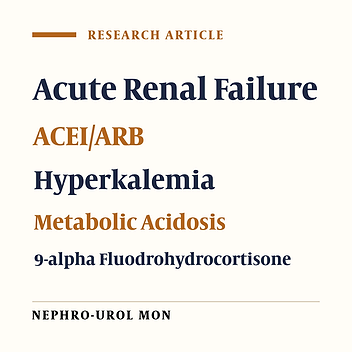
Background and Aims: Previous studies indicate that angiotensin converting enzyme inhibitors (ACEI) cause acute renal failure (ARF) in patients with diabetes, hypertension, and congestive heart failure. Volume depletion is a determining factor for ACEI-induced ARF. This study presents a syndrome of reversible ARF accompanied by hyperkalemia, metabolic acidosis, and anemia associated with ACEI and angiotensin receptor blocker (ARB).
Methods: Data were collected from a total of 12 patients; 11 were admitted to the hospitals and 1 as an outpatient. Six patients had uncontrolled diabetes. Four of these patients also had hypertension. Eight patients (67 percent) received lisinopril; 4 (33 percent) received ARB. Diuretics were the commonest accompaniment. They showed moderate to severe azotemia. Estimated glomerular filtration rate (eGFR) ranged from 9.3 to 32.2 ml/min with an average eGFR of 14.1 ml/min. Six patients (50 percent) had moderate to severe hyperkalemia. All but 2 patients had metabolic acidosis, and 6 patients (50 percent) were anemic. ACEI or ARB and diuretics were discontinued in all patients, and all hospitalized patients were treated with normal saline or bicarbonate infusion, erythropoietin, and 9-alpha fluodrohydrocortisone, as required.
Results: Azotemia reversed and renal function improved to normal or near normal in 8 patients (67 percent). One of these patients required one-time hemodialysis. Renal function returned to baseline or better in 3 patients with preexisting renal insufficiency. Renal function improved in 1. All hyperkalemic patients became normokalemic, and all but 1 recovered from metabolic acidosis. Anemia also improved.
Conclusions: This novel observation substantiates our previous observation and further reiterates that ACEI/ARB causes a syndrome of reversible azotemia, hyperkalemia, metabolic acidosis, and anemia. Discontinuance of ACEI/ARB and diuretics-and treatment with a combination of bicarbonate infusion, 9-alpha fluodrohydrocortisone (Florinef®), and exogenous erythropoietin-hasten recovery from this syndrome. Continuation of a diuretic but without ACEI/ARB doesn't hinder renal function recovery.
© 2010, Author(s). This open-access article is available under the Creative Commons Attribution 4.0 (CC BY 4.0) International License (https://creativecommons.org/licenses/by/4.0/), which allows for unrestricted use, distribution, and reproduction in any medium, provided that the original work is properly cited.
Morishita Y, Kusano E. Direct Renin Inhibitor: Aliskiren in Chronic Kidney Disease. Nephro-Urol Mon. 2012;5(1):668-672. doi: https://doi.org/10.5812/numonthly.3679
Maneshian M, Kaffash Farkhad N, Shahraki S. A Closer Review of Therapeutic Effects of Renal Denervation on the Cardiorenal Syndrome: The Role of Classical and Non-Classical Renin-Angiotensin System Axes. J Clin Res Paramed Sci. 2023;12(2):e139751. doi: https://doi.org/10.5812/jcrps-139751
Minshawy O, Osman A. Albuminuria Predicts Kidney Function Outcome in Egyptian Essential Hypertensive Patients. Nephro-Urol Mon. 2010;2(1):. doi:
Soltani MH, Alemzadeh-Ansari MJ, Taghavi S, Ghadrdoost B, Maleki M, et al. Worsening Renal Function in Acute Decompensated Systolic Heart Failure; Observations from RASHF Registry, an Iranian Heart Failure Registry. Int Cardiovasc Res J. 2017;11(1):e10547. doi:
Niki Bakhsh A, Mahmoudzadeh H, Karamiyar M, Ilkhanizadeh B. Acute Renal Failure in a Child with Idiopathic Nephritic Syndrome (A Case Study). J Kermanshah Univ Med Sci. 2006;10(3):e81818. doi:
Last Update: 1 day ago
Last Update: 1 day ago
Last Update: 1 day ago
Last Update: 4 days ago
Last Update: 2 days ago
Last Update: 1 day ago
