
1. Background
Surgery is a very stressful condition for patients. Preoperative anxiety is present in 80% of patients (1). Numerous studies have shown that women suffer from anxiety disorders more than men, which may be related to their genetics and hormones (2). The most common causes of anxiety in surgical patients are postoperative complications and fear of medical team mistakes, not regaining consciousness, death, and unknown reasons (3). Preoperative anxiety increases the use of sedatives, pain, nausea, and vomiting after surgery, and risk of infection, and prolongs the patient recovery period (4). On the other hand, one of the effective factors on anxiety is age. Adults become anxious due to the cost of treatment and length of hospital stay. Hospitalization history and experiences gained from family and friends also affect patients’ anxiety levels (5).
Common strategies for the management of preoperative anxiety are pharmacological and non-pharmacological interventions. Effective non-pharmacological interventions in reducing anxiety include acupuncture, massage therapy, music therapy, and aromatherapy (4, 6). Recently, aromatherapy has attracted more attention as a non-pharmacological method to reduce anxiety in patients. The benefits of aromatherapy are low risk, good efficiency, and few side effects (7). This method is accepted in many countries as one of the duties of nurses (8). In aromatherapy, aromatic essential oils stimulate the olfactory system and release neurotransmitters, cause individuals to calm and reduce anxiety (9).
Aromatherapy reduces anxiety by lowering cortisol levels and increasing serotonin levels. There is evidence that inhaling essential oils releases endorphins and reduces anxiety (10). One of the scents used to reduce anxiety is the scent of Citrus aurantium. Citrus essential oils have a stimulating effect on the central nervous system. These essential oils have antispasmodic and anti-inflammatory properties and reduce blood pressure. The flavonoids in C. aurantium act as benzodiazepine receptors and reduce anxiety levels. Citrus aroma has the same effect as diazepam and can be substituted (7).
Anxiety disorders are more common in women than men, and these anxiety disorders in women often become more severe during hormonal fluctuations, including puberty period, before menstruation, in pregnancy, or after childbirth and menopause (11); therefore, the incidence of anxiety can also depend on gender (2). The results of a study conducted on the effect of aromatherapy in reducing anxiety in pregnant women showed that aromatherapy decreases anxiety in women (12). Another study also reported the anti-anxiety effects of C. aurantium aroma in the first stage of labor (13).
A clinical study showed that aromatherapy with C. aurantium reduces anxiety in patients with acute coronary syndrome (14). A clinical trial also showed that aromatherapy with C. aurantium is effective in reducing anxiety in patients undergoing coronary angiography (7).
Anxiety disorders are more common in women than men, and these anxiety disorders in women often become more severe during hormonal fluctuations, including puberty period, before menstruation, in pregnancy, or after childbirth and menopause. Numerous studies have shown that women suffer from anxiety disorders more than men, which may be related to their genetics and hormones.
Aromatherapy reduces anxiety by lowering cortisol levels and increasing serotonin levels. There is evidence that inhaling essential oils releases endorphins and reduces anxiety. The results of a study conducted on the effect of aromatherapy in reducing anxiety in pregnant women showed that aromatherapy decreases anxiety in women. Another study also reported the anti-anxiety effects of C. aurantium aroma in the first stage of labor.
2. Objectives
The current study aimed to investigate the sedative effects of C. aurantium aroma on anxiety in men and women candidates for surgery.
3. Methods
3.1. Trial Design and Participants
This prospective single-blind randomized controlled clinical trial controlled by placebo was performed in hospitals affiliated to Shiraz University of Medical Sciences, Shiraz, Iran, in 2018. The candidates for general surgery were randomly divided into intervention and control groups using a simple lottery method. The total number of participants was 60, with 15 men and 15 women in each group of 30 subjects (i.e., aromatherapy and control groups).
3.2. Ethical Considerations
This study was registered with the ethics code of IR.SUMS.REC.1395.169 in the Ethics Committee of Shiraz University of Medical Sciences and with the code of IRCT2017031433083N1 in the list of clinical trials in Iran. The purpose of the study was explained to the patients. After the approval of the Ethics Committee, written informed consent was obtained from all the participants.
3.3. Sample Size Calculation
The total number of participants in this study was 60. Based on the sample size formula comparing the two means, 30 subjects were determined in each group. The error was considered to be 0.05 with a 95% confidence interval. It should be noted that all the patients participated up to the end of the study (Figure 1).
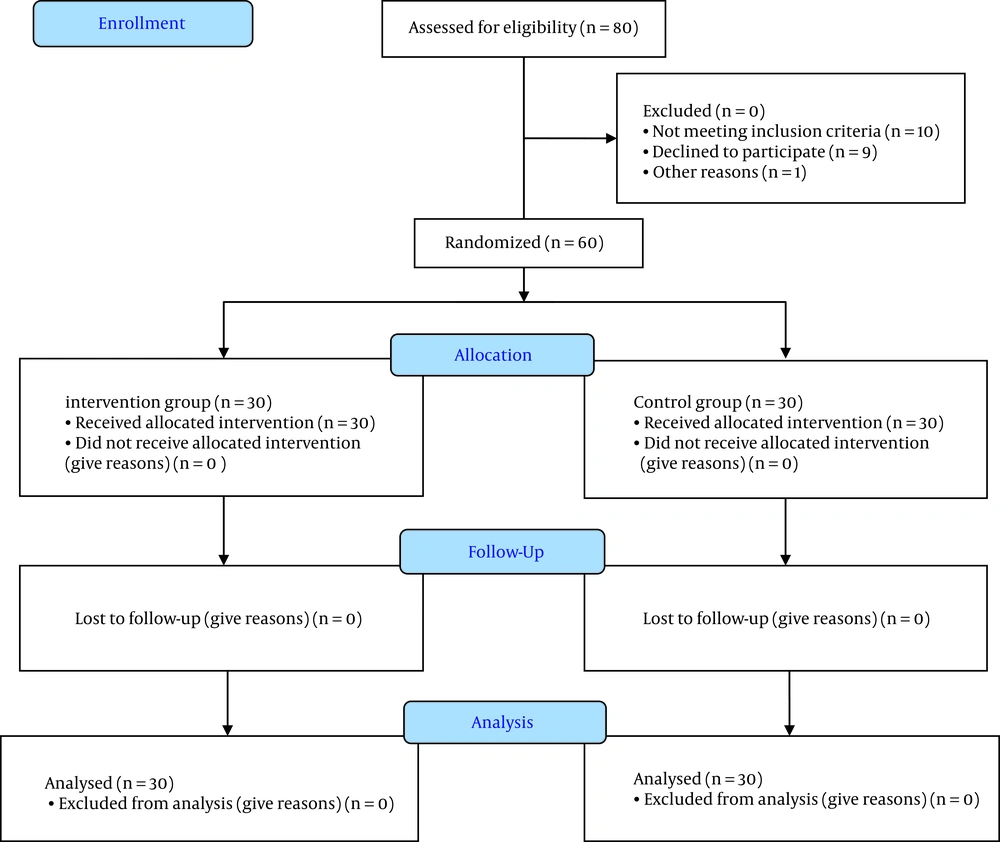
Figure 1.
CONSORT flow diagram of study participants
3.4. Inclusion and Exclusion Criteria
The inclusion criteria were conscious men and women of 40 years and older who were candidates for general surgery, not taken herbal and anti-anxiety drugs before surgery, not addicted to drugs, without employment in the health care system, with no treatment, with no hearing, vision, or smell problems, with no acute illness, and with scores of at least 20 (mild anxiety) in the Spielberger State-Trait Anxiety Inventory (STAI) questionnaire. The exclusion criteria were acute pain at the time of completing the questionnaire, willingness to withdraw from the study at any stage of the intervention, severe anxiety, and emergency surgery.
3.5. Intervention
The patients completed the STAI questionnaire before the intervention. The intervention was performed 60 min before the start of surgery. Two drops of C. aurantium essential oil with 100% purity were poured on a napkin using a standard dropper, and the patient inhaled it for 20 min at a distance of 20 cm. The same method was performed in the control group; however, distilled water was used instead of aroma. The data on overt and covert anxiety were collected using the STAI questionnaire 20 min after the intervention. Evaluations before and after the intervention in all the participants were performed by one individual. In addition, the C. aurantium essential oil used in the present study was produced by Barij Essence Pharmaceutical Company in Iran. This essential oil was purified and analyzed using Cooper J.C. chromatography.
3.6. Demographic Information Questionnaire
The patients’ demographic information questionnaire, including age, gender, marriage, level of education, and underlying diseases, was completed by the participants before the intervention.
3.7. Spielberger State-Trait Anxiety Inventory
The STAI is often used to assess state and trait anxiety. The STAI scale is valid and reliable, with 40 items, namely 1 - 20 and 21 - 40 related to state and trait anxiety, respectively. Item scoring related to state anxiety is based on a 4-point Likert scale, including (1) not at all, (2) somewhat, (3) moderately so, and (4) very much so. Trait anxiety items are also scored based on a 4-point Likert scale, including (1) almost never, (2) sometimes, (3) often, and (4) almost always (15). Minimum and maximum scores of 20 and 80 are considered for both state anxiety and trait anxiety. The scores obtained from the questionnaire are divided into low (20 - 39), moderate (59 - 40), and high (80 - 60) anxiety. The reliability of this questionnaire, using Cronbach’s alpha coefficient, was reported as 93%. The STAI, used nationally and internationally, has good validity and reliability (4, 16).
3.8. Safety Evaluation
The patients were asked to report side effects at each stage of the study.
3.9. Statistical Analysis
The data obtained from the patients’ questionnaire were analyzed by SPSS software (version 16). Descriptive statistics were used to obtain the mean, standard deviation, and frequency distribution tables. Moreover, analytical statistical methods were utilized to perform independent t-test, paired t-test, and chi-square test. Due to the fact that the normal distribution of the data was obtained using the Kolmogorov-Smirnov test, parametric methods were used for analysis. In addition, a P-value of less than 0.05 was considered statistically significant for all the tests.
4. Results
In this study, 60 patients who were candidates for surgery were divided into two groups of intervention (n = 30) and control (n = 30). Each group consisted of 15 men and 15 women. There was no statistically significant difference between the groups in terms of demographic information (P > 0.05; Table 1).
Table 1.
Patients’ Demographic Data a
| Variables | Intervention Group | Control Group | P-Value |
|---|---|---|---|
| Total | |||
| Total number of participants | 30 (50) | 30 (50) | |
| Gender | 1.00 a | ||
| Male | 15 (50) | 15 (50) | |
| Female | 15 (50) | 15 (50) | |
| Educational level | 0.920 a | ||
| Illiteracy | 18 (60) | 18 (60) | |
| Under diploma | 6 (20) | 5 (16.7) | |
| Above diploma | 6 (20) | 7 (23.3) | |
| Marital status | 1.00 a | ||
| Married | 20 (66.7) | 20 (66.7) | |
| Single | 10 (33.3) | 10 (33.3) | |
| Hospitalization | 0.606 a | ||
| Yes | 16 (53.3) | 14 (46.7) | |
| No | 14 (46.7) | 16 (53.3) | |
| Occupancy | 0.714 a | ||
| Unemployed | 4 (13.3) | 5 (16.7) | |
| Employed | 14 (46.7) | 16 (53.3) | |
| Housewife | 12 (40) | 9 (30) | |
| Age; mean ± SD | 51.93 ± 7.26 | 51.47 ± 5.87 | 0 .906 b |
a Values are expressed as No. (%) unless otherwise indicated.
b Chi-square test.
c Kruskal-Wallis test.
After aromatherapy, more subjects among men reached the level of relatively mild anxiety. Furthermore, most subjects among women reached the level of relatively mild anxiety (Tables 2 and 3). In men and women, the mean score of state anxiety in the aromatherapy group with C. aurantium was significantly lower than that reported after the intervention (P = 0.001). On the other hand, in women, the mean score of state anxiety in the control group was significantly higher than that reported after placebo intervention (P = 0.02; Table 4; Figure 2). In male and female participants, the mean score of trait anxiety in the aromatherapy group with C. aurantium was significantly lower than that reported after the intervention (P = 0.001; Table 5; Figure 3). The comparison of the mean changes of state and trait anxiety before and after the intervention in the two groups in men and women according to the significance level of the test, which was less than the assumed error in the study, showed significant differences between the groups (Table 6).
Table 2.
Frequency Distribution of State Anxiety in Two Groups Before and After Intervention a
| Gender/Anxiety | Control | Citrus aurantium | ||
|---|---|---|---|---|
| Before Intervention | After Intervention | Before Intervention | After Intervention | |
| Male | ||||
| Mild | 4 (26.7) | 3 (20) | 3 (20) | |
| Relatively mild | 9 (60) | 9 (60) | 12 (80) | 12 (80) |
| Relatively intense | 2 (13.3) | 3 (20) | 3 (20) | |
| Female | ||||
| Mild | 1 (6.7) | 3 (20) | ||
| Relatively mild | 11 (73.3) | 13 (86.7) | 12 (80) | 11 (73.3) |
| Relatively intense | 3 (20) | 2 (13.3) | 3 (20) | 1 (6.7) |
| Total | ||||
| Mild | 5 (16.7) | 3 (10) | 6 (20) | |
| Relatively mild | 20 (66.7) | 22 (73.3) | 24 (80) | 23 (76.7) |
| Relatively intense | 5 (16.7) | 5 (16.7) | 6 (20) | 1 (3.3) |
a Values are expressed as No. (%).
Table 3.
Frequency Distribution of Trait Anxiety in Two Groups Before and After Intervention
| Gender/Anxiety | Control | Citrus aurantium | ||
|---|---|---|---|---|
| Before Intervention | After Intervention | After Intervention | Before Intervention | |
| Male | ||||
| Mild | 3 (20) | 3 (20) | 3 (20) | |
| Relatively mild | 9 (60) | 9 (60) | 10 (66.7) | 12 (80) |
| Relatively intense | 3 (20) | 3 (20) | 5 (33.3) | |
| Female | ||||
| Mild | 1 (6.7) | 3 (20) | ||
| Relatively mild | 12 (80) | 13 (86.7) | 11 (73.3) | 11 (73.3) |
| Relatively intense | 2 (13.3) | 2 (13.3) | 4 (26.7) | 1 (6.7) |
| Total | ||||
| Mild | 4 (13.3) | 3 (10) | 6 (20) | |
| Relatively mild | 21 (70) | 22 (73.3) | 21 (70) | 23 (76.7) |
| Relatively intense | 5 (16.7) | 5 (16.7) | 9 (30) | 1 (3.3) |
Table 4.
Analytical Statistics of State Anxiety in Patients Undergoing Surgery in Two Groups and Comparison of Means at Two Times
| Gender/Group/Time | Mean (Standard Deviation) | t-test | Df | P-Value a |
|---|---|---|---|---|
| Male | ||||
| Control | -0.50 | 14 | 0.628 | |
| Before intervention | 37.53 (11) | |||
| After intervention | 37.87 (9.85) | |||
| Citrus aurantium | 11.68 | 14 | 0.001 | |
| Before intervention | 43.53 (8.16) | |||
| After intervention | 30.33 (5.73) | |||
| Female | ||||
| Control | -2.62 | 14 | 0.02 | |
| Before intervention | 41.87 (8.77) | |||
| After intervention | 43.53 (8.98) | |||
| C. aurantium | 15.33 | 14 | 0.001 | |
| Before intervention | 42.80 (7.88) | |||
| After intervention | 30.00 (5.66) | |||
| Total | ||||
| Control | -2.12 | 29 | 0.043 | |
| Before intervention | 39.70 (10.02) | |||
| After intervention | 40.70 (9.7) | |||
| C. aurantium | 18.80 | 29 | 0.001 | |
| Before intervention | 43.17 (7.89) | |||
| After intervention | 30.17 (5.6) |
a Paired t-test.
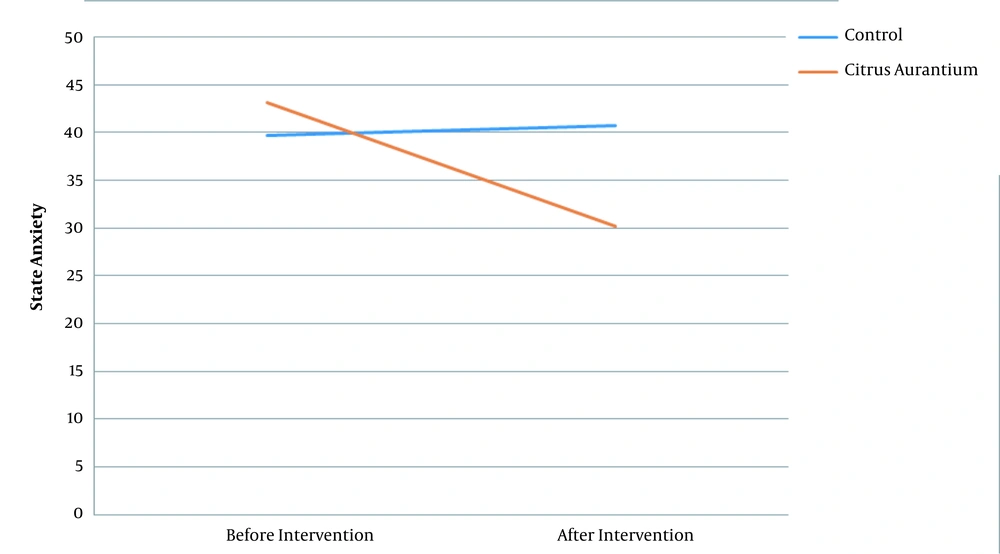
Figure 2.
Mean of state anxiety in study groups
Table 5.
Analytical Statistics of Trait Anxiety in Patients Undergoing Surgery in Two Groups and Comparison of Means at Two Times
| Gender/Group/Time | Mean (Standard Deviation) | t-test | Df | P-Value a |
|---|---|---|---|---|
| Male | ||||
| Control | -1.07 | 14 | 0.305 | |
| Before intervention | 38.20 (9.86) | |||
| After intervention | 38.60 (9.66) | |||
| Citrus aurantium | 20.07 | 14 | 0.001 | |
| Before intervention | 46.33 (7.72) | |||
| After intervention | 36.07 (7.29) | |||
| Female | ||||
| Control | -1.50 | 14 | 0.156 | |
| Before intervention | 41.87 (8.54) | |||
| After intervention | 42.47 (8.11 | |||
| C. aurantium | 14.81 | 14 | 0.001 | |
| Before intervention | 44.33 (7.99) | |||
| After intervention | 33.73 (7.52) | |||
| Total | -1.85 | 29 | 0.074 | |
| Control | ||||
| Before intervention | 40.03 (9.25) | |||
| After intervention | 40.53 (8.98) | |||
| C. aurantium | 24.08 | 29 | 0.001 | |
| Before intervention | 45.33 (7.79) | |||
| After intervention | 34.90 (7.37) |
a Paired t-test.
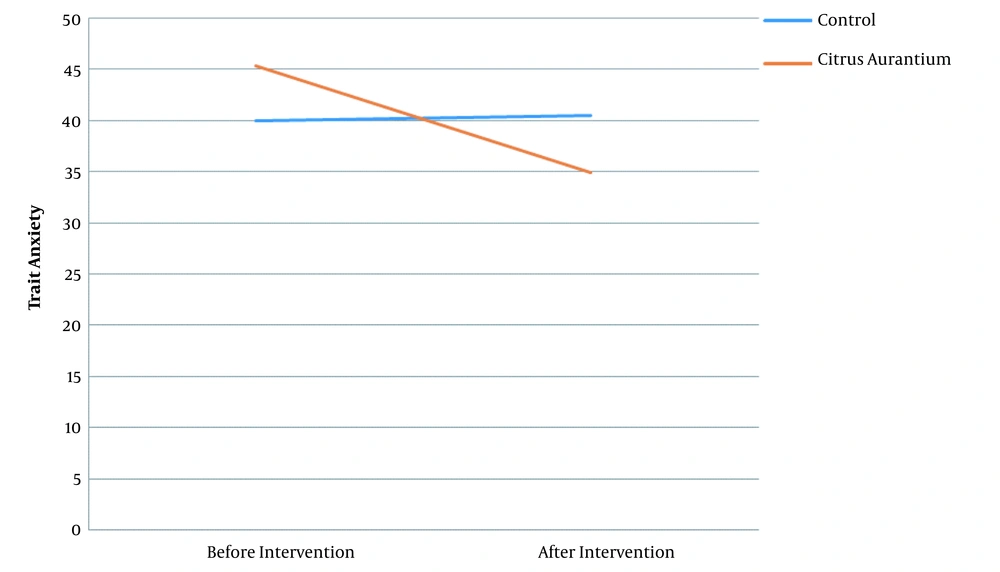
Figure 3.
Mean of trait anxiety in study groups
Table 6.
Comparison of Mean and Standard Deviation Changes of State and Trait Anxiety of Patients Undergoing Surgery in Two Groups Before and After Intervention
| Variables/Gender/Group | Mean (Standard Deviation) | T | Df | P-Value a |
|---|---|---|---|---|
| State anxiety | ||||
| Male | 10.283 | 28 | 0.001 | |
| Control | 0.33 (2.61) | |||
| Citrus aurantium | -13.20 (4.38) | |||
| Female | 13.772 | 28 | 0.001 | |
| Control | 1.67 (2.47) | |||
| C. aurantium | -12.80 (3.23) | |||
| Total | 16.719 | 58 | 0.001 | |
| Control | 1.00 (2.59) | |||
| C. aurantium | -13.00 (3.79) | |||
| Trait anxiety | 16.812 | 28 | 0.001 | |
| Male | ||||
| Control | 0.40 (1.45) | |||
| C. aurantium | -10.27 (1.98) | |||
| Female | 13.659 | 28 | 0.001 | |
| Control | 0.60 (1.55) | |||
| C. aurantium | -10.60 (2.77) | |||
| Total | 21.411 | 58 | 0.001 | |
| Control | 0.50 (1.48) | |||
| C. aurantium | -10.43 (2.37) |
a Independent t-test.
5. Discussion
The current study aimed to investigate the anti-anxiety effects of C. aurantium aromatherapy on men and women candidates for surgery. Since one of the factors affecting anxiety is age (5), in order to limit the interfering factor, the patients aged 40 years and older were included in the present study. According to the present study, it can be concluded that inhaling two drops of C. aurantium essential oil for 20 min with 100% purity at a distance of 20 cm from the nose was effective in the reduction of anxiety in male and female patients. According to a study conducted on more than 15,000 female patients undergoing non-obstetric surgery, anxiety is often listed as the worst aspect of the preoperative period (17).
Because anxiety is a mental process, psychological factors, such as treatment outcomes, patient characteristics, financial and moral support of the family, and health insurance, also affect the anxiety level of patients (7). In the current study, all the patients had insurance coverage, and none of them had a previous history of surgery because failure or dissatisfaction with previous surgery may increase patient anxiety (18). The findings of a study showed that aromatherapy with C. aurantium essential oil reduces anxiety in patients before surgery (4). The results of a study conducted by Pimenta et al. aiming to determine the effect of aromatherapy with C. aurantium on anxiety in patients with leukemia before bone marrow removal showed that anxiety levels and physiological parameters significantly improved (19).
In addition, based on a study performed by Moradi et al. on 80 patients, it was concluded that aromatherapy with C. aurantium 60 min before coronary angiography for 10 - 15 min reduces the symptoms of anxiety in patients (7). Regarding the improvement of anxiety symptoms, the results of all the aforementioned studies are consistent with the results of the present study. The findings of a review of clinical trials conducted by Manucci et al. showed that the oral administration or inhalation of C. aurantium could have beneficial effects on anxiety reduction (20). The main component of C. aurantium essential oil is limonene, with anti-anxiety and sedative effects, affecting the activity of the central nervous system (21).
In one study, orange essential oil, with similar compounds to C. aurantium essential oil, reduced anxiety in children referring to the dentist (22). In another study, anxiety before coronary artery bypass grafting was reported to be higher in men than that in men (23). Moreover, in a study carried out by Altan et al., anxiety during dental surgery was more frequently reported in women than that in men; however, there was no statistically significant difference (24). Furthermore, in the current study, anxiety before the intervention was higher in women than that in men, but with no statistical significance. In addition, after the intervention with C. aurantium essential oil, women’s anxiety decreased less than men’s anxiety; nevertheless, it was not statistically significant.
In general, aromatherapy with C. aurantium reduced state and trait anxiety significantly in men and women, compared to anxiety before the intervention. In the control group, after the intervention with placebo (i.e., distilled water), state anxiety increased in men; nonetheless, it was not significant. Moreover, trait anxiety remained unchanged. State and trait anxiety also increased significantly in female patients. Therefore, it can be concluded that the placebo increased anxiety in women. However, the results of a study performed by Franco et al. showed that a placebo reduced patients’ anxiety, the reason for which could be related to paying too much attention to patients (25). In the present study, no aromatherapy side effects were observed in the patients, which was similar to the results of other studies (4, 21).
According to the results of the current study, the C. aurantium essential oil can be used to reduce anxiety in patients waiting for surgery. The strength of this study was the comparison of the aromatherapy effectiveness in men and women for the first time. The limitations of this study were the lack of odor inhalation by the control group because only the patients in the aromatherapy group inhaled the odor; nonetheless, the control group inhaled distilled water, which may affect the evaluation of the results. On the other hand, the sample size of this study was small, and the study was limited to one city. Therefore, it is recommended to perform studies with a larger sample size in other regions and use different doses and types of fragrances.
5.1. Conclusions
The results of this study indicated that inhaling the C. aurantium aroma significantly reduced state and trait anxiety in men and women compared to anxiety before the intervention. Aromatherapy has the potential to be replaced by chemical drugs due to fewer side effects and risks, and cost-effectiveness. Therefore, it is possible to use preoperative aromatherapy performed by a nurse, benefited from a health care program.