
1. Background
Guillain-Barré syndrome (GBS) is a peripheral neuropathy that leads to acute neuromuscular failure (1). This rare disorder arises when the body’s immune system attacks peripheral nerves, resulting in limb weakness, numbness, tingling, and potentially complete paralysis (1). The etiology of GBS remains unclear, but it often follows viral infections such as the common cold or influenza. Additionally, infection with the bacterium Campylobacter can precipitate the disease (2-4). The GBS typically manifests in four forms: Acute inflammatory demyelinating polyradiculoneuropathy (AIDP), acute motor axonal neuropathy (AMAN), acute motor-sensory axonal neuropathy (AMSAN), and Miller-Fisher syndrome (4). The incidence of GBS is estimated at 1.2 to 1.6 cases per 100,000 individuals, with a male-to-female prevalence ratio of 1.5:1 (4). In some instances, GBS symptoms may emerge post-surgery. While the cause is sometimes unknown, all cases involve immune system dysfunction (5).
Symptoms generally begin with numbness and weakness in the legs, often progressing to the upper body within days or weeks, leading to arm and upper limb weakness. In severe cases, patients may be unable to walk, potentially resulting in complete paralysis. Diagnosis is primarily symptom-based, focusing on limb weakness and ambulation difficulties, supplemented by paraclinical examinations. Electromyography and cerebrospinal fluid (CSF) analysis are commonly employed diagnostic tools (5). Although there is no definitive cure for GBS, symptom improvement is achievable through intravenous immunoglobulin (IVIg) and plasmapheresis. The prognosis is generally favorable, with most patients recovering, though recovery may take up to two years (6). Symptoms typically worsen over 2 to 3 weeks before gradually improving (7, 8).
2. Objectives
Given the rising prevalence of GBS and increased hospitalizations for suspected cases across various age groups, timely diagnosis and appropriate treatment are crucial for recovery. The present study aimed to identify the demographic characteristics, clinical manifestations, and outcomes of patients with GBS admitted to Ghaem Hospital in Mashhad in 2021.
3. Methods
3.1. Participants
Patients with GBS who were consecutively referred to Ghaem Hospital in Mashhad, Iran, between March 21, 2021, and March 21, 2022, were included. The diagnosis of GBS was confirmed by a neurologist according to the National Institute of Neurological Disorders and Stroke (NINDS) criteria.
3.2. Entry Criteria
- Age above 14 years
- Diagnosis of GBS based on NINDS criteria by a neurologist
- Consent to participate in the study
Patients were excluded if they had incomplete medical records, an uncertain diagnosis, or refused to give consent.
3.3. Data Collection
Demographic and clinical information about patients was collected through a pre-designed questionnaire. A history of infection in the last month was documented. Clinical details included paraparesis, tetraparesis, cranial nerve involvement, respiratory muscle involvement, sensory symptoms, sphincteric disorder, occurrence of respiratory or gastrointestinal infection before movement symptoms, need for intubation, mechanical ventilation, duration of intubation, duration of hospitalization in the ICU, duration of hospitalization in the ward, type of treatment performed (IVIg or plasmapheresis), electrodiagnostic findings, and CSF evaluation findings, if performed. Muscle strength was assessed based on the Medical Research Council (MRC) criteria at the beginning of hospitalization and at discharge. A favorable outcome was defined as a GBS disability score of 0 - 2 at 6 months. History of infection included any respiratory or gastrointestinal symptoms occurring within four weeks prior to symptom onset.
3.4. Muscle Strength Grading
- Grade 5: Normal
- Grade 4: Movement against gravity and resistance
- Grade 3: Movement against gravity in (almost) full range
- Grade 2: Limb movement but not against gravity
- Grade 1: Visible contraction without limb movement (absent for hip flexion)
- Grade 0: No visible contraction
The outcome of the disease was evaluated based on the GBS disability score at discharge and three and six months after symptom onset. The severity of movement disorders was classified according to the Guillain-Barré classification system as follows:
- 0: Healthy
- 1: Mild signs and symptoms; the patient is able to run
- 2: The patient can walk at least 5 meters without assistance but cannot run
- 3: The patient can walk 5 meters with assistance
- 4: The patient is bedridden
- 5: Requires assisted ventilation
- 6: Death
The CSF was collected in all patients by the Ghaem Hospital laboratory and analyzed for cells, proteins, and sugar. Protein levels above 45 mg/dL were considered high. In all patients in the acute stage of the disease, at least one electrophysiological examination was performed, with findings recorded during the early stages of the disease and throughout hospitalization.
3.5. Statistical Methods
The normality of continuous variables was assessed using the Shapiro-Wilk test. Chi-square tests were used for categorical variables. Due to the retrospective design and relatively small sample size, multivariate regression analysis to control for potential confounders was not performed. The obtained information was manually extracted and analyzed using SPSS software. Comparisons between outcome measures were assessed using two-tailed t-tests for continuous variables and chi-square tests for categorical variables. A P-value of 0.05 was considered statistically significant.
4. Results
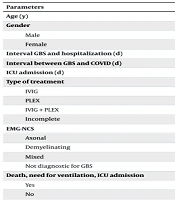
In total, 82 patients with GBS were studied. The age range of the patients was 15 to 89 years, with a mean age of 45.90 ± 17.93 years (Table 1). In this study, 47 patients (52.8%) were men and 35 patients (39.3%) were women. The distribution of patients by season of hospitalization was as follows: 24.7% in spring, 27% in summer, and 20.2% in both autumn and winter. On average, patients spent 12.17 ± 10.93 days in the hospital and 1.00 ± 3.07 days in the ICU. The average time from symptom onset to hospital visit was 7.18 ± 5.76 days. In this study, 28.1% of patients had no history of infection, 29 patients (32.6%) had a history of respiratory infection in the past month, 16 patients (18%) had a history of diarrhea, and 12 patients (13.5%) had a history of recent vaccination (Table 1). Nineteen patients (21.3%) had cranial nerve involvement, 16 patients (18%) had bulbar involvement, 11 patients (12.4%) had autonomic involvement, and 46 patients (51.7%) had sensory impairment (Table 3). During follow-up, 3 patients (3.4%) developed chronic inflammatory demyelinating polyneuropathy (CIDP), 2 patients (2.2%) experienced recurrence, and 1 patient was diagnosed with gastrointestinal cancer (Table 1). A total of five patients died during hospitalization, and one patient died during follow-up due to COVID-19. Overall, 64% of patients had no history of underlying diseases. Among the 25 patients (28.1%) with a previous underlying disease, 20 patients (22%) had hypertension, 10 patients (11%) had diabetes, 1 patient (1.1%) had hyperlipidemia, 4 patients (4.4%) had heart disease, 1 patient (1.1%) had hyponatremia, 2 patients (2.2%) had a history of stroke, 3 patients (3.3%) had hypothyroidism, and 2 patients (2.2%) had a history of blood disorders (Table 1). During hospitalization, 4.5% of patients required mechanical ventilation (Table 2), 1.1% had a catheter shunt infection, 2.2% had jugular vein thrombosis, and 1.1% developed sepsis (Table 2). Approximately 68.5% of patients had quadriparesis, and 14.6% had paraparesis (Table 3). Sixty patients (67.4%) did not have their CSF protein measured; of those measured, 22.5% had increased CSF protein, and 3.4% had normal protein levels. Plasmapheresis was performed in 50.68% of patients, IVIg in 28.1%, and both treatments in 13.5% (Table 3). The electrodiagnostic characteristics of patients are shown in Table 3. The largest subgroup, comprising 51 patients (62.2%), had acute motor demyelinating polyneuropathy/sensory motor/sensorimotor polyneuropathy/polyradiculoneuropathy, followed by 22 patients (26.8%) with acute motor axonal polyneuropathy/polyradiculoneuropathy. Additionally, 5 patients (6.1%) had acute sensorimotor axonal polyneuropathy/sensory motor/polyradiculoneuropathy, and 4 patients (4.9%) were normal (Table 3). The total MRC scores were 40.56 ± 12.93 on the first day of hospitalization and 47.16 ± 15.45 on the day of discharge (Table 4). The average GBS disability score at discharge was 3.04 ± 1.01, with 4 patients (4.9%) scoring 1, 23 patients (28%) scoring 2, 26 patients (31.7%) scoring 3, 24 patients (29.3%) scoring 4, and 5 patients (6.1%) scoring 6. Overall, 67.1% had a score of 3 or higher at discharge (Table 4). The average GBS disability score 3 months post-discharge was 2.05 ± 1.63, with 24 patients (29.3%) scoring 0, 5 patients (6.1%) scoring 1, 19 patients (23.2%) scoring 2, 17 patients (20.7%) scoring 3, 11 patients (13.4%) scoring 4, and 6 patients (7.3%) scoring 6. Overall, 41.4% had a score greater than 3 three months post-discharge. The average GBS disability score 6 months post-discharge was 1.34 ± 1.60, with 37 patients (45.1%) scoring 0, 14 patients (17.1%) scoring 1, 15 patients (18.3%) scoring 2, 4 patients (4.9%) scoring 3, 6 patients (7.3%) scoring 4, and 6 patients (7.3%) scoring 6. Overall, 19.5% had a score of 3 or higher 6 months post-discharge (Table 4).
Table 1.
Demographic Characteristics and Underlying Disease History in Patients with Guillain-Barré Syndrome a
| Variables | Values | Min-Max | P-Value |
|---|---|---|---|
| Age | 45.90 ± 17.93 | 15 - 89 | < 0.001 |
| Sex | 0.184 | ||
| Man | 47 (52.8) | ||
| Women | 35 (39.3) | ||
| Hospitalization season of patients | 0.725 | ||
| Spring | 22 (24.7) | ||
| Summer | 24 (27) | ||
| Fall | 18 (20.2) | ||
| Winter | 18 (20.2) | ||
| Number of days of hospitalization (n = 82) | 12.17 ± 10.93 | 1 - 79 | |
| Number of days of hospitalization in ICU (n = 82) | 1 ± 3.06 | 0 - 19 | |
| The time from the onset of symptoms to the visit to the hospital | 7.18 ± 5.75 | 0 - 28 | |
| History of recent infection | |||
| No infection | 25 (28.1) | ||
| Respiratory infection | 29 (32.6) | ||
| Diarrhea | 16 (18) | ||
| Recent vaccinations | 12 (13.5) | ||
| History of underlying disease | 0.0004 | ||
| Yes | 25 (28.1) | ||
| No | 57 (64) | ||
| History of underlying disease and electrolyte disorders | 0.025 | ||
| Blood pressure | 20 (22) | ||
| High blood fat | 1 (1.1) | ||
| Heart disease | 4 (4.4) | ||
| Hyponatremia | 1 (1.1) | ||
| Previous stroke | 2 (2.2) | ||
| Hypothyroidism | 3 (33.3) | ||
| Diabetes | 10 (11) | ||
| Hematologic disease | 2 (2.2) |
a Values are expressed as No. (%) or mean ± SD.
Table 2.
Specific Conditions of Guillain-Barré Syndrome Patients During Hospitalization
| Variables | No. (%) | P-Value |
|---|---|---|
| Disturbances that occurred during the examination (n = 82) | 0.666 | |
| Chronic inflammatory demyelinating polyneuropathy (CIDP) | 3 (3.4) | |
| Gastrointestinal cancer | 1 (1.1) | |
| Recurrence | 2 (2.2) | |
| Death | 6 (7.3) | |
| Special conditions during hospitalization (n = 82) | < 0.001 | |
| Non | 73 (82) | |
| Ventilation | 4 (4.5) | |
| Shunt infection | 73 (82) | |
| Jugular vein | 1 (1.1) | |
| Thrombosis | 2 (2.2) | |
| Sepsis | 1 (1.1) |
Table 3.
Specific Conditions of Clinical Neurology of Patients During Hospitalization
| Clinical Neurology Features | No. (%) | P-Value |
|---|---|---|
| Cranial nerve involvement | < 0.001 | |
| Yes | 19 (21.3) | |
| No | 62 (70.8) | |
| Bulbar conflict | < 0.001 | |
| Yes | 16 (18) | |
| No | 66 (74.2) | |
| Autonomous conflict | < 0.001 | |
| Yes | 11 (12.4) | |
| No | 71 (79.8) | |
| Sensory disorder | < 0.001 | |
| Yes | 46 (51.7) | |
| No | 36 (40.4) | |
| Clinical characteristics (n = 82) | < 0.001 | |
| Quadriparesis | 63 (68.5) | |
| Paraparesis | 13 (14.6) | |
| None | 6 (6.7) | |
| CSF (n = 82) | < 0.001 | |
| Undone | 59 (67.4) | |
| Enhanced cell-free protein | 20 (22.5) | |
| Normal | 3 (3.4) | |
| Characteristics of electrodiagnosis | < 0.001 | |
| Acute motor demyelinating polyneuropathy/sensory motor/sensory motor/polyradiculoneuropathy | 51 (62.2) | |
| Acute motor axonal polyneuropathy/polyradiculoneuropathy | 22 (26.8) | |
| Acute sensorimotor axonal polyneuropathy/sensorimotor/polyradiculoneuropathy | 5 (6.1) | |
| Normal | 4 (4.9) | |
| Type of treatment (n = 82) | < 0.001 | |
| IVIg | 25 (28.1) | |
| Plasmapheresis | 45 (28.1) | |
| Combination of plasmapheresis and IVIg | 12 (13.5) | |
| Patient discharge conditions (n = 77) | ||
| discharge | 73 (86.5) | |
| Personal satisfaction | 4 (4.5) |
Abbreviations: CSF, cerebrospinal fluid; IVIg, intravenous immunoglobulin.
Table 4.
Disease Score Evaluation in Patients a
| Variables | Values |
|---|---|
| Total MRC scores on the day of admission, (n = 82) | 40.56 ± 12.93 |
| Total MRC scores on the day of discharge, (n = 77) | 47.16 ± 15.45 |
| GBS disability score at discharge | 3.04 ± 1.01 |
| 1 | 4 (4.9) |
| 2 | 23 (28) |
| 3 | 26 (31.7) |
| 4 | 24 (29.3) |
| 6 | 5 (6.1) |
| GBS disability score 3 months after discharge | 2.05 ± 1.63 |
| 0 | 24 (29.3) |
| 1 | 5 (6.1) |
| 2 | 19 (23.2) |
| 3 | 17 (20.7) |
| 4 | 11 (13.4) |
| 6 | 6 (7.3) |
| GBS disability score 6 months after discharge | 1.34 ± 1.60 |
| 0 | 37 (45.1) |
| 1 | 14 (17.1) |
| 2 | 15 (18.3) |
| 3 | 4 (4.9) |
| 4 | 6 (7.3) |
| 6 | 6 (7.3) |
Abbreviations: MRC, Medical Research Council; GBS, Guillain-Barré syndrome.
a Min-max: 0 - 60.
5. Discussion
In this study, men had a higher infection rate, being 1.3 times more likely than women to contract an infection. The incidence of GBS was higher in the summer and spring. Approximately 32.6% of patients had a history of respiratory infections in the past month. The most common manifestations were sensory disorder (51.7%) and quadriparesis (68.5%). Plasmapheresis was the most common treatment, administered to 50.68% of patients. In 20 patients, CSF protein levels exceeded 45 mg/dL. At discharge, 67.1% of patients had a GBS disability score of 3 or higher, which decreased to 41.4% three months post-discharge and 19.5% six months post-discharge. The total MRC scores increased from 40.56 on the first day of hospitalization to 47.16 at discharge. Electrodiagnostic characteristics revealed that the largest subgroup, comprising 51 patients (62.2%), had acute motor/motor sensory/sensorimotor demyelinating polyneuropathy/polyradiculoneuropathy (AIDP), followed by 22 patients (26.8%) with acute motor axonal polyneuropathy/polyradiculoneuropathy (AMAN). Additionally, 5 patients (6.1%) had acute sensorimotor/motor sensory axonal polyneuropathy or polyradiculoneuropathy (AMSAN), and 4 patients (4.9%) were normal. Disease recurrence was observed in 2 patients (2.2%).
The average GBS disability score at discharge and three- and six-months post-discharge was investigated. The GBS disability rate decreased over the study period, with 60.1% of patients having a score greater than 3 at discharge, decreasing to 19.1% six months later, indicating a high recovery rate due to treatment, which has not been previously reported in Iran. Previous studies reported a male incidence rate approximately 1.5 times that of females (9). In this study, the ratio was 1.3, indicating higher susceptibility among men. The autoimmune nature of GBS does not fully explain this male predominance. Arami et al. in West Azerbaijan reported a ratio of 1.45 (9), Mazaheri et al. in Hamadan reported 2.4 (1), and other reports suggest a ratio of 2.5 (10). In Western countries, GBS incidence ranges from 0.89 to 1.89 per 100,000 people, increasing by 20% for every 10-year age increment after the first decade of life (11). The oldest patient in this study was 89 years old, and the youngest was 15. A Chinese study reported an average age of 46.37 years, with the highest incidence in those over 60 (12). Rocha et al. in Brazil observed a clear increase in incidence between ages 15 and 40 (13). Faradmal et al. reported the highest incidence between ages 21 and 30, potentially due to Iran’s younger population compared to Western societies (14).
The average hospitalization duration was 12.17 ± 10.93 days. Manafi et al. reported an average of 13.61 days (4), and Alanazy et al. reported 2.4 weeks (15). Most studies indicate that two-thirds of patients have a history of viral infection or trauma before GBS onset. In this study, 50.6% of patients had respiratory histories and diarrhea, and 13.5% were recently vaccinated. Rocha et al. confirmed that respiratory infections were most common, followed by gastrointestinal infections (13). Arami reported a rate close to international statistics at 65.8% (16). This likely results from immune response stimulation and counter-reaction to axon and Schwann cell antigens (17).
Most patients recovered well, with one diagnosed with digestive cancer during follow-up. Five patients died during hospitalization, and one died from COVID-19 during follow-up. Mazaheri et al. reported one death (1), and another study reported two deaths from respiratory failure (17). Other studies report similar mortality rates (50). Intravenous immunoglobulin and plasma exchange are proven, equally effective treatments for GBS; however, IVIg is more commonly used due to easier administration, while plasma exchange is often discontinued (18-21). In this study, plasmapheresis was more commonly used, likely due to IVIg’s high cost. Chaudhuri’s study found similar efficacy between plasmapheresis and IVIg, with no consensus on combined use. Hospitalization duration was longer with plasmapheresis, and IVIg was more expensive (22). Arami et al. reported plasmapheresis in 31 patients (40.8%) and IVIg in 30 patients (39.5%), with both treatments in 12 patients (15.8%) (16).
The study also discusses variations in GBS incidence, suggesting links to abrupt weather changes affecting infection susceptibility. This aligns with research noting peaks in spring and winter (23, 24). Lyu et al. in Taiwan reported a springtime prevalence of AIDP-type GBS from March to May (25), while Barzegar et al. reported higher incidences in spring and summer in Tabriz (8). However, other studies found no clear connection between GBS incidence and seasonal changes. Quadriparesis was the most frequent symptom, consistent with multiple studies (26, 27). Cranial nerve involvement was less common, present in 21.3% of cases, despite reports indicating a prevalence of 50 - 75% (28, 29). All patients with cranial nerve palsy also exhibited quadriparesis, indicating severe disease. Mechanical ventilation was required for 4.5% of patients, compared to 7% in Denmark (30), 14.8% of adults and 10% of children in northern China (31), and 13% in a German multicenter study (28). Amin et al. reported respiratory problems in 44% of children in Shiraz, leading to mechanical ventilation in 23% (32).
The most common GBS type was acute motor demyelinating polyneuropathy/sensory motor/sensorimotor polyneuropathy/polyradiculoneuropathy, followed by acute motor axonal polyneuropathy/polyradiculoneuropathy. The GBS incidence varies among populations. Acute inflammatory demyelinating polyradiculoneuropathy predominates in North America and Europe, accounting for about 90% of cases, typically presenting with sensory symptoms, muscle weakness, cranial nerve weakness, and autonomic dysfunction. Acute motor axonal neuropathy, characterized by isolated muscle weakness without sensory involvement, is seen in fewer than 10% of GBS cases in these regions, with infrequent cranial nerve involvement. The AMSAN, leading to severe muscle weakness and anesthesia, along with AMAN, accounts for 30 - 50% of GBS cases in Asia and Latin America, but only 3 - 5% in North America and Europe (10, 11, 31-34). Miller-Fisher syndrome is prevalent in Asia, comprising about 20% of GBS cases, compared to less than 5% in North America and Europe (12, 13, 33-36).
5.1. Conclusions
The GBS is an acute peripheral neuropathy where prompt diagnosis and treatment are essential to improve patient outcomes. The most effective methods for early diagnosis include obtaining detailed medical histories and conducting thorough physical examinations, especially in settings with limited medical resources. The GBS is primarily diagnosed through clinical assessment, and delaying treatment for antibody testing, CSF analysis, or electrophysiological studies is generally discouraged. Healthcare providers should utilize recent research advancements for early detection and implement tailored interventions to reduce disability and mortality associated with the disease. The generalizability of our findings may be limited due to the single-center nature of the study and demographic differences from other populations.
5.2. Limitations
This study has several limitations. First, it was conducted at a single center, which may affect the generalizability of the findings. Second, not all paraclinical tests were available for all patients. Third, the retrospective nature of the study might have introduced selection or reporting biases.